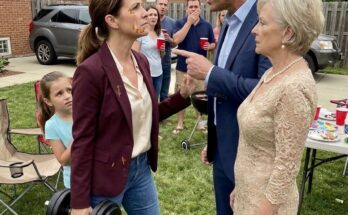
PART 3 — THE NAME THEY NEVER KNEW
“Decorated combat veteran?” Grant repeated. “There must be some mistake. She works in an office.”
“I do handle paperwork,” I said.
The senior officer smiled.
“So did General Eisenhower. Job titles rarely tell the complete story.”
Several neighbors laughed quietly.
Grant didn’t.
His face had become pale.
Travis looked between us.
“What rank did you call her?”
“Major.”
“That’s impossible. I would have known.”
“No,” the officer replied. “You would have assumed. There is a difference.”
The younger officer began gathering witness statements.
Mrs. Reynolds had recorded Travis throwing the gloves.
Mr. Palmer had captured Grant encouraging him.
A teenager near the sidewalk recorded my warnings and Travis’s first punch.
Seven videos showed nearly identical events from different angles.
Travis threatened me.
I refused to fight.
I repeatedly told him to walk away.
He attacked.
I used only enough force to protect myself.
After viewing the footage, the younger officer closed his notebook.
“I don’t see evidence that Major Bennett assaulted anyone.”
“Neither do I,” the senior officer said.
“My son was thrown to the ground!” Grant protested.
“After attempting to strike someone. Virginia law permits reasonable self-defense.”
He looked at Travis.
“You are fortunate.”
“Fortunate?”
“Major Bennett showed remarkable restraint. What happened here wasn’t punishment.”
His voice became quieter.
“It was mercy.”
Even Travis understood.
The officer asked him directly whether he threatened to break my arm.
Travis looked toward his father.
Grant gave a small shake of his head.
The officer noticed.
“You will answer for yourself.”
After several seconds, Travis admitted it.
Then he admitted throwing the first punch.
His teammates walked toward their truck.
“We’re leaving,” one said.
Travis watched all four men go.
None looked back.
For the first time, he understood he had lost more than a confrontation.
The senior officer asked why he ignored my warnings.
Travis lowered his head.
“I thought she was bluffing.”
“The strongest people rarely need to convince anyone they are strong,” the officer said.
Grant attempted to take Travis home.
The officer stopped him.
“You made an inaccurate report to emergency services.”
“I misunderstood.”
Mrs. Reynolds answered from the crowd.
“No. You lied.”
Nobody disagreed.
The officer turned toward Travis.
“You owe someone an apology.”
Travis slowly approached me, unable to meet my eyes.
“I’m sorry.”
“Not to me.”
He looked up.
I rested one hand on Sophie’s shoulder.
“She was the person you tried to frighten.”
Travis swallowed.
“I’m sorry, Sophie. You didn’t deserve to witness any of this.”
Sophie remained close to me.
“Will you leave us alone now?”
Her question struck him harder than anything I had done.
“Yes,” he said. “I will.”
For the first time that afternoon, he sounded sincere.
Then the officer confronted Grant.
“Your son made a serious mistake. You encouraged it. You watched a child become frightened and continued demanding violence.”
“I never touched anyone.”
“No. You only instructed someone else to do it.”
“That isn’t a crime.”
“It says a great deal about your character.”
Natalie lowered her eyes.
Shame finally reached her face.
She approached me slowly.
“I should have stopped him.”
“I wasn’t the person who needed you.”
She looked confused.
I nodded toward Sophie.
“She was.”
Natalie’s eyes filled.
“I’m sorry, Sophie. I should have protected you.”
Sophie didn’t answer.
She held my hand more tightly.
The senior officer thanked me for showing restraint.
“My daughter was watching,” I said.
“I know. And she learned that real strength isn’t about winning a fight. It’s about recognizing when one never needed to happen.”
Just as the officers prepared to leave, a black SUV entered the court.
The vehicle had no official markings.
A tall man wearing a navy polo stepped out. Gray touched the hair near his temples, but his posture hadn’t changed.
Colonel Daniel Harper.
My former commanding officer.
He saw me and smiled.
“I leave you alone for six months, and somehow you still find trouble.”
Grant whispered, “Who is that?”
The senior officer answered.
“Colonel Daniel Harper. United States Army.”
Harper approached and shook my hand.
“It’s good to see you, sir,” I said.
“You too, Major.”
His eyes moved toward Sophie.
“This must be your daughter.”
He knelt beside her.
“Your mother once saved more people than she will ever admit.”
Sophie’s eyes widened.
“Really?”
“She will probably tell you she was merely doing her job.”
“I was,” I said.
Harper laughed.
“Exactly.”
Grant shifted nervously.
“What is happening?”
Harper looked at him.
“You must be the gentleman who thought threatening one of my officers in front of her daughter was sensible.”
“I didn’t know who she was.”
“No. You only believed you did.”
Grant stared at me.
“She never told anyone.”
Harper’s expression hardened.
“Major Bennett never used her service to impress people. She believed respect should be earned, not demanded.”
The words landed harder than any punch.
One of Travis’s gym partners asked whether I had truly served in Special Operations.
Harper glanced at me before answering.
“There are questions honorable people don’t answer.”
The fighter nodded immediately.
“I understand.”
Grant didn’t.
“So was she or wasn’t she?”
Nobody responded.
Even the police officers remained silent.
That silence told him more than a speech could have.
Harper turned toward Sophie.
“I’ve spent thirty years leading soldiers. The loudest person in a conflict is rarely the bravest.”
He smiled at her.
“The bravest person here never raised her voice.”
“Me?”
“You stayed. You trusted your mother. And although you were frightened, you asked the man who frightened you whether he would leave you alone.”
“I was scared.”
“So was every brave person I have known. Courage isn’t the absence of fear. It is choosing the right action while afraid.”
Mrs. Reynolds stepped forward afterward.
“We owe Claire an apology. We’ve watched the Caldwells bully people since they arrived. We stayed quiet because it was easier.”
One neighbor after another agreed.
“We should have spoken sooner.”
“We allowed it to continue too long.”
“The important thing is that you spoke today,” I told them.
Mr. Palmer picked up the MMA gloves and offered them to Travis.
Travis stared at them.
Then he dropped them into the nearest trash can.
The objects intended to humiliate me had become reminders of his most public mistake.
By sunset, the police cars were gone and the cookout had ended.
Sophie sat beside me on our front porch.
“Were you really never afraid?” she asked.
“I was afraid the moment Travis looked at you.”
“You were?”
“Of course.”
“Then why didn’t you look frightened?”
I placed one arm around her shoulders.
“Courage isn’t pretending fear doesn’t exist. It is deciding someone else matters more than your fear.”
Three slow knocks sounded against our door.
Travis stood alone outside.
No Grant.
No Natalie.
No friends from the gym.
He held the MMA gloves.
“I took them out of the trash.”
I waited.
“I thought they belonged with me. But I was wrong.”
He placed them on the porch.
“I don’t want them. I don’t deserve them.”
He looked toward Sophie.
“I know apologizing again won’t repair what happened, but I needed you to hear it when nobody was watching.”
Sophie nodded cautiously.
“Thank you.”
Travis faced me.
“I spent years believing strength meant making people afraid. It turns out I was the weakest person on the street.”
“Real strength begins when you are willing to admit that.”
“I hope my daughter can respect me again someday.”
“That will depend on what you do tomorrow and the day after—not what you say tonight.”
He understood.
The following morning, a moving truck arrived at the Caldwell estate.
Grant argued loudly in the driveway.
Travis didn’t argue back.
When Grant pointed toward my house, Travis calmly shook his head.
“No. I’m done.”
He began carrying boxes into the truck.
Three days later, he left a handwritten letter in my mailbox.
He wrote that he had enrolled in anger-management counseling and resigned from the gym where he had mistaken intimidation for respect.
He didn’t ask for forgiveness.
He wrote that his own young daughter had also witnessed the confrontation.
She had asked why he wanted to fight someone who wasn’t fighting him.
He couldn’t answer her.
He hoped that one day he could become the kind of father who could.
That afternoon, a black luxury sedan stopped outside my house.
A man in an expensive gray suit stepped out carrying a leather briefcase.
“My name is Richard Sloan,” he said. “I represent Caldwell Development Group.”
He opened the case.
Inside was a cashier’s check for five hundred thousand dollars.
Grant wasn’t offering an apology.
He was attempting to purchase silence.
Mr. Sloan explained that Grant would pay my legal expenses and make a public statement.
In return, I would waive any civil claim, make no public comments, and sign a confidentiality agreement.
“It isn’t an apology,” Mrs. Reynolds said from her porch. “It’s damage control.”
Mr. Sloan didn’t disagree.
I looked at him.
“If nobody had spoken at the cookout, if nobody had recorded what happened, and if Travis had seriously injured me, would Grant still have sent you?”
“I cannot answer that.”
“You just did.”
I refused the check.
“Tell your client that money can repair damaged property. It cannot repair character.”
Sloan closed his briefcase.
Before entering his car, he stopped.
“My client isn’t afraid only of a lawsuit.”
“What is he afraid of?”
“Someone else has begun asking questions.”
“What kind of questions?”
“The Department of Defense.”
He met my eyes.
“And they aren’t asking about you. They’re asking about Grant Caldwell.”
For the first time since the cookout, I understood that the confrontation had never been only about Travis.