PART 3 — THE LIGHT BESIDE THE DOOR
By the following winter, Sarah had recovered enough to begin planning a home of her own.
Nathan assumed she and the children would remain at the estate.
The house had more than enough space, and Lily had finally grown comfortable there.
But Sarah needed something different.
“I’m grateful,” she told him. “But this is your home.”
“It can be yours too.”
“That’s not the same thing.”
Nathan waited.
Sarah looked around the enormous kitchen.
“For seven years, I lived inside a house where everything belonged to Marcus. The accounts, the keys, the car, even the telephone. He reminded me every day that I could lose access to all of it.”
She touched the bracelet resting in the ceramic bowl.
“I need to know I can open my own door.”
Nathan understood.
Sarah found a modest house within driving distance of his estate.
It had three bedrooms, a small kitchen, and a narrow backyard surrounded by pine trees.
The windows were older.
The floors creaked.
The porch tilted slightly to one side.
Lily loved it immediately.
“Does this one belong to Mommy?” she asked.
“It will,” Sarah replied.
Nathan offered to buy it.
Sarah refused.
He offered again, explaining that he had more money than he could use.
She refused again.
Finally, they wrote down repayment terms for the deposit—clear terms Sarah could manage without becoming dependent upon him.
Nathan signed the agreement without argument.
That mattered to her more than the money.
He wasn’t giving her a house and expecting gratitude.
He was helping her establish something that remained hers.
On moving day, Lily carried the ceramic bowl from Nathan’s entry table.
The smooth stones rattled against the old bracelet as she walked.
“Where does this go?” she asked.
Sarah looked at Nathan.
Then toward the new front door.
“Beside our keys.”
The twins were nearly walking by then.
Owen crawled faster than anyone could catch him.
Ethan remained quieter but had developed a determined habit of following his brother into every room.
Nathan installed safety gates, repaired the porch step, and stopped when Sarah told him she wanted to paint the kitchen herself.
He was learning that helping didn’t require taking over.
The case against Marcus continued through the slow legal process.
The court heard evidence of the assault, his financial control, the intercepted communication, and the danger created when Lily had to carry the twins into the blizzard.
Marcus continued insisting that Nathan had interfered in his marriage.
But the forged bracelet and false letter revealed that Marcus had been interfering in Sarah’s family relationships for years.
Sarah did not seek revenge.
She sought legal protection, financial independence, custody of her children, and permanent control over who could enter their lives.
The court granted her primary custody and extended the no-contact order.
Marcus was held responsible for the assault and the financial misconduct established by the evidence.
He was prohibited from contacting the children outside approved legal channels, and any future request for access would require professional review.
Sarah accepted the outcome without celebration.
No ruling could return seven lost years.
No sentence could erase Lily’s walk through the storm.
But the law had finally placed the decisions where they belonged.
With Sarah.
Nathan asked whether she felt justice had been done.
“I feel safe,” she replied. “That matters more.”
The relationship between brother and sister continued healing slowly.
They didn’t pretend the years apart had vanished.
Sometimes Sarah became angry without warning.
A missed call from Nathan could bring back every message she believed he ignored.
A careless comment could remind her of the day he ordered her to leave.
Nathan learned not to defend himself immediately.
He listened.
Apologized when an apology was owed.
And allowed Sarah to decide how close she wanted him to stand.
One evening, several weeks after the move, Sarah found him repairing the loose porch railing.
“You don’t have to fix everything,” she said.
Nathan tightened one final screw.
“I know.”
“Do you?”
He looked at her.
“I’m trying.”
Sarah leaned against the doorframe.
“For years, Marcus made every kind action feel like a debt. Every gift became a reason I owed him obedience.”
Nathan placed the screwdriver inside his toolbox.
“If anything I do feels like that, tell me.”
“I will.”
“And I’ll listen.”
She nodded.
It was a small conversation.
That was what rebuilding looked like.
Not dramatic forgiveness.
Not pretending betrayal never happened.
Clear words.
Boundaries respected.
Ordinary moments that ended differently from the past.
Lily’s recovery continued too.
She no longer hid food.
She stopped checking the twins every hour.
She began kindergarten and told her teacher that her uncle was a heart doctor who made terrible soup.
One afternoon, she brought home a drawing.
It showed a large glass house on a mountain.
A tiny figure stood outside beneath falling snow.
A second figure held the door open.
Nathan studied it.
“Is that you?” he asked, pointing to the child.
Lily nodded.
“And that’s you.”
She pointed toward the person in the doorway.
The figure’s arms were drawn too long, reaching nearly across the page.
“You gave me very long arms,” Nathan said.
“So you can reach us.”
He had to look away before she saw his eyes fill.
On the first anniversary of the blizzard, snow began falling in gentle flakes.
Nothing like the violent storm Lily remembered.
Sarah stood in the new kitchen while the twins played on the floor and Nathan attempted to make pancakes under Lily’s supervision.
“You’re using too much flour,” Lily warned.
“I’m a surgeon.”
“That doesn’t mean you know pancakes.”
Sarah laughed.
The sound stopped Nathan for a moment.
He hadn’t heard his sister laugh freely in years.
Later that evening, Sarah picked up the real bracelet from the ceramic bowl.
The scratches remained.
So did the crescent-shaped repair mark beside the clasp.
She fastened it around her wrist for the first time in seven years.
Nathan noticed but didn’t comment.
The decision belonged to her.
Lily noticed immediately.
“You’re wearing it.”
“Yes.”
“Does it mean you belong to Uncle Nathan?”
Sarah knelt beside her.
“No, sweetheart.”
“What does it mean?”
Sarah turned the bracelet so Lily could see the engraving.
“It means I belong to myself.”
Lily considered that.
“Do I belong to myself too?”
“Always.”
“And Owen and Ethan?”
“They belong to themselves too.”
Lily looked toward Nathan.
“What about Uncle Nathan?”
Nathan placed one hand over his heart.
“Especially me.”
Lily laughed.
Before Nathan left that evening, he lined three pairs of little boots near the heater.
Lily’s boots were pink.
Owen and Ethan’s were matching blue pairs.
Outside, snow covered the driveway in a thin white layer.
Nathan opened the front door and switched on the porch light.
A warm path appeared across the snow, stretching from the driveway to the house.
Lily looked through the window.
“Are we waiting for someone?”
Nathan glanced toward Sarah.
This time, neither of them looked away.
“No,” he said. “We’re making sure anyone coming home can see the way.”
Sarah stood beside him with the bracelet around her wrist.
Seven years earlier, a forged letter and counterfeit bracelet had convinced them that their family was gone.
Marcus had relied on silence, pride, and distance to keep the lie alive.
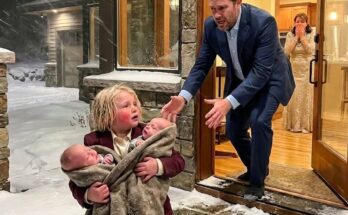
But the truth returned through a five-year-old girl walking barefoot through a blizzard with two babies in her arms.
The real bracelet had exposed the counterfeit one.
Lily’s courage exposed Marcus’s lies.
And an open door exposed the difference between controlling someone and giving them a safe place to return.
Nathan could not undo the words he had spoken seven years earlier.
Sarah could not recover the messages that never reached him.
Neither could erase the storm.
But they could decide what happened after it.
Sarah had her own house.
Her own keys.
Her children beside her.
Nathan remained close enough to help and far enough to respect her choices.
The bracelet no longer represented abandonment.
It represented the truth Marcus had tried to destroy.
Sarah had always belonged to herself.
And the porch light remained on—not because anyone was lost, but because this family would never again allow darkness to hide the way home.