By the time the first wedding guests began arriving, Mara’s shoulders already ached.
She had started before sunset because event nights were always better than ordinary nights. Weddings meant extra plastic bottles, soda cans, boxes, ribbons, and leftover food containers. If she was lucky, she could collect enough recyclables in one evening to earn almost what she usually made in two days. Her mother had looked at her before she left and said she should not stay too late, but both of them knew what that really meant. It meant come home when you have enough to matter. It meant tonight cannot be wasted.
The wedding hall sat at the end of a broad road lined with trimmed hedges and parked cars so polished they reflected the streetlights like mirrors. Mara always noticed the cars first. She could tell which guests would leave half-full bottles in the parking lot and which ones would hand a box to the attendants before walking in without a glance at the ground. Wealth had a way of moving quickly, as if it had somewhere more important to be than the rest of the world.
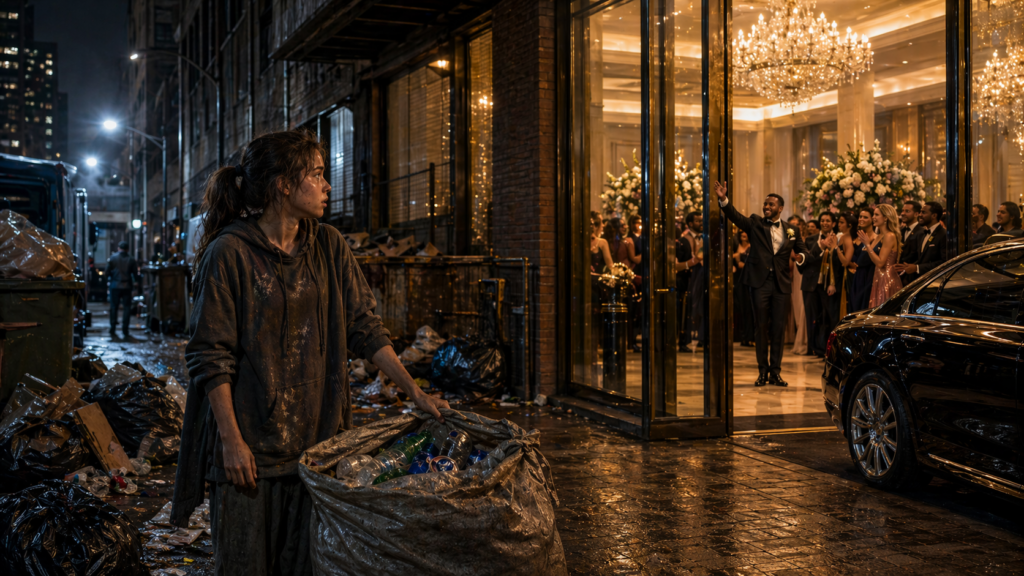
She adjusted the large white sack hanging from one shoulder and kept close to the service area near the side of the building. That was where workers dumped bag after bag of waste from the kitchen and the outdoor tables. She had learned to make herself small in places like this. Not invisible exactly, because people still saw her. But easy to dismiss. Easy to step around. Easy to ignore.
The air smelled of jasmine garlands, perfume, grilled meat, and bleach. Music thumped softly through the walls while waiters hurried past with trays balanced on one hand. Nobody stopped her because nobody really looked long enough to care. To them she was just part of the outside mess, another shadow moving near the bins.
She tied her hair tighter with the elastic loop she wore on her wrist and bent to pull plastic bottles from a half-torn trash bag. Some still had warm liquid in them. Others were crushed and sticky. She shook them out, dropped them into her sack, and worked quickly.
She was good at it now. Fast hands. Sharp eyes. A stomach that had learned not to turn at smells that once made her gag.
A woman in a fitted dress wrinkled her nose as she walked by the service lane holding her phone away from her body.
“Why do they let this happen so close to the hall?” the woman muttered to the man with her. “It ruins the atmosphere.”
The man barely glanced at Mara. “Come on,” he said. “You’ll miss the entrance.”
They moved on.
Mara did not look up. She had heard worse. People spoke around her as if she could not understand words once they were said with enough contempt. She had learned not to waste anger on every passing voice. Anger could not buy rice. Anger could not pay rent. Anger could not lower her mother’s fever on nights when the coughing would not stop.
She reached for another bag and found a stack of untouched water bottles beside a crate. That was good. She slipped them into her sack and stood, rolling one shoulder to ease the sting in it.
From where she stood, she could see the front of the hall reflected in the glass doors. White flowers framed the entrance. Gold fabric draped from the columns. A carpet ran from the steps to the interior lobby where guests were being welcomed beneath a giant arrangement of lights shaped like falling stars. Even from outside, it looked expensive in a way that almost did not seem real.
She wondered what it felt like to enter a place through the front doors instead of the side. To wear clean shoes and carry a small purse instead of a sack. To be expected.
The thought passed quickly. It had no use.
She moved toward the rear loading area where more bags were piled beside the kitchen. Two young staff members stood smoking near the wall.
“One more hour,” one of them said. “Then the family speeches.”
“This wedding must have cost more than my yearly salary,” the other replied. “The groom’s side paid for everything, I heard.”
“Of course they did. He owns those car dealerships. Everyone knows him.”
Mara had half an ear on them while she sorted through boxes. Wealthy men always owned something: dealerships, properties, transport companies, import businesses. People like that appeared in stories her mother sometimes mentioned about old classmates and old promises, the kind she would stop herself from finishing.
“His new wife is from a good family too,” one staff member said. “Perfect match.”
“Better than the mess he had before, probably.”
The other laughed. “What mess?”
“I don’t know. Someone said there was some village girl years ago. Maybe a rumor.”
Mara’s hands stopped.
Not because the words were clear, but because something inside her tightened before she even understood why.
She kept her head down and listened.
“Everyone has old stories,” the second man said. “Doesn’t matter now. Look at him. Rich, respected, starting fresh.”
Starting fresh.
The phrase turned strangely in Mara’s mind. As if a life were a room you could simply leave dirty and lock behind you while you moved into another.
She pushed the flattened boxes aside harder than she meant to. The sound made the workers glance over.
“Careful there,” one called. “Don’t scatter it.”
She nodded without speaking.
Her mother had always spoken about Mara’s father carefully, as if his name were something edged and dangerous. Sometimes Mara wondered whether the man was more memory than person. There were no photographs of him in their room. No letters. No gifts. Only a few facts repeated over the years in different shapes.
He had once been kind.
He had promised marriage.
He had left when things became difficult.
He had later denied everything.
As a child Mara had asked the natural questions. What is his name? Where is he now? Does he know about me? Will he come back? Her mother had answered some and avoided others. His name was Ruben. He lived in the city now. Yes, he knew. No, he would not come back.
When Mara was nine, she had asked why.
Her mother had been sewing under the weak light near the window. She did not look up when she answered.
“Because some people only love what costs them nothing.”
That line stayed.
Tonight, Mara worked faster. She did not know why the conversation behind the kitchen had unsettled her, only that it had put something restless in her chest. She moved from pile to pile, lifting bottles, shaking out cartons, separating metal from plastic. The sack grew heavier. Her palms became tacky with spilled soda and grease.
When the music inside rose louder, guests began drifting onto the front steps for photos. She avoided the main entrance, but there was only so much distance the narrow lane allowed. Every now and then the doors opened wide enough for her to see a flash of chandeliers, flower arrangements, and women in shimmering dresses.
Then she heard applause.
Not the scattered applause that came with a toast. This was fuller, warmer, gathering everyone’s attention at once.
She straightened slightly and looked toward the entrance without meaning to.
The song changed to something slow and formal. A waiter pushing a cart paused near the door, blocking part of her view. Then he moved.
Inside, on the dance floor, the groom turned with the bride in his arms.
Mara saw the line of his jaw first.
Then the set of his shoulders.
Then the way he smiled when other people were watching him.
Her whole body went still.
There are moments when truth does not arrive slowly. It does not reason with you or ask permission. It strikes one clean blow and leaves the rest of you trying to catch up.
The man inside the hall was older than the face Mara had built in her mind from fragments. Broader. Better dressed. His hair was shorter, touched with the first signs of age. But there was no doubt. She knew him from the way her own eyes were shaped like his. She knew him from the half memory of a voice from very early childhood, from a profile she had once seen across a market years ago and stored away because her mother had suddenly gone silent and pulled her in the other direction.
Ruben.
Her father.
The man dancing beneath the lights while guests cheered and cameras flashed.
Mara’s fingers loosened around the bottle she was holding. It dropped, rolled once, and settled near her foot.
She could not breathe properly.
He was real. He was here. Not dead. Not lost. Not broken somewhere. Not searching. Not sorry. Here. At a wedding. Smiling so openly that it was as if another life had never existed.
Her throat tightened so fast it hurt.
She stepped closer to the glass doors before she could think better of it. Through the reflection of the lights she saw his face clearly now. There was something almost unbearable about how happy he looked. Not because happiness itself was wrong, but because it sat so easily on a man who had once abandoned a girl and her mother to hunger, gossip, and years of surviving one day at a time.
Mara remembered the rainy season when the roof leaked and her mother used pots to catch water while trying not to cough too hard. She remembered not paying school fees on time. Remembered wearing borrowed uniforms and pretending she had simply outgrown one shoe faster than the other. Remembered a teacher asking why her guardian never came to school meetings. Remembered boys whispering words like fatherless and girls learning cruel smiles from their mothers.
And here he was.
He had not vanished. He had chosen.
The bride laughed as Ruben spun her gently and guests clapped. Someone sprayed a fine mist of glitter into the air that caught the light above them.
Outside, Mara stood in worn slippers with a sack of bottles cutting into her shoulder.
A security guard near the entrance noticed her and walked over with the wary impatience of someone already annoyed.
“You can’t stand here,” he said.
Mara did not move.
“Did you hear me?” he asked, more sharply now. “Go around the back.”
She looked at him, but it took effort to focus. “Who is the groom?”
The guard frowned. “That’s not your concern.”
“What is his name?”
He gave her a hard look. “Move along.”
She stared past him through the glass. “Ruben,” she whispered, not asking this time.
The guard glanced over his shoulder as though checking whether anyone important had seen them. “I said go.”
Mara stepped back automatically, but not because he had authority over her. Her legs were unsteady. She turned away from the doors and walked toward the side wall of the building, the sack bumping against her back.
She set it down near a drain and sat on the low curb, elbows on her knees, trying not to cry where strangers could see.
For several minutes she heard only muffled music and laughter and the rush of blood in her ears.
Then a woman’s voice said, “You all right?”
Mara looked up. An older kitchen worker stood near her holding a tray covered in foil. She had kind eyes and tired shoulders. Mara had seen her once or twice before on other event nights.
“I’m fine,” Mara said automatically.
The woman’s gaze dropped to the sack, then back to Mara’s face. “That word doesn’t match your eyes.”
Mara almost smiled at that, but the expression would not form.
The woman crouched a little, lowering the tray. “Have you eaten?”
Mara shook her head.
Without another word, the woman lifted the foil enough to reveal pieces of chicken, rice, and sautéed vegetables that had likely been meant for staff. She handed Mara a plate and a plastic spoon.
“Take it before someone asks me where it went.”
Mara hesitated. “I can’t pay.”
“I didn’t ask you to.”
The smell hit her all at once, and hunger rose with such force that shame followed close behind. She accepted the plate quietly.
The woman remained standing there for a moment. “Don’t sit in the open too long,” she said. “Some people don’t like being reminded there’s another world outside their party.”
Then she turned and disappeared through the service door.
Mara stared at the food but could not eat immediately. The first tears came instead, slipping down before she could stop them. She wiped them roughly with the back of her wrist. Crying always made her feel younger than she wanted to be.
When she finally took a bite, the rice was still warm.
She ate slowly, as if giving her body something steady might calm the storm inside her. It did not. Every few minutes she glanced toward the hall again, half expecting the sight she had seen to dissolve into mistake. But the music continued. Guests moved in and out. Cars kept arriving. The wedding was real.
Ruben was real.
A memory rose then, sudden and sharp.
She was maybe six, standing in a crowded market with her mother near the fruit stalls. A man in a crisp shirt had passed by laughing with someone. Her mother’s hand had tightened painfully around Mara’s wrist. Mara had followed her gaze and seen only the side of the man’s face before her mother turned them away and said they were leaving. Mara had asked who that was. Her mother had said nobody. Yet that night, while thinking Mara was asleep, she had cried into the pillow without sound.
Nobody.
The plate was empty before Mara realized she had finished eating. She set it down and pressed both hands between her knees.
What was she supposed to do now?
Go home and tell her mother she had seen him dancing at a wedding?
Say nothing and carry this alone?
Walk inside and ask him, in front of everyone, why?
The last thought came like a spark in dry grass. Impossible, reckless, humiliating—and once imagined, hard to extinguish.
She pictured stepping through the doors in her stained dress and worn slippers. She pictured guests turning. Security dragging her out. Ruben looking at her with either shock or worse, indifference.
Maybe he would say he did not know her.
Maybe he would say she was lying.
Maybe he would look embarrassed, not guilty.
The idea made her stomach turn.
And yet another thought rose behind it, quiet but stubborn.
If he could celebrate openly while she sorted through trash outside his wedding, why should she be the one hiding?
She stood abruptly and picked up her sack. Her hands were trembling. Not with weakness now, but something hotter.
The service lane curved toward the front steps. She walked it slowly, each step feeling unreal, as though she were moving inside someone else’s life. The guard at the entrance saw her and stiffened.
“You again?”
“I need to speak to him.”
“No.”
“He’s my father.”
The words hung between them.
The guard stared, then laughed once out of pure disbelief. “Go home, child.”
“I’m not lying.”
“You can’t just say things like that on a wedding night.”
Mara lifted her chin even though fear was pressing hard against her ribs. “Then ask him if he knows the name Lita Solano.”
For the first time, the guard’s face changed. Not because he recognized the name, but because she had given one with such certainty that dismissal became slightly less easy.
A younger attendant nearby had begun listening.
The guard lowered his voice. “Even if that were true, this is not the time.”
“For him it was always not the time.”
The attendant looked between them. “What’s going on?”
“Nothing,” the guard said quickly.
But it was already too late for nothing. A few guests near the entrance had noticed the exchange. People always noticed tension, especially at celebrations. It glittered more brightly than any decoration.
Mara looked through the glass again and saw Ruben moving from table to table with the bride, greeting guests.
She did not think anymore after that.
She stepped around the guard.
His hand caught her arm, but she twisted free with surprising force. The doors opened as a family exited laughing, and Mara slipped through the gap into the lobby.
Cold air washed over her. The floor beneath her feet gleamed. Light flooded everything.
Conversations faltered one by one, like a line of candles pinching out.
Mara kept walking.
Guests turned first because of her clothes, then because of her face. Someone near the photo display frowned. A woman holding a wineglass pulled her child a little closer. The band kept playing for a few more uncertain seconds before the sound thinned and stopped.
At the center of the room, Ruben looked up.
Their eyes met.
He went utterly still.
Whatever he had expected to see that night, it was not the daughter he had denied standing in the lobby with a sack of bottles over one shoulder.
The bride followed his gaze and blinked in confusion.
Ruben’s face changed so fast it was almost frightening: joy, shock, recognition, calculation. The human mind can reveal itself most honestly in the first second before it remembers to protect itself.
Mara saw enough.
He knew.
She took two more steps forward. Her voice came out clearer than she felt.
“You told everyone I didn’t exist.”
No one moved.
The bride looked from Mara to Ruben. “What is she talking about?”
Ruben glanced at the guests, at the security guard hurrying in behind Mara, at the family tables where older relatives were already leaning forward. When he spoke, his voice was low and tight.
“This is not the place.”
Mara laughed once, but it broke in the middle. “Outside was the place, then? Outside with the trash?”
A murmur ran through the room.
The bride slowly lowered her bouquet to her side. “Ruben?”
He did not answer her immediately. That silence was louder than anything he could have said.
Mara felt tears threatening again, and anger helped her hold them back. “My mother raised me alone. She worked until she got sick. I left school to help. And you—” She looked around at the flowers, the lights, the guests in pressed clothes. “You had all this.”
Somewhere in the back, a woman whispered, “Who is she?”
Ruben took a step toward Mara. “We can talk privately.”
“No.” The word snapped out before fear could soften it. “You had fifteen years to talk privately.”
The bride’s face had gone pale. “Ruben, tell me what is happening.”
He turned to her. “I can explain.”
But Mara saw in the bride’s expression the precise moment trust began to crack. Not because the explanation had come, but because it hadn’t come fast enough.
An older woman from Ruben’s side of the family stood up. “Ruben,” she said sharply, “who is this girl?”
Mara answered for him.
“I’m his daughter.”
The room erupted in whispers.
Ruben closed his eyes briefly as if the force of the truth itself offended him.
The bride stepped back from him. “You told me there was no child.”
His jaw tightened. “I said there was a situation from years ago that was never proven.”
Mara felt something in her chest turn cold.
Never proven.
As if she were paperwork. As if her whole life were a disputed inconvenience.
“My face is proof,” she said.
And it was. Now that everyone was looking, it was impossible not to see it. The same brow line. The same eyes. The same slight cleft in the chin. Even guests who had only met Ruben that evening could detect the resemblance.
The bride’s mother rose from her table, outrage overcoming manners. “Is this true?”
Ruben spread both hands in a gesture that might have been appeal or control. “I was very young. There were complications. Her mother—”
“Do not speak about my mother like that.” Mara’s voice shook with a fury so pure it steadied her. “She begged you to acknowledge me. She went to your house when I was born. Your family turned her away. When I got sick at three years old, she asked again. When school asked for documents, she asked again. You always had an excuse.”
Ruben’s mother, seated near the front, had gone rigid as stone. She looked older all at once. Not innocent. Not surprised. Just cornered by a truth she had hoped time had buried.
The bride looked directly at her. “You knew?”
The older woman did not answer.
That answer was enough.
A man from the bride’s family muttered, “This wedding should stop.”
The band members stood frozen by their instruments, avoiding eye contact with anyone.
Ruben moved closer to Mara again, lowering his voice. “I can help you now. But not like this.”
Those words lit a fresh blaze inside her. Not like this. Always later. Always somewhere hidden. Always after he had secured his comfort first.
“I didn’t come for money,” Mara said. “I came because I saw you through the glass while I was collecting garbage outside your wedding hall.”
She let the sentence sit there.
Several guests visibly flinched.
“I wanted to see whether you would still pretend not to know me when you had lights over your head and respectable people around you.”
Ruben’s expression hardened. For the first time she saw something beneath the polished exterior: annoyance. Not sorrow. Not remorse. Annoyance that his carefully arranged life had been interrupted by the consequences of his own choices.
“You should have thought about your mother before causing this scene,” he said.
Mara stared at him in disbelief.
Then she laughed again, this time with tears finally spilling over. “My mother spent years thinking about you. That’s why we suffered.”
The bride set down her bouquet entirely. Her hands were shaking. “Did you lie to me from the beginning?”
Ruben turned to her, voice urgent now. “Please. Not here.”
“Where else?” she asked, echoing Mara without seeming to realize it.
The bride was younger than Mara had first thought, maybe late twenties. Her makeup was flawless, her dress elegant, but none of that shielded the hurt in her face. She looked at Mara, and something in her expression changed from shock to understanding—not of every detail, but of enough.
“What is your name?” she asked softly.
“Mara.”
The bride nodded once. “Did he ever support you?”
Mara swallowed. “No.”
“Did he ever visit?”
“No.”
“Did he ever claim you in public?”
Mara looked at Ruben. “Never.”
The bride closed her eyes briefly. When she opened them, they were bright with tears but steady. She turned to the guests.
“I need everyone to excuse us.”
No one moved.
Then the bride’s father, a dignified man with silver hair, stood and spoke with quiet authority. “The celebration is over.”
The room erupted again, louder this time.
Some guests immediately reached for phones before relatives hissed for them to stop. Others rose reluctantly, staring as though unwilling to miss a second of scandal. Waiters began clearing paths. The mood had shifted so completely it felt like a physical change in the air, as if the hall itself had lost oxygen.
Ruben’s face darkened. “This is absurd.”
The bride faced him fully. “No. What is absurd is that a fifteen-year-old girl had to walk in from the street to tell me who you really are.”
Ruben opened his mouth, but the bride’s father cut in.
“You leave,” he said. “Now.”
For the first time that night, Ruben looked afraid.
Not of Mara. Not even of truth. Of consequence. Of reputation. Of losing what he had spent years building.
He glanced toward his mother, perhaps expecting support. She looked away.
The silence from her side told its own story.
Mara suddenly felt exhausted. The anger that had carried her inside began draining, leaving her cold and shaky. She had not planned beyond being seen. Now that everyone had seen, she did not know what came next.
The kitchen worker who had given her food appeared near the doorway, looking stunned but not disapproving. When Mara’s knees threatened to buckle, the woman moved closer without drawing attention.
The bride took off her veil with slow, deliberate hands. Gasps rose from nearby tables, but she ignored them. She placed the veil on a chair.
“I am not marrying you tonight,” she said.
Ruben stepped forward. “You’re making a mistake.”
“No,” she said. “You made one fifteen years ago and kept making it every day since.”
Her words settled heavily over the room.
Ruben turned back to Mara then, and in his eyes she finally saw what she had wanted and dreaded in equal measure: recognition unhidden. He knew exactly who she was. There was no refuge left in denial.
But with that recognition came no tenderness. Only a grim awareness that the lie had ended.
“I was going to take care of it,” he said.
Mara looked at him through blurred vision. “I was never an it.”
That was when the bride’s mother began crying openly. A few guests slipped out. Others lingered in clusters, whispering behind raised hands. The wedding planner near the stage seemed close to fainting.
The bride walked toward Mara slowly. When she reached her, she looked at the stained dress, the sack, the bruised-looking shadows beneath the girl’s eyes. Then she took off the shawl draped around her own shoulders and gently placed it around Mara.
It was such a simple act that it nearly undid Mara more than anything else.
“No child should have had to come here like this,” the bride said.
Mara could not answer. Her throat closed completely.
Security no longer touched her. No one dared.
Ruben’s mother rose at last and came halfway forward. Her face was tight with pride battling shame.
“This should not have happened publicly,” she said.
Mara turned toward her. “It happened publicly because you all kept it hidden privately.”
The older woman stopped.
That, too, was answer enough.
The bride’s father spoke to one of the attendants, ordering cars brought around. Family members began ushering out elderly guests. A cousin collected the gift envelopes from the reception table with dazed motions.
In the middle of the unraveling hall, Mara felt oddly detached, as though she were watching a film whose ending she did not know. She had imagined many versions of meeting her father one day. None had looked like chandeliers dimming over abandoned centerpieces and a bride standing in silence with mascara beginning to mark her face.
The kitchen worker touched Mara’s elbow gently. “Do you have someone to call?”
“My mother.”
“Call her.”
Mara’s hands were shaking too much to handle a phone, and she had no credit anyway. The worker offered hers.
It took three tries for Mara to press the right numbers.
Her mother answered on the second ring, breathless with worry. “Mara? Where are you?”
Mara opened her mouth, but the words tangled. She looked once more at Ruben across the wreckage of his wedding night. He was arguing now with the bride’s father in hushed furious tones, but every few seconds his eyes returned to Mara, unable to make her disappear.
“I found him,” Mara said.
Silence.
Then, very softly, “Where?”
“At a wedding.”
Her mother did not speak for a long moment. Mara could hear only the faint sound of traffic at their end and distant voices at this one.
Finally her mother said, “Stay where people can see you. I’m coming.”
The line ended.
Mara handed the phone back.
The next half hour blurred. Most guests left. Some of Ruben’s relatives followed him into a side room, where muffled arguments rose and fell. The bride changed out of her gown before leaving with her family, but not before coming once more to Mara.
“You did the right thing,” she said.
Mara almost objected, because right did not feel like the word for what her chest currently held. It felt more like disaster, grief, and relief crammed together until breathing hurt.
Still, she nodded.
“I’m sorry,” the bride added, and looked as though she meant it not for losing a wedding, but for being another person who had not known what had been done to Mara and her mother.
When she left, the hall seemed suddenly larger and emptier.
Ruben did not approach Mara again until many people had gone. Perhaps he wanted fewer witnesses now that the damage was done. He came toward her with the uneasy composure of a man forced into honesty after years of choosing comfort.
“You’ve embarrassed a lot of people tonight,” he said.
Mara looked at him and felt something settle into place. She had spent years wondering what kind of explanation could justify abandonment. The truth was smaller and uglier than she had imagined. There was no grand reason. Only selfishness carefully maintained.
“We were embarrassed every day,” she said. “You just never had to see it.”
He exhaled sharply. “Your mother always knew how complicated this was.”
Mara stared at him. “Complicated because you wanted another life?”
He ran a hand over his face. Without the room full of admirers, he looked suddenly older. Less invincible. But age did not equal remorse.
“I came from nothing too,” he said. “I had to build myself. There were expectations. Opportunities. If I had tied myself to—”
He stopped.
“To what?” Mara asked quietly. “To us?”
He did not answer.
She nodded once, because now she understood more than she had wanted to. He had not left because he could not stay. He had left because he believed loving them would cost him status, convenience, mobility. He had chosen the version of himself that could rise unburdened.
“My mother never asked you for luxury,” Mara said. “Only truth.”
Ruben’s gaze shifted away.
“And when I was little,” Mara continued, voice trembling now with the weight of memory, “I used to think maybe you didn’t know where we were. Maybe you were sick. Maybe someone had lied to you. But you knew. You just didn’t want us.”
He spoke more softly then, perhaps because harshness had started sounding dangerous in the emptier room. “That isn’t fair.”
Mara almost smiled at the absurdity. “No. It isn’t.”
Headlights flashed across the glass doors.
Her mother had arrived.
Lita entered wearing the same faded blouse she had worn that morning, hair hurriedly pinned back, sandals mismatched from age and use. She looked small at first beneath the high lights of the hall. Then she saw Ruben.
Everything in her posture changed.
She did not run to Mara immediately. She walked with a kind of terrible control, each step measured, eyes fixed on the man before her. When she reached Mara, she put one hand on the girl’s shoulder without looking away from him.
For a moment nobody spoke.
Years stood there with them.
Ruben was the first to break. “Lita.”
The name sounded wrong in his mouth now, like something borrowed from a poorer version of himself.
Lita’s expression did not shift. “So you are still alive.”
He flinched, only slightly.
Mara leaned into her mother’s side and felt her shaking. Not with weakness. With contained rage.
“I didn’t come to beg this time,” Lita said. “I came because my daughter called me from your wedding.”
Ruben’s jaw tightened. “This is not how I wanted—”
“No,” Lita said. “It is exactly how you wanted. Hidden until it benefited you otherwise.”
The kitchen worker withdrew discreetly, leaving the three of them in a pocket of charged air.
Ruben’s mother emerged from the side room and stopped when she saw Lita. Something like old resentment flickered across her face, but it was no longer backed by certainty.
Lita saw her too. “You told me to disappear,” she said. “Remember? You said your son had a future and I should not ruin it.”
The older woman drew herself up. “You had no proof.”
Lita gave a short bitter laugh. “Proof? I stood at your gate carrying his newborn child.”
Mara felt her mother’s fingers dig slightly into her shoulder, grounding herself.
“I asked for nothing but acknowledgment,” Lita continued. “School documents. Help with medicine once when Mara had a lung infection. I worked, I struggled, I kept her alive, and every time I tried to reach him, your family acted as if we were dirt on your shoes.”
Ruben said, “That’s enough.”
Lita turned on him then. “Enough?” Her voice cracked with the first visible break in her control. “Do you know what enough is? Enough is a child going to bed hungry and pretending she isn’t. Enough is hearing her ask why other girls have fathers at school events. Enough is watching her sort garbage at fifteen while you pay for chandeliers.”
The last word rang through the hall.
Ruben looked at Mara then, really looked, perhaps for the first time that night beyond the threat she posed to him. The sack still sat near her feet. The bride’s shawl hung around her thin shoulders. There was grime on her fingers. She had come to him not from safety, but from work no child should have to do.
Some small measure of shame appeared at last.
It did not undo anything.
Lita pulled a folded envelope from her bag and held it out. “These are copies of letters, clinic notes, and the messages you ignored through relatives. I kept everything because one day I knew he would become respectable enough to fear the truth.”
Ruben did not take the envelope.
Lita dropped it onto a nearby table set with untouched wedding favors.
“You will not erase her anymore,” she said. “I don’t care if the city hears. I don’t care if your business partners hear. I don’t care if every guest who ate your food tonight hears. She exists.”
Mara felt the words like heat against old ice.
Ruben’s mother moved as if to interrupt, but a male voice from behind said, “Let her speak.”
It was one of Ruben’s older uncles, a man with a cane who had likely heard enough from the side room to recognize which way the moral wind now blew. He looked at Ruben with open disgust.
“This family covered too much for too long,” the uncle said. “Not tonight.”
The older woman’s mouth tightened, but she fell silent.
Ruben rubbed his forehead. The polished man from the dance floor was gone now. In his place stood someone smaller, stripped of audience and angle.
“What do you want?” he asked at last.
The question landed badly.
Mara saw pain flash across her mother’s face—not because she wanted anything from him, but because after all these years he still believed the issue was transaction.
Lita answered first. “We wanted dignity. That was free, and you still withheld it.”
Ruben said nothing.
Then Mara spoke, surprising even herself with the steadiness of her voice.
“I wanted to see if you would deny me to my face.”
He met her eyes.
He did not deny her.
That absence mattered. Not enough. But it mattered.
Lita looked at him with exhausted contempt. “Say her name.”
The hall seemed to hold still.
Ruben’s throat moved once. “Mara.”
It was the first time Mara had ever heard him say it.
She had imagined that moment differently too. In imagination, hearing her father speak her name might have filled some hollow place inside her. Instead it hurt. Not because it was ugly, but because it had been withheld so long.
Lita closed her eyes briefly.
“We are leaving,” she said.
Ruben looked alarmed. “We need to discuss support. Arrangements.”
Arrangements. Again the language of distance.
Lita gave him a long level stare. “Now you want arrangements because witnesses remain.”
He did not deny that either.
The uncle with the cane stepped forward. “You will provide for the girl,” he said to Ruben, his tone no longer family but judgment. “And publicly acknowledge her. Tomorrow.”
Ruben bristled. “This is a private matter.”
“No,” the uncle said. “It stopped being private when your daughter entered your wedding hall carrying trash to survive.”
Even Ruben seemed unable to argue with that sentence.
Lita guided Mara toward the doors. The bride’s shawl slipped slightly, and she adjusted it around her daughter as they walked. At the threshold, Mara turned once more.
The dance floor was empty. Flowers still stood in perfect arrangements around a broken celebration. On one table the envelope of evidence lay beside untouched favors tied with gold ribbon. A photographer’s flash unit, abandoned near the stage, reflected dimly in the polished floor. The whole hall looked like a lie that had lost its lighting.
Outside, the night air struck cool against Mara’s face.
Mother and daughter stood for a second on the steps without moving.
Then Lita pulled Mara into her arms.
It was not graceful. The sack got caught between them. Mara nearly lost her footing. But the embrace was fierce enough to make up for everything neat and pretty that the night had lacked.
Mara buried her face against her mother’s shoulder and cried properly at last.
“I’m sorry,” she said between breaths. “I’m sorry I went inside. I’m sorry if I made it worse.”
Lita held the back of her head. “No,” she whispered. “No, child. He made it worse years ago.”
They stayed that way until Mara could breathe again.
On the drive home in a neighbor’s borrowed tuk-tuk, neither spoke much. The city lights passed in blurred streaks. Mara leaned against her mother and watched shopfronts close one by one. She felt emptied out, as if whatever had pushed her forward all evening had now burned through completely.
At home, their room looked the same as always—narrow bed, sewing machine, basin by the door, two cups drying upside down—but Mara stepped into it feeling altered in a way she could not yet name.
Lita heated water while Mara washed her hands and face. Brown water swirled down the bucket. The bride’s shawl remained around her shoulders until her mother noticed it.
“Whose is this?”
Mara explained. Lita listened without interruption, then folded the shawl carefully and set it aside as if it represented not wealth, but a moment of unexpected kindness.
They sat on the bed with tea neither really drank.
After a long silence, Lita said, “I should have told you more.”
Mara shook her head. “I knew enough.”
“No.” Lita stared into her cup. “I kept thinking if I carried the bitterness alone, you could grow lighter. But children always feel the shape of what adults hide.”
Mara leaned her head against the wall. “Did you ever love him?”
The question lingered.
“Yes,” Lita said at last. “That is what made the lesson expensive.”
Mara thought about that for a long while.
Morning came after little sleep.
By nine o’clock, the story had spread farther than either of them expected. A vegetable seller near their lane had already heard some version of it from a cousin who worked in events. By ten, one of Mara’s former school friends messaged from an unknown number asking if the rumor was true. By noon, a local page had posted vague comments about a wealthy businessman’s canceled wedding after a “family revelation.”
The city was doing what cities do: chewing scandal into gossip.
But along with gossip came something else.
The bride’s family, perhaps to control the narrative or perhaps out of conscience, confirmed privately to several influential relatives that the wedding had indeed been halted because Ruben had concealed a daughter. The truth, once given social oxygen, moved quickly.
That afternoon Ruben came to their neighborhood.
He did not arrive alone. A lawyer-looking man and one older relative came with him. The sight of his vehicle stopping at the mouth of their lane was enough to bring neighbors to doorways.
Mara watched from inside as he stepped carefully around puddles, visibly uncomfortable in a place he had once belonged to and then worked hard to forget.
Lita did not invite him to sit.
The conversation that followed was tense, formal in places, raw in others. Ruben offered financial support, school re-enrollment, medical help for Lita, and acknowledgment papers. He spoke like a man trying to manage damage. Lita replied like a woman who had survived too much to confuse practical help with repentance.
Mara listened from the corner, studying him without the lights and music and crowd. He looked at everything in the room except the sewing machine, perhaps because it testified too directly to what her mother had endured.
When paperwork was placed on the table, Mara noticed his hand shake slightly as he signed.
She noticed too that he looked at her more often now, with a complicated expression she could not trust. Guilt, maybe. Curiosity. Regret sharpened by public disgrace. But whatever feeling had finally found him, it had arrived fifteen years late.
The neighborhood watched him leave.
In the weeks that followed, practical changes came faster than emotional ones. Mara returned to school on a partial arrangement funded by Ruben’s now-documented support. Lita saw a doctor regularly. Rent stopped being a monthly terror. There was better food. New uniforms. A second-hand desk. Small things that should have existed years earlier began appearing one by one.
People called it a happy outcome.
Mara never knew what to say to that.
Better was real. Better mattered. But better was not the same as repaired.
She still woke sometimes hearing wedding music in her head. Still saw her father through glass doors, smiling as though the world had never asked anything difficult of him. Still felt the rough edge of the bottle in her hand when recognition struck.
At school, whispers followed for a while. Some students were sympathetic. Some were fascinated. A few were cruel in subtler ways than before, suddenly interested in her because shame had shifted into notoriety. Mara learned quickly that public truth did not erase all judgment. It simply changed its tone.
One Saturday, nearly three months after the wedding, Ruben asked to see her alone in a café near the river.
Lita left the choice to Mara.
Mara went because refusing would not answer her questions.
He was already seated when she arrived, dressed simply this time, without the armor of celebration or business. He stood awkwardly as she sat across from him.
“You look older,” he said, and then seemed to realize how foolish that sounded.
“So do you,” Mara replied.
For a moment neither knew where to begin.
Finally he said, “I have been trying to understand how to speak to you.”
Mara looked at the table. “You could start with the truth.”
He nodded slowly. “I was cowardly.”
It was the cleanest sentence she had ever heard from him.
He continued, voice low. “When your mother became pregnant, I was just beginning to move upward. My family believed I had a chance to rise beyond where we came from. They made it clear that tying myself to a poor woman with a child would end opportunities. I told myself I would come back when I was established enough to help. But the longer I waited, the more shame grew around what I had done. Then denial became easier than return.”
Mara listened without interrupting.
“I married my work,” he said bitterly. “Then later I almost married comfort. I kept telling myself the past was complicated. But complicated was just a word I used so I wouldn’t have to call myself what I was.”
Mara met his eyes. “And what were you?”
He held her gaze this time. “A man who abandoned his child because he wanted a cleaner life.”
The truth, when finally spoken plainly, was almost quiet.
Mara looked out at the river for a moment. Boats moved lazily in the late afternoon light. Somewhere nearby a child laughed.
“I used to imagine meeting you and feeling something bigger,” she said. “Anger forever. Or relief. Or love. But mostly I just feel tired.”
He nodded as if he deserved no more than that.
“You don’t get to become my father because paperwork changed,” she said. “Do you understand?”
“Yes.”
“You can support us. You can tell the truth. You can even be sorry. But those are not the same as being a father.”
His face tightened, but he accepted it.
“I know.”
That conversation did not heal them. Healing was too generous a word. But it drew a line around reality. Sometimes that is the first mercy after years of distortion.
Months passed.
Lita’s health improved. Mara studied hard, partly because she wanted a future and partly because success, once only a private hope, had become a way of refusing the script written for girls like her. She no longer collected bottles outside event halls, though every time she passed one, some part of her body remembered the smell of spilled soda and warm trash under wedding lights.
The bride—whose name was Celeste—sent a letter once. It contained no dramatic confessions, only a note wishing Mara strength and enclosing the shawl officially as a gift if she wanted to keep it. Mara did. Not because it was beautiful, though it was, but because it represented the moment another woman chose decency over appearance.
On Mara’s sixteenth birthday, Ruben came by with a book, awkward flowers, and the uncertain posture of a man entering a room where forgiveness had not been promised. Lita let him in. Mara accepted the book because refusing gifts just to make a point no longer interested her.
They drank tea together in a silence that was uncomfortable but honest.
Before leaving, Ruben said, “I know I don’t deserve to ask this. But maybe one day you’ll let me know what you dream about.”
Mara looked at him for a long moment.
“When I was little,” she said, “I dreamed you would come back.”
He bowed his head.
“Now,” she continued, “I dream I won’t need you to.”
He absorbed that quietly.
As the months turned into a year, the story of the canceled wedding faded from public talk, replaced by fresher scandals and newer amusements. But for Mara, the night remained a dividing line. Before it, her father had been an absence powerful enough to shape every room. After it, he was merely a flawed man whose choices had names and consequences.
That difference changed everything.
One evening near the anniversary of the wedding, Mara and Lita walked past the same hall on their way back from a clinic visit. Another celebration was underway. Lights shimmered. Music drifted into the street. Staff wheeled out bags of waste toward the bins.
Mara slowed.
Lita looked at her carefully. “Do you want to avoid it?”
Mara considered the glowing doors, the guests laughing beneath decorations, the workers moving in the background unseen.
Then she shook her head. “No.”
They kept walking.
Near the service lane, Mara noticed a girl younger than she had been, sorting through a bag with practiced hands. Without a word, Mara crossed toward her. She gave the girl the packed bread and fruit she had bought earlier for home, along with more cash than the girl expected. The child stared up in disbelief.
“For tonight,” Mara said.
The girl nodded mutely.
As Mara turned back, she caught her reflection briefly in the hall’s glass doors. Not rich. Not polished. Not transformed into some storybook version of victory. Still carrying old scars, old anger, old tenderness for her mother that felt as deep as bone.
But standing upright.
Seen.
Real.
That night, walking beside Lita beneath ordinary streetlights, Mara understood something she had not been able to name before.
The most painful part of being denied had never been the poverty alone. It had been being treated as if she were unworthy of acknowledgment, as if her life belonged outside the glass where other people celebrated. The wedding night had not given her back the years lost to that lie. Nothing could. But it had broken the glass.
And once broken, the truth let air in.