Amelia Reed had practiced the smile three times that morning.
Not because she was fake, and not because she needed help feeling happy, but because she knew cameras were waiting, relatives were emotional, and a wedding day had a way of magnifying every expression into a memory that lasted longer than the marriage itself. She had stood in front of the tall mirror in the bridal suite of St. Catherine’s Chapel, fingertips lightly touching the satin at her waist, and smiled once to see how it looked, twice to relax her jaw, and a third time because the first two had turned into nervous laughter.
Her maid of honor, Vanessa, had watched from the edge of the bed with an amused expression. “You know,” she said, lifting a curling iron and setting it down again, “normal brides worry about mascara or shoes. You’re over here rehearsing your joy.”
Amelia had laughed. “I’m not rehearsing joy. I’m rehearsing not crying and ruining four hundred dollars’ worth of makeup.”
Vanessa gave her a look that said she didn’t believe that for a second. “You’re going to cry anyway.”
Amelia turned back to the mirror. Her dress was elegant without being dramatic, fitted through the waist with a soft sweep at the bottom, ivory instead of bright white because the bright white had made her skin look tired. Her mother had cried when she first tried it on. Her older sister, Claire, had said it made her look calm, which Amelia had taken as the best compliment possible.
Calm. Steady. Sure.
That was what she wanted her wedding day to feel like.
Outside the bridal suite, the chapel hummed with movement. Chairs being adjusted. Programs handed out. The low distant sound of a pianist warming up. The florist had just finished laying white roses and eucalyptus along the front pews. The stained glass windows softened the morning light into pale blues and golds that slipped over the polished wood floor.
Everything was ready.
Including Daniel.
That thought settled gently inside her the way it always had. Daniel Mercer was the kind of man who made people feel that life would be okay. He listened when others interrupted. He remembered names. He brought extra umbrellas in the trunk when rain was in the forecast. He carried grocery bags without being asked and called his mother every Sunday evening. Even now, if Amelia closed her eyes, she could picture the first time she had noticed him at the community fundraiser two years and nine months earlier: sleeves rolled up, stacking folding tables in the rain while everyone else rushed indoors.
She had loved that about him from the beginning—not the performance of kindness, but the habit of it.
Or at least that was what she believed.
Her mother entered the room carrying a small tissue packet and a face full of emotion she was trying and failing to control. “Everyone’s here,” she said softly.
Amelia turned. “You’re already crying.”
“I have every right.”
“You’ve had every right for the last month.”
Her mother came closer and adjusted a strand of hair near Amelia’s ear with careful fingers. For a second neither of them spoke. The air shifted, quieting around them, and Amelia saw the same look in her mother’s eyes that she had seen on graduation day, on the day she moved into her first apartment, on the day she called home after Daniel proposed.
The look said, My little girl is stepping into something larger than me now.
“You look beautiful,” her mother whispered.
Amelia swallowed. “Mom.”
“No, let me have the moment.”
They laughed, but softly.
Her father knocked once and opened the door halfway. He was already in his charcoal suit, tie slightly crooked the way it always became within an hour of being tied. “Five minutes,” he said, then saw both their faces and sighed. “I should have waited outside, shouldn’t I?”
“Yes,” all three women said at once, and he smiled.
When the door closed again, Vanessa handed Amelia the bouquet. White garden roses, cream ranunculus, a little greenery. Clean, understated, and exactly what she wanted.
“You ready?” Vanessa asked.
Amelia drew in a breath that felt like the edge of something holy and human at the same time. “Yes.”
She believed it when she said it.
Down the hall, guests were taking their seats. Daniel’s younger brother, Connor, helped direct a few late arrivals into the side pews. Amelia’s cousin Maya whispered too loudly and had to be shushed by her husband. The pianist moved into the opening bars of the processional.
At the front of the chapel, Daniel stood with his hands clasped so tightly the knuckles had gone pale. He had never liked being the center of attention, but he had agreed to the full ceremony because Amelia loved tradition. He wore a dark navy suit with a cream tie and a single white rose pinned to his lapel. His hair was freshly cut. His jaw was tense.
“Relax,” Connor muttered beside him.
Daniel exhaled through his nose. “I am relaxed.”
Connor almost smiled. “Your face says otherwise.”
Daniel shifted his weight. The truth was, nerves had been rolling through him since dawn. Not second thoughts. Not fear of marriage. Just the overwhelming pressure of wanting everything to be right. Wanting Amelia to walk down that aisle and see nothing but certainty on his face.
She deserved certainty.
The officiant, Reverend Lewis, nodded politely in his direction. “We’ll begin as soon as the bridal party is lined up.”
Daniel nodded back, but his heartbeat stayed stubborn. He glanced once toward the chapel doors, then toward the guests. Familiar faces blurred in rows: his mother dabbing the corner of one eye, Amelia’s father sitting straighter than usual, coworkers, cousins, old neighbors, friends from college. So many people who had come to witness a beginning.
The music changed.
Everyone rose.
And then Amelia appeared.
For one suspended instant, everything else disappeared. The guests, the flowers, the nervousness, the months of planning, all of it fell away beneath the simple fact of her moving toward him with light catching in the veil around her shoulders. She looked not glamorous or distant but deeply, unmistakably herself. Her smile trembled at the edges. Her eyes already shone with tears she was trying to hold back. Her father’s arm was steady beneath her hand.
Daniel’s own eyes filled at once.
This, he thought. This is my life. This is the woman I love. This is home.
He smiled, and Amelia smiled back, the private kind that belonged only to the two of them.
When she reached him, her father kissed her cheek, placed her hand in Daniel’s, and sat down. Amelia’s fingers were cool. Daniel held them carefully.
“You’re breathtaking,” he whispered.
“You look terrified,” she whispered back.
“I am. But in a dignified way.”
That nearly made her laugh out loud. Her shoulders softened. For the first thirty seconds, everything was perfect again.
Reverend Lewis welcomed the guests, speaking in the warm practiced cadence of a man who had stood beside dozens of couples at the threshold of marriage. He spoke of love, commitment, patience, truth, and the daily work of choosing one another.
Truth.
Amelia would remember that word later and wonder if life had a cruel sense of timing.
The chapel doors at the back opened just enough to let in a bright blade of noon light from outside. A few guests turned, distracted for a moment, expecting a late family member. The ushers glanced back.
Amelia barely noticed. Daniel didn’t either.
Then there was the soft sound of quick small shoes on the aisle runner.
Heads turned one by one.
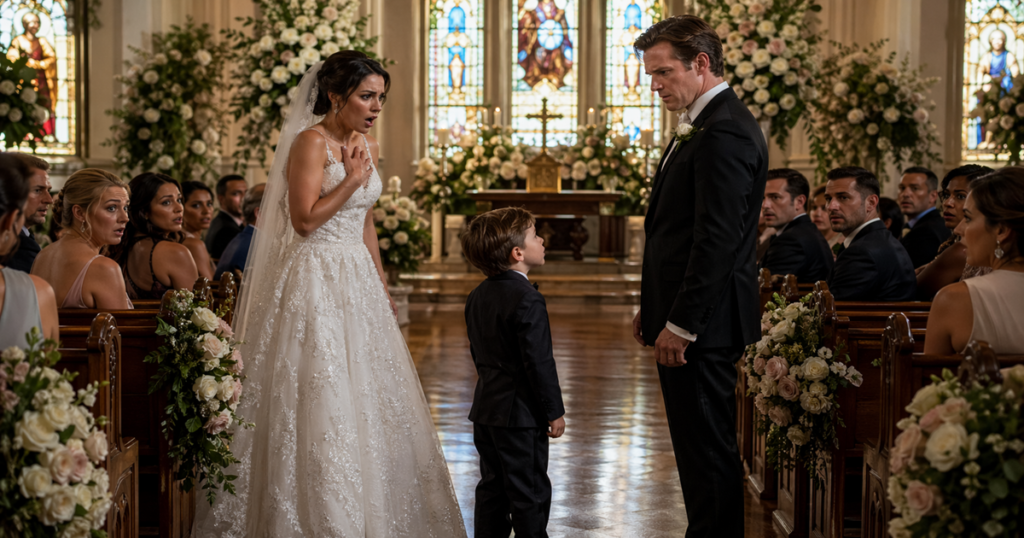
A child had entered the chapel.
He looked about six years old, dressed in navy pants, a white button-down shirt, and shoes polished so recently they still reflected light. His hair was dark and slightly too long over the forehead. He had escaped the grasp of a woman near the back, who now stood frozen between two pews with alarm on her face. Another older woman reached for the boy, but he had already slipped away.
Children wandered at weddings sometimes. It happened. Amelia’s first confused thought was that someone’s nephew had gotten loose.
The little boy walked quickly down the aisle, not wild or laughing, but purposeful. Certain. He wasn’t looking at the flowers or the guests or the bride. He was looking only at Daniel.
There was something so direct in that gaze that Amelia felt a faint, cold line slide down her spine.
The boy stopped halfway to the altar, breathing lightly as if he had run just enough to be excited, and stared up.
Then, in the clear unguarded voice children use when they believe adults will answer honestly, he said, “Dad.”
No one moved.
The word did not echo loudly, but it landed everywhere.
Amelia’s first instinct was not pain. It was confusion. Total, clean confusion. Her mind refused to connect the child, the word, and the man beside her into anything meaningful. She turned toward Daniel with the beginning of an uncertain smile, the kind meant for awkward accidents.
Maybe the child was mistaken.
Maybe Daniel coached little league and hadn’t mentioned this family.
Maybe—
Then she saw Daniel’s face.
All the color had drained from it.
His mouth opened slightly, then closed. His hand around hers changed—not tightening, not comforting, just going strangely absent, as if the rest of him had gone somewhere she could not follow.
The air in the chapel changed. Amelia could feel it physically, like the moment before a storm breaks.
The boy looked puzzled by the silence. “Dad?” he repeated, smaller this time.
From the back, the woman who had chased after him finally reached the middle aisle. “Eli,” she said, breathless. “Come here, baby.”
Daniel flinched at the name.
Amelia felt the blood leave her own face now.
She turned slowly toward the woman. Late twenties, maybe early thirties. Dark green dress. Hair pinned back too quickly, as if she had gotten ready while distracted. Her expression held embarrassment, panic, and something Amelia could not yet read.
Reverend Lewis had stopped speaking. The guests sat motionless. Somebody near the back whispered, “Oh my God,” in a voice that was not nearly as quiet as intended.
Amelia looked back at Daniel. “Who is that child?”
He didn’t answer.
Not immediately. Not fast enough.
And in that silence, truth arrived before words did.
Her bouquet felt heavy all at once. The chapel tilted without actually moving. Her ears filled with a thin rushing sound, but Daniel’s face remained sharp, painfully sharp, because she was seeing him for the first time and also not seeing him at all.
“Daniel,” she said, and her voice came out low and steady only because shock had turned it into glass. “Who is that child?”
The little boy had reached the altar now. He looked up at Daniel, then over at Amelia in her dress, curious and uncertain. “Mom said you were busy,” he said. “But Grandma said today was important.”
A murmur rippled through the room.
The older woman near the back closed her eyes as if something terrible she had been trying to prevent had finally happened.
Daniel released Amelia’s hand.
That simple movement hurt more than anything else so far.
He crouched down in front of the child. “Eli,” he said softly, strained, “what are you doing here?”
The boy frowned. “I wanted to see you.”
Amelia took one small step backward. Vanessa was instantly beside her, though Amelia hadn’t seen her move. One hand hovered near Amelia’s elbow without touching yet, waiting to see what was needed.
The woman in green reached the front. Up close, Amelia could see she was trying not to cry. “I’m so sorry,” she said, to everyone and no one. “He saw the address in the car. He realized where I was bringing my mother. I didn’t know he understood. He just ran.”
Amelia stared at her. “Who are you?”
The woman met her eyes, and whatever hope Amelia had left folded in on itself at once, because shame and truth looked out from that face together.
“My name is Nora.”
Amelia waited for the rest, because there had to be more.
Nora swallowed. “Eli is Daniel’s son.”
A sharp inhale moved through the chapel like a single body breathing in disbelief.
Daniel stood. “Amelia—”
She held up one hand. Not dramatic. Not angry. Just a stop. Her fingers trembled only at the tips.
“How long?” she asked.
He opened his mouth, closed it, and Amelia thought with detached horror that he was still trying to choose the least damaging version.
“How long have you known?” she repeated.
“Since before I met you.”
The words did not break loudly. They settled, and that made them worse.
Amelia laughed once, but there was no humor in it. It was the sound a body makes when it is trying to understand how it remains upright after impact.
“Before you met me,” she said. “Before you met me.”
Vanessa moved closer. Claire rose from the front pew. Amelia’s mother had both hands pressed over her mouth. Her father was halfway standing, face darkening with a kind of contained fury Amelia had only seen once before in her life.
The bride turned and looked at the guests. Dozens of eyes. Pity, shock, curiosity, discomfort. Phones lowered but not always quickly enough. She felt suddenly exposed in a way that had nothing to do with the gown or the room.
Then she looked down at the child.
Eli was not smiling now. He understood that something had gone terribly wrong, even if he didn’t understand the shape of it. His lower lip trembled. He looked between Daniel and Nora and Amelia as if searching for the right adult to make sense of the world again.
Amelia’s chest tightened unexpectedly.
The child was innocent.
The child was not the betrayal.
The child was evidence of it.
She turned to Nora. “Did you know he was getting married?”
Nora nodded once, shame flooding her face. “Yes.”
“And you said nothing.”
Nora’s eyes filled. “I wanted to. Many times. I told him he had to tell you. I told him this could not keep going like this.”
Amelia’s gaze shifted to Daniel again. “Keep going like what?”
He ran a hand over his mouth. “Amelia, please. Not here.”
That sentence, more than anything, brought heat to her shock.
“Not here?” she repeated. “You lied to me for three years, stood in front of my family, let me plan a wedding, let me send invitations, let me write vows, and now you want to talk about not here?”
Her voice rose only on the last two words, but the whole chapel heard them.
Daniel lowered his eyes for a second. “I was going to tell you.”
“When?”
He had no answer.
Amelia stared at him, and memory began rearranging itself in brutal sequence. The weekends he was “helping his mother” but never wanted her to come. The unexplained call he once silenced at midnight and said was work. The birthday party for a “friend’s kid” he attended alone because it was “just family.” The times he seemed distracted on certain Sundays. The way he always avoided conversations about when they would start trying for children of their own, saying only that he wanted to wait until the timing felt right.
Not hesitation. Not caution.
Concealment.
Reverend Lewis cleared his throat softly, then stopped, realizing there was nothing a reverend could say in a moment like this that would not sound absurd.
Amelia set down her bouquet on a front pew because she could no longer bear its weight. She untucked her hand from Daniel’s reach when he moved toward her.
“Did anyone else know?” she asked.
Silence.
Then Daniel’s mother, from the second pew on the groom’s side, began crying openly.
Amelia turned to her. “You knew.”
The older woman nodded through tears. “I begged him to tell you.”
“How long?”
She covered her face. “Since Eli was born.”
A quiet sound left Amelia—half breath, half disbelief.
Connor stood as well, jaw tight. “I found out last year,” he said. “I told him this was wrong.”
Amelia looked around the room at the people who knew and the people who didn’t, and there it was again, that feeling of standing inside a life she thought belonged to her and discovering hidden rooms behind every wall.
Her father finally walked to her side. He did not touch Daniel. He did not even look at him at first. He looked only at Amelia. “Honey.”
She nodded once, though she wasn’t sure what she was answering.
Daniel stepped forward. “I love you.”
That almost made the room crueler.
Amelia faced him fully now. “Do not say that to fix this.”
“I’m not trying to fix it with words.”
“No,” she said quietly. “You tried to build a marriage on top of a lie and hoped love would cover the floorboards.”
He shut his eyes.
Nora pulled Eli gently against her side. The little boy clung to her hand. Amelia noticed then that he and Daniel shared the same eyes. Not identical, but near enough that once seen it could not be unseen. A dreadful resemblance. Small proof with a heartbeat.
“Does he know?” Amelia asked, looking at Eli.
Daniel answered. “He knows I’m his father.”
“But not enough to see you openly,” she said. “Not enough to stand beside you in daylight.”
“Amelia—”
“How often do you see him?”
He hesitated again.
And again, that hesitation told the truth before words.
“Not enough,” Nora said quietly, bitterness entering her voice for the first time. “He sees him when it suits him. Birthdays sometimes. A few afternoons here and there. Promises when guilt gets heavy. Silence when his new life feels more convenient.”
Daniel turned sharply. “That’s not fair.”
Nora laughed once, wounded and exhausted. “Fair? You are standing in a church about to marry a woman who doesn’t even know your son exists, and you want to talk to me about fair?”
The line hit because it was true.
Eli began crying then—not loudly, but the soft frightened crying of a child who has finally understood that adults are breaking in front of him. Nora bent to comfort him, whispering that it was okay, though it clearly wasn’t.
Amelia felt something inside herself move from shock into clarity.
The wedding could not continue.
That part was obvious.
But more than that, the man before her was not simply someone who had hidden a fact. He had hidden a child. A whole life. A moral failure so large it had shaped every tender memory of their relationship into something unstable.
She lifted both hands to remove the veil from her hair. Vanessa immediately stepped in to help untangle one corner that had caught. Together they lifted it free. Amelia handed it to her without a word.
Then she looked at Reverend Lewis. “I’m sorry.”
He gave a small sad nod. “There is nothing for you to apologize for.”
Those words nearly undid her.
Her father placed his jacket around her shoulders though she did not need warmth. It was an old instinct from scraped knees and storms and bad news. She let him.
Daniel reached toward her one last time. “Please let me explain.”
Amelia’s eyes met his. She noticed that he was crying now. Real tears. Real regret, maybe. But regret at being discovered was not the same as honesty, and she could no longer confuse the two.
“You had years to explain,” she said. “You chose silence every day.”
Then, because the child was still crying and because some part of her refused to become cruel in front of him, she lowered her voice.
“He deserved better than this too.”
That landed harder than accusation.
Daniel looked at Eli, and for the first time since the boy entered, something like naked shame crossed his face without defense.
Amelia turned and walked down the aisle without bouquet, without veil, without ceremony. Vanessa was beside her. Her father on the other side. Claire followed close behind. Guests moved their legs aside from the pews and looked away when she passed, which she appreciated more than sympathy.
At the back of the chapel, her mother caught up, tears running freely now. Someone asked whether they should call the venue coordinator. Someone else asked what to do about lunch. The practical world was already trying to reassemble itself around disaster.
Outside, the day was offensively beautiful.
The sky was bright. Wind moved through the hedges. The reception hall across the courtyard waited with tables set in cream linen and strings of lights hanging above untouched centerpieces. A chalkboard sign near the door still read, Welcome to the wedding of Amelia & Daniel.
Amelia stared at it for several seconds.
Then Claire stepped forward, turned it face down, and that small act nearly made Amelia collapse.
Back in the bridal suite, the room that had held excitement an hour earlier now held wreckage. Hairpins on the vanity. lipstick open. half-drunk glasses of water. A robe tossed over a chair. The ordinary remains of preparation looked obscene beside what had happened.
Vanessa shut the door and locked it.
Nobody spoke immediately.
Then Amelia sat on the edge of the bed and finally cried.
Not delicately. Not beautifully. Her body bent forward with it, both hands over her face, the dress tightening across her ribs as if even fabric had become difficult to bear. Her mother knelt in front of her. Claire rubbed circles between her shoulder blades. Vanessa handed tissues, then stopped when tissues became useless.
“It’s okay,” her mother whispered, though again it wasn’t. “It’s okay, baby. Let it out.”
Amelia shook her head. “How did I not know?”
No one answered, because that question never truly has an answer simple enough to soothe the person asking it.
After a while, when the first wave had passed, her father stepped inside. He had stayed out to handle people, which was his way. Quietly protecting the perimeter.
“The venue manager is asking what you want to do,” he said gently. “We can send everyone home. Or we can keep the meal for close family. Whatever you want.”
Amelia wiped her face. “Send them home.”
He nodded. “Done.”
“And tell the photographer not to follow me anywhere.”
A faint grim line appeared at his mouth. “Already done.”
She almost smiled through tears. Her father knew her too well.
There was a knock. Vanessa stiffened, ready to refuse whoever it was, but Connor’s voice came through the door.
“Amelia? It’s Connor. Just me.”
The women looked at her. Amelia inhaled, then nodded once.
Connor entered slowly, looking like a man who hated his own last name. He had Daniel’s height but none of his calm today. “I’m sorry,” he said immediately. “I know that’s worthless, but I’m sorry.”
Amelia studied him. “Did you know he wasn’t going to tell me before today?”
Connor lowered his eyes. “I hoped he would. I pushed him last week. I told him if he loved you at all, he had to tell you before the wedding. He said he would handle it.”
Amelia laughed weakly through her nose. “Handle it.”
“I know.”
“Why didn’t you tell me yourself?”
His guilt deepened. “Because he’s my brother. Because I thought it wasn’t my place. Because I kept choosing family loyalty over what was right.” He looked at her directly then. “I was wrong.”
The honesty of that at least had weight.
Amelia nodded once. “Thank you for saying it.”
Connor hesitated. “Nora’s leaving. She wanted me to tell you she never meant for it to happen like this.”
Amelia looked down at the folds of her dress. “Neither did I.”
After he left, Amelia sat in silence for a long time.
She did not remove the gown immediately. Part of her felt that if she changed out of it too fast, the day would become real in a way she still could not bear. Instead she sat with mascara dried in faint tracks near her temples, wedding shoes still on, and stared at the mirror where she had smiled earlier.
That woman felt like a stranger now.
By evening, the dress hung in a garment bag no one wanted to zip shut. The cake was donated. The flowers were divided among family to avoid waste. Amelia moved back into her childhood bedroom for what she said would be “a few days,” though even she knew that meant she had no idea what came next.
Daniel called thirteen times that night.
She did not answer.
He texted paragraphs.
She did not read them until morning.
I’m sorry.
I love you.
Please let me explain.
It was never because I didn’t love you.
I was afraid.
I know I’ve ruined everything.
Please talk to me.
Afraid.
The word filled her with cold anger. Afraid of what? Losing her? Facing judgment? Taking responsibility? A child had lived in partial secrecy for six years because a grown man had been afraid.
On the second day, Amelia met him in a public park because she refused to let him step into her parents’ house.
He looked worse than she expected. Unshaven. Hollow-eyed. Jacket thrown over a wrinkled shirt as if he had dressed without attention. He stood when she approached, then thought better of reaching for her.
“Thank you for coming.”
“I came because I need facts, not apologies.”
He nodded. They sat on opposite ends of a bench facing a pond where two children fed breadcrumbs to ducks nearby. The normalcy of it was almost cruel.
Daniel spoke carefully, as if each sentence might detonate.
“Nora and I dated briefly before I met you. It wasn’t serious in the way people say that, but clearly it mattered. She got pregnant after we’d already broken up. She told me when she was three months along.”
“And what did you do?”
“At first I panicked. Then I said I’d support the child financially. We argued a lot. Her family hated me. Mine was angry too. I visited after Eli was born, but things were tense. I kept telling myself I’d become more present once life settled.”
Amelia stared ahead. “Life settled for whom?”
He flinched.
She continued. “Did you sign the birth certificate?”
“Yes.”
“Do you pay support?”
“Yes.”
“Does Eli know you well?”
A pause. “Not well enough.”
“Because?”
He exhaled slowly. “Because every time I thought about being fully present, it meant explaining him to everyone else. To future relationships. To you. To the life I wanted. And the longer I waited, the harder it became.”
“The life you wanted,” she repeated. “You mean the life that looked cleaner.”
He looked down. “Yes.”
The honesty did not make it better, but at least it stopped insulting her intelligence.
“Did you ever intend to tell me before the wedding?”
“I told myself I would. I kept waiting for the right time. After your grandmother got sick. After your job stress eased up. After the engagement. Then it became impossible without losing you.”
She turned to him then, truly turned. “Daniel, you lost me every single day you chose not to tell me. I just didn’t know it yet.”
His eyes filled. “I know that now.”
“That’s convenient timing.”
He pressed the heels of his hands to his eyes. For a moment he looked less like a liar and more like a weak man finally standing in the wreckage weakness creates. Amelia hated that pity touched her at all.
“What about Nora?” she asked. “Were you still involved with her?”
“No.”
“Never?”
“Not romantically after Eli was born.”
“But you saw her.”
“Yes.”
“You spoke with her. Arranged visits. Discussed school. Health. Holidays.”
“Yes.”
“All while telling me nothing.”
His voice dropped. “Yes.”
A jogger passed. Somewhere behind them a dog barked twice. Amelia thought about the absurd fact that the world kept moving.
“I need you to understand something,” she said. “This is not only about cheating me out of information. You taught me to trust a version of you that never existed. Every good memory is contaminated now because I don’t know what you were hiding on the day it happened.”
Daniel swallowed hard. “I do understand.”
“No,” she said. “I don’t think you do yet. You think this is a confession problem. It’s a character problem.”
The words stayed between them.
Finally he asked, voice raw, “Is there any path back from this?”
Amelia looked at the children by the pond, at the ducks, at the father crouching to tie a little girl’s shoe. Then she thought of Eli in the chapel, tears on his face, wanting only to see the man who should never have hidden him.
“There may be a path for you,” she said quietly. “But I don’t think I’m on it.”
That was the last honest conversation they had.
The weeks that followed were slow and humiliating in the way public heartbreak often is. Vendors emailed about cancellations. A few relatives called too often. Others avoided calling at all. Someone posted speculation online, and Amelia had to ask a cousin to take it down. At work, people offered pity with careful faces. She returned the dress. She canceled the honeymoon. She boxed Daniel’s things with mechanical efficiency and left them with Connor.
Some nights she cried.
Some nights she felt nothing.
Some mornings she woke up and forgot for three full seconds, which turned out to be its own kind of pain.
Yet beneath the grief, something steadier began to grow: anger sharpened into self-respect.
She started therapy in the second month. At first she went only because Vanessa insisted heartbreak that public needed private help. But therapy gave shape to things Amelia had not known how to say out loud. Betrayal was not just sadness. It was disorientation. A loss of narrative. A collapse of trust not only in another person but in one’s own ability to judge reality.
“You didn’t miss the truth because you were foolish,” her therapist told her. “You missed it because deception works by design, especially when it comes wrapped in tenderness.”
That sentence stayed with her.
In the third month, something happened she had not expected. Nora called.
Amelia let it ring once, then twice. Finally she answered.
“I know you may hang up,” Nora said quickly, voice tense, “but I wanted to apologize to you directly. Not for what Daniel did. For my part in remaining silent.”
Amelia was quiet.
Nora continued, “I told myself it wasn’t my responsibility to manage his honesty. I told myself he’d tell you. I told myself protecting my son from chaos mattered more than exposing yours.” She took a breath. “But silence still helped him. And I’m sorry.”
Amelia leaned against her kitchen counter and closed her eyes. “Why are you calling now?”
“Because Eli keeps asking why he can’t see his dad. Daniel has been trying to ‘get his life together,’ which mostly means disappearing into guilt. And because I realized the person least responsible ended up carrying the most public pain.”
For the first time, Amelia heard not shame but exhaustion in Nora’s voice. Real exhaustion. The kind single parents wore deep in the bones.
“How is Eli?” Amelia asked before she could stop herself.
Nora was silent for a beat, perhaps surprised by the question. “Confused. Sensitive. He thinks he ruined something.”
Amelia’s throat tightened. “He didn’t.”
“I know that. I keep telling him that.”
After a pause, Nora added, “He drew a picture of the church last week. He put everyone crying except you. He drew you standing straight.”
Amelia looked out the window at the late afternoon sun catching on the neighbor’s fence. Something in that image—the child’s memory of her standing straight—reached a place in her still healing.
“I’m glad he doesn’t remember me being angry at him,” she said.
“You weren’t.”
“No,” Amelia answered softly. “I wasn’t.”
That call did not make them friends. It did something more useful. It shifted the story slightly, away from spectacle and back toward humanity.
Months later, Amelia saw Daniel one last time at family court.
Not because she was involved. Not because she had chosen drama. But because Connor, who had become unexpectedly decent in the aftermath, called to say Daniel was finally formalizing a custody arrangement and Nora was terrified he’d back out at the last minute. Amelia had already taken the day off and, to her own surprise, drove there.
She sat in the back hallway outside the courtroom for nearly forty minutes before Daniel saw her. He looked startled, then ashamed, then grateful in a way she did not want.
“I’m not here for you,” she said before he could speak.
He nodded. “I figured.”
Nora arrived with Eli, who had grown taller somehow in the months since the wedding. He wore a small blue sweater and held a toy car in one hand. When he saw Amelia, recognition flickered.
“That’s the lady from the church,” he whispered to Nora.
Amelia crouched to his level. “Hi, Eli.”
He studied her with the solemnity children use when sorting adults into categories. “Are you still sad?”
The hallway seemed to hold its breath.
Amelia answered honestly. “Not like before.”
He considered that. “Good.”
Then he offered her the toy car for a second as if sharing mattered more than awkward history. Amelia smiled and handed it back gently.
Watching Daniel sign those papers later did not heal what he had broken. But it did confirm something Amelia had already learned: truth comes late sometimes, but it still changes the room when it enters. Daniel was finally beginning to act like a father in public, under fluorescent lights, before a clerk and two attorneys, because secrecy had failed him.
It should never have taken that much.
A year after the wedding that never happened, Amelia returned to St. Catherine’s for a very different event: Claire’s daughter’s baptism.
She hesitated before going inside. The memory still lived in the wood and light of that place. But she went.
The same stained glass warmed the floor. The same pews stood polished and still. Yet the room no longer felt like a graveyard of embarrassment. Time had done its quiet work. It had not erased the day, but it had put distance between Amelia and the woman who thought a smile at the altar guaranteed safety.
Vanessa slid into the pew beside her and whispered, “You’re okay?”
Amelia looked toward the front where her niece wriggled in white lace, making faces at everyone. Then she smiled, and this time it required no rehearsal.
“Yes,” she said. “I really am.”
Later, outside on the church steps, she stood in sunlight with her family gathered around her. Her mother was laughing at something her father said. Claire bounced the baby on one hip. Vanessa complained about heels. Ordinary love surrounded Amelia, unperformed and solid.
She thought then about weddings, promises, and the dangerous beauty of appearances. She thought about how close she had come to binding herself legally, emotionally, and spiritually to a man who had mistaken avoidance for mercy. She thought about the child who spoke a truth the adults refused to carry properly. She thought about the version of herself who had walked down the aisle believing certainty was visible.
It wasn’t.
Character was visible only over time.
And sometimes only after crisis.
A gentle voice interrupted her thoughts.
“Amelia?”
She turned. Nora stood a few steps away with Eli, who was now holding a paper cup of juice. The encounter startled her, though perhaps it shouldn’t have. St. Catherine’s served a wide part of the community. People’s lives overlapped whether pain liked it or not.
Nora looked cautious. “I didn’t know you’d be here.”
“I’m here for my niece.”
Nora nodded. “We’re here for my cousin’s baby.”
A brief awkward silence followed, then Eli smiled a little. “Hi.”
Amelia smiled back. “Hi, Eli.”
He pointed at the church doors. “I know you from there.”
“I remember.”
Nora shifted the cup from one hand to the other. “He’s doing better.”
“I’m glad.”
“And Daniel’s… trying. Still late sometimes. Still learning. But trying.”
Amelia accepted that with a small nod. It was the only place that information belonged now—in the life she no longer shared.
Nora hesitated, then said quietly, “For what it’s worth, that day changed more than your life. It forced the truth into daylight for all of us.”
Amelia looked at Eli. “He deserved daylight from the start.”
Nora’s eyes filled briefly. “Yes. He did.”
They stood there another moment, not bonded, not healed together, but linked by the fact that one man’s cowardice had once made strangers of them all and truth had eventually rearranged that.
When Nora and Eli walked away, Amelia felt no jealousy, no fury, no urge to revisit the past. Only sadness for what had been damaged unnecessarily and relief that she had not entered a marriage built on concealment.
That evening, back at home, Amelia opened a box she had not touched in months. Inside lay the wedding program, one ivory shoe, a pressed flower from the bouquet, and the vows she had written by hand.
She unfolded the paper and read the first lines.
I promise to meet truth with truth.
I promise that what is hardest to say will still be spoken.
I promise that love will never ask you to live in the dark.
She sat very still.
Then, with no ceremony at all, she fed the pages into the fireplace one by one and watched them curl inward, blacken, and lift away as ash.
It did not feel like losing a future anymore.
It felt like releasing a lie.
Months later, when someone asked Amelia whether she still believed in marriage after everything, she answered with surprising calm.
“Yes,” she said. “But I believe in honesty first.”
That was the real vow now. Not one spoken beneath flowers or before guests. One carried quietly into every room afterward.
Years from now, people would still remember the wedding that stopped when a child called the groom “Dad.” They would tell it as a story of scandal, shock, or public humiliation because people like neat dramatic versions of other people’s pain.
But Amelia knew the fuller truth.
It was not the story of a perfect day ruined in a single second.
It was the story of a hidden truth arriving at the exact moment it could no longer be buried.
It was the story of a child speaking plainly in a room full of adults who had failed him.
It was the story of a woman discovering that heartbreak in public is still survivable in private.
And it was the story of leaving before a lie could become a life.
If there was any mercy in the memory, it was this:
She had smiled at the wedding, yes.
But she had walked away with her dignity.
And in the end, that mattered more than making it to “I do.”