On the morning Manuel Sarmiento was told to leave his own house, the coffee had already gone cold twice.
He sat alone at the kitchen table with both hands around the cup, as if warmth could still be found in it if he waited long enough. The table was old narra wood, dented in places, faded in others, with a pale burn mark near the edge from the time his youngest son, Daniel, had knocked over a hot pot as a child and cried harder from fear than from pain. Manuel remembered lifting him into his lap, checking his small red fingers, kissing them one by one while his wife Elena laughed through her worry and said,
“You spoil them too much.”
He had. He knew that now.
The house was quiet in the careful, unnatural way that only happens when other people are awake but avoiding you. Cabinets opened and closed more softly than usual. Footsteps paused before reaching the kitchen, then turned away. Muffled voices came from the back room where his eldest son, Arturo, and daughter-in-law, Celia, had been sleeping since moving in “temporarily” two years earlier. Temporary had become permanent, as these things often do when excuses are spoken gently enough and often enough.
Manuel looked toward the window above the sink. The bougainvillea Elena had planted years ago still climbed over the side wall in a burst of purple that never failed to make the yard seem alive, even in the dry months. The sight pressed something deep into his chest.
He missed her most in the mornings.
At night, grief was a room he had learned to sit in. In the morning, it still ambushed him.
The back door opened. Daniel came in first, hair still damp from a rushed shower, shirt untucked at the waist. At forty-one, he still carried traces of the boy who used to run barefoot through the yard and climb the guava tree even after being told not to. His face, though fuller now and lined with the stress of adulthood, still had softness around the eyes. It was that softness Manuel had trusted too much.
“Papa,” Daniel said.
Just that one word.
No “good morning.” No question. No attempt at ease.
Manuel raised his head slowly. “You’re up early.”
Daniel rubbed the back of his neck. “Arturo wanted us to talk before the kids wake up.”
The coffee went bitter in Manuel’s mouth. He placed the cup down carefully. “Then sit.”
Daniel did not sit. He remained standing beside the refrigerator, glancing once toward the hallway.
A few seconds later Arturo appeared, already dressed for work in pressed slacks and a tucked-in polo shirt, though Manuel knew he would not leave for another hour. Arturo had been methodical even as a boy, always arranging his pencils by length, always folding his school uniform with sharp corners. Elena used to say that if Daniel was heart, Arturo was structure. They had both seemed necessary then. Together they had felt like balance.
Now Arturo stood with his arms crossed, jaw tight.
Celia entered next, followed by Daniel’s wife Marissa. Neither woman sat either. The four of them remained standing, and only Manuel sat at the table.
It made him feel, suddenly and clearly, like a defendant waiting to hear a sentence.
“What is this?” he asked, keeping his voice level.
Arturo cleared his throat. “Papa, we’ve been talking for some time about the situation.”
Manuel almost smiled, but there was no humor in him. “Which situation? There are several in this house.”
“About the living arrangement,” Arturo said.
The words were careful, polished. Business words. Human pain dressed in office language.
Manuel leaned back slightly in his chair. His knees ached. The weather had been shifting all week, and his joints always knew before the sky admitted it. “What about it?”
Celia stepped in before Arturo could continue. “It’s becoming difficult, Tatay.”
Tatays and Papas appeared when people wanted to soften what came next.
“The children need more space,” she said. “We all do. The house is crowded. There’s tension. It hasn’t been healthy.”
Manuel turned to look at her fully. “You mean my presence has not been healthy.”
Marissa glanced down. Daniel stared at the floor tiles.
Arturo exhaled, impatient already. “Papa, please don’t make this harder than it has to be.”
Something in Manuel’s chest shifted then. A small, hard movement. Not surprise. Not even pain yet. Just the first clean crack of understanding.
He looked from one face to another and saw it all at once: the rehearsed expressions, the avoidance, the moral exhaustion of people who had convinced themselves that cruelty was practicality.
“When?” he asked.
No one answered.
“When do you want me gone?”
Daniel finally lifted his head. His eyes were wet already, which angered Manuel more than if he had been cold. Tears before the act were always easier than remorse after it.
“Papa,” Daniel said hoarsely, “maybe for now you could stay at Tita Rosa’s. Or with Father Ben at the parish housing for seniors. Just until we sort things out.”
“Tita Rosa is seventy-eight and lives with your cousin in two rented rooms,” Manuel replied. “And the parish shelter is for people with nowhere else to go.”
Silence.
Then Arturo said, “We’ve checked. They have a place.”
Manuel looked at his eldest son for a long time.
“You’ve checked.”
Arturo straightened. “This isn’t about disrespect. It’s about reality. We can’t keep living like this. Maintenance costs are rising. The roof needs repair. Taxes are due. The children are growing. Daniel’s business is unstable. We’ve all been carrying too much.”
Manuel’s voice dropped. “This house is paid for.”
“Yes, but—”
“It is paid for,” Manuel repeated. “By me. By your mother and me. Brick by brick. Payment by payment. So tell me plainly, Arturo, because I am too old for decorated lies. Are you saying there is no room for me in my own home?”
Celia pressed her lips together. Marissa turned her face away.
Arturo answered, “Legally, the property is already under our names.”
The room changed.
It changed in a way Manuel could almost hear.
A distant dog barked outside. A motorbike passed on the road. Somewhere in the neighborhood a radio played an old love song. But inside the kitchen, the air seemed to pull inward and sharpen.
Manuel blinked once. “What did you say?”
Daniel stepped forward now, palms out. “Papa, please, it’s not like that—”
“It is exactly like that.” Manuel rose too quickly, and the room tilted. He had to grip the edge of the table. “Under your names?”
Arturo’s gaze hardened, perhaps because kindness at that point would have required courage. “You signed the transfer papers three years ago.”
Three years ago.
Manuel saw it then—not as memory at first, but as fragments. A trip to the municipal office. Arturo saying they needed signatures to “simplify inheritance matters” after Elena died. Daniel standing nearby, anxious but encouraging. Papers stacked thick in a brown envelope. Manuel grieving, exhausted, barely sleeping, willing to sign anything that meant not having to think about death in administrative language.
“You said those were for tax processing,” Manuel whispered.
Arturo did not answer.
Daniel did. “We thought it would make things easier later.”
“Later?” Manuel repeated. He laughed once, a broken sound. “You prepared for my death while asking me what soup I wanted for dinner?”
“Papa, please,” Daniel said.
Manuel looked at him, and what hurt was not the betrayal alone. It was the weakness. The surrender. Daniel had always been the one who hugged longest, apologized first, came back to the table after an argument and asked, “Are you still angry?” To see him standing there, participating in this, was like losing a second thing after the first had already been taken.
He sank back into the chair.
For a moment no one spoke.
Then Celia, perhaps misunderstanding his silence, said gently, “We’ve packed some things for you.”
The sentence landed with such insult that Manuel went still.
“You packed some things for me.”
“Just essentials,” she said. “Clothes. Medicine. Toiletries.”
Marissa whispered, “We didn’t want you to strain yourself.”
Manuel turned toward the hallway where the bedrooms were. He imagined strangers touching his drawers, folding his undershirts, deciding which parts of a life counted as essential.
He closed his eyes.
In the darkness behind them came Elena’s voice from years before, standing in this same kitchen while rice steamed and rain hit the roof: Promise me something, Manuel. No matter what happens when they grow up, do not let pride become bigger than love.
He had promised.
He opened his eyes again.
“Bring the bag,” he said.
Daniel froze. “Papa…”
“Bring the bag.”
Arturo nodded toward the hallway. Celia left and returned with a small canvas duffel, faded blue, with a broken zipper tab tied to a piece of string. Manuel recognized it immediately. It was the bag he used to carry tools when he still repaired electrical lines for the municipality. How fitting, he thought dimly, that the container chosen for his removal was the one that had built the life they were now taking.
Celia placed it near the table.
Manuel looked at it, then at each of them in turn.
“You should all listen carefully,” he said.
His voice was quiet enough that they leaned in.
“I am leaving because I do not intend to wrestle with my own children in front of their children. I am leaving because your mother would die a second death if this house became a battlefield. I am leaving because old age teaches a person the difference between what can be saved and what has already been handed over to darkness.”
Daniel began crying in earnest then, silent tears slipping down the sides of his face.
Arturo stood like stone.
“But hear me,” Manuel continued. “What you have done today will not leave this house with me. It will stay here. In the walls. In the dining room. In the beds where your children sleep. One day they will ask who built this home. One day they will ask where their grandfather went. And you will have to answer them with the same mouths you used to send me away.”
No one moved.
Manuel bent slowly, picked up the bag, and winced at the pull in his back.
Marissa took a half step forward. “At least eat breakfast first.”
He looked at her with tired disbelief. “Do not offer me eggs after serving me exile.”
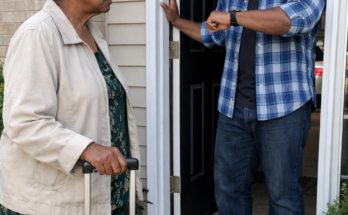
Then he walked to the front door.
At the threshold he paused, not because he hoped someone would stop him, but because habit made him glance toward the shelf beside the door where Elena’s framed photograph stood between a Santo Niño and a bowl of dried sampaguita. In the picture she was fifty-two and laughing at something he had said just before the shutter clicked. Her eyes were bright and alive.
I tried, he told her silently. I truly tried.
Then he stepped outside.
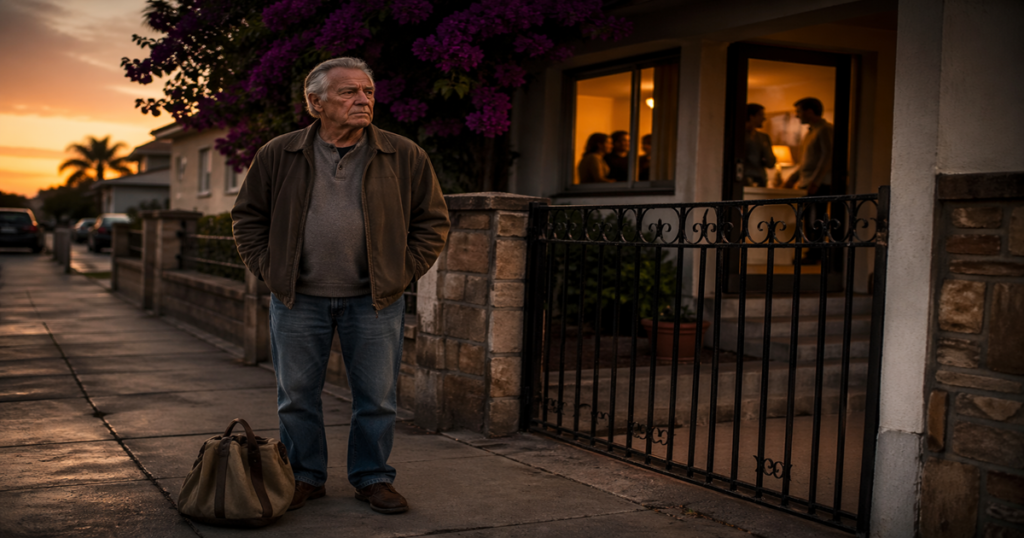
The morning light was too bright. It flattened everything—the street, the gate, the parked tricycle two houses down, the neighbor sweeping leaves into a pan. Manuel stood on the path for a second, feeling oddly detached, as if he had walked out of one life and into another without the proper transition.
Behind him, the door closed.
Not slammed. Not softened. Just closed.
He walked to the front gate and out to the sidewalk. The bag felt heavier with every step, though it could not have weighed much. His medicines rattled inside with each movement.
At the corner store, Mrs. Valdez looked up from arranging instant coffee packets and frowned.
“Manuel? You’re out early.”
He managed a small nod.
Her eyes dropped to the bag. She was a widow, sharp-eyed and sparing with words. She understood more than most people without needing it explained. “Are you all right?”
He could have lied. He almost did. But shame had already taken enough from him that morning.
“My sons say there is no room for me in the house.”
Mrs. Valdez went still, one hand resting on a crate of eggs.
For a long second the only sound was the buzz of flies near the fruit stand.
Then she said quietly, “Sit.”
He sat on the wooden bench outside her store because there was nowhere else to go.
By noon, half the street knew.
Not because Manuel told them. He barely spoke. But neighborhood grief travels faster than neighborhood gossip when people have watched a family for decades. They remembered Manuel hauling sacks of cement when the house was being built. They remembered Elena handing out rice cakes on feast days. They remembered the boys in their school uniforms, hair wet from hurried baths, calling from the gate, “Papa, open!”
Now the old man sat outside with a canvas bag and a face that looked years older than it had the day before.
Some people approached. Some left food. Some stood nearby and cursed under their breath on his behalf. Others pretended not to see, perhaps because they feared witnessing too much. Compassion, Manuel had learned, often came mixed with discomfort.
By late afternoon Father Ben arrived in his dusty white sedan.
He came around the front of the vehicle with the careful speed of a man whose spirit moved younger than his knees. He was in his sixties, with kind eyes and a permanent crease between his brows caused less by age than by concern.
“Manuel,” he said softly.
Manuel looked up from where he sat beneath the acacia tree across from the house. The shade had shifted twice already. “So they called you.”
Mrs. Valdez answered from the store doorway. “I called him.”
Father Ben crouched with some difficulty and placed a hand on Manuel’s shoulder. “Come with me.”
“To the parish shelter?”
“To the parish guest room, if you’ll accept it for tonight. After that we’ll see.”
Manuel stared at the house across the road. Through the front window he could see movement—small shadows passing, curtains shifting. Life continuing.
“I do not want to die in charity housing,” he said.
Father Ben’s grip tightened slightly. “Then do not make tonight about dying.”
Manuel gave a tired breath that almost became a laugh. “You always speak like that.”
“You always need speaking to.”
Mrs. Valdez brought over a plastic container wrapped in a towel. “Soup,” she said. “You can return the container when the world improves.”
Father Ben helped Manuel up and took the bag from his hand without asking.
As they drove away, Manuel did not look back until they reached the end of the street. Even then he only glanced once. The house stood calm and ordinary in the fading light, as if nothing monstrous had happened there at all.
That first night in the parish guest room, Manuel could not sleep.
The room was clean, small, and painted a pale green that reminded him faintly of hospital walls. There was a narrow bed, a wooden crucifix, a metal cabinet, and a stand fan that clicked every twelve rotations. The window overlooked the side garden where the sisters grew herbs and white roses. Somewhere down the hall, someone coughed in intervals.
Manuel lay on top of the blanket in his undershirt, listening to the fan and feeling the shape of absence press around him. He thought of Elena. He thought of the way she used to wake just before dawn and reach for his arm in her sleep, not to hold him exactly, but to confirm he was there. He thought of Arturo at age ten, feverish and clinging to him through a typhoon. He thought of Daniel at seventeen, begging forgiveness after wrecking the borrowed motorcycle of a neighbor. He had forgiven so easily then. Too easily.
He turned on his side. His hip throbbed.
On the chair by the bed sat the canvas bag. Propped against it was the old family photo he had taken with him from the house. He had not even remembered placing it in the bag. Perhaps his hands had chosen before his mind had.
In the photo, Elena sat in the middle, younger than Manuel had ever learned to imagine her now. Arturo stood at her shoulder, serious even in childhood, and Daniel leaned over the back of her chair making her laugh. Manuel himself stood behind them all, one hand on Elena’s shoulder, looking not at the camera but at the family.
It had been taken after the last payment on the house.
That day they had eaten noodles with too much soy sauce because it was all they had, and Elena had said, “One day the boys will bring their children here, and this house will never be empty.”
She had been right in the cruelest possible way.
Near midnight, there was a knock.
“Come,” Manuel said, pushing himself upright.
Father Ben entered with two mugs of hot salabat. He handed one over and took the chair.
“I knew you would be awake,” the priest said.
“Am I that transparent?”
“When people have had a wound opened that deeply, yes.”
Manuel held the warm mug, letting the heat settle into his palms. “Do you want me to say I forgive them?”
“No.”
“Good.”
Father Ben leaned back. “I want you to say what you haven’t said yet.”
Manuel looked into the steam. “I am ashamed.”
The words came out flat and heavy.
“Of them?” Father Ben asked.
“Of myself.”
The priest waited.
Manuel swallowed. “I signed the papers. I did not read them. I let grief make me blind. Elena had just died. Arturo handled everything. Bank visits. Taxes. Hospital balances. He spoke like a son taking care of his father. I was grateful.” He stared at the mug. “How foolish does an old man have to be to hand away the roof over his head?”
Father Ben answered gently, “Trust is not foolishness. Betrayal is.”
Manuel shook his head. “Maybe. But I taught them to think this was theirs before they had earned it. I covered Daniel’s debts too many times. I let Arturo make decisions because it was easier after Elena died. I confused peace with wisdom.” He looked up, eyes shining but dry. “Tell me, Father, at what point does kindness become participation in your own destruction?”
Father Ben had no quick answer. That, more than anything, made Manuel trust him.
Finally the priest said, “When it no longer leaves room for truth.”
They sat quietly after that.
Before leaving, Father Ben placed a folded card on the bedside table. “A friend of mine is a lawyer,” he said. “Not for a lawsuit, unless that becomes necessary. Just for clarity. You need to know where you stand.”
Manuel gave a tired nod. “Thank you.”
At the door Father Ben paused. “You also need to call Sofia.”
Manuel’s face tightened.
“No,” he said.
“She is your daughter too.”
The word daughter opened an ache older than the one from that morning.
Sofia, their youngest, had left years ago after a family argument that had grown so sharp it cut through more than pride. She had wanted to marry Tomas, a mechanic with rough hands and no savings. Arturo had called him unworthy. Daniel had tried to mediate and made it worse. Elena had cried. Manuel, tired from work and afraid of losing control of the family, had sided with the sons and told Sofia that if she chose disobedience, she would live with the consequences.
She had stood in the yard with a suitcase and red eyes and said, “One day you will learn that silence from the people you love can wound more than shouting.”
She left anyway.
Elena had reconciled with her quietly before her death, but Manuel and Sofia had never fully repaired what pride and time had done.
“She has her own life,” Manuel muttered.
Father Ben looked at him. “And yet if she learns from someone else that her father was put out on the street, what then?”
Manuel closed his eyes.
The priest left him with that.
The next morning, the lawyer came.
Her name was Atty. Isabel Reyes, mid-fifties, hair cut in a clean silver bob, with the sort of voice that sounded calm even when delivering unpleasant facts. She met Manuel in the parish office, where old catechism posters curled at the edges and the electric kettle never fully switched off.
She reviewed the photocopies Father Ben had obtained from municipal records.
“The transfer appears valid on its face,” she said. “Your signatures are here on the deed of donation and notarized acknowledgment.”
Manuel nodded once. “I signed them.”
“However,” she continued, “there may be questions regarding informed consent, especially given the timing, your bereavement, and the representation made to you. But legal recovery is difficult, especially if the current title is clean and there’s no written proof of deception.”
“I see.”
She studied him for a moment, perhaps expecting anger. But Manuel felt oddly calm. The law, he realized, could describe injury without undoing it.
“There is something else,” she said.
From her folder she drew another document.
“This is a certified copy of a separate instrument filed six months after the transfer.”
Manuel adjusted his glasses and squinted at the page. Legal terms blurred together until one name snapped into focus.
Sofia Elena Sarmiento.
His grip tightened.
“What is this?”
“A reservation of usufruct and conditional directive,” Atty. Reyes explained. “It appears your late wife had a supplementary property instruction prepared during her illness. It was activated upon the transfer.”
Manuel stared at her.
“She anticipated the house might be transferred to the children,” the lawyer said. “The directive states that regardless of title ownership, you retain lifetime residential rights and care priority while living. It also states that if you are forcibly removed, neglected, or denied residence by any title holder, a separate asset under her sole name is to be released according to the terms she specified.”
Manuel could hear his own heartbeat.
“A separate asset?”
Atty. Reyes nodded. “A parcel of commercial land on the highway side of Santa Mesa, currently under long-term lease to a fuel station operator. The income has been accumulating in a trust arrangement. It is substantial.”
The room seemed suddenly smaller.
“Elena never told me.”
“She may have feared precisely this,” the lawyer said. “Or she may have meant it as protection of last resort.”
Manuel kept staring at the paper, at his daughter’s name.
“Why is Sofia’s name here?”
“Because she is the designated executor of the conditional directive.”
For several seconds Manuel could not speak.
He remembered Elena on one of her final lucid afternoons, thin from illness but stubbornly upright, asking him where the brown envelope from the steel cabinet had gone. He had said Arturo took all the documents to organize them. Elena had closed her eyes and whispered, “Then maybe I should have hidden more things from all of you.”
He had thought it was morphine talking.
Now he wasn’t so sure.
Atty. Reyes continued, “If the facts are as you describe, then legally and financially, your sons may have placed themselves in very serious difficulty. Not only did they have no right to remove you, but doing so may have triggered consequences your wife designed specifically to penalize that behavior.”
Manuel looked up slowly. “And Sofia knew?”
“She signed acceptance papers years ago. Whether she expected them to be needed, I cannot say.”
A strange mix of grief, admiration, and shame rose in him then.
Elena had seen farther than he had.
Sofia had carried a responsibility he knew nothing about.
And his sons, for all their cleverness, had mistaken possession for victory.
Atty. Reyes folded her hands. “You have choices. You may enforce your residential right and return to the home with legal notice. You may seek damages. Or, depending on the trust terms, you may decline the right and redirect the asset disposition according to your wife’s final clause.”
“There’s another clause?”
The lawyer nodded once. “If you choose not to return and instead affirm permanent separation due to moral injury, full discretionary authority passes to you and the executor jointly for redistribution.”
Manuel sat back slowly.
The old fan in the corner hummed.
“What kind of redistribution?”
“Almost anything lawful,” she said. “Family support, medical care, charitable bequests, educational trusts, sale instructions. Your wife left it intentionally broad.”
Father Ben, who had remained silent by the window, finally spoke. “Elena knew your heart.”
Manuel lowered his eyes.
Yes, he thought. But had she known his weakness too?
That afternoon he asked for Sofia’s number.
His hands shook while dialing.
The phone rang four times.
“Hello?”
Her voice was older, fuller, more measured than the girl who had once left their house with a suitcase. But it was still Sofia.
For a moment he could not answer.
Then he said, “Anak.”
A long silence.
When she spoke again, her voice broke slightly. “Papa?”
He closed his eyes. “Yes.”
“What happened?” she asked immediately. “Father Ben already sent a message saying you were with him. He said you were safe but… Papa, what happened?”
It is a terrible thing, to hear concern from someone you once failed.
He told her.
Not every detail. Not yet. But enough.
She listened without interrupting. He could hear traffic on her end, maybe from the city, and the faint sound of a child in the background.
When he finished, there was only breathing between them.
Finally Sofia said, low and shaking, “I told Mama this might happen.”
Manuel gripped the receiver harder. “You knew.”
“Mama was afraid after the transfer. She didn’t trust the way Arturo kept pushing paperwork. She said if they were capable of rushing ownership while she was sick, they might be capable of worse after she was gone.” Sofia inhaled slowly. “She wanted to protect you, even from your own refusal to suspect your children.”
Each word was deserved. That did not make it easier.
“I was wrong,” Manuel said.
Sofia was quiet.
Then, very softly, “Yes.”
The honesty of it cut him cleanly and left no poison.
He nodded even though she could not see him. “Will you come?”
“I’m leaving now.”
She arrived just before evening with her husband Tomas and their eight-year-old daughter, Leila.
When Manuel saw Sofia step out of the van, something inside him gave way. She was thinner than Elena had been at her age, with the same direct eyes and steady mouth. Her hair was tied back carelessly, and she wore no makeup, only the face of a woman who had been busy with real life. Tomas came around the other side carrying a paper bag of groceries and looked at Manuel with concern but no resentment. That, more than any apology, shamed him.
Sofia walked toward her father slowly at first, then faster.
Manuel stood.
For one terrible second he feared she might stop short, keep distance, preserve the dignity of years lost.
Instead she wrapped both arms around him.
He felt how strong she had become. He also felt the tremor in her shoulders.
“You should have called me sooner,” she whispered.
He pressed his face against her hair and closed his eyes. “I know.”
Leila came next, shyly, peeking from behind Tomas’s leg until Sofia said, “This is Lolo.”
The child stepped forward and placed a biscuit packet into Manuel’s hand. “For your snacks,” she said solemnly.
He almost wept then.
That night, seated around a borrowed table in the parish dining area, the whole story unfolded.
Sofia had known about the conditional directive because Elena made her promise to keep it quiet unless the worst happened. After the conflict years earlier, Elena had maintained contact with her in secret at first, then openly near the end. Arturo disapproved. Daniel avoided involvement. Manuel, lost in pride and then grief, had let time harden around the silence.
“She wanted to tell you,” Sofia said. “But every time she tried, she said you still looked at me like I had betrayed the family.”
Manuel stared at his plate.
“I betrayed you first,” he said.
Sofia’s expression flickered, pain meeting relief. She had likely waited years to hear it.
Tomas cleared his throat and looked down respectfully. “Sir, for what it’s worth, Elena always defended you. She said grief and pride make men stupid in different ways.”
Manuel let out an unexpected laugh. It hurt, but it was a laugh. “That sounds like her.”
They spoke long into the night—about Elena, about the land, about the trust income, about what should be done.
Sofia wanted legal action.
“They humiliated you,” she said, anger flashing. “They put you outside like an unwanted tenant. They should answer for that.”
Father Ben favored restraint but not surrender. “Justice and revenge are not the same, but they can wear similar clothes.”
Manuel listened to all of it.
In the end he said only, “I need to see them once more.”
So three days later, with Atty. Reyes beside him and Sofia standing half a step behind, Manuel returned to the house.
The neighborhood noticed immediately.
Curtains shifted. Gates opened a little wider. Children were called inside by mothers pretending not to watch. Mrs. Valdez crossed her arms from her storefront like a guard posted by history itself.
Arturo opened the door.
His face drained when he saw the lawyer.
Daniel appeared behind him, already pale.
For a second no one spoke.
Then Manuel said, “May we come in?”
They moved aside.
The living room smelled faintly of fabric spray and fried garlic. The sofa had been rearranged. Elena’s photograph was no longer on the front shelf but on the piano near the dining room, as if memory itself had been repositioned for convenience.
Manuel remained standing.
Atty. Reyes spoke first, concise and formal. She outlined Manuel’s retained lifetime right of residence and the violation committed by removing him. She explained the trust trigger, the conditional directive, and the potential liability arising from moral and custodial neglect. Every sentence took more color from Arturo’s face.
Celia sat down without being asked.
Marissa began crying.
Daniel kept whispering, “I didn’t know. I swear I didn’t know all of that.”
Arturo turned sharply. “What do you mean, you didn’t know? We both signed—”
“Signed what you told me to sign,” Daniel snapped, sudden bitterness rising through fear. “Like always.”
The room fractured.
Old loyalties loosened in real time.
“You wanted the house,” Daniel said. “You kept saying Papa needed management, that he was too trusting, that if we didn’t secure things now, Sofia and that husband of hers would one day take half.”
Sofia’s eyes flashed, but she remained silent.
Arturo shot back, “And you were happy enough to move in and stop paying rent.”
“That doesn’t mean I wanted this!”
Celia stood abruptly. “Stop. Both of you. Not in front of them.”
Manuel watched his sons, and what he felt was stranger than anger.
He saw frightened boys inside aging men. One armored in control. One drowning in weakness. He saw the long chain of small permissions that had led here—the times he had favored silence over correction, peace over truth, convenience over difficult love.
He raised a hand.
The room quieted.
“I did not come here to listen to you divide blame like market fish,” he said.
Daniel lowered his head.
Arturo’s jaw trembled, though whether from rage or shame Manuel could not tell.
Then Manuel reached into his coat and removed an envelope.
Inside was a handwritten document, witnessed and prepared with counsel.
“I have made my decision,” he said.
All eyes fixed on him.
“I will not return to live in this house.”
Daniel looked up in disbelief. “Papa…”
“No.” Manuel’s voice remained calm. “A home is more than walls. Whatever this place was, you both broke it when you put me outside.”
Celia covered her mouth.
Marissa sobbed quietly.
“But I also will not drag this family through a public court battle if it can be avoided. I am tired. I do not wish to spend the last portion of my life measuring revenge in legal fees.”
Arturo spoke then, rough and uncertain for the first time. “What are you saying?”
Manuel unfolded the paper.
“The highway property your mother protected will not pass to either of you.”
Silence.
“Instead,” Manuel continued, “part of it will fund my care and independence. Part of it will establish an educational trust for all grandchildren equally, including Sofia’s daughter. Part of it will go to the parish elder care program for abandoned seniors. And part of it will create a small community legal fund to help older people review property and inheritance papers before signing them.”
No one moved.
Arturo stared as if he had been struck.
Daniel whispered, “You’re giving it away?”
“I am putting it where greed cannot rot it.”
He let the words settle.
“As for this house,” he said, “you may keep your title. But you will keep it with the story attached. Everyone here knows what happened. One day your children will know too. That will be your inheritance.”
Marissa began weeping harder.
Celia sank back onto the sofa and stared at the floor.
Daniel took an unsteady step forward. “Papa, please. We made a terrible mistake. Let us fix it. Come back. We’ll change everything. I’ll leave if that’s what it takes. I swear.”
Manuel looked at his younger son with a depth of sadness that made Daniel cry before he even answered.
“You are still asking how to rearrange the house,” Manuel said. “You have not yet understood that the ruin is not in the rooms.”
Then Arturo did something no one expected.
He knelt.
At first it seemed almost involuntary, as if his body had given way before his mind agreed. He knelt on the polished tile and bowed his head. When he spoke, his voice was stripped of all the firmness he had worn like status.
“I thought I was protecting what should stay in the family,” he said. “After Mama died, everything felt unstable. I kept thinking if I didn’t control things, everything would scatter. The house, the money, the land, all of it.” He looked up, eyes wet and red. “But somewhere along the way I stopped seeing you as my father and started seeing you as the last obstacle to managing what I thought was mine.”
The honesty stunned the room.
Manuel held his gaze.
“I don’t ask for the property,” Arturo whispered. “I ask for a chance not to end as the kind of man who did this and learned nothing.”
The old man felt his heart pull in two directions at once. One toward the wound. One toward the memory of a boy who once walked five kilometers in the rain because he had used his lunch money to buy Elena medicine.
People are rarely only the worst thing they have done. That, Manuel knew, was both mercy and tragedy.
He folded the paper again.
“I am not refusing you because I hate you,” he said quietly. “I am refusing because consequences are the last teachers left when love has been ignored.”
No one spoke after that.
When Manuel turned to leave, Daniel fell to his knees beside Arturo. Neither son tried to touch him. Perhaps they knew the distance had been earned.
Outside, the air felt lighter.
Sofia walked beside him to the gate. Only when they reached the sidewalk did she let out the breath she had been holding.
“You were kinder than I wanted,” she said.
Manuel gave a faint smile. “Your mother would say I was still too dramatic.”
Sofia laughed through sudden tears.
In the months that followed, Manuel moved into a small bungalow on the grounds of a retired teachers’ residence funded partly through the initial release from Elena’s trust. It was not grand, but it had a front porch, a guava tree, and enough room for a narrow bed, a table, two chairs, and the cabinet that held Elena’s photo and his medicines. He chose it because it smelled of old books and sunlight rather than pity.
He built a routine there.
Morning walks.
Newspapers under the tree.
Weekly chess with a widower named Ernesto who cheated badly and denied it worse.
Sunday lunch with Sofia’s family.
Occasional visits to the parish where the elder care fund slowly took form.
The community legal clinic became real within a year. Once a month, volunteer lawyers reviewed deeds, transfers, and inheritance documents for elderly residents at no cost. People came embarrassed at first, then grateful. Some arrived clutching envelopes the way Manuel once had, trusting that signatures were only signatures and not doors being closed behind them.
When asked why he funded it, Manuel would say simply, “Because old age should not require suspicion to survive.”
The grandchildren’s education trust was established quietly. No publicity. No family ceremony. Arturo and Daniel learned of its details through formal notice. Each child would receive support directly for schooling expenses, administered independently, beyond the reach of parental manipulation.
This wounded the sons in a way money alone could not.
It told them plainly: your father no longer trusts you with what was meant for the next generation.
Yet even in that there was care.
Manuel saw his sons only rarely at first. They came separately, never together.
Daniel visited first, six weeks after the confrontation. He arrived holding a plastic container of arroz caldo and looked thinner, as though guilt had eaten before he did. He stood at the porch steps like a schoolboy outside the principal’s office.
“I know you may not want to see me,” he said.
“But I do see you,” Manuel replied. “Come up.”
Daniel cried before sitting down.
He cried for the house, for Elena, for signing papers, for not defending his father, for letting fear of his older brother become a habit that replaced conscience. He cried because remorse often comes with the humiliating discovery that weakness can hurt people as deeply as cruelty.
Manuel listened.
When Daniel finished, Manuel said, “An apology is not measured by tears. It is measured by what becomes different afterward.”
Daniel nodded, wiping his face. “Tell me how.”
“Start by becoming a man who can stand alone when standing with others would make him wrong.”
It was not forgiveness in full. But it was a direction.
Arturo took longer.
Nearly four months passed before he appeared. He did not bring food. He brought documents.
“I’ve sold my share in the logistics partnership,” he said without preamble, placing the folder on the table. “Part of the proceeds will be used to repair the house roof and settle Daniel’s portion of utility arrears so the children aren’t affected.” He paused. “And I’ve begun transferring my monthly bonus into the elder care fund.”
Manuel looked at him steadily. “Why?”
Arturo answered with difficulty. “Because I spent years calling myself responsible while using responsibility as a cover for greed. I do not know how to correct that except by surrendering something that cost me.”
There it was again: honesty, late but real.
Manuel opened the folder. The documents were genuine.
“You always did understand systems,” he said.
Arturo gave a broken smile. “I only recently understood that morality should have been one of them.”
They were quiet.
Then Arturo said, very low, “Did Mama hate me in the end?”
The question, so childlike beneath the man, pierced Manuel unexpectedly.
“No,” he said. “She feared what you were becoming. But she did not hate you.”
Arturo bowed his head.
That was the first day Manuel placed a hand on his eldest son’s shoulder since being thrown out.
Not absolution. Not yet.
But not rejection either.
Time moved the way it always does—without asking whether hearts are ready.
Leila lost a front tooth and insisted Manuel keep it in a tissue “for luck.”
Daniel found steadier work managing supply inventory for a hardware chain.
Marissa began volunteering at the parish meal service, perhaps from guilt, perhaps from change, perhaps from both.
Celia, to everyone’s surprise, joined the legal clinic administration and became fiercely protective of widows who arrived with sons speaking too quickly for them.
The house on the old street remained occupied, but it changed in reputation. No longer simply the Sarmiento home, it became the house where the old man had been turned away. People remembered. Communities always do. They may stop speaking aloud, but memory clings to concrete.
The grandchildren grew old enough to ask questions.
Why doesn’t Lolo live with us?
Why does Aunt Sofia come alone sometimes?
Why does Daddy get quiet when someone mentions Grandma’s papers?
And because children keep asking until adults choose truth or cowardice, the story surfaced bit by bit.
Not all at once. Not with every ugly detail. But enough.
Enough for shame to do its honest work.
One late afternoon, nearly two years after the day at the gate, Arturo and Daniel came together to Manuel’s bungalow carrying lumber.
“We’re building you a better porch rail,” Daniel announced awkwardly.
“The current one leans,” Arturo added.
“It doesn’t lean,” Manuel said.
“It definitely leans,” Sofia said from the doorway, grinning.
So they built.
Tomas measured twice and cut once. Daniel hammered too hard. Arturo corrected everyone and was ignored. Leila ran screws back and forth in a plastic basin like a supervisor with no technical knowledge but absolute confidence. Sofia brought cold drinks and told them all they were doing it wrong. For a few hours the air held something that had not been present in years: family life without performance.
At sunset, when the work was done, they sat on the porch steps looking at the finished rail.
Daniel said quietly, “I still think about that morning.”
No one had to ask which one.
Arturo stared ahead. “So do I.”
Manuel rested both hands on his cane. “Good.”
They looked at him.
He turned toward them slowly.
“Some memories are mercifully meant to sting forever. Otherwise we would repeat ourselves too easily.”
Daniel nodded.
Arturo swallowed.
Then Manuel added, after a pause, “But pain that teaches should not be the only thing left.”
The brothers were silent.
And then, haltingly, imperfectly, the conversation that should have happened years earlier began.
Not about property.
Not about title.
Not about what belonged to whom.
About fear.
About Elena’s death.
About resentment.
About favoritism.
About pride.
About the quiet ways families break long before they admit they are broken.
They talked until the mosquitoes came and Sofia made everyone move inside.
That night, after they left, Manuel sat alone by the window with Elena’s photograph in his lap.
The bungalow was quiet except for the clock and the faint chirp of insects beyond the screen. Moonlight touched the edge of the frame. In the picture, Elena still laughed as if life were simple.
“Well,” he murmured, “your final decision changed everything.”
He imagined her answering the way she always had when he took too long to understand what she had seen immediately.
Of course it did. Someone in this family had to think ahead.
He smiled, then cried, then smiled again.
Years later, when people in town told the story, they often told it wrong.
They said an old man had been thrown out by ungrateful sons and then got even with hidden money.
They said his final choice destroyed the greedy children.
They said justice came like thunder.
But that was never the truest version.
The truest version was quieter.
An old man was betrayed by the very children he had loved imperfectly but deeply.
A wise woman, seeing what love alone might not prevent, planted protection inside paperwork.
A daughter carried loyalty without recognition.
A final decision did not simply punish wrongdoing; it redirected what remained toward dignity, fairness, and truth.
And because of that, a family did not stay innocent, but neither did it stay permanently lost.
Manuel lived long enough to see Leila finish secondary school.
Long enough to attend Daniel’s son’s graduation.
Long enough to watch Arturo, once so obsessed with ownership, spend his Saturdays repairing roofs for elderly neighbors through the parish volunteer group.
Long enough to sit under his guava tree and feel that the last chapter of his life had not been stolen after all.
When his health finally began to fail in earnest, he was not alone.
Sofia handled his medicines.
Daniel drove him to appointments.
Arturo managed the paperwork without touching a single signature line until Manuel had read it himself twice.
Tomas fixed the leaking faucet.
The grandchildren visited with noisy affection.
Even Celia and Marissa came often, not as women defending a household, but as women who had seen what silence can cost and no longer wished to pay in it.
On one of his final good afternoons, Manuel asked to be taken past the old house.
They drove slowly.
The bougainvillea still spilled over the wall in thick purple clusters. The gate had been repainted. The roof no longer sagged. From the street, it looked like any other family home that had survived weather and time.
Manuel watched it through the car window for a long moment.
“Do you miss it?” Sofia asked gently.
He thought about the kitchen table, Elena’s laughter, the boys as children, the morning of exile, the afternoon of return.
Then he said, “I miss who we were supposed to be there.”
No one spoke.
After a while he added, “But not everything worth loving needs to be lived in forever.”
They drove on.
When Manuel died, the church was full.
Not because he had been rich.
Not because of scandal.
Not because people love tragedy when it belongs to someone else.
The church was full because his story had become a warning and a comfort both.
A warning that parents are not furniture to be shifted when inconvenient.
A comfort that dignity can still be reclaimed, even late.
A reminder that justice does not always roar. Sometimes it signs its name quietly, waits in an envelope, and opens only when character does.
After the burial, the family gathered under a white tent while neighbors brought food and memories.
Mrs. Valdez, older now and still unsentimental, stood with a paper plate in hand and told anyone willing to listen, “That man’s greatest revenge was refusing to become small.”
Father Ben, hair nearly all white, smiled when he heard it. “Not revenge,” he corrected gently. “Clarity.”
Sofia stood beside her brothers near the edge of the yard.
They did not look like healed people exactly. Healing is often too clean a word for families. They looked like people still carrying what happened, but carrying it honestly.
Arturo held the folded program in both hands. Daniel rubbed at his eyes. Sofia gazed toward the cemetery hill where fresh earth still showed dark against the grass.
“He loved you both,” she said at last.
Daniel let out a shaky breath. “I know.”
Arturo nodded, unable to speak.
“And he did not leave you empty,” Sofia continued. “He left you with work.”
She was right.
Not work of earning back inheritance.
That door had closed.
Work of becoming the kind of people who would never again confuse age with weakness, dependence with worthlessness, ownership with love, or silence with peace.
That was the final decision’s deepest change.
Not the money.
Not the property.
Not the public shame.
It was the refusal to let betrayal become the last family tradition.
And maybe that is why, even now, the story still moves people.
Because somewhere, in more homes than anyone admits, there are older parents sitting quietly at tables they paid for, wondering when they became burdens in places built by their own hands.
And somewhere too, there are children mistaking access for entitlement, convenience for necessity, impatience for maturity.
This story endures because it asks a question no family can avoid forever:
When the people who carried you become slow, dependent, forgetful, or difficult, who will you become in response?
Manuel Sarmiento answered with dignity.
Elena answered with foresight.
Sofia answered with loyalty.
And in the end, even the sons—late, broken, ashamed—were given one more chance to answer differently than they had before.
That was the true inheritance.
Not the house.
Not the land.
Not the money.
The chance to become better before it was too late.