On Willow Street, people noticed everything and understood almost nothing.
They noticed whose son came home late. They noticed which husband had been drinking again. They noticed which lawns had gone brown, which daughters had dyed their hair, which wives had stopped wearing their rings. They noticed packages on porches, overdue notices caught in screen doors, and unfamiliar cars parked too long at the curb.
It was the kind of narrow street where curtains moved without ever appearing to move. Where concern and curiosity dressed alike. Where kindness was often performed loudly and cruelty was practiced softly.
At number 18 lived Helena Voss.
Most people on Willow Street called her “the widow,” as if grief had replaced her name.
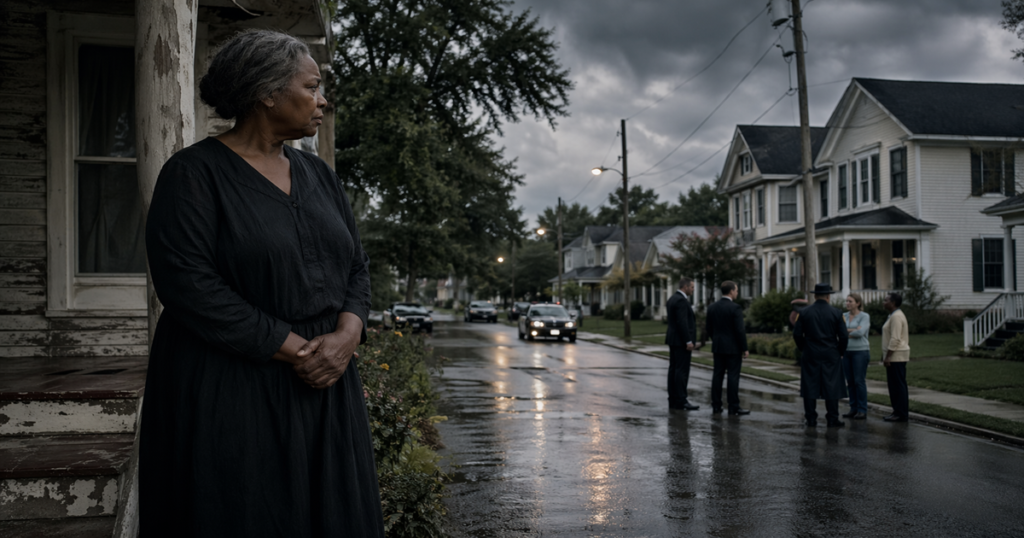
She was fifty-six, though the last few years had added a weight around her eyes that made strangers guess older. Her husband, Daniel, had died three winters earlier after a sudden stroke that arrived one icy morning and took him before the ambulance made it past the county line. Since then, Helena had remained in the narrow, aging house they had bought when mortgage rates were high and hope was cheap. The paint had peeled from the porch rails. One shutter hung slightly crooked. In heavy rain, the gutter over the kitchen window overflowed in a tired silver sheet.
She cleaned two offices downtown three nights a week and sewed hems and school uniform patches for anyone willing to pay cash. Some weeks she had enough for groceries and the electric bill. Other weeks she had to choose. She did not complain. She simply adapted, the way some women do after life takes the luxury of collapse away from them.
Every morning, she walked to Mercer’s Market with a cloth bag folded beneath her arm and a list written in careful blue ink on the back of old envelopes.
She bought what she could afford. Rice. Potatoes. Tea. Sometimes eggs. Meat only when marked down. She counted her money twice before reaching the register, not because she was slow, but because being short by even two dollars in front of other people felt like being stripped of something private.
The first time Helena heard them laugh, she told herself it had nothing to do with her.
The second time, she knew better.
One Saturday near the bread aisle, Tessa Granger tilted her head toward Helena’s cart and said to the woman beside her, in a voice polished by false sweetness, “Some people never learn that pride won’t pay the bills.”
The other woman, Lorna Pike, let out a soft laugh through her nose. “At least black is practical. You can wear the same thing every day and call it mourning.”
They did not look directly at Helena. That was part of the cruelty. It allowed them to pretend innocence if confronted. But Helena had long since learned that humiliation often arrives smiling at someone else.
She kept her eyes on the shelf, picked up the store-brand flour, and placed it in her cart with steady hands.
By the time she reached the register, the back of her neck felt hot.
“Morning, Mrs. Voss,” said Eli Mercer, the grocer’s son, who had kind eyes and the awkward gentleness of a man raised by decent parents. He noticed the way Helena was clutching her list. “You want me to put this on hold until next week? The butcher marked down chicken thighs. I can save you a pack.”
Helena offered him a grateful smile. “That’s kind, Eli, but not today.”
He hesitated. “You sure?”
“I’m sure.”
She paid in exact change. Outside, the sun was bright and careless, and Helena stood for a moment by the brick planter near the door, pressing her fingers against the handle of her bag until the sting in her chest passed.
Across the street, three women stood outside the bakery under its striped awning, coffee cups in hand. Tessa Granger was among them, immaculate as always in a cream blouse and fitted trousers, gold earrings catching the morning light. Beside her stood Jean Holloway, who never missed church and never missed a chance to repeat something private as if it were prayer concern. The third was Mallory Kent, younger than the others but eager to belong, laughing half a beat too fast at whatever Tessa said.
Helena did not hear the words this time.
She only saw the glance in her direction and the small bend of mouths afterward.
That was enough.
She walked home with her shoulders straight.
Inside her house, she set down the groceries, washed her hands, and stood before the sink longer than necessary. The kitchen smelled faintly of soap and old wood. A crack above the window had spread another inch since January. The table was still the same oak one Daniel had found at a yard sale and refinished himself, humming while he worked, sawdust in his hair.
On the far wall hung his photograph: Daniel in a navy work shirt, smiling with one eyebrow slightly higher than the other, as if amusement had always reached him first.
Helena looked at the photo and exhaled.
“They’re still at it,” she said quietly.
The house, faithful to grief, gave no reply.
By noon she had mended two uniforms, watered the basil on the sill, and swept the porch. Routine kept the heart from wandering into dangerous rooms.
That afternoon, as she pinned a hem by the front window, she saw a dark sedan glide slowly down Willow Street and stop outside number 24, the Granger house.
A man stepped out.
He wore a charcoal coat despite the mild weather, and he moved with the contained confidence of someone used to entering places where he was not expected but rarely refused. He was perhaps in his mid-forties, broad-shouldered, clean-shaven, with iron-gray at his temples. He checked the house number, looked once up and down the street, then walked to Tessa Granger’s front door.
Helena knew nearly everyone on Willow Street by sight.
She had never seen him before.
Tessa opened the door only halfway. Even from across the street Helena could sense something rigid in her posture. The man spoke. Tessa stepped outside and pulled the door closed behind her.
That caught Helena’s attention.
On Willow Street, people performed openness. Doors were left wide, greetings loud, conversations conveniently public. Privacy always meant one of two things: shame or fear.
The stranger handed Tessa a folded paper. Tessa did not take it at first.
He spoke again.
After a long moment, she snatched the paper, glanced at it, and stiffened. Even at a distance Helena could see the change in her face. The careful composure vanished. In its place came something rawer.
The conversation lasted less than three minutes.
Then Tessa said something sharp, pointed once toward the street as if dismissing him, and went back inside. The man remained on the porch for a breath, then turned and looked up and down Willow Street again.
His gaze passed over Helena’s house without settling.
Still, she lowered the curtain slightly and waited until he drove away.
That night, she mentioned it to no one, because there was no one to mention it to. But she wrote down the license plate anyway, on the back of an unpaid gas statement, and tucked it into the blue bowl by the phone.
It was an old habit from her years with Daniel.
Daniel had believed in small records. “Memory gets emotional,” he used to say. “Paper stays sober.”
Two days later, the stranger returned.
This time he parked near the end of the street, farther from Tessa’s house, as if trying not to be seen. Helena noticed him because she was hanging laundry in the backyard, and through the gap in the fence she could see the shine of his car.
He did not go straight to number 24.
Instead, he stood at the sidewalk smoking, looking toward the Holloways’ house at number 12.
Ten minutes later, Jean Holloway came out, cardigan wrapped tightly over her dress despite the warmth. She walked past him without greeting, and together they crossed the street toward the small park at the corner. They spoke there for almost fifteen minutes beneath the sycamore tree, too far for Helena to hear.
When Jean returned home, her face looked pale enough to vanish in sunlight.
Again Helena wrote it down.
Strange man. Same car. Tuesday. Spoke to Jean.
Not because she was suspicious by nature.
Because widowhood had taught her that what other people dismissed as “nothing” often became everything later.
The dead man’s name was Adrian Bell.
Until the morning his body was found, most of Willow Street knew him only as a rumor in good shoes.
The rumor became reality on a Thursday.
Helena had gone to Mercer’s Market early to catch discounted produce. At the register, she noticed the store had gone unusually quiet. Two men near the coffee station were speaking in low, urgent voices. Eli Mercer looked rattled, mis-scanning a carton of milk.
“What happened?” Helena asked.
Eli glanced toward the front windows, then back at her. “You didn’t hear?”
“Hear what?”
He leaned in slightly. “Someone found a body.”
The words settled coldly.
“Where?”
“Near the empty lot behind Birch Lane. County detectives are there now. They say it’s a man from outside town.”
Helena stood very still. Behind Birch Lane was barely a five-minute walk from Willow Street.
“Do they know who?”
Eli lowered his voice further. “A name’s going around. Adrian Bell.”
The name meant nothing to Helena.
But by the time she stepped back onto the sidewalk, Willow Street was vibrating with the kind of fear that disguises itself as excitement.
People stood in clusters speaking too quickly. Phones were out. Car doors opened and shut. The same women who usually savored scandal now wore it on their faces like weather.
Tessa Granger was at her front gate with Mallory Kent, both speaking in urgent whispers. Jean Holloway lingered on her porch pretending to shake a rug that did not need shaking.
When Helena approached her own house, their voices dipped.
She unlocked the door.
Inside, the kitchen seemed unusually dim, though the sun was high.
She set down her groceries and stared at the blue bowl by the phone.
Then she took out the envelope scrap with the license plate.
Her pulse began to thud.
By late afternoon, two detectives were going door to door.
They arrived at Helena’s house just after five.
She saw them through the screen: a tall Black woman in a tan overcoat, posture calm and direct, and a stockier white man with tired eyes and a notebook already in hand.
Helena opened the door before they knocked.
“Mrs. Voss?” the woman asked.
“Yes.”
“I’m Detective Mara Ellis. This is Detective Owen Shaw. We’re asking residents a few questions about a man named Adrian Bell.”
Helena stepped aside. “Please come in.”
People always underestimated the dignity of small houses. Detectives too, sometimes. Mara Ellis took in the spotless kitchen, the mended curtains, the jar of fresh cut basil, and nodded once, as if she understood what effort looked like when money was absent.
“Did you know Adrian Bell?” Shaw asked.
“No.”
“Ever seen him before?”
Helena looked at the blue bowl.
Then she said, “I may have.”
Both detectives went still.
She reached for the folded paper, smoothing it carefully against the table. “I saw a man come to this street twice this week. I didn’t know his name. But if that’s him—”
She described the charcoal coat, the gray at the temples, the sedan, the way he spoke first to Tessa Granger, then to Jean Holloway.
Detective Shaw’s pen moved quickly.
Detective Ellis asked, “Why did you write down the license plate?”
Helena gave a small, apologetic shrug. “Because it seemed unusual.”
“Unusual how?”
“He didn’t belong here, and the women he visited didn’t want to be seen with him.”
Detective Ellis glanced toward the window, where the Granger porch was just visible through lace curtains.
“You told anyone else?”
“No.”
“Can we take this?” Shaw held up the paper.
“Yes, of course.”
Ellis studied Helena for a moment. “Anything else stand out?”
Helena hesitated.
She could hear, faintly, laughter from months ago in the bread aisle. Pride won’t pay the bills. Black is practical.
She folded her hands.
“When he left the Granger house the first time, he looked angry,” she said. “Not shouting angry. Controlled angry. The kind people wear when they believe they still have leverage.”
Detective Ellis’s expression sharpened. “Leverage?”
“That’s how it felt.”
The detectives thanked her and left by the front door.
Across the street, Tessa Granger was watering already-wet hydrangeas.
Helena knew at once she had been watching.
Their eyes met for less than a second.
Tessa looked away first.
The next morning, Willow Street stopped pretending Helena did not exist.
At eight-thirty, Jean Holloway arrived at Helena’s porch carrying banana bread on a plate as if kindness could be baked at short notice.
“Helena, dear,” she said, smiling too much, “I thought you might like something fresh.”
Helena looked at the loaf, then at Jean’s face. There were crescents under her eyes and powder settling badly around the mouth.
“That’s thoughtful,” Helena said. “Thank you.”
Jean stepped closer. “I heard the detectives came by.”
“So they did.”
“Terrible business, isn’t it? This Adrian Bell business.”
“It is.”
Jean lowered her voice. “Of course, things can look strange when seen from a distance.”
Helena said nothing.
Jean gave a nervous little laugh. “A person might misread a conversation, or forget details, especially with stress and all.”
Helena’s gaze remained calm.
“Did you come here to give me bread,” she asked softly, “or instructions?”
Jean’s smile faltered.
“Now, Helena, I only meant—”
“I remember what I saw.”
Jean’s face hardened for a flash before recovering. “Well. Naturally. I’m sure you do.”
She left the bread on the porch table and went home without another word.
By noon, Mallory Kent crossed the street under the excuse of returning a casserole dish Helena had lent her eight months earlier and forgotten.
By three, Tessa Granger herself appeared.
That one surprised Helena.
Tessa stood on the porch in sunglasses though the sky was overcast. She remained upright, elegant, every blond strand in place, but something brittle had entered her voice.
“Can we speak?”
Helena opened the screen door but did not invite her inside.
Tessa gave the front room a quick glance, perhaps hoping not to be seen by anyone passing.
“I’m told you mentioned me to the police.”
“I answered their questions.”
Tessa folded her arms. “Adrian Bell was an insurance consultant.”
“For what?”
“For my brother’s estate.” Tessa said it too quickly.
Helena waited.
When silence did not rescue the lie, Tessa continued, “He had paperwork. There was confusion. That’s all.”
“Then I’m sure the detectives will sort it out.”
Tessa’s jaw tightened. “You know how these things spread. People talk.”
A breeze moved the dead fern hanging by the porch rail.
“Yes,” Helena said. “They do.”
The words landed between them with such precision that Tessa’s expression changed.
Not anger first.
Recognition.
For the first time, she understood that Helena had not forgotten the market, the sidewalk, the bakery, the years of small public humiliations carried out under the cover of community.
Tessa removed her sunglasses. “Look, Helena. If I ever said anything that came out wrong—”
“Came out wrong?”
Tessa inhaled sharply. “You know what I mean.”
“I do.”
The silence stretched.
From somewhere down the street came the sound of a lawn mower starting, then sputtering into rhythm.
Tessa lowered her voice. “You can make this harder than it needs to be.”
Helena stared at her.
Then she said, very quietly, “So can the truth.”
Tessa left without another attempt.
That evening Detective Ellis returned alone.
“Mind if I ask a few follow-ups?” she said.
Helena made tea.
This time the questions went deeper.
Had Helena ever heard Adrian Bell’s name before the body was found? No.
Had she noticed tension between certain neighbors recently? Yes.
Who?
Helena named Tessa Granger and Jean Holloway with certainty. Mallory Kent, perhaps, but she seemed more nervous than involved.
“Any men?” Ellis asked.
Helena thought of Thomas Granger, Tessa’s husband, a real estate agent with polished shoes and a laugh that carried too far. She thought of Reverend Holloway’s son Luke visiting more often than usual, face drawn and hands restless. She thought of the expensive black pickup that had parked twice outside Tessa’s house after midnight in the past month.
“I’m not sure,” Helena said honestly. “But something has been wrong on this street for a while.”
Ellis took a sip of tea and looked toward Daniel’s photograph. “Your husband a careful man?”
Helena smiled faintly. “Very.”
“You wrote the plate number. You noticed patterns. That come from him?”
“It came from surviving him being gone.”
Ellis nodded as if she understood even that.
Before leaving, she paused at the door. “Mrs. Voss, if anyone speaks to you about what you told us, I want you to call this number.” She handed Helena a card. “Immediately.”
Helena looked at the card. “That serious?”
“Yes.”
After Ellis left, Helena locked both doors before sunset.
Sleep did not come easily.
The house creaked in old familiar ways, but beneath those sounds she heard every passing tire, every late-footed step on the sidewalk, every shift of branch against gutter. Grief had taught her solitude. Fear was teaching her vigilance.
At 11:17 p.m., headlights washed across her bedroom ceiling and stopped.
Her breath caught.
She moved carefully to the window and lifted the curtain no more than a finger’s width.
A dark vehicle idled across the street.
Not a police car.
After a moment, it rolled forward and disappeared.
Helena stood there long after it was gone.
The next day brought rain.
By midmorning, it was no longer possible for Willow Street to deny that the investigation was not random. Detectives entered and exited number 24 twice. They spoke to Jean Holloway on her porch for nearly an hour. Near noon, a tow truck took away Thomas Granger’s black Lexus. At two, a county officer taped off the detached garage behind the Holloways’ house.
The street, once so eager to consume other people’s trouble, now choked on its own.
At Mercer’s Market, conversation turned cautious. Eli rang up Helena’s groceries without being asked, then slipped an orange into her bag.
“For you,” he said.
She looked at him.
“My mother said vitamin C helps with stress.”
Despite everything, Helena smiled. “Tell your mother thank you.”
He leaned in. “People are saying you’re the one who started this.”
Helena’s smile faded. “Did I?”
Eli shook his head. “No. I think you just told the truth first.”
She carried those words home like something fragile.
That evening, as rain tapped against the kitchen window, Helena sat at the table with her mending basket untouched.
Outside, Willow Street glistened beneath the lamps. Reflections stretched in broken gold across the wet pavement.
At 7:40, someone knocked.
Not on the front door.
On the side door by the driveway.
Helena froze.
No one who wished her well used that door.
She crossed the kitchen quietly and looked through the small pane.
Thomas Granger stood there soaked through, hair plastered to his forehead, face gray with exhaustion.
He looked less like the immaculate real estate agent Willow Street knew and more like a man whose life had turned against him in private.
Helena did not open the door at once.
“Please,” he said through the glass. “I just need five minutes.”
Against her better judgment, she unlatched the door but kept the chain in place.
“What do you want?”
Thomas swallowed. Rainwater ran from his jaw. “They think Tessa knew him better than she admits.”
“Did she?”
He closed his eyes briefly. “I don’t know everything.”
“Then why are you here?”
“Because she thinks you’re going to bury us.”
Helena stared at him.
“Us?”
He looked away. “The whole street has been living on appearances. You know that.”
“I know some people have.”
Thomas flinched, perhaps hearing the distinction.
He lowered his voice. “Adrian Bell wasn’t an insurance consultant. He handled private debt recovery. Quiet settlements. Leverage. He knew people’s secrets and made money from them.”
Helena felt her pulse shift.
“What kind of secrets?”
Thomas let out a humorless breath. “Affairs. Gambling. hidden loans. False property disclosures. Cash that wasn’t reported. He found weaknesses and sold silence.”
“And Tessa?”
Thomas’s face crumpled for a second, then reset. “She had business with him before I met her. I think he came back asking for more.”
Helena said nothing.
Thomas’s voice shook. “If she lied, she lied because she was afraid.”
“Fear doesn’t make people kind.”
That hit him harder than accusation.
He stared at the floor. “No. It doesn’t.”
From inside the house came the soft click of the old wall clock turning to the next minute.
Thomas lifted his head. “Did you see anything the night he died?”
“No.”
“Did you hear anything?”
“No.”
He studied her face, perhaps hoping for mercy hidden inside it.
What he found was composure.
“Then I can’t help you,” Helena said.
He nodded once, water dripping from his coat sleeve, and walked back into the rain.
The body of Adrian Bell had been found on Wednesday morning, but according to the medical examiner, he had died late Tuesday night between ten and midnight. That detail traveled through town quickly enough to become weather.
Helena turned the timeline over in her mind.
Tuesday night.
At ten-fifteen she had been in the kitchen finishing a hem under the yellow lamp. At ten-thirty she had taken the trash to the side bin and heard a car engine idling briefly near the corner. At ten-thirty-five she had seen headlights sweep the curtains of the front room. She had assumed a neighbor was returning home.
At the time, it had meant nothing.
Now she wasn’t sure.
She fetched the small desk calendar by the phone. On Tuesday’s square, she had written only one thing: Finish Pike alterations.
Nothing about the headlights. Nothing about the engine.
Paper stays sober, Daniel had said.
But only if you give it the truth in time.
Two more days passed before the next break in the case, and it came from the last person Willow Street expected.
Mallory Kent.
Helena was pruning basil on the back step when Mallory appeared at the gate, mascara smudged, arms wrapped around herself though the afternoon was warm.
“Can I talk to you?” she asked.
Helena should have said no.
Instead she said, “Come in.”
Mallory stood in the kitchen twisting a tissue in both hands. Up close she looked young in a way Helena had not previously noticed—young enough to mistake belonging for safety, approval for friendship.
“I shouldn’t be here,” Mallory said.
“That’s for you to decide.”
Mallory’s eyes filled. “Tessa said you hated all of us.”
Helena set down the pruning scissors. “Did she.”
“She said you were bitter and looking for revenge because people had moved on and you never did.”
Helena absorbed that quietly.
Mallory wiped beneath one eye. “I don’t think that now.”
“Why are you here, Mallory?”
Mallory looked toward the window as if afraid of being seen. “Because the police asked whether Adrian Bell ever came to my house, and I lied.”
Helena said nothing, giving the confession room to land.
“He did,” Mallory whispered. “Once. About a month ago. He said he knew things about Tessa and Jean and some others. He said if I wanted to protect myself, I should keep copies of any messages they asked me to pass along.”
“Messages?”
Mallory nodded shakily. “Tessa used me sometimes. Little errands. Taking envelopes. Dropping off things. She said it was business. I didn’t ask questions because…” Her face twisted. “Because I wanted those women to like me.”
The words were so painfully honest that Helena’s anger softened, if only slightly.
“What kind of things?”
“Cash. Papers. Once a flash drive.” Mallory’s breathing quickened. “I never looked. I swear.”
“And Tuesday night?”
Mallory clutched the tissue tighter. “I saw Jean’s son Luke driving toward Birch Lane around ten-thirty. I thought maybe it was nothing. Then when they found Adrian Bell…” She shook her head violently. “I got scared.”
“Does the police know this?”
“No.”
“You need to tell them.”
Mallory’s voice cracked. “If I do, everyone will hate me.”
Helena looked at her a long time.
Then she said, “Child, they were never protecting you. They were using you.”
Something in Mallory broke at that. She sat down hard at the kitchen table and cried into both hands.
Helena let her.
When the crying eased, Helena poured water, handed her a clean cloth, and dialed Detective Ellis.
By evening, the detectives had taken Mallory’s statement.
The next morning, Luke Holloway was brought in for questioning.
By sunset, the town had learned enough to ruin three reputations and not yet enough to solve a murder.
Willow Street held its breath.
Then, on Sunday after church, the truth cracked wider.
Helena was hanging her black dress to dry when shouting erupted outside.
She stepped onto the porch.
Across the street, Jean Holloway stood on Tessa Granger’s lawn, raincoat unbuttoned, hair coming loose from its clip, pointing with a trembling hand.
“You told them it was Luke!” Jean shouted.
Tessa’s face had gone pale with fury. “Because it was Luke who followed him!”
“I told my son to scare him, not kill him!”
The words slammed through the air.
Two doors down, someone gasped.
Helena stayed perfectly still.
Thomas Granger rushed out, trying to pull Tessa back toward the house. Jean jerked away from him with such force she nearly fell.
“You said Adrian was only bluffing,” Jean cried. “You said if we stood firm, he’d stop.”
“He was destroying people!” Tessa snapped. “He had files on everyone.”
“And now my son is in this!”
By then several neighbors had emerged, drawn by the oldest human instinct: catastrophe performed in public.
Tessa saw them and lowered her voice too late.
Jean’s face changed, as if she too realized what she had revealed.
Then patrol cars turned onto Willow Street.
Someone had already called.
The officers separated the women and led Jean to one vehicle, Tessa to another.
Thomas stood in the yard, hands at his sides, looking suddenly decades older.
Mallory wept on her porch.
Helena did not move until Detective Ellis herself crossed the street toward her.
“You heard that?” Ellis asked.
“Yes.”
Ellis’s gaze was steady. “We have enough to make arrests, but not enough yet for the full chain. We think Adrian Bell had been extorting multiple residents. Tessa was one of the primary contacts. Jean knew. Luke confronted Bell Tuesday night. What we don’t know is whether the confrontation became fatal by intent or panic.”
Helena looked past her at the patrol cars.
“And the others?”
“Thomas concealed financial records. Mallory carried messages. A few more names are surfacing.” Ellis paused. “What you gave us early mattered. It broke the wall.”
Helena felt no triumph.
Only a deep, tired sadness.
The wall Ellis meant was not just silence.
It was class. Image. Social permission. The old invisible law that says people with polished houses are granted complexity while poor widows are reduced to cautionary tales.
That law had ruled Willow Street for years.
Not today.
The arrests came in layers.
Jean Holloway was charged first—not with the killing, but with obstruction and conspiracy connected to Adrian Bell’s extortion scheme. Tessa Granger faced fraud charges within the week, along with tampering and knowingly withholding evidence. Thomas Granger was not arrested at once, but his office was searched, and clients began calling in panic. Mallory Kent received immunity in exchange for full cooperation.
Luke Holloway, pale and shaking in every courthouse photo, admitted he had gone to Birch Lane to confront Adrian Bell after discovering Bell was threatening to expose loan documents that could ruin his father and implicate his mother. Luke said he only meant to scare him. He admitted there was a struggle. He admitted Adrian fell, struck his head on a concrete edge near the drainage ditch, and stopped moving.
He had panicked.
He called his mother.
From there, every lie grew legs.
Jean called Tessa.
Tessa called Thomas.
And before dawn, four otherwise respectable people had agreed that protecting themselves mattered more than telling the truth about a dead man.
Adrian Bell had not been innocent. His business records revealed years of intimidation, blackmail, and coercive settlements targeting people terrified of embarrassment. But the fact that he was a cruel man did not make his death simple. It only made the aftermath uglier.
For weeks, reporters came and went. Willow Street was filmed from the corner, its maples and porches briefly transformed into a backdrop for headlines.
People who had once spoken with certainty now avoided eye contact.
The women outside the bakery disappeared.
Church pews shifted.
Conversations died when Helena entered a room, but not for the old reasons.
This time it was not contempt.
It was discomfort.
Because everyone knew now that the woman they had reduced to pity and ridicule had seen them more clearly than they had seen themselves.
One afternoon, nearly a month after the first detective came to her kitchen, Helena went to Mercer’s Market for tea and flour.
The store hummed quietly around her. Summer had begun to gather in the doorway, bringing in the smell of cut grass and hot pavement. She selected tomatoes, compared prices on pasta, and turned down the baking aisle.
There, by the shelf of cooking oil, stood Tessa Granger’s sister, Nadine, who lived across town and had lately taken over bringing in mail and sorting legal paperwork from the Granger house.
Nadine glanced at Helena, then away.
Then back again.
“You’re Helena Voss,” she said.
“Yes.”
Nadine held her purse tighter. “My sister says you ruined her.”
Helena considered the woman before her—same cheekbones as Tessa, same sharpness around the mouth, but less practiced.
“Your sister ruined herself,” Helena said calmly. “I answered a question.”
Nadine looked as if she had expected argument and did not know what to do with plain truth. She gave a stiff nod and moved aside.
Helena reached for the oil on the top shelf.
A moment later, Eli Mercer appeared with a small step stool.
“Here,” he said. “Let me.”
“Thank you.”
As he placed the bottle gently in her cart, he said in a low voice, “People around here still don’t know how to talk to you.”
Helena almost laughed.
“That makes two of us.”
He grinned, then sobered. “For what it’s worth, my mom says you’re the bravest person on this street.”
Helena thought about that on the walk home.
Bravery.
The word felt too grand for what she had done. She had not chased danger or delivered speeches or shattered corruption with righteous force.
She had simply paid attention.
She had refused to let fear edit her memory.
She had told the truth while poorer, lonelier, and less protected than everyone who wanted her quiet.
If that was bravery, it was a humble kind.
The kind widows carry every day without applause.
By August, the Holloways’ house went up for sale.
By September, Thomas Granger moved into a rental across town after filing for separation. Tessa’s legal troubles deepened when investigators found records linking her to years of undeclared cash payments and falsified disclosures in at least three property transactions. The case widened beyond Willow Street, drawing in names no one on the block had ever heard but many suspected existed.
Mallory Kent took a job in another county and left without goodbye. Before she did, she placed an envelope in Helena’s mailbox.
Inside was a note written on lined paper.
I’m sorry for the times I laughed because I was afraid not to. You were the only real adult among us.
Helena read it twice, then folded it carefully and placed it in the same blue bowl where the license plate had once sat.
Autumn arrived with dry leaves and sharper skies.
One Sunday afternoon, Helena climbed a chair to wash the outside of the front windows. Halfway through, she noticed someone standing at the gate.
Jean Holloway.
Not the old Jean in crisp cardigans and social confidence.
This Jean looked smaller, reduced by shame in a way no courtroom sketch could have captured. Her hair had gone almost fully gray at the temples in a matter of months. She held no banana bread this time. No offering. No performance.
Helena stepped down from the chair and opened the door.
Jean remained at the gate. “I won’t come closer unless you ask me to.”
Helena waited.
Jean swallowed. “Luke took a plea.”
Helena nodded once. She had read it in the paper.
“It spares him the worst of it,” Jean said, voice trembling. “But not enough.”
No answer.
Jean’s eyes shone. “I came because I have spent my whole life believing decent shoes and careful manners meant decency. I thought if something ugly entered our home, we could manage it quietly and remain who we said we were.” A broken smile crossed her face. “I was wrong.”
A crow called from somewhere beyond the alley.
Jean gripped the gate. “I was cruel to you.”
“Yes.”
“No excuse.”
“No.”
Jean took a breath that sounded painful. “I wanted to say I’m sorry anyway.”
Helena looked at her for a long time.
She thought of the bread aisle. The bakery awning. The porch conversation where Jean tried to coach her memory into submission. She thought, too, of Luke’s frightened face in the newspaper and the way mothers inherit the consequences of their own moral failures through their children’s suffering.
“I accept that you said it,” Helena replied.
Jean blinked, tears slipping free.
It was not absolution.
But it was honest.
Sometimes honest was the best mercy available.
Winter returned to Willow Street quieter than the last.
The reporters were gone. The trial dates had been set. New neighbors viewed the empty Holloway house online without yet knowing its history. Fresh paint appeared on the Granger porch, though no amount of white could make the past look clean.
Helena’s life did not transform into comfort just because the truth had won.
Bills remained. The gutter still overflowed in rain until Eli Mercer and his father fixed it one Saturday without charging her. The roof still needed work. Her hands still ached in cold weather from sewing late into the night.
But something had changed.
People greeted her now and meant it, or tried to. Mrs. Alvarez from number 9 began dropping off soup when Helena worked late. The librarian asked if Helena would join the Tuesday reading circle. A woman from church who had once smiled past her now stopped to ask, awkwardly but sincerely, whether Helena needed a ride in bad weather.
Not everyone had become better.
Some had simply become careful.
Even so, the air on Willow Street had altered. A hierarchy had cracked. The old casual cruelty no longer moved with such confidence.
One evening in December, Helena sat by the front window mending a child’s coat while snow began to fall in soft, hesitant flakes.
Daniel’s photograph caught the lamp glow from across the room.
She looked at him and smiled faintly.
“You would have said this street finally got what it had coming,” she murmured.
In memory, she could almost hear his answer: Took them long enough.
She threaded the needle again.
Outside, snow gathered quietly along the porch rails and curb edges, blurring the small imperfections of the neighborhood without erasing them. That seemed right to Helena. Real life did not erase. It layered. It carried stains beneath fresh weather. It asked people to keep living with what they had done and what had been done to them.
A week before Christmas, Detective Mara Ellis came by one last time.
No trench coat this visit. Just a wool scarf and tired eyes made softer by something like respect.
“I was nearby,” Ellis said, holding a paper sack. “Figured I’d bring coffee beans. My brother roasts them.”
Helena laughed gently. “You came to a widow’s house with work files and left with community obligations.”
Ellis smiled. “Occupational hazard.”
They sat in the kitchen with coffee and store-bought biscuits.
“The Bell case is heading toward final disposition,” Ellis said. “Likely no trial for Luke. Plea agreement will stand. Tessa’s still fighting the fraud counts, but the evidence is strong. Jean’s taking a deal.”
Helena stirred her coffee slowly. “And Adrian Bell?”
Ellis leaned back. “He had no wife, no children. One estranged sister in Oregon who signed the release forms. Hardly anyone showed up to claim his personal effects.”
Helena looked down at the steam rising from her cup.
“It’s strange,” she said. “A man can do harm for years and still die lonely enough to fit in one box.”
Ellis considered that. “Most people think evil announces itself. Often it just invoices quietly.”
Helena smiled despite herself.
After a pause, Ellis said, “You know, when I first walked in here, I thought I was meeting a witness. I think I was actually meeting the only person on this street who still knew the difference between shame and guilt.”
Helena felt the words settle somewhere deep.
After Ellis left, she stood at the door watching snow dust the bare branches.
The neighborhood was almost beautiful in winter.
Not innocent.
Just quieter.
On Christmas Eve, there was a knock at Helena’s door around six in the evening.
When she opened it, she found three things on the porch: a poinsettia in a red foil wrapper, a tin of butter cookies, and a plain white envelope.
No person in sight.
Inside the envelope was a card signed by eight households from Willow Street.
The message was short.
For the times we failed to see you clearly.
For the times we chose comfort over decency.
For standing firm when others hid.
Thank you.
Helena read it twice.
Then she set the card beside Daniel’s photograph and stood very still.
She did not cry often anymore. Widowhood had changed tears from weather into ceremony. But now her eyes filled.
Not because the note erased anything.
It did not.
Mockery does not vanish because shame arrives late. Loneliness does not rewrite itself because neighbors learn manners after scandal.
Still, repentance matters, even when imperfect.
To be seen clearly after years of dismissal is no small thing.
Helena touched the edge of the card with two fingers.
Then she made tea, opened the cookie tin, and turned on the small radio in the kitchen. Soft music filled the room, humble and warm. Outside, the streetlights glowed over snow, and Willow Street, for once, seemed willing to keep its voice down.
Later that night, she sat by the window in the old armchair Daniel had once threatened to throw out and never did. Across the street, the Granger house was dark except for one upstairs room. At the corner, the Holloway house stood empty, a FOR SALE sign leaning slightly in the frozen ground. Farther down, children’s laughter rang from the Alvarez home where cousins had gathered for the holiday.
Life, indifferent and faithful, kept moving.
Helena rested her hand over her wedding ring.
She thought of how easily people had mistaken poverty for powerlessness, grief for passivity, silence for ignorance. She thought of the women who laughed while holding expensive coffee cups, sure that respectability could protect them from consequences. She thought of Adrian Bell, who fed on people’s fear until fear itself devoured the lives around him. She thought of young Mallory wanting so badly to be included that she helped carry other people’s secrets. She thought of Luke, whose one act of panicked foolishness had shattered his mother’s illusions and redirected his own future forever.
And she thought of herself.
Not as the widow.
Not as the witness.
Simply Helena Voss.
A woman who had buried the person she loved most and gone on living anyway.
A woman who had learned to count coins without surrendering dignity.
A woman who had seen cruelty at close range and refused to become cruel in return.
A woman who knew that truth rarely arrives dressed in glory. More often, it comes in tired shoes, carrying groceries, writing down a license plate on the back of an unpaid bill.
The next morning, snow gleamed white against the cracked porch steps.
Helena opened the front door and breathed in the cold.
Across the street, Mrs. Alvarez waved from her driveway. Two houses down, Eli Mercer was helping his father jump-start a neighbor’s car. Somewhere a dog barked. Somewhere a kettle whistled. Somewhere a radio played a carol a little too loudly.
Ordinary life.
She had once thought ordinary life was what came before tragedy.
Now she understood it was what survived after.
Helena stepped onto the porch with her broom and began clearing a path through the snow.
Not because anyone was coming.
Because some doors should remain reachable.