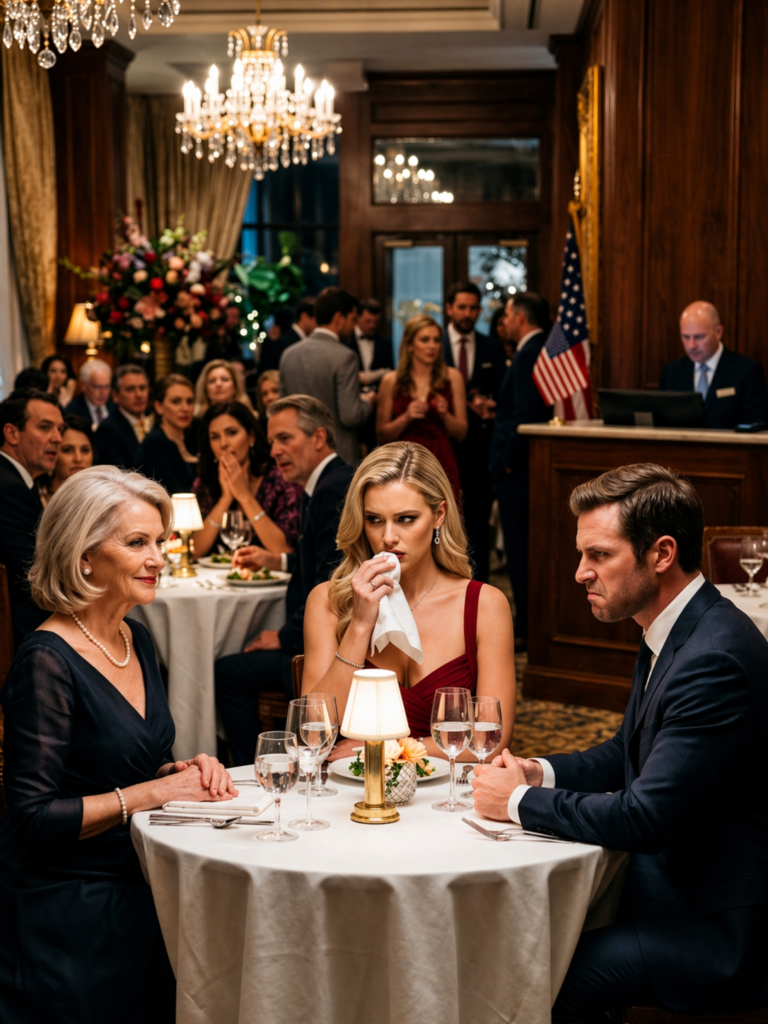
When I refused to pay the bill at the luxury restaurant, my husband looked at me as if I were a stranger.
His mother smiled across the table, enjoying every second of it.
Then, without warning, Javier picked up his glass and splashed red wine directly across my face.
The cold wine hit my skin, soaked into my dress, and dripped down my neck while the entire restaurant fell silent.
“You pay,” he said through clenched teeth, leaning toward me, “or this ends right here.”
For a moment, no one moved.
Not the waiter.
Not the couple at the next table.
Not even Mercedes, his mother, who simply sat there with a satisfied smile, as if this was exactly what she had been waiting for.
I slowly wiped my cheek with my napkin.
My hands were trembling, but my mind had never been clearer.
I looked Javier straight in the eyes and said, “Perfect.”
Then I reached into my purse.
Not for my credit card.
For my phone.
And when I dialed 112, my husband finally realized something he should have understood years earlier.
I was not about to fund my own humiliation.
I was about to end it.
My name is Clara Morales, and until that night, I had been trying to convince myself that my marriage to Javier Rivas was simply going through a rough season.
A rough season.
That was what I called it when he mocked my work.
That was what I called it when he controlled our money.
That was what I called it when he dismissed my feelings, isolated me from friends, and let his mother treat me like a guest who had overstayed her welcome in his family.
For years, I softened the truth because the truth was too painful.
But that dinner changed everything.
Mercedes had “invited” us to a luxury restaurant in Madrid, the kind of place where the lights were warm, the glassware sparkled like jewelry, and the waiters spoke in quiet, careful voices.
From the moment we arrived, Mercedes acted like royalty.
She ordered for everyone.
She corrected the sommelier.
She chose the wine.
She even picked the dessert, only so she could comment later that my taste would have been “too simple.”
“Clara, you’re always so practical,” she said with that polished smile of hers.
The way she said it made practicality sound like a flaw.
Javier laughed.
He always laughed when his mother made me feel small.
I sat there with my napkin clenched in my lap and told myself the same thing I had told myself for years.
Just get through tonight.
But dinner was not dinner.
It was a performance.
Every course had been chosen without asking me. Every comment carried a hidden insult. Every smile from Mercedes reminded me that she believed I existed to serve her son’s comfort.
Then the bill arrived.
The waiter placed it in front of Javier with quiet elegance.
Javier did not even look at it.
He simply pushed it toward me.
“You pay,” he said.
I stared at him.
“Excuse me?”
His eyebrows lifted, impatient and cold.
“My mother brought us here,” he said. “We’re not going to embarrass ourselves. Pay.”
I looked at Mercedes.
She was smiling.
Waiting.
Enjoying the show.
I picked up the bill and checked the total. It was outrageous. There were charges for two extra bottles of wine we had never ordered, along with a strange supplement that no one had explained.
But it was not only about the money.
It was about the trap.
The humiliation.
The expectation that I would obey because I always had.
“I’m not paying for something I didn’t order,” I said slowly.
Javier’s face changed.
For one brief second, he looked almost confused, as if he did not recognize the woman sitting beside him.
Mercedes gave a soft laugh.
“Oh, son,” she began, “I told you—”
Javier lifted one hand sharply, cutting her off.
Then he picked up his wine glass.
Before I could move, the red wine struck my face.
Gasps spread through the room.
The wine ran down my cheek and soaked into the front of my dress. My skin felt cold. My chest felt tight. Around us, conversations stopped one by one until the whole restaurant seemed frozen.
“You pay,” Javier said, “or this ends right here.”
His voice was low, but everyone close enough heard him.
I did not cry.
I did not scream.
I wiped my face slowly, because if I moved too quickly, I was afraid I would break.
Then I whispered, “All right.”
Javier leaned back with a cruel little smile, believing he had won.
Mercedes relaxed in her chair, still smiling.
But I had already made my decision.
I pulled out my phone and called the waiter over.
“Please,” I said, keeping my voice steady, “I need to speak with the manager. I want this bill reviewed. And I need security called.”
The waiter hesitated.
His eyes moved from my wine-soaked face to Javier’s clenched jaw.
Then he nodded and rushed away.
Javier clicked his tongue.
“Don’t make a scene, Clara.”
I looked at him.
“You made one when you threw wine in my face.”
His smile faded.
I opened my banking app and turned the screen just enough for him to see.
“The card you want me to use is linked to our joint account,” I said. “That account is funded mostly by my work. My income. My effort. And I am not going to finance my own humiliation.”
Javier went pale.
“What are you saying?”
“I’m saying I’m not paying. And what you just did has consequences.”
His jaw tightened.
“No one is going to believe you. It was an accident.”
“An accident does not come with a threat,” I replied.
That was when the manager arrived.
His name was Álvaro. He was calm, serious, and professional. Two security staff stood behind him.
“Ma’am,” he said gently, looking at my dress and my face, “are you all right?”
“No,” I said. “I want the cameras reviewed.”
Mercedes immediately tried to take control.
“This is a misunderstanding,” she said in a wounded tone. “My son only—”
Álvaro raised one hand politely.
“Ma’am, I need to hear from the client.”
For the first time that evening, Mercedes had no command over the room.
I handed Álvaro the bill.
“There are charges here that do not belong to us,” I said. “Two bottles we never received, and a supplement no one explained. I want the bill corrected. I also want the incident documented.”
Javier stood abruptly.
Security stepped closer.
They did not touch him.
They did not need to.
Their presence was enough.
While Álvaro asked the waiter for an itemized bill, I opened WhatsApp and messaged Lucía, my lawyer and university friend.
I wrote: “I’ve been assaulted in a restaurant. There are cameras. I need advice now.”
She answered almost immediately.
“Stay calm. Ask them to preserve the recordings. Do not sign anything. Call police if there was a threat.”
The message steadied me.
For the first time in years, I felt like I had a seatbelt on in the middle of a crash.
The corrected bill arrived minutes later.
Just as I thought, the extra bottles had never been served to our table. The mysterious supplement could not be properly explained.
Álvaro apologized and ordered the bill corrected.
Mercedes tried to interrupt again, but no one was listening to her anymore.
I looked at Javier.
“Did you really expect me to pay after you threw wine at me?”
He lowered his voice.
“Clara, let’s go. You’re embarrassing yourself.”
I smiled for the first time that night.
It was not happiness.
It was freedom beginning to take shape.
“No, Javier. You embarrassed yourself when you thought you could treat me like this in front of witnesses.”
He leaned closer and whispered, “If you call the police, forget about me. It’s over.”
He said it like a punishment.
Like losing him was supposed to terrify me.
I held his gaze.
“That is exactly what I want.”
Then, in front of the manager, the waiter, security, his mother, and half the restaurant, I dialed 112.
When the operator answered, my voice did not shake.
“Good evening. I need assistance. I have been physically assaulted and threatened in a restaurant. There are cameras.”
Javier froze.
Mercedes stood so quickly her chair scraped against the floor.
“This is ridiculous,” she said. “My son would never—”
But she stopped when Álvaro spoke.
“We will preserve the recordings,” he said. “And we will cooperate fully.”
That was the moment Javier understood.
This was not going to disappear.
This was not going to be hidden behind family influence, money, or his mother’s performance.
This time, there was evidence.
There were witnesses.
And I was done protecting him.
By the time the police arrived, the wine had dried against my skin. My dress was stained dark red, and my face felt sticky. But inside, something had gone strangely calm.
The officer who took my first statement had kind eyes and a serious voice.
“Mrs. Rivas?”
“Clara Morales,” I corrected softly. “I’m going back to my own name.”
She nodded and wrote it down.
“Clara, has anything like this happened before?”
I wrapped my hands around a paper cup of lukewarm coffee and stared through the precinct window at the pale morning light.
“The wine was new,” I said. “But the control was not.”
I told her about the financial pressure.
The public humiliation.
The way Javier drained my accounts whenever my design business succeeded.
The way Mercedes arranged expensive dinners, vacations, and family obligations that I was expected to pay for while being reminded how lucky I was to belong to their world.
I told her I had not seen my best friend Claire in three years because Javier had convinced me she was jealous of our marriage.
I told her how small my life had become.
Then I told her the part Javier did not know.
Two years earlier, I had started documenting everything.
Every bank transfer.
Every suspicious expense.
Every threat.
Every manipulation.
I had opened a separate account and slowly built an escape fund.
I had collected copies of financial records, joint account statements, and business expenses Javier had tried to disguise.
The officer looked up.
“You planned this?”
“For two years, three months, and twelve days,” I said. “That is how long it took me to understand the shame was never mine. It belonged to them.”
My phone buzzed again.
Another message from Javier.
There had been dozens since I left the restaurant.
First threats.
Then anger.
Then pleading.
Then bargaining.
The latest message said:
“Baby, please. We can work this out. I’ll get help. Don’t destroy everything we built.”
I showed it to the officer.
“What we built,” I said quietly, “was a prison with expensive walls.”
A knock came at the door.
Another officer entered.
“Clara,” he said, “there are visitors asking to speak with you. One is Mercedes Rivas’s lawyer. The other says she is your sister-in-law.”
I looked up.
“Catalina?”
Catalina Rivas was Javier’s younger sister. The black sheep of the family. She had been cut off years earlier after refusing to participate in what she called “the family machine.”
Javier had made sure I stopped speaking to her.
Another relationship quietly severed.
I stood.
“Yes,” I said. “I’ll speak with her.”
But before I entered the room, I turned back to the officer.
“There is something you need to know about the Rivas family business.”
The officer waited.
“The dinner last night was not just about a bill,” I said. “Mercedes recently found out I had records. Proof that Javier has been taking money from his own family’s foundation. And I think Catalina knows even more.”
When I entered the room, Catalina stood immediately.
She looked almost the same as I remembered: wild curly hair, tired eyes, and a defiant strength the Rivas family had never been able to crush.
Then she hugged me.
“I saw the video,” she whispered. “Someone at the restaurant posted it online. Clara, you were brave.”
I pulled back.
“The lawyer?”
“I told him I needed a moment alone with my sister-in-law first,” she said. “He is probably calling Mercedes right now, warning her that the black sheep has returned.”
She placed a worn notebook on the table.
“We do not have much time.”
Inside were notes, dates, names, and financial records.
Catalina explained that the Rivas family had a pattern.
They targeted successful independent women through marriage, slowly drained their businesses and personal savings, then made them financially dependent.
The expensive dinners.
The family obligations.
The guilt.
The pressure.
It was all part of the same system.
“They were never trying to help your design business grow,” Catalina said gently. “They were trying to weaken it.”
I felt my stomach turn.
“How many women?”
“More than you want to know,” she said. “Wives, partners, relatives by marriage. Women who came into the family with talent, businesses, savings, confidence. One by one, they were drained.”
“Why?”
“Power,” she said. “Control. And money.”
Then she told me about the foundation.
The Rivas Family Foundation was not only a charity. It was being used to hide money, move assets, and cover questionable transactions through struggling businesses.
My business had been one of their tools.
My marriage had been part of their strategy.
Before I could respond, another officer entered.
“Clara, we received a call from your sister Leah’s nurse. There has been an incident at the hospital.”
My heart stopped.
“What kind of incident?”
“Someone tried to enter her room claiming to be family. When they were denied, they became aggressive. Security intervened.”
Catalina and I said the same name at the same time.
“Javier.”
We rushed to the hospital with the officer following behind.
Leah had been fighting cancer for months. Javier had always insisted on helping with her care, choosing doctors, handling payments, making himself look generous.
Now I understood.
He had not been helping.
He had been watching.
When we reached Leah’s floor, two security guards stood outside her room. A medical cart had been knocked over in the hallway.
Then I heard my sister’s voice.
“I told you to get out.”
I ran inside.
Leah was sitting upright in bed, pale but alert.
At the foot of her bed stood Mercedes, perfectly dressed as always.
Beside her was Malcolm Jones, the accountant who had supposedly helped me gather financial evidence against the Rivas family.
My blood went cold.
Malcolm had been reporting back to them.
Mercedes smiled.
“How good of you to join us, Clara. We were just discussing loyalty.”
Leah looked at me.
“They tried to buy my silence again,” she said.
Again.
That one word opened a door I had not known existed.
Leah had once worked as a bookkeeper for a Rivas subsidiary. Years earlier, she had found irregularities in the company records.
She had kept copies.
Soon after, her health began to fail.
At first, everyone believed it was simply illness.
But now, with a doctor reviewing her treatment history, another truth began to surface.
Some medications had been prescribed in combinations that made her condition worse while making it appear natural.
Javier had insisted on using the family doctor.
He had insisted on being involved.
He had insisted because he was protecting his family’s secrets.
Leah opened the drawer beside her bed and handed me an old journal.
“I kept copies,” she said. “Financial records. Medical records. And something else.”
Mercedes stepped forward, but the officer blocked her.
Leah’s voice weakened.
“The painting. The lighthouse painting I gave you on your wedding day.”
I remembered it instantly.
A painting of a lighthouse at dawn.
Javier had always hated it.
He called it amateur.
I had kept it in my home office because Leah painted it for me.
“There is something hidden behind it,” Leah said. “Something about Richard Rivas’s death.”
Richard was Javier’s father.
Officially, he had died of a heart attack years earlier.
But Leah told us he had discovered the family’s crimes. He had been preparing to expose Mercedes and Javier.
Leah had seen Mercedes put something into his coffee.
She had taken photos and kept documents.
Mercedes’s face hardened.
Then she pulled out her phone.
“Javier,” she said coldly. “It is time for Plan B.”
The lights in the room flickered.
Then went out.
For a few terrifying seconds, everything was darkness.
When the emergency lights came back on, Mercedes and Malcolm were gone.
But they had left a medical chart behind.
Inside was a forged waiver, backdated years earlier, with Leah’s signature copied onto it.
They had been preparing to protect themselves if anyone questioned her treatment.
Then my phone buzzed.
A message from Javier.
It was a photo of my home office.
The wall where Leah’s lighthouse painting had hung was empty.
Under the photo, he wrote:
“Did you really think I didn’t know? Come alone to the lakehouse. Time to finish this.”
Leah gripped my hand.
“Go,” she whispered.
“I’m not leaving you.”
“You have to,” she said. “They have the painting. But they don’t know everything.”
Catalina stayed with Leah.
The police began coordinating with financial crime investigators.
And I made one more call.
To Claire.
My best friend.
The woman Javier had pushed out of my life years ago.
She answered on the second ring.
“Clara?”
Hearing her voice nearly broke me.
“Claire,” I said. “You were right about Javier. About all of them. I need help.”
Claire worked in financial crimes.
Within minutes, a plan was forming.
Javier thought I would come alone.
So I did.
But behind me, at a distance, were unmarked vehicles and officers ready to move.
The lakehouse stood dark against the setting sun.
Javier’s car was parked outside.
Mercedes’s SUV was there too.
I walked to the door.
Javier opened it before I could knock.
His hair was messy. His eyes were wild. He smelled like expensive whiskey and panic.
“Where is the painting?” I asked.
He pointed to the living room.
Leah’s lighthouse leaned against the fireplace.
Mercedes sat in an armchair, composed and cold.
Malcolm paced by the window.
Mercedes spoke first.
“We know Leah hid documents in that painting. Give us any copies, and perhaps we can resolve this privately.”
I walked toward the painting and studied it.
“You never really looked at it, did you?” I said.
Javier frowned.
“What are you talking about?”
“You always called it amateur. But Leah’s art was never careless. She layered things. Reflections. Shadows. Hidden meanings.”
I turned to Mercedes.
“Like your family. One truth above the surface, another underneath.”
Mercedes stood.
“Enough.”
“Richard saw the truth too,” I said. “That is why you silenced him.”
The room went still.
Javier looked at his mother.
Mercedes stared at me with ice in her eyes.
“Leah told you.”
“She did,” I said. “But she was not the only one who knew.”
Then I told them the secret I had kept for years.
My father had been a forensic accountant.
Before his death, he had been helping Richard Rivas gather evidence against the family. He had taught me how to document, how to protect records, how to wait until the evidence was strong enough.
Javier went pale.
“You knew?”
“I knew enough,” I said. “And I spent years finishing what my father and Richard started.”
Then I walked to Mercedes’s favorite chair.
Behind it was a hidden panel Richard had once shown my father.
The latch clicked open.
Inside were files.
Old files.
The kind that could not be explained away.
At that moment, bright lights flooded the windows.
Sirens sounded outside.
Claire’s voice came through a speaker.
“Police. Financial crimes unit. The house is surrounded.”
Malcolm ran for the door and was stopped.
Javier lunged toward the painting, but I grabbed it first and pulled it away.
He fell back, stunned less by the movement than by the realization that he had completely lost control.
Mercedes did not run.
She sat back down, still elegant, still proud, but something in her face had changed.
“You will not win,” she said softly. “You have no idea how far this family reaches.”
I placed one final photo in her lap.
It showed Richard Rivas, my father, and one more person.
Catalina.
Mercedes whispered her daughter’s name.
“She has been part of this from the beginning,” I said. “You thought you cut her off. You thought you destroyed her. But she let you believe that because it gave her freedom to keep investigating.”
As officers moved in, I picked up Leah’s painting.
“There were no documents hidden inside,” I said. “Leah’s art was always just art. Honest. Beautiful. Real. Everything your family could never control.”
But Mercedes had one final secret.
As officers led her away, she stopped and looked at me.
“You remind me of someone,” she said.
“Who?”
“Me,” she answered. “Before I made my choice.”
For the first time, Mercedes told the truth.
Thirty years earlier, she had been like the women she later targeted: successful, independent, full of ambition.
Then she married into the Rivas family.
Richard’s father had destroyed her business, isolated her, and trapped her.
But instead of breaking the system, Mercedes learned from it.
When she finally gained power, she used the same cruelty against others.
“I became the predator,” she said. “Because I could not bear being prey.”
I looked at her, feeling no pity, only a heavy understanding.
“You were the first victim.”
“No,” she said. “I was the last victim. Then I became the first perpetrator.”
Before she was taken away, she gave one final instruction.
“Check the foundations,” she said. “Not the charity. The actual foundations. The lakehouse. The main house. All the properties.”
Hidden rooms were soon discovered beneath multiple Rivas properties.
Inside were decades of records.
Evidence.
Accounts.
Property deeds.
Trust documents.
A fortune built from broken businesses and stolen futures.
In Mercedes’s study, behind a painting, investigators found a safe.
Inside was a letter addressed to:
“To the woman who finally stops me.”
The letter had been written years earlier, when Mercedes was pregnant with Javier.
In it, she confessed everything.
She explained that for every woman the family had destroyed, she had kept real records of what was taken.
She had created hidden legal documents that could return stolen assets with interest.
She claimed she had kept them as insurance, but admitted the truth was simpler.
Some part of her had been waiting for someone strong enough to end what she could not.
Three months later, I stood outside the newly renamed foundation building.
The Rivas Family Foundation was gone.
In its place stood the Open Eyes Foundation for Women’s Economic Justice.
The hidden records had made it possible to return money, property, and dignity to women the family had harmed for decades.
Catalina stood beside me, adjusting the sign above the entrance.
Leah was there too, weaker than before but alive, wrapped in a pale scarf, smiling in a way I had not seen in years.
Claire stood near the front steps, speaking with reporters.
Former victims arrived one by one.
Some came with tears.
Some came with documents.
Some came with anger.
Some came with silence.
All of them came with a piece of themselves they were ready to reclaim.
Catalina looked at me.
“Ready?”
I thought back to that night in the restaurant.
The wine on my face.
Mercedes’s smile.
Javier’s threat.
The moment I wiped my cheek and reached into my purse.
For years, I thought freedom would arrive loudly.
I thought it would feel like victory.
But standing there, watching women walk through the doors of a foundation built from the ruins of a family’s cruelty, I realized freedom was quieter than that.
Freedom was keeping your voice when someone tried to silence it.
Freedom was refusing to pay for your own humiliation.
Freedom was dialing the number.
Telling the truth.
And never again mistaking endurance for love.
I looked at Catalina and nodded.
“Yes,” I said. “I’m ready.”