My mother left me sitting alone in a church when I was only four years old.
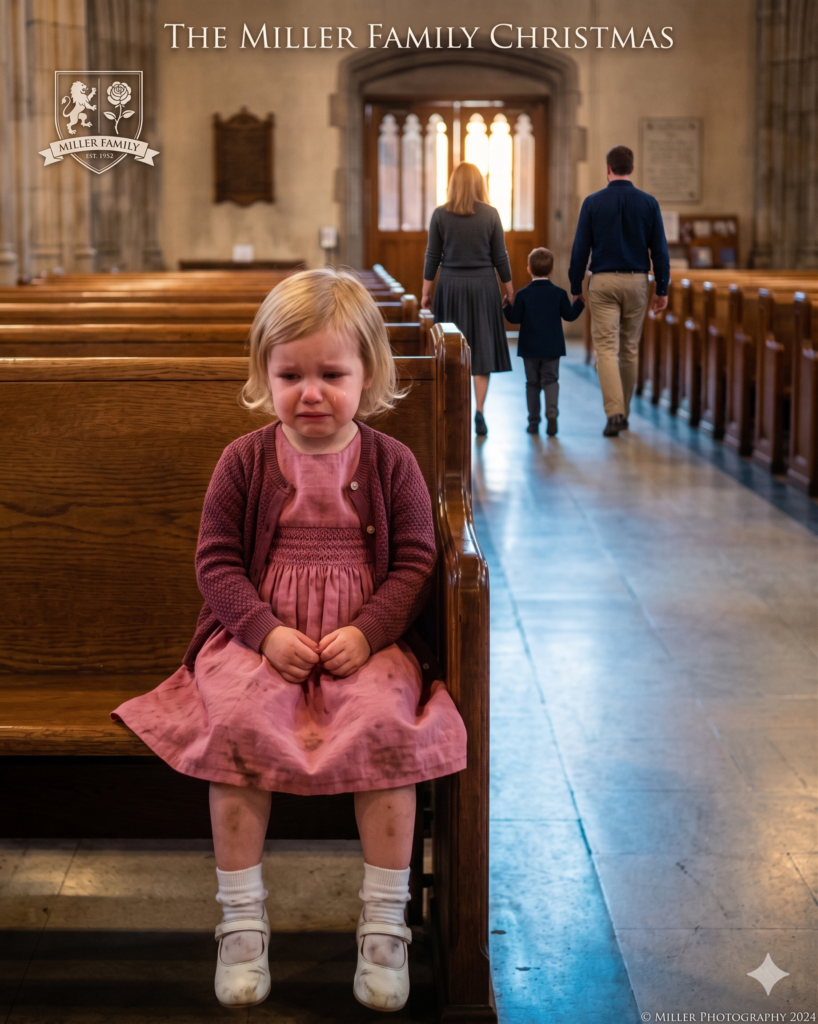
She smiled softly as she adjusted the collar of my little gray coat, then whispered, “Stay right here, sweetheart. God will take care of you.”
At that age, I didn’t understand goodbye when it was hidden behind a gentle voice.
I didn’t understand that the woman brushing hair from my forehead was about to walk out of my life.
The church was quiet that morning. Sunlight streamed through the tall stained-glass windows, scattering soft colors across the wooden floor. My feet dangled above the polished pew, too small to touch the ground.
My father stood a few steps away, silent. My older brother was beside him, holding a small backpack. None of them looked upset. None of them looked afraid.
That was what stayed with me the most.
How calm they were.
My mother leaned down one last time and pressed her lips against my forehead.
“Be a good girl,” she whispered.
Then she stood up.
My father took her hand. My brother followed them down the aisle.
I watched them walk toward the church doors, waiting for someone to turn around and laugh, waiting for them to call me after them, waiting for my mother to say this was all some kind of mistake.
But she only glanced back once.
And she smiled.
A soft, peaceful smile.
The kind of smile that should have comforted me, but instead became the memory that followed me for the next twenty years.
The doors opened. A rush of cold air swept into the church.
Then they were gone.
At first, I didn’t cry.
I sat there quietly, swinging my little legs, looking at the colored light on the floor. I remember the smell of candle wax. I remember the echo of distant footsteps. I remember waiting because my mother had told me to stay.
And children believe their mothers.
A nun found me later. Then a priest came. Then a social worker.
There was no note.
No explanation.
No address.
No promise that anyone would come back for me.
Only a small child in a gray coat, sitting beneath stained glass, still waiting for a family that had already chosen to leave.
For a long time, no one could find my parents. They had disappeared without a trace. Adults spoke in low voices around me, careful with every word, as if the truth might break me more than being left behind already had.
Months later, I was placed with a woman named Evelyn Harper.
She was nearly sixty, unmarried, and lived alone in a small house filled with books, old music sheets, and the gentle scent of lavender. She worked as the church pianist, though her fingers sometimes ached so badly she had to soak them in warm water before Sunday service.
Evelyn was not rich. She was not young. She did not make big promises.
But she stayed.
That was the first thing I learned about love from her.
Love was not always loud. It was not always dramatic. Sometimes love was someone making you toast before school. Someone sitting beside your bed when you had nightmares. Someone attending parent-teacher meetings even when her knees hurt.
Evelyn never tried to erase what happened to me.
She never told me my parents must have had a good reason. She never forced forgiveness into my mouth before my heart was ready.
Instead, she gave me truth gently.
One night, when I was eight, I asked her why my mother had left me.
Evelyn was brushing my hair, her fingers slow and careful.
She paused for a long moment before answering.
“Some people leave because they’re overwhelmed,” she said softly. “Some leave because they are selfish. And some leave because they cannot face who they have become.”
Then she touched my shoulder and added, “But none of that is the child’s fault.”
I held on to those words for years.
Because when you are abandoned as a child, part of you always wonders what was wrong with you.
Was I too difficult?
Too small?
Too quiet?
Too much?
Evelyn spent the rest of her life showing me the answer was no.
She packed my lunches. She helped with homework. She saved coins in a jar so I could go on school trips. She clapped the loudest when I sang in church choir, even though I was always nervous and sometimes forgot the words.
Slowly, the memory of that church bench became less sharp.
It never disappeared.
But it stopped controlling me.
As I grew older, I stopped waiting for my parents to return. I stopped imagining my mother bursting through the door with tears in her eyes, begging forgiveness. I stopped asking whether my brother remembered me.
Evelyn had taught me something stronger than hope.
She taught me how to build a life.
I studied hard. I earned a scholarship to a small Catholic college. I kept my world simple and quiet. And after graduation, I came back to Saint Bridget’s Church—the same church where my life had once fallen apart.
People thought returning there would reopen old wounds.
But it didn’t.
At least, not in the way they imagined.
The church no longer felt like the place where I had been left.
It became the place where I had been found.
By twenty-four, I was working there as a parish outreach coordinator. I organized food drives, helped families with paperwork, delivered donated clothes, and ran Sunday programs for children whose parents were struggling.
Sometimes, when Evelyn’s hands hurt too much to play piano, I sat at the bench and played for service.
It was not a grand life.
But it was mine.
And for the first time, I felt like I belonged somewhere without having to beg anyone to keep me.
Then, on a rainy afternoon in October, exactly twenty years after the day I was left behind, the doors of Saint Bridget’s opened again.
Three people walked inside.
An older woman with trembling hands.
A tired-looking man with gray in his beard.
And a man around thirty, standing slightly behind them, unable to meet my eyes.
I knew them before anyone said a word.
My mother.
My father.
My brother.
For a moment, the entire church seemed to tilt beneath me.
I was four years old again, sitting on that wooden pew, watching them walk away.
My mother stepped forward, tears already filling her eyes.
“Claire,” she whispered.
I had not heard that voice in twenty years.
Then she reached for me as if time had not passed at all.
“We’re your family,” she said, her voice breaking. “We’ve come to take you home.”
But something in her words felt wrong.
Not warm.
Not sorry.
Not like a mother returning for the child she lost.
More like a woman reaching for something she needed.
And suddenly, Evelyn’s old warning echoed in my mind.
Not everyone comes back because they love you.
Sometimes they come back because they need something.
[Part 2] My Mother Left Me in a Church at 4—Twenty Years Later, She Came Back Crying