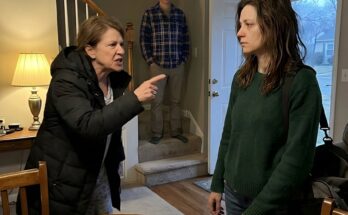
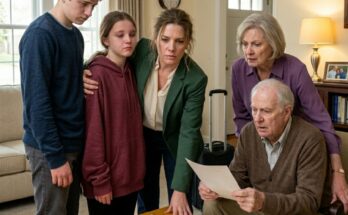
For a moment, I simply stared at my father.
“My signature?” I repeated.
My mother quickly wiped her tears, as if she had just remembered she was supposed to be crying.
“It’s complicated,” she said. “We didn’t want to overwhelm you.”
I almost laughed.
They had left a four-year-old child alone in a church, but now they were worried about overwhelming me.
“What exactly do you need me to sign?” I asked.
My brother shifted uncomfortably behind them.
My father reached into his coat and pulled out a folder. The edges were damp from the rain. He held it out, but I didn’t take it.
“It’s just paperwork,” he said. “A family matter.”
“A family matter,” I repeated quietly.
The words felt almost insulting.
For twenty years, I had not been family enough to receive a birthday card, a letter, or even an explanation. But now, suddenly, I was family when a signature was needed.
Before I could respond, Evelyn’s voice came from behind me.
“She won’t sign anything without reading it.”
I turned.
Evelyn stood near the side aisle, one hand resting on the end of a pew for support. Her hair was whiter now, her body smaller with age, but her eyes were still clear and steady.
My mother’s expression changed instantly.
Recognition flickered across her face.
“You,” she said.
Evelyn stepped closer. “Yes. Me.”
The silence that followed was heavy.
I looked between them. “You know each other?”
My mother opened her mouth, but Evelyn answered first.
“I knew your grandmother.”
My heart tightened.
“My grandmother?”
Evelyn nodded slowly. “Your father’s mother. Margaret.”
My father’s jaw hardened. “This has nothing to do with you.”
“It has everything to do with her,” Evelyn said, looking at me.
My mother stepped forward, forcing a soft voice again. “Claire, please. Don’t listen to old bitterness. We came here to fix things.”
“No,” Evelyn said. “You came here because Margaret’s will finally became active.”
The church went still.
I looked at the folder in my father’s hand.
“What will?” I asked.
My brother closed his eyes.
My father’s face tightened. My mother’s tears were gone now.
Evelyn took a slow breath.
“Your grandmother never believed the story your parents told about you,” she said. “They claimed you had been placed safely with relatives. But Margaret suspected the truth. She searched for you for years.”
My chest grew tight.
“She searched for me?”
Evelyn nodded. “She came to Saint Bridget’s more than once. By the time she found out you had been placed with me, she was already very ill. She wanted to meet you, but your parents kept interfering. They told her it would only confuse you. They told her to leave the past alone.”
I turned toward my parents.
My voice was barely above a whisper. “Is that true?”
My father looked away.
My mother rushed in. “Your grandmother was old. She didn’t understand everything. We were trying to protect everyone.”
“Protect everyone?” I asked. “You left me in a church.”
My mother’s face tightened. “We were young. We had no money. Your brother was already difficult to care for. We thought—”
“You thought I was the one you could leave behind,” I said.
She flinched, but she did not deny it.
My father shoved the folder toward me. “This is not the time for drama. Your grandmother left property and money under conditions. We need all legal heirs to release their claims so the estate can be settled properly.”
“All legal heirs,” I said slowly.
Evelyn looked at me with sadness in her eyes.
“Margaret left part of her estate to you,” she said. “Not to them. To you.”
My mother’s voice sharpened. “Only because she felt guilty. She was manipulated by stories. Claire, we’re not asking for much. We only need you to sign your portion back to the family so we can move forward.”
“The family,” I said again.
That word kept returning like a door being opened and closed in my face.
My brother finally spoke.
“Mom, stop.”
Both my parents turned toward him.
Daniel looked pale. His hands were clenched at his sides.
“She deserves to know,” he said.
My mother’s eyes widened. “Daniel.”
But he kept going.
“I remember that day,” he said, looking at me for the first time. “I was ten. I knew something was wrong. I asked where you were when we got home. Mom said you were staying somewhere better. Dad told me never to ask again.”
His voice cracked.
“I believed them because I was a kid. But later, I knew. I knew they had left you. And I was too afraid to say anything.”
My throat tightened.
For twenty years, I had imagined my brother as part of the leaving. I had imagined him walking away without caring. But the man in front of me looked like someone who had been carrying a weight for most of his life.
“I’m sorry,” Daniel whispered. “I should have looked for you when I got older. I should have done something.”
My mother grabbed his arm. “Enough.”
He pulled away.
“No. It’s not enough. It was never enough.”
My father’s voice turned cold. “We came here to handle a legal matter, not to dig up the past.”
Evelyn stepped beside me. “The past is exactly why you’re here.”
I looked down at the folder. My father had placed it on the edge of the pew. I picked it up and opened it.
The papers were filled with legal language, but one thing was clear.
They were asking me to give up my claim.
Not only to money, but to a small house and land that had belonged to my grandmother.
A house I had never seen.
A house my parents apparently wanted badly enough to return after twenty years.
“Why?” I asked. “Why do you need it so much?”
My father said nothing.
Daniel answered quietly.
“They’re in debt.”
My mother turned on him. “Daniel!”
He ignored her.
“They borrowed against almost everything. The house, the business, the cars. Grandma’s property is the only thing left that can save them.”
I looked at my parents, and for the first time, I saw them clearly.
They were not powerful figures from a childhood nightmare.
They were just people who had made selfish choices and hoped time would protect them from the consequences.
My mother reached for my hand.
I stepped back.
“Claire,” she pleaded. “We are still your parents.”
“No,” I said softly. “You are the people who left me.”
Her face crumpled, but this time I did not move to comfort her.
For years, I had wondered what I would do if I ever saw her again. I thought I might scream. I thought I might fall apart. I thought I might beg her to explain why I had not been enough.
But standing there in the church where she had abandoned me, I realized I no longer needed her answer to survive.
I had already survived.
I closed the folder.
“I’m not signing this.”
My father’s face darkened. “You don’t understand what you’re doing.”
“I understand perfectly.”
My mother’s voice trembled. “You would let your own family lose everything?”
I looked at Evelyn.
Her hands were folded in front of her. Her face was calm, but her eyes were wet.
Then I turned back to my mother.
“My family didn’t leave me on a church bench,” I said. “My family found me there.”
The words settled between us like a final line.
My mother began to cry again, but this time her tears did not pull me back into the little girl I used to be.
My father snatched the folder from my hands. “You’ll regret this.”
Daniel stepped forward. “No, Dad. She won’t.”
For a moment, I thought my father might argue, but perhaps even he understood there was nothing left to take from me.
Not anymore.
They left soon after.
My father walked out first, angry and stiff. My mother followed, pausing near the doors as if waiting for me to call her back.
I didn’t.
Daniel stayed behind.
He stood in the aisle, rainwater dripping from his coat onto the floor.
“I know I don’t deserve anything from you,” he said. “But if you ever want to know about Grandma… or about what happened after… I’ll tell you the truth. All of it.”
I studied his face.
There was shame there. Real shame. Not the polished tears my mother had brought with her, but something quiet and heavy.
“I don’t know if I can forgive you,” I said.
He nodded. “I know.”
“But I might be willing to hear the truth someday.”
His eyes filled with tears.
“That’s more than I deserve.”
He left his phone number on the back of a church program and walked out into the rain.
After they were gone, the church felt impossibly quiet.
I sat down on the same pew where my mother had left me twenty years earlier.
For the first time, I did not feel like the abandoned child waiting for someone to come back.
I felt like the woman who had finally stopped waiting.
Evelyn sat beside me slowly, her hand trembling as she placed it over mine.
“I’m sorry you had to hear all of that,” she said.
I leaned my head against her shoulder.
“I think I needed to.”
A few weeks later, I met with the estate attorney. Everything Evelyn had said was true. My grandmother Margaret had left a portion of her estate to me, along with a letter.
The attorney handed it to me in a cream-colored envelope, my name written across the front in shaky handwriting.
I opened it with trembling hands.
My dear Claire,
If this letter reaches you, then I pray you know one thing first: you were never forgotten by me.
I looked for you. I asked questions. I made mistakes by trusting the wrong people, but I never stopped hoping that you were safe and loved.
If I could not give you the years that were stolen, let this give you something else—a place that is yours, a future no one can take, and the truth that you were always worthy of being kept.
With all the love I was not allowed to give you,Grandma Margaret
I cried then.
Not the way I had cried as a child, from confusion and fear.
I cried for the grandmother who had searched. For the little girl who had waited. For the woman I had become despite everything.
The property Margaret left me was a modest old house outside town. It needed repairs, but it had strong walls, a wide porch, and a garden that had gone wild with weeds and roses.
I did not sell it.
Instead, with Evelyn’s encouragement, I turned it into a small outreach home connected to Saint Bridget’s—a place where struggling mothers could receive food, counseling referrals, clothing, and temporary support before they reached the point of desperation.
I named it Margaret House.
Not because money could heal the past.
But because something good could still grow from what had been broken.
Months later, Daniel came to visit. He brought old photographs of our grandmother and a small wooden music box she had kept. He did not ask for forgiveness. He did not pressure me. He simply told the truth, piece by piece.
Our relationship did not magically become whole.
Real healing is not that simple.
But honesty gave us a beginning.
As for my parents, I heard from the attorney that they eventually lost much of what they had tried so hard to protect. For years, they had built their lives on silence, and silence had finally collapsed under them.
My mother sent one letter.
It was full of explanations, regret, and careful apologies. I read it once. Then I placed it in a drawer.
I was not ready to forgive her.
Maybe one day I would be.
Maybe I wouldn’t.
But I no longer needed forgiveness to be free.
One Sunday morning, nearly a year after they returned, I sat at the piano in Saint Bridget’s while sunlight poured through the stained-glass windows.
The same colors danced across the same wooden floor.
A little girl from the children’s program sat in the front pew, swinging her feet just as I once had. Her mother sat beside her, holding her hand tightly.
Evelyn was in the back row, smiling proudly.
My fingers moved across the keys, and for the first time, the memory of that church no longer ended with a door closing.
It ended with music.
It ended with a home I had built.
It ended with the truth I had waited twenty years to hear.
I had been left behind.
But I had never been unwanted.
And the people who walked away from me did not get to decide what my life would become.
I did.
The End.