In 1979, Richard Miller’s life had fallen into a quiet, heavy silence.
At thirty-four years old, he was already a widower. His wife, Anne, had passed away two years earlier after a long illness, leaving behind a home that once held laughter, dreams, and plans for children they never got to raise together.
Now the house felt empty.
Evenings were the hardest.
Richard often sat alone at the kitchen table beneath the dim yellow glow of a single lightbulb, staring at the faded wallpaper while the ticking clock reminded him how slowly time moved when there was no one left to share it with.
Friends tried to encourage him.
“You’re still young,” they would say gently. “You can remarry one day. You can build a new life.”
Richard always nodded politely.
But deep down, he knew they did not understand.
He did not want a new life.
He wanted the life he had built with Anne.
The only thing that kept him moving forward was a promise she had whispered during her final days in the hospital. Her voice had been weak, but her eyes were steady as she held his hand.
“Don’t let love die with me,” she had said softly. “Give it somewhere to go.”
At the time, Richard did not understand what those words meant.
He had no idea how he could possibly fulfill that promise.
Then one rainy evening, everything changed.
His aging pickup truck broke down near St. Mary’s Orphanage at the edge of the city. Hoping to use a telephone, Richard stepped inside the old building, rain dripping from his coat as he entered the quiet hallway.
Before he reached the office, he heard something that stopped him.
Crying.
It was not one baby.
It was many.
Some cried softly. Others whimpered louder. Their tiny voices blended together in a fragile sound that echoed down the narrow corridor.
Concerned, Richard followed the crying until he reached a small nursery.
Inside were rows of cribs.
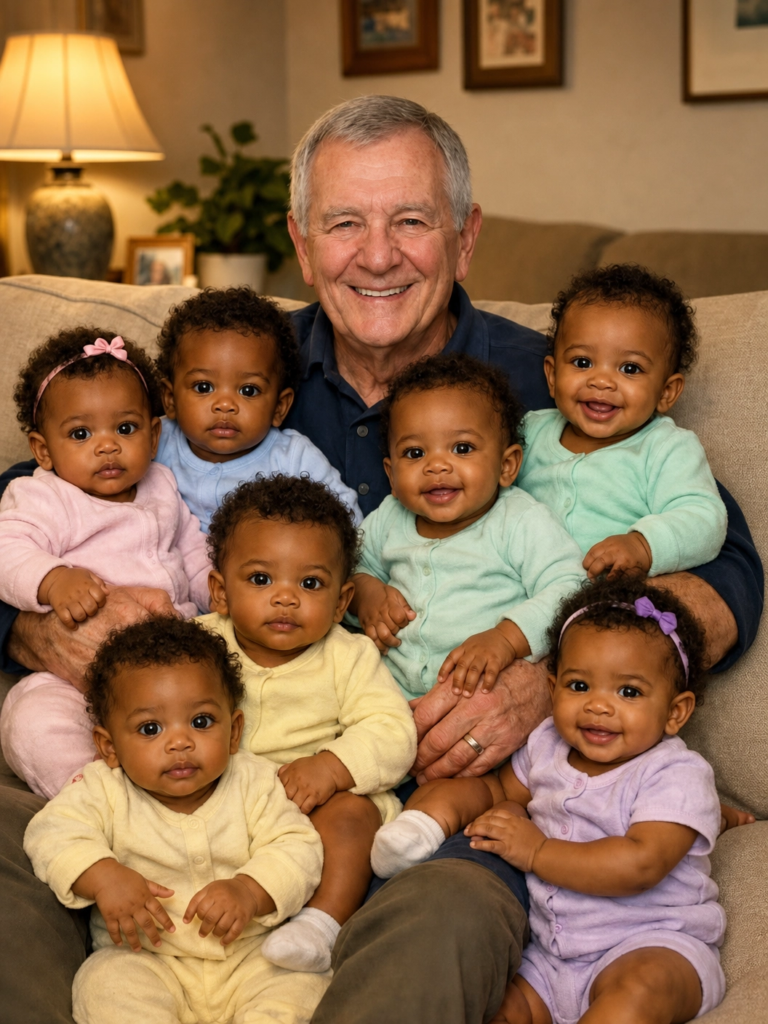
And inside those cribs were nine baby girls.
All of them had dark skin, wide brown eyes, and tiny arms reaching upward as if waiting for someone to pick them up. Some cried restlessly. Some stared around the room. One looked directly at Richard with a calmness that made him freeze in the doorway.
Nine babies.
Nine little lives.
A young nurse noticed the look on his face and stepped beside him.
“They were found together on the steps of a church,” she explained gently. “It was the middle of the night. They were wrapped in the same blanket. There was no note, no names, no explanation.”
Richard swallowed hard.
The nurse looked back at the cribs, her voice growing softer.
“Families come here sometimes to adopt. One baby, maybe two. But never nine.”
Then she said the words that struck Richard deeply.
“They’ll have to be separated soon.”
Separated.
That single word settled heavily in his chest.
Richard thought of Anne. He thought of the promise he had made beside her hospital bed. Anne had always believed family was not only about blood. To her, family was love, loyalty, and the courage to stay when staying was hard.
His throat tightened.
Quietly, he asked, “What if someone adopted all of them?”
The nurse looked at him in disbelief.
“All nine?” she asked. “Sir, raising nine babies alone would be almost impossible. You would need money, help, time… people would think you had lost your mind.”
But Richard was no longer listening to the doubts.
He stepped closer to the cribs.
One baby stared up at him with wide, trusting eyes. Another reached out and caught the edge of his sleeve with tiny fingers. A third smiled, a soft innocent smile that seemed to reach straight into the empty place inside him.
And in that moment, something in Richard changed.
The emptiness he had carried since Anne’s passing cracked open and filled with something he had not expected to feel again.
Purpose.
Responsibility.
Love.
“I’ll take them,” he said quietly.
What followed was not easy.
For months, Richard faced resistance, questions, and disbelief. Social workers worried that one man could not raise nine babies alone. Relatives warned him that he was making a mistake. Neighbors whispered behind closed curtains.
Some people asked cruel questions.
Some judged him for being a white man raising nine Black daughters.
Others said things meant to make him feel ashamed or afraid.
But Richard never changed his mind.
To provide for the girls, he sold almost everything he owned. His truck. Some of Anne’s jewelry. Even his own tools.
He worked every extra shift he could find at the factory. At night, he picked up work at a diner. On weekends, he repaired roofs, fixed fences, and did odd jobs for neighbors. Every dollar went toward formula, diapers, clothes, blankets, and everything nine babies needed.
He built cribs with his own hands and lined them carefully across the nursery.
His nights were spent warming bottles on the stove, changing diapers, rocking crying babies, and hanging laundry across the backyard until it looked like rows of tiny dresses and blankets waving in the wind.
Slowly, Richard learned each girl.
Sarah had the loudest laugh.
Ruth was shy and always reached for his sleeve when strangers came near.
Naomi and Esther became mischievous partners, even before they could walk properly.
Leah was gentle and quiet.
Mary had a calm strength that made her seem older than she was.
Hannah, Rachel, and Deborah were almost impossible to separate, always babbling, laughing, and reaching for one another.
With patience, Richard learned how to care for them in every way. He learned which lullabies calmed them. He learned who needed to be rocked longer. He learned how to soothe fevers, prepare bottles, wash tiny clothes, and stretch every dollar farther than he ever thought possible.
He even taught himself how to braid their hair.
At first, his braids were uneven and messy, but he kept trying. He practiced late at night after long shifts because he wanted his daughters to feel cared for, loved, and proud.
Many nights, after the house finally grew quiet, Richard would stand in the nursery doorway and count their breaths.
One.
Two.
Three.
All the way to nine.
The thought of losing even one of them frightened him more than anything.
Outside that house, people still judged him.
Parents whispered when he brought the girls to school events. Strangers stared in grocery store aisles. Some people made hurtful comments, saying he would regret his decision one day.
But regret never came.
Instead, there were mornings filled with baby laughter.
Birthdays with crooked homemade cakes.
Christmas mornings where gifts wrapped in newspaper were opened by excited little hands.
There were bedtime stories, scraped knees, school projects, lost shoes, loud breakfasts, and nights when the small house felt far too crowded—but Richard would not have traded it for anything.
Soon, the town began calling them “The Miller Nine.”
But to Richard, they were never a headline.
They were simply his daughters.
Life was never easy.
Money remained tight. The years of hard work slowly bent Richard’s back and turned his hair gray earlier than expected. There were days when he was so tired he could barely stand, but he kept going because nine little girls believed he could.
And somehow, that belief gave him strength.
As the girls grew older, they began to understand what he had done for them.
They noticed how he wore the same coat for years so they could have warm clothes.
They noticed how he skipped meals sometimes and said he was “not hungry,” even when they knew he was.
They noticed how he worked with swollen hands and still came home smiling.
They noticed how he never once made them feel like a burden.
Richard taught them that love was not just a feeling.
Love was showing up.
Love was staying.
Love was choosing someone again and again, even when the world questioned why.
By the late 1990s, one by one, the girls became young women and left home for college, careers, and families of their own.
The house slowly grew quiet again.
But this time, the silence felt different.
It was not the painful emptiness Richard had known after Anne.
It was the peaceful quiet of a life that had been fully lived.
On the evening the last daughter packed her belongings and moved away, Richard sat alone in the living room, holding a framed photograph of the nine girls as toddlers. They stood side by side in the picture, smiling in matching little dresses he had bought secondhand and carefully washed by hand.
Looking at the photo, Richard whispered softly, “I kept my promise, Anne.”
Years turned into decades.
The girls built beautiful lives. Some became teachers. Some became nurses. Some became artists, mothers, and community leaders. They lived in different places and carried different dreams, but they never forgot the man who had kept them together when the world was ready to separate them.
No matter how busy life became, they returned home for holidays.
And every time they came back, the small house came alive again.
Laughter filled the kitchen.
Old stories were told around the table.
Grandchildren ran through the hallway where nine cribs had once stood.
Richard would sit quietly in his chair, watching them with soft eyes, realizing that the love Anne told him to give away had returned to him many times over.
In 2025, forty-six years after that rainy night at St. Mary’s Orphanage, Richard sat in a large armchair surrounded by nine grown women dressed in elegant cream-colored dresses.
Their hands rested proudly on his shoulders.
Cameras flashed.
Reporters captured the moment.
Newspapers began writing about the man who had adopted nine abandoned baby girls in 1979 and raised them as his own.
But Richard was not thinking about fame.
He was not thinking about headlines.
He was thinking about Anne.
He was thinking about the promise.
And he was thinking about the night he walked into that orphanage broken, never knowing he would walk out as a father.
Then one of his daughters leaned down close to his ear.
Her voice trembled with emotion.
“Dad,” she whispered, “you kept us together.”
Richard’s lips quivered.
For a moment, he could not speak.
Then he looked at the nine women around him—the daughters he had chosen, raised, protected, and loved through every hardship.
“No,” he whispered softly. “We kept each other together.”
His eyes filled with tears.
“Love did that.”
For the first time in many years, Richard let himself cry freely.
Because the promise he had made beside Anne’s hospital bed had not only survived.
It had grown.
It had become nine daughters, many grandchildren, a home full of memories, and a legacy that no hardship, judgment, or passing year could ever erase.
Richard Miller had walked into St. Mary’s Orphanage as a heartbroken man with nowhere for his love to go.
He walked out as a father.
And forty-six years later, the whole town finally understood what Anne had meant.
Love never truly ends.
Sometimes, it simply waits for someone brave enough to give it a new home.