The first time I saw Leo, he was standing on the hot pavement outside the county office, rocking back and forth on his heels while the adults around him argued about what to do with him.
He was eight years old.
Small for his age.
Swallowed by a faded oversized jacket.
Heavy noise-canceling headphones clamped over his ears.
His foster mother stood beside the social worker, waving her hands and talking loud enough for half the parking lot to hear. She said he was too difficult. Too unresponsive. Too much work.
She used words about him that no child should ever hear.
I was sitting in my rusted pickup truck across the lot, waiting on paperwork for an injured donkey I had agreed to take from animal control. I’m Mac Callahan, sixty years old, a veteran, and for the last decade I’ve run a quiet therapeutic farm for senior and disabled animals.
I know what fear looks like when it has nowhere safe to go.
And that boy was full of it.
Right across the chain-link fence, another kind of rejection was happening.
Two animal control workers were trying to pull a massive mixed-breed dog across the gravel courtyard. He was scarred, heavy, block-headed, and strong enough that both workers had to lean back on the leash.
His file had already decided who he was.
Aggressive.
Unadoptable.
Completely deaf.
Final day.
The dog’s ears didn’t move when the workers shouted. His eyes kept scanning everything instead, reading movement, tension, hands, faces.
A dog who could not hear had learned to survive by watching the world very carefully.
Then a commercial garbage truck turned the corner and blasted its air horn.
The sound ripped through the street.
Leo’s headphones could soften sound, but they could not stop the vibration that traveled through the ground and into his body.
He dropped to his knees.
Then curled into a tight ball on the asphalt, hands pressed to his head, screaming from a place deeper than words.
The foster parents stepped back like his pain embarrassed them.
The social worker rushed forward and grabbed his shoulder.
It was the worst thing she could have done.
The sudden touch sent Leo into blind panic. He scrambled backward, slipped out of his jacket, and bolted through a rusted gap under the chain-link fence.
Straight into the animal control yard.
Straight toward the giant scarred dog.
The shelter workers shouted for someone to grab the child before something terrible happened. The leash tightened. The dog’s body braced. Everyone moved too fast.
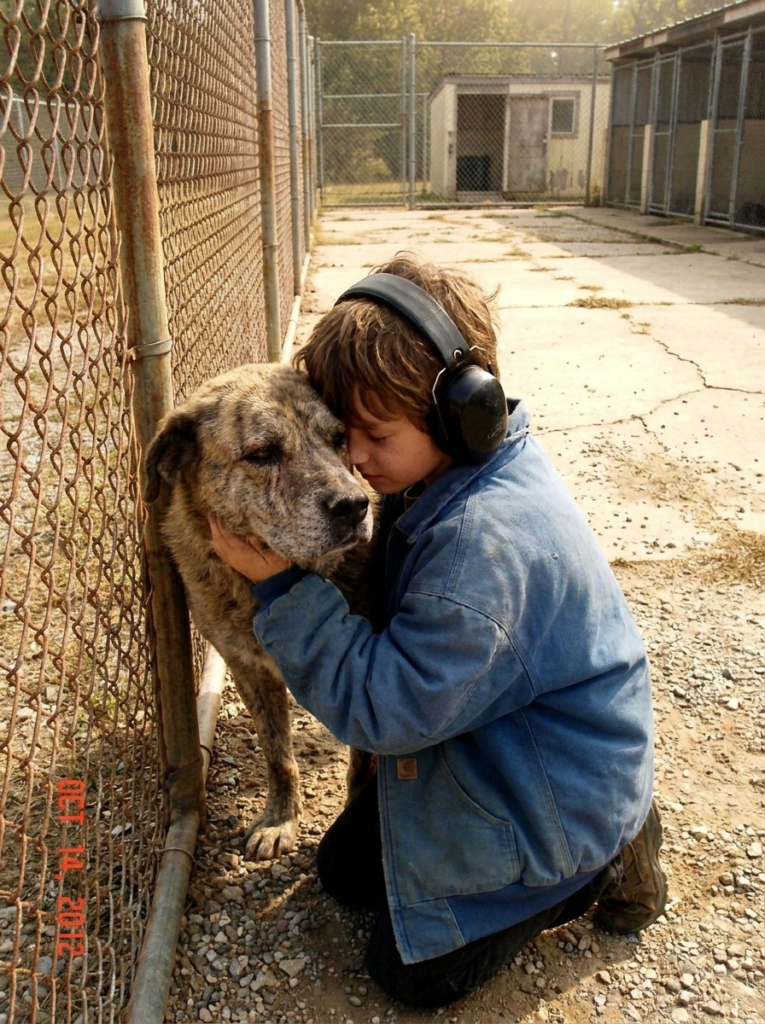
Then Leo crashed into the dog’s side and buried his tear-streaked face into the animal’s thick neck.
The whole yard froze.
The giant dog did not growl.
He did not snap.
He did not pull away.
Slowly, deliberately, the massive animal folded his legs and lowered himself to the gravel. Then he curved his body around the shaking boy like a wall made of warmth.
Because the dog was deaf, he could not hear the shouting workers or the social worker calling from the fence. He was insulated from the chaos in a way Leo desperately wanted to be.
And somehow, in that loud, panicked courtyard, the two rejected souls found the only quiet place available.
Each other.
I threw open my truck door and jogged across the parking lot.
The shelter manager was rushing out with a catch pole. I stepped in front of him and raised both hands.
“Stop yelling,” I said. “You’re making it worse.”
He started to argue.
I didn’t move.
“I said stop yelling.”
Something in my voice must have reminded him I had given orders in worse places than a county lot, because he stopped.
I walked slowly toward Leo and the dog, then knelt three feet away.
Leo was still clinging to the animal, but his screams had turned into ragged sobs. The dog stayed still, breathing slow and steady.
Deep pressure.
Warmth.
Weight.
An anchor.
I caught the dog’s eye and used a simple hand signal I had taught more animals than I could count.
Closed fist to chest.
Safe.
Calm.
The dog blinked slowly.
He understood.
The social worker told me the child was scheduled to be transported to a strict group home because no foster family had been able to manage his sensory needs and communication struggles.
The shelter manager told me the dog was county property and had been scheduled for a final procedure within the hour.
They were both labeled too difficult.
Too much.
Too damaged.
The system had decided neither fit neatly anywhere, so one was being sent away, and the other was being quietly removed from the world.
I stood up.
I pulled out my wallet and shoved cash into the shelter manager’s hand.
“That dog is mine now,” I said. “You can write the receipt, print the papers, or call whoever you need to call. But if anybody puts a pole on my dog, we’re going to have a serious problem.”
Then I turned to the social worker.
“I’m a registered therapeutic foster provider,” I told her. “I’m also a veteran with full clearance and an open placement record. Sending a child in severe sensory overload into a chaotic group home without stabilizing him first is not care.”
It took three hours of phone calls.
Three hours sitting on the tailgate of my truck while Leo and the dog refused to leave each other’s side.
The boy’s file said his name was Leo.
The dog did not have a name anyone cared enough to use.
By sunset, the county granted a seventy-two-hour emergency placement.
Leo was coming home with me.
So was the dog.
I named him Tank before we even reached the farm.
That first night, Leo would not sleep in the guest bedroom. He walked straight to the insulated barn with his blanket in his arms, looked at the corner near the hay bales, and stopped.
I brought out a heavy sleeping pad and laid it down without making it a discussion.
Tank walked over and curled his massive body around the pad like a crescent moon. Leo lay down inside that curve.
Then, for the first time all day, he took off his headphones.
Tank did not bark.
He could not hear himself bark, and maybe he had learned not to waste sound in a world that rarely listened anyway.
He just breathed.
Low.
Steady.
Alive.
Leo slept.
Over the next few weeks, my lawyer fought to extend the temporary guardianship. The county kept granting extensions, pushing the final custody hearing farther down the calendar.
Meanwhile, Leo and Tank became inseparable.
They spoke a silent, beautiful language.
Because Tank could not hear, he relied on visual cues. Because Leo struggled with spoken communication, he found freedom in Tank’s silence.
I started teaching Leo basic sign language.
Food.
Water.
Walk.
Good boy.
Heavy.
Safe.
For a child who had been trapped inside a world too loud for him, his hands became a door.
He signed to Tank constantly.
About the horses.
The grass.
The wind.
The goats.
The way sunlight moved across the barn floor.
For the first time in his life, Leo was not a burden to be managed.
He was a leader.
He was Tank’s whole world.
Whenever the world got too loud or bright, Leo didn’t run anymore. He signed the word heavy.
Tank would immediately lay across Leo’s lap, careful despite his size, becoming a warm weight against the boy’s frantic nervous system.
I had spent years helping old animals recover from the idea that they were unwanted.
But Leo and Tank taught each other faster than I ever could.
Then the real world caught up.
The final custody hearing was scheduled.
A distant aunt suddenly appeared and filed a petition for full custody. Her name was Sarah. She had not seen Leo since he was an infant. My lawyer discovered she had recently filed for bankruptcy and had asked about state support for caring for a disabled dependent before she asked about Leo’s favorite food.
The day of the hearing, the courthouse felt cold and sterile.
Leo sat in the gallery wearing his headphones, staring at the floor. Tank sat beside him wearing an official service-dog-in-training vest.
The aunt took the stand and cried at all the right moments. She talked about blood relations. She talked about family. She painted me as an isolated old veteran living on a dirt farm with a dangerous dog.
The judge looked tired.
He leaned toward the microphone and said the law heavily favored placing a child with a biological relative when possible.
My heart dropped.
He was preparing to rule in the aunt’s favor.
Then a sharp snap echoed through the courtroom.
Leo had pulled his headphones from his head and placed them on the wooden bench.
The room fell silent.
Everyone stared at the small boy whose file described him as mostly nonverbal.
Leo signed stay to Tank.
Then he walked through the small swinging gate, came straight to my table, and grabbed my rough hand with his small fingers.
He took a deep, shaky breath.
“Tank is broken,” Leo said slowly.
His voice was raspy from years of not using it much.
“Leo is broken. The lady in the parking lot said so.”
He squeezed my hand tighter.
“But Mac doesn’t throw away broken things. Mac fixes them. Mac learned my hands. Tank is safe. Mac is safe.”
The courtroom was so quiet I could hear him breathe.
Leo looked directly at the judge.
“Aunt Sarah doesn’t know my hands. Aunt Sarah doesn’t like the quiet. She wants the money. If you make me go, I will not talk. I will only scream.”
His fingers tightened around mine.
“Please. Let me stay with my dog. Let me stay with my dad.”
The aunt’s face lost its color.
The judge stared at Leo, then down at the psychological evaluation in the file.
Finally, he spoke.
“In my twenty-five years on the bench, I have never heard a more compelling argument.”
He picked up his pen.
“The petition of the biological aunt is denied. Custody, with an immediate pathway to full legal adoption, is awarded to the current guardian. Case dismissed.”
The gavel came down.
Leo did not flinch.
He simply walked back to the bench and buried his face in Tank’s thick neck.
That was the day he became my son.
Five years passed.
Leo is thirteen now. He still wears headphones at the grocery store, but he talks more than anyone expected. He reads veterinary textbooks for fun. He knows the names of bones most adults can’t pronounce and can explain animal behavior with the seriousness of a professor and the patience of a saint.
Tank got old.
His muzzle turned white. His hips grew stiff. Cold mornings were harder on him. But wherever Leo went on the farm, a giant block-headed shadow stayed no more than two steps behind.
Society looks at people like me, children like Leo, and animals like Tank, and it sees liability.
Scars.
Labels.
Risk.
But out on the farm, watching a teenage boy use his hands to tell a deaf dog he is a good boy, I learned the truth.
Nothing is ever truly broken.
Sometimes, you just need to find the people who speak your language.
The ones who are not afraid of the quiet.
Then one afternoon, five years after the judge let my boy come home for good, a black SUV rolled through my farm gate and tried to buy him.
I was by the east pasture fixing a bent latch with a crescent wrench and bad knees when Leo whistled twice through his fingers.
That was his signal for strangers.
Tank got there before I did.
He was old in the bones now, but when Leo needed him, he still moved like a wall with a heartbeat.
He planted himself between my son and the man stepping out of the SUV.
The man was around fifty. Pressed shirt. Soft hands. Expensive smile.
“Mr. Callahan?” he asked.
“Depends who’s asking.”
He looked around the farm.
The old red barn. The goat pen. The sensory garden Leo had built, with wind chimes wrapped in cloth because he liked to see movement without hearing sharp clatter.
Then he looked at Leo.
Leo stood behind Tank with one hand buried in the fur at Tank’s shoulder, headphones around his neck, dark hair falling into his eyes.
The man smiled wider.
“There they are,” he said softly. “The famous pair.”
Something in my back tightened.
Nobody came through my gate calling us famous for a good reason.
He introduced himself as Warren Bell from the Stillwater Futures Foundation. He handed me a glossy folder heavy enough to have money in it.
He said his foundation funded exceptional development opportunities for children with complex neurological profiles.
There was an academy.
Residential options.
Private specialists.
Adaptive technology.
Speech and occupational therapy.
College-track planning.
Animal science electives.
When he said that last part, Leo’s chin lifted.
That was the first thing Warren got right.
My boy loved animals more than almost anything.
Then Warren opened the folder.
Inside was a grant proposal with more zeros than I had seen in years.
Enough to fix the leaking roof over the goat stalls.
Enough to rebuild the west fence.
Enough to buy feed without counting every bale twice.
But money like that never travels alone.
“What’s the catch?” I asked.
Warren gave me the same polished smile.
“No catch. Just partnership.”
I almost laughed.
Men in good shoes always call it partnership when they want to hold the steering wheel.
Warren explained that Stillwater wanted to feature Leo and Tank in a new campaign.
A story of resilience.
A story of second chances.
A story donors would feel in their chests.
Leo signed from behind Tank.
What is campaign?
I signed back.
A commercial with better manners.
Leo’s mouth twitched.
Warren noticed our hands moving.
“Yes,” he said, crouching slightly toward Leo. “Your story could help a lot of children.”
Tank took one slow step forward.
Not growling.
Just moving his bulk into the space Warren was trying to take.
Warren straightened.
“That dog is still protective?”
“That dog has better instincts than half the adults I’ve met,” I said.
Warren nodded like he was being gracious.
Then he said the sentence that told me exactly who he was.
“We would, of course, need to evaluate whether the attachment remains developmentally healthy.”
Attachment.
Not love.
Not trust.
Not the living bridge that had carried my boy out of terror and into language.
Attachment.
Like Tank was a bad habit Leo needed to outgrow.
Leo signed again.
He means me and Tank.
“I know what he means,” I said.
Warren looked between us, still smiling.
“Children grow,” he said. “Sometimes the tools that saved them at eight are not the tools that prepare them for eighteen.”
That landed harder than I wanted it to.
Because the dangerous thing about men like Warren is that they rarely bring pure lies.
They bring half-truths dressed like salvation.
I told him I wasn’t interested.
I told him my son was not a campaign, my dog was not a case study, and my farm was not a backdrop for donor feelings.
Warren didn’t argue. He left the folder on my porch anyway.
As he walked back to the SUV, he looked at Leo and said gently, “Smart children eventually ask what happens when their protector is no longer there.”
That was the shot.
Not at my pride.
At my age.
At the truth I saw in the mirror every morning.
I was sixty-five now. My hair was mostly gray. My shoulder ached when it rained. Sometimes, when I carried feed sacks too heavy for common sense, my heart pounded hard enough to remind me I was not immortal.
Leo saw my face change.
He always saw more than people thought.
He put one hand flat against Tank’s back and signed one word.
Stay.
So I did.
The next morning, Tank fell.
It was one of those ordinary accidents that divides life into before and after.
Dew had slicked the grass near the orchard. Leo was walking Tank before breakfast, signing to him with one hand and carrying a book in the other.
I heard a low yelp from fifty yards away.
By the time I got there, Leo was on his knees in the wet grass with both hands on Tank’s face.
Tank tried to stand.
His back leg buckled.
Leo looked up at me with a face I had not seen in years.
Not the parking lot panic.
Something worse.
The look of a child old enough to understand that love can still be helpless.
“Mac,” he said.
Just that.
I hauled the truck around, laid an old quilt in the back seat, and we got Tank to the clinic twenty miles away.
Dr. Nora had been our vet since Tank was young enough to scare the technicians and gentle enough to win them over anyway.
She examined him, took images, moved his leg carefully, then looked at me over her glasses.
I knew that face.
Doctors wear it when truth is coming in stages.
“Ligament tear,” she said. “A bad one.”
Leo’s fingers froze on Tank’s collar.
Dr. Nora explained that Tank already had arthritis in both hips. The injury had pushed him from stiffness into real pain.
There were options.
Rest and medication for comfort.
Or surgery, followed by recovery and rehab.
Not a miracle.
Not youth.
But a chance at good time instead of managed decline.
“How much?” I asked.
She told me.
The room seemed to shrink.
It wasn’t impossible money.
That was the worst part.
Impossible money lets you throw up your hands and hate the world.
This was reachable money.
The kind that sits just inside the border between devotion and ruin.
Leo signed quickly.
I translated for Dr. Nora.
“He wants to know if Tank will hurt every day.”
Dr. Nora respected Leo too much to soften it beyond truth.
“He’ll hurt less with medication,” she said. “He could have some decent months. But if you want the best shot at real comfort, surgery is the stronger option.”
Leo swallowed.
“Will he die?”
Nobody enjoyed that question.
Dr. Nora stepped closer.
“Not today,” she said. “Not because of this. But he is old, sweetheart. Every choice matters more now.”
On the drive home, Leo did not put his headphones on.
That scared me more than tears would have.
He sat with one hand on Tank and stared straight ahead.
When we pulled into the driveway, Warren’s glossy folder was still on the porch swing.
Leo saw it.
Then he looked at Tank trying to climb carefully down from the truck.
Then at me.
I could see the math happening in his head.
Not child math.
Survival math.
That evening, I made Tank a bed in the living room because the porch steps were too much and the barn was too cold for a dog on pain medicine. Leo dragged his mattress beside him.
I did not argue.
The house was quiet except for the refrigerator hum and Tank’s breathing.
I sat at the kitchen table with bills spread out in front of me and the Stillwater folder under my hand.
Leo came into the kitchen in his socks.
He pointed at the folder.
“You should open it.”
“I should throw it in the stove.”
He looked toward Tank.
“Maybe after.”
That hit me in a soft place.
So I opened it.
The papers were exactly what I feared.
Funding package.
Educational placement plan.
Transportation.
Medical advocacy.
Media authorization forms.
Public partnership language.
Not just for Leo.
For our farm.
For our story.
Buried deep inside was the condition that made the rest make sense.
Leo would need to participate in a twelve-month placement at Stillwater Academy’s residential campus four nights a week.
Transition toward independence.
Structured peer immersion.
Reduced dependency on nonclinical regulation sources.
I read that sentence three times.
Reduced dependency on nonclinical regulation sources.
They had found expensive words to say they wanted my son away from his dog.
Leo was reading over my shoulder.
“Nonclinical means Tank,” he said.
“Yes.”
He kept reading.
They were offering to cover animal care support as appropriate to transition goals.
In plain English, they might pay for Tank’s surgery if Tank stopped being Leo’s lifeline and became a pleasant mascot in the background.
Leo’s voice became small.
“They would help him.”
“No,” I said. “They would purchase access to him.”
Leo looked toward the living room.
Tank shifted in his sleep and groaned.
Leo flinched like someone had touched a bruise.
“Mac,” he said carefully, “when I was little, you told me safe is not the same as small.”
I knew then this would not be simple.
Over the next week, Tank started medication. It helped some, but not enough to hide the pain from Leo. My boy watched every careful step, every pause, every small wince.
He also started asking questions I had been hoping to approach slowly.
What happens if you die first?
Who gets the farm?
Can I stay here alone at eighteen?
What if Tank is gone and then you are gone too?
What if I need more than this place?
Every question was fair.
Every one felt like barbed wire in my throat.
Because love does not cancel math.
Love does not stop time.
And if I was honest, part of me had gotten selfish in our healing.
I had fought so hard to keep Leo safe that I had started imagining safety as a finished thing.
A fence line.
A deed.
A boy with his dog on my land forever.
But children are not kept.
They are raised.
Those are not the same thing.
Stillwater requested a meeting through Leo’s school. I wanted to refuse, but the counselor said Leo had a right to hear about opportunities.
That stung because it was true.
So I drove him myself.
Their office was polished and quiet. Soft chairs. Muted walls. Everything designed to look calm enough to trust.
Dr. Elise Rowan greeted us.
She signed hello before speaking.
That threw me off.
She spoke to Leo directly, not around him. She asked what he loved, what overloaded him, what made school feel false, what made him feel capable.
Leo answered more than I expected.
Animals.
Predictable tasks.
Clear language.
No surprise touches.
No fluorescent buzzing.
No being treated like a group project.
Dr. Rowan nodded.
“Reasonable.”
I disliked liking her.
That was the trouble with the whole thing.
Stillwater was not full of cartoon villains. It had competent people who believed systems could finish what love began.
That made the fight harder.
She showed Leo the campus virtually.
Small dorm rooms with dimmable lights.
Quiet study areas.
Animal science labs.
Garden paths.
Peer groups.
Certifications.
Leo leaned in despite himself.
I saw the hunger.
Not to escape.
To expand.
That was different.
And harder for a father to oppose without becoming a cage in boots.
Then Dr. Rowan said gently, “We encourage students to develop multiple regulation strategies. Not all support can remain external forever.”
Leo signed fast.
Tank is not dependence. Tank is language.
She answered both in voice and sign.
“I believe that,” she said. “I also believe language should grow.”
I stepped in.
“Grow into what?”
Her gaze met mine.
“Into a life that can survive grief, adulthood, and loss.”
There it was again.
The truth under the sale.
On the drive home, Leo was silent for ten miles.
Then he said, “I liked her.”
“I noticed.”
“She did not talk to you like I was furniture.”
“No.”
“She talked to me like I was going somewhere.”
He did not mean to wound me.
That was why it did.
Three days later, my body betrayed me in the feed room.
I was hauling sacks because I am proud and foolish in equal measure. A sharp pressure tightened under my breastbone. I braced both hands on the wall and waited for the room to settle.
Leo walked in halfway through it.
He saw the sweat.
He saw how fast I tried to straighten.
He signed one word.
Again?
That was when I realized he had seen it before.
Maybe more than once.
“It’s fine,” I said.
He signed harder.
Again?
I sat on an overturned bucket because lying to him while standing suddenly felt disrespectful.
“Sometimes,” I admitted.
“How many?”
“A few.”
He stared at me with a silence that felt like a courtroom.
“You said no surprises,” he said.
He was right.
That was our rule.
No surprise touches.
No surprise plans.
No surprise departures.
I had built our whole house around that rule, then broken it when it scared me.
That night, I called Jo Mercer, the lawyer who had helped us years before.
She came out with files, a legal pad, and the kind of expression only an old friend can wear while telling you the truth rudely.
“You should have done this two years ago,” she said.
“I know.”
“You could choke on a chicken bone tomorrow.”
“I know.”
“You eat like a divorced raccoon.”
“I know that too.”
Leo sat at the table with us. Jo treated him like a participant, not a decoration.
She explained guardianship planning, emergency directives, educational trusts, backup caregivers, property transfer options.
I hated every word.
Leo listened to all of it.
He asked good questions.
Hard questions.
Could he stay on the farm if I died?
Could Tank?
Who would manage money?
Could he choose?
When Jo left, Leo watched her truck lights fade.
“You are making plans now because they came,” he said.
Stillwater.
“Partly,” I admitted.
He looked toward Tank asleep on the rug.
“Then maybe they are not all bad.”
That was how children grow up.
Not in one big betrayal.
In small moments when they realize the people who saved them are still people.
Limited.
Scared.
Late.
“They are not all bad,” I said. “But bad doesn’t have to be all of a person before they can still take too much.”
Leo nodded.
Understanding is the road children use to leave you.
The real fracture came two weeks later.
Dr. Nora called and said a representative from Stillwater had requested Tank’s records.
I drove home with dirt on my face and fear in my mouth.
Leo sat on the back porch, hands in his lap.
That is never a good sign.
I sat beside him.
“Did you authorize them?”
He did not look at me.
“I signed a form.”
“Without asking me.”
“You would say no.”
“Yes, I would.”
“I know.”
We sat in silence until it told the truth for us.
Finally, Leo spoke.
“If I can get Tank surgery and go to the school and learn animal medicine, why do you get to decide that your fear is more important than all of that?”
There it was.
My fear.
Not wisdom.
Not experience.
Fear.
“Because I have lived long enough to know when people are buying a story instead of helping a child,” I said.
He turned to me, eyes bright and angry.
“They can be doing both.”
I stared at him.
“The article helped the donkeys,” he said. “People gave money because of our story.”
“That was our choice.”
“This would also be my choice.”
“No,” I said. “This would be a contract.”
He stood so fast the chair scraped.
“I am not eight anymore.”
“I know that.”
“No,” he said. “You know words. You do not act like you know.”
Tank rose and stepped between us.
Not choosing sides.
Just placing his old body in the space where love was becoming a fight.
Leo’s face changed into something sadder than anger.
“Sometimes I think you need me to stay the kid from the courtroom,” he said, “because then you always know what to do.”
That sentence nearly flattened me.
Because some part of it was true.
The county lot had been clear.
A terrified child.
A rejected dog.
A system moving too fast.
You step in.
You fight.
You win.
This was not clear.
This was a boy with a future asking whether my love was becoming too small for it.
He went to the barn.
Tank followed him.
Not because he chose a side.
Because he knew who was hurting worse.
The next morning, I drove to Stillwater and asked to see Warren.
I placed the contract on his desk.
“No donor events,” I said. “No image rights. No public story use. No residential requirement. Day program only. Tank’s surgery independent of placement. Leo chooses whether to continue after sixty days.”
Warren listened like I was asking him to redesign the moon.
“That is not our model,” he said.
“Then your model is no.”
He folded his hands.
“The foundation does not invest this level of support without measurable impact.”
“There it is.”
“There what is?”
“The part where you say child and mean asset.”
His smile went cold.
“We provide opportunity to families who cannot otherwise access it.”
“Families,” I said, “or stories?”
I went home and told Leo exactly what I had done.
He listened.
Then asked the question that ended any chance of me pretending the argument was only about Stillwater.
“Did you ask me what I wanted before you asked for it?”
I had not.
That was my answer.
“You keep saying they do not hear my language,” Leo said. “But sometimes you do not either.”
I wish fathers always knew the right thing to say.
Mostly, we learn the true thing too late.
The second betrayal arrived that Friday.
A white envelope from Stillwater came in the mail.
Inside was an invitation to a benefit dinner at a restored hotel downtown.
One featured presentation.
“One Boy, One Dog, One Future.”
At the bottom, under guest coordination, was Leo’s name.
I found him in the barn loft with Tank’s head in his lap.
He knew the moment he saw the envelope in my hand.
“I was going to tell you.”
“When?”
“After.”
“After what?”
“After I did it.”
I could barely keep my voice level.
“You agreed to appear at a donor event?”
“They move Tank’s surgery up if I attend. Tomorrow they confirm the slot.”
Anger hit a wall and turned into hurt.
“You traded yourself.”
“No,” he said. “I traded one night.”
“One night becomes ten. Ten becomes a year.”
“Maybe a year gets me ready.”
“For what?”
“For life after you.”
The words landed between us before either of us could soften them.
Leo’s voice shook.
“You think I don’t know Tank is old? You think I don’t know you are old? I know every time he takes stairs slowly. I know every time you hold your chest and call it nothing. I know all of it, Mac. And I am still the one everybody expects to be brave, nice, and grateful.”
That tore through me.
Because children who survive hard things are often expected to become inspiring.
Reasonable.
Strong.
As if hardship should produce a personality other people can admire.
I sat on a hay bale because my legs didn’t feel trustworthy.
“Listen to me,” I said. “I’m sorry. I’m sorry for hiding my health. I’m sorry for trying to negotiate your future without asking. I’m sorry for confusing protection with control.”
His eyes filled.
Then I told him the part I could not bend on.
“I will never let somebody put the hardest day of your life on a screen so strangers can feel noble over dinner.”
Leo stared at me.
“You think that is what it is.”
“I know what it is.”
“You do not know if I can use them back.”
That stopped me.
Use them back.
Not surrender.
Use.
A thirteen-year-old strategy born from too much awareness.
Maybe brilliant.
Maybe heartbreaking.
Maybe both.
“I need to try,” he said.
“And if they hurt you?”
He looked down at Tank.
“Then I will know.”
The dinner was the next night.
I told myself I would stop it.
Then I told myself I would let him choose.
In the end, I drove us there.
Because some choices cannot be made clean by a parent once a child starts becoming himself.
The ballroom was everything I distrusted.
Too much polished wood.
Too much glass.
People speaking softly in outfits worth more than my truck.
A projection screen bigger than my feed room wall.
Leo wore dark slacks and a blue button-down Jo had bought him because she said if he was going to walk into a room of donors, he ought to do it dressed like someone nobody could patronize by mistake.
His headphones rested around his neck.
Tank wore a black support harness and walked carefully at his side.
We were brought to a side room to prepare.
There was bottled water, fruit trays, cue cards, and a young woman with a headset who kept calling Leo sweetheart until he stopped answering her.
Then I saw it.
On a display easel stood a blown-up photo from the county hearing.
Leo at eight.
Small.
Headphones in his hands.
Fear and courage on his face.
Tank beside him.
Above it, in tasteful letters, were the words:
FROM BROKEN TO BRIGHT
My vision narrowed.
I crossed the room in three steps and ripped the photo off the easel.
The young woman gasped.
Warren came in quickly.
“Mr. Callahan—”
“No.”
He raised both hands.
“It is meant to honor the journey.”
I was close enough to smell his clean cologne.
“He was never broken.”
Warren’s jaw tightened.
“Language matters. We’re trying to make the transformation clear.”
Leo spoke from behind me.
“So people can clap at it.”
Everyone turned.
Leo’s voice had that effect when he chose to use it.
Not because it was loud.
Because he did not spend words carelessly.
Warren recovered.
“This event funds a lot of children.”
Leo looked at the photo in my hand.
Then at the screen beyond the door.
Then at Tank, who was shifting weight off his sore leg.
“Show me the speech,” Leo said.
Warren handed him the pages.
I read over his shoulder.
It was all there.
The trauma.
The rescue.
The loving guardian.
The special bond.
The future unlocked through Stillwater’s evidence-based care model.
As if Tank had not been evidence all along.
As if our farm had not been a daily record of what happens when people stop demanding normal long enough to see what actually heals.
Leo handed the speech back.
“No,” he said.
Warren blinked.
“I’m sorry?”
“I will talk,” Leo said. “But not that.”
Warren glanced toward the ballroom.
At the schedule.
At the donors waiting to feel useful.
“Just stay on message.”
Leo looked him dead in the eye.
“I am.”
The dinner began.
Speeches about outcomes and access.
A video of smiling children in quiet classrooms.
Then Warren introduced Leo as a young man whose life had been transformed through courage, connection, and structured support.
Which was impressive, considering structured support had not yet done a thing for him.
Leo walked to the stage.
Tank walked beside him.
Old.
Hurting.
Loyal beyond reason.
I followed three steps behind because nothing on earth was going to stop me.
The stage lights hit Leo’s face.
For one terrible second, I thought he might freeze.
Then he touched two fingers to Tank’s shoulder.
Safe.
He looked out at the crowd.
“My name is Leo Callahan,” he said.
The room went still.
“When I was eight, adults kept using the word broken around me. Broken child. Broken dog. Broken system. Broken past. They said it so much I started thinking maybe broken was my real name.”
Someone inhaled sharply.
Leo continued.
“I do not remember every sound from that parking lot. I remember the feeling. Heat. Gravel. Fear. Everybody bigger than me and in a hurry.”
He looked down at Tank.
“I remember the first thing that ever made the world smaller without making me smaller too.”
He lifted his head.
“This dog did that.”
A soft murmur moved through the room.
They were ready to be pleased.
Leo saw it.
Then he changed everything.
“Some of you were told I am here so you can help children like me,” he said. “That part is true.”
Warren smiled from the side.
Too early.
“But some of you were also told the goal is to turn kids like me into a version of comfortable that makes other people relax.”
Warren’s smile faded.
Leo’s hands rose. He signed as he spoke, not because the room needed it, but because he did.
“People say independence like it means being far away from the things that help you stay steady. Sometimes help is a room quiet enough to think. Sometimes it is lights that do not hurt. Sometimes it is a dog who does not need you to explain yourself before he stays.”
He touched his headphones.
“Sometimes people want us to outgrow what helps because needing help makes them nervous.”
A woman at the front table began to cry.
Leo did not look at her.
He was past watching their faces now.
“Independence is not pretending I am easy,” he said. “It is not letting people remove every support until I look inspiring from far away.”
He took a breath.
“Independence is being trusted to know my own language.”
The room shifted.
“I came here because my dog is old and hurting,” Leo said.
No polish.
No pretty wrapping.
“I came because I thought maybe if I traded one night of my story, I could buy him more time.”
The ballroom changed.
No longer charity.
Self-recognition.
The kind people hate when it arrives during dessert.
Leo’s voice shook once.
“But backstage, I saw a picture of the scariest day of my life blown up big so people could eat dinner and feel hopeful.”
No one moved.
“And I understood something.”
He placed one hand on Tank’s head.
“Being seen is not the same thing as being known.”
That line moved through the room like weather.
Through me too.
Because I had made my own version of that mistake.
Seeing Leo safe.
Assuming I knew who he needed to become.
Leo looked toward Warren, then back at the crowd.
“If you want to help children like me, do not ask us to perform our pain in a way that fits your brochure. Do not call us success only after we become easier to explain.”
He pointed to the farm photo behind him.
“This place helped me.”
Then to Tank.
“He helped me.”
Then toward me.
“And Mac helped me.”
My throat closed.
“But love can get scared,” Leo said gently.
I did not deserve how gently he said it.
“Love can hold too tight because loss is real.”
He looked at me.
Not accusing.
Inviting.
“I do not need to be sold to strangers to grow,” he said. “And I do not need to stay small to prove gratitude.”
There it was.
The whole fight.
No villain speech.
No perfect saint speech.
Just the truth neither side could survive without hearing.
Leo faced the audience one last time.
“If you really want to help, fund places that let people keep the supports that already speak their language. Fund quiet. Fund time. Fund families before they break trying to look official enough for your paperwork.”
He paused.
“Do not rescue me by requiring me to become more convenient for you.”
When he stepped back, nobody clapped at first.
People do not clap right away when they have just been handed a mirror.
Then one person stood.
Then another.
Then half the room.
Then the rest.
The applause came too hard.
Too sudden.
Leo flinched.
Tank tried to stand faster than his sore leg allowed and stumbled.
I was onstage in two steps.
Leo dropped to one knee, hands on Tank’s harness.
The old dog’s leg folded awkwardly beneath him, and he gave a low grunt that made Leo’s face go white.
Leo signed fast.
Out. Out. Out.
We moved.
A side door opened.
Cold night air hit us like mercy.
In the alley behind the hotel, Tank trembled beneath the security light. Leo wrapped both arms around his neck and pressed his forehead into the white fur at his cheek.
“I’m sorry,” he whispered again and again.
I knelt beside them.
“Hey,” I said.
Leo did not look up.
“I used him.”
“No,” I said firmly. “You loved him and tried to save him. Adults built the bad deal. That is not the same thing.”
The hotel door opened behind us.
I turned, ready for Warren.
But it was Dr. Rowan.
No clipboard.
No polished smile.
Just her coat over one arm and car keys in hand.
She crouched a few feet away.
“You were right,” she said.
I waited.
She looked at Leo.
Then at Tank.
“Our model gets too hungry for proof sometimes.”
That was the most honest sentence I had heard all night besides Leo’s.
She told us she had argued against the display.
Against the word broken.
Against the donor performance.
She lost.
That did not excuse it, and she said so.
Then she added, “There may be another way, if you’ll hear it.”
“Lady,” I said, exhausted, “tonight is not a good night to sell me anything.”
“I’m not selling.”
She nodded toward Tank.
“There is a surgical fund under the medical branch that does not require placement. Most families never hear about it because it is small and has no ribbon-cutting value. No speeches. No rights. No campaign. It won’t cover everything, but it may cover enough combined with local support.”
I stared at her.
“Why tell us now?”
Her face shifted between shame and conviction.
“Because your son just said in public what some of us have been failing to say in private.”
Leo watched her.
Dr. Rowan signed carefully.
You should not have to bleed to qualify for help.
Leo blinked.
Then signed back.
Then change it.
She nodded once.
“I’m trying.”
The next month was a storm.
Leo’s speech got out because of course it did. People argued online. Some called me stubborn. Some called Leo brave. Some defended Stillwater. Some said good intentions still harm people when they need a spotlight.
For once, I did not read much of it.
Real life was louder.
Dr. Rowan made good on her word. The surgical fund covered part of Tank’s care. A retired carpenter with a grandson on the spectrum dropped a plain white envelope in our mailbox. The woman who cried at the dinner paid for six weeks of rehab and wrote one line:
For comfort without conditions.
Jo created a proper legal support trust because apparently lawyers show love through paperwork and insults.
And me?
I sold the old tractor I kept pretending I would restore.
Pride has market value if you finally admit it.
Tank had the surgery.
Recovery was slow.
Messy.
Humbling.
He wore a rehab harness and looked personally offended every time we helped him into the truck for therapy appointments.
Leo learned the exercises from Dr. Nora’s techs and treated them like sacred work.
Count reps.
Pause.
Massage.
Support.
Encourage.
Good boy.
Good boy.
Good boy.
He said it with his hands and his voice both.
Because Tank had taught him language can enter through more than one door.
At the same time, I did what I should have done earlier.
I stopped acting like every formal support was a thief in a tie.
Not all of them were.
Some were tools.
And tools don’t ask to be loved.
They just need to be used correctly.
With Dr. Rowan’s help and Leo’s terms written in black ink, we built something that belonged to us.
Day classes only.
Two mornings a week at Stillwater’s animal lab.
No media.
No donor appearances.
No story rights.
Headphones when needed.
Sign breaks built in.
Tank allowed in outdoor sessions once cleared by rehab.
And backup plans.
Real ones.
Guardianship paperwork.
Health directives.
Emergency caregivers.
A future that did not depend entirely on my stubborn old body continuing forever.
I signed every document with a hand that shook.
Not because I doubted the choice.
Because love shakes when it admits it cannot guard everything alone.
The first day of Leo’s lab program, I drove him there before sunrise.
Tank came too, cleared for limited time and looking smug about it.
Leo wore the same blue shirt from the dinner.
He looked taller than he had a month before.
Sometimes children grow in the crack left by hard truth.
At the gate, he did not get out right away.
He looked at me.
Then at Tank.
Then back at me.
“Are you scared?” he asked.
“Yes.”
“Me too.”
We sat with that.
Then he smiled a little.
“Maybe that means it is real.”
I laughed.
“Maybe.”
He squeezed my forearm once.
That was his version of a hug when the day ahead felt too big for full contact.
Then he got out.
Tank climbed down slowly but proudly.
Leo signed to him.
Job now.
They walked toward the building together.
Not because Leo could not walk in alone.
Because nobody should have to prove growth by pretending companionship is weakness.
I sat in the truck and watched until the door closed behind them.
Then I cried like an old fool with bad knees and no audience.
Not because I was losing him.
Because I wasn’t.
Because for the first time since that county lot, I understood that keeping a child safe and teaching him to leave are not opposite jobs.
They are the same job done honestly.
Tank never became young again.
That was never on offer.
But he became comfortable.
Comfortable enough to nap in the sun.
Comfortable enough to patrol the garden.
Comfortable enough to follow Leo to the barn like a graying bodyguard who had accepted part-time duty.
Comfortable enough to make it through one more spring.
Then summer.
Then the bright edge of fall, when the maples on our road turned red enough to look lit from inside.
One October evening, Leo and I sat on the porch watching Tank sleep in the yard.
His chest rose and fell slowly.
White muzzle on crossed paws.
A good old dog at peace in his kingdom.
Leo had a veterinary anatomy workbook open on his knee and a grease mark on his cheek from helping me repair the trailer.
He looked more like the future than the frightened little boy from the courthouse now.
And also exactly like him.
That is the thing nobody tells you.
Healing does not erase who you were.
It gives that part of you somewhere safer to stand.
Leo closed the workbook.
“Mac?”
“Yeah?”
“Do you still think people look at us and see liabilities?”
I watched Tank sleeping in the orange light.
I thought about the county lot.
The courtroom.
The dinner.
The alley.
The paperwork now sitting in a drawer because I had finally loved Leo enough to plan for a world that might outlast me.
“Some do,” I said.
Leo nodded.
“Me too.”
Then he added, “I do not care as much.”
I looked at him.
“Why not?”
He shrugged one shoulder.
“Because being known is heavier than being seen.”
I smiled into the dark.
There was my boy again.
Saying the plain thing that could survive any storm.
A few minutes later, Tank woke, groaned his old-man groan, and climbed the porch steps one careful step at a time.
Leo shifted to make room before Tank reached us.
Tank settled with his giant head across both our boots, as if we were still one unit he intended to guard.
Leo bent down and signed against the side of Tank’s neck where only the dog and the people who loved him would notice.
Good boy.
Best boy.
Home.
Then Leo said it out loud too.
Because some truths deserve every language you have.
I placed one hand on the old dog’s head and the other on my son’s shoulder.
I thought about all the systems built to sort the easy from the inconvenient, the inspiring from the difficult, the savable from the expensive.
I thought about how many children are called ready only after they stop asking the world to bend. How many families are praised only when they hand over their story with a smile. How many old dogs, old men, scared boys, and complicated homes are told they should be grateful for any help, no matter what it costs.
Then I looked at the two souls beside me.
The boy who taught me silence is not emptiness.
The dog who taught us support is not shame.
And I knew something I wish every tired parent, every scared child, and every person reduced to a label could know in their bones.
The right future does not ask you to become easier to love.
It asks the world to love you with more honesty.
Out on the porch, under a sky going dark by degrees, Leo leaned into me for one brief second.
Tank sighed.
The wind moved through the trees without asking anything of us.
And in the quiet, which had once sounded to all three of us like loneliness, it finally sounded like what it had been trying to become all along.
Home.
━━━━━━━━━━━━━━━━━━━━━━━━━━━━━━━━━━━━━━