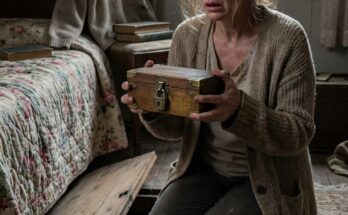
My daughter left for college years ago. While cleaning her old room, I found a small, locked wooden box hidden under a loose floorboard. I finally found the key and opened it. Inside, I saw something that made my heart stop. She kept this secret for 20 years. The contents changed everything I thought I knew about her childhood.
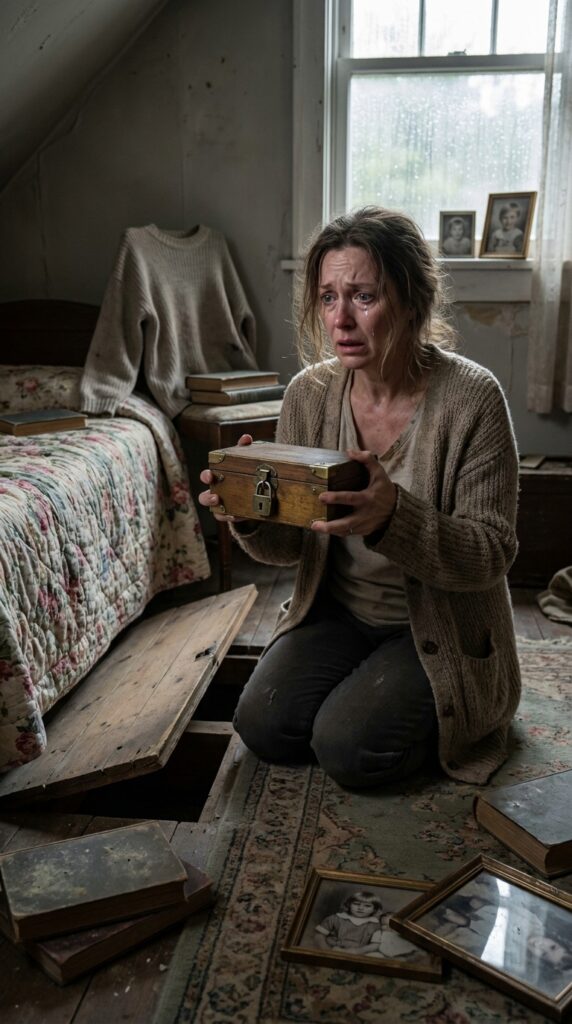
When my daughter Emily left for college, I told myself her room would stay exactly the way she left it.
For the first year, I barely touched anything. Her books still leaned against each other on the white shelf by the window. Her old desk lamp still sat near a stack of notebooks she had not taken with her. A faded blue sweater hung over the back of her chair, as if she might walk in at any moment, grab it, and complain that the house was too cold.
But years passed.
Emily graduated, found a job two states away, and built a life that no longer needed her childhood bedroom waiting like a museum. She called often. She visited on holidays when work allowed it. She laughed on the phone, asked about my garden, reminded me to take my vitamins, and always ended every call with, “Love you, Mom.”
Still, there was a quiet distance between us that I could never fully explain.
She was kind. She was respectful. She never stopped loving me.
But somewhere between childhood and adulthood, my daughter had learned how to keep pieces of herself hidden.
I blamed time. I blamed growing up. I blamed myself a little, too.
Then one rainy Saturday morning in October, I decided it was finally time to clean her old room.
The house felt still that day. Rain tapped gently against the windows, and the hallway smelled faintly of dust and lemon cleaner. I carried a cardboard box upstairs, telling myself I would only sort through things she clearly did not need anymore.
Old school papers. Broken pens. Birthday cards. Half-used notebooks. Small reminders of the girl she used to be.
At first, cleaning made me smile.
I found a drawing she had made in third grade of our family standing in front of a house with a crooked chimney. I found a certificate from a spelling bee she had not won, but had proudly kept anyway. I found a tiny bracelet made of plastic beads, each one a different color, spelling out “MOM.”
I sat on the edge of her bed and held it for a long time.
Then I moved the bed slightly to sweep behind it.
That was when I noticed the loose floorboard.
It was near the wall, half-hidden under the faded corner of an old rug. At first, I thought the wood had simply lifted with age. But when I pressed my fingers against it, the board shifted too easily.
My heart gave a strange little jump.
I pushed the rug aside and knelt down. The board had a tiny notch at one end, almost invisible unless you were looking for it. I slipped my fingernail under it and lifted.
Underneath was a narrow space.
And inside that space was a small wooden box.
It was old, dark brown, and locked with a tiny brass latch. Dust covered the top, but when I wiped it away with my sleeve, I saw something carved into the lid.
E.M.
Emily’s initials.
For a moment, I simply stared.
I told myself it was probably nothing. Maybe old notes from friends. Childhood treasures. A diary she had forgotten. Something private, yes, but harmless.
Still, the sight of that little locked box hidden beneath the floor made my stomach tighten.
I carried it downstairs to the kitchen and set it on the table.
The rain outside grew heavier.
I called Emily first.
She did not answer.
That was not unusual. She worked long hours and often kept her phone on silent. I started to leave a voicemail, then stopped. What was I supposed to say?
“Hi, sweetheart, I found a locked box hidden under your bedroom floor. Should I open it?”
The question felt wrong.
For almost an hour, I left it untouched.
I made coffee. I cleaned the counter. I folded a towel that did not need folding. But my eyes kept returning to the box.
Finally, I remembered the small ceramic bowl on Emily’s old dresser, the one where she used to keep hair clips, coins, and tiny treasures. I went back upstairs and searched through it.
At the very bottom, hidden beneath a cracked friendship bracelet, was a small brass key.
My hands trembled as I carried it back downstairs.
I sat at the kitchen table, slid the key into the lock, and turned it.
The latch clicked open.
Inside the box was not money.
Not jewelry.
Not anything I expected.
There was a stack of folded papers tied with a pale yellow ribbon. Beneath them was a small photograph, a child’s drawing, and a hospital bracelet with Emily’s name on it.
The bracelet made me freeze.
I remembered it immediately.
Emily had worn it when she was seven, after she fell from the old oak tree in the backyard and spent one night at the hospital. It had been a frightening night, but she recovered quickly. At least, that was what I had always believed.
I picked up the photograph.
It showed Emily at about eight years old, sitting on the back steps of our old house. Her hair was tied in uneven pigtails. She was holding a stuffed rabbit against her chest. Her eyes looked directly at the camera, but she was not smiling.
On the back, written in small handwriting, were the words:
“I wanted someone to notice.”
My breath caught.
I untied the ribbon around the papers and unfolded the first one.
It was a letter.
Not to me.
To Emily.
The handwriting was familiar, but it took me several seconds to understand why.
It belonged to her father.
My husband, Daniel, had passed away when Emily was seventeen. For years, I had carried a quiet grief for him. He had been charming, hardworking, respected by neighbors, admired by friends.
But our marriage had not been perfect.
Daniel was often distant. He had moods I learned to walk around carefully. He loved Emily, I thought, but he did not always know how to show tenderness.
The letter in my hands was dated twenty years earlier.
Emily would have been eight.
My eyes moved slowly across the page.
“Emily, I’m sorry I told you not to talk about it. I was scared. I thought keeping quiet would protect this family, but I was wrong.”
I stopped reading.
My hands went cold.
I looked at the next paper. Then the next.
They were not letters from Daniel to Emily.
They were letters from Emily to herself.
Pages and pages of a little girl trying to make sense of things no child should have to carry alone.
The words were simple, sometimes misspelled, written in pencil and colored pen.
“Mom is tired today, so I won’t tell her.”
“Dad said it was an accident, but I don’t think it was.”
“I heard them arguing again.”
“I wish Mom knew I was scared when the house gets quiet.”
“I don’t want anyone to be mad.”
My eyes filled so quickly I could barely see.
The story came together slowly, painfully, through the papers in that box.
When Emily was little, there had been arguments in the house that I had tried to hide from her. I thought I had protected her by pretending everything was fine. I thought she was too young to understand the sharp silences, the closed doors, the careful smiles.
But she had understood more than I ever imagined.
She had heard things.
Seen things.
Carried fear quietly because she thought telling me would make my life harder.
One letter described the day she fell from the oak tree.
Only, according to her writing, she had not been climbing for fun.
She had climbed because she wanted to get away from the sound of another argument inside the house. She had sat on a branch, hugging herself, waiting for the voices to stop. When Daniel came outside and called her name, she startled, slipped, and fell.
At the hospital, I remembered asking her what happened.
She had whispered, “I was just playing.”
And I believed her.
I pressed a hand over my mouth.
All those years, I thought I knew the story of my daughter’s childhood.
I thought I had been there for every important moment.
But while I was trying to survive my own pain, Emily had been quietly surviving hers.
At the bottom of the box, beneath the last folded letter, was one more envelope.
This one had my name on it.
“Mom.”
The letters were written in Emily’s teenage handwriting. Neater. Stronger. Still familiar.
I opened it carefully.
“Dear Mom,
If you ever find this, please don’t blame yourself before you finish reading.
I know you. You’ll cry first. Then you’ll think of every moment you missed. But I need you to know something.
I never hid this because I hated you.
I hid it because I loved you.
When I was little, I thought love meant staying quiet so nobody else would hurt. I thought if I told you I was scared, you would break. You were already carrying so much.
But as I got older, I realized silence can become its own kind of pain.
Dad wrote me one letter before he passed. He said he was sorry for the way his anger filled the house. He told me he wished he had been better. I kept it because part of me needed proof that what I felt was real.
I’m not writing this to reopen old wounds. I’m writing this because I want you to know the truth someday.
My childhood wasn’t all sad. Please remember that.
I remember pancakes on Saturday mornings. I remember you singing badly in the car. I remember you staying up all night sewing my costume for the school play. I remember how safe I felt when you held my hand.
You did love me.
I knew that.
I still know that.
But there were things I didn’t know how to tell you then.
Maybe one day, when we’re both ready, we can talk about it.
Love,
Emily.”
By the time I finished, I was crying so hard I had to put the letter down.
For years, I had wondered why Emily always seemed careful around family memories. Why she smiled softly but changed the subject when I brought up certain parts of the past. Why she loved me but never fully leaned into me the way she had as a little girl.
Now I knew.
It was not because she had forgotten.
It was because she remembered too much.
I sat at the kitchen table until the rain stopped.
Then my phone rang.
Emily’s name appeared on the screen.
For a few seconds, I could not move.
Finally, I answered.
“Hi, Mom,” she said warmly. “Sorry I missed your call. Everything okay?”
I tried to speak, but my voice broke.
There was silence on the other end.
“Mom?” she asked, softer now. “What happened?”
“I cleaned your room today,” I whispered.
Another silence.
This one was different.
Longer.
Heavier.
Then Emily breathed in slowly.
“You found it,” she said.
I closed my eyes. “Yes.”
Neither of us spoke for a while.
Then I said the only words I could find.
“I am so sorry.”
Emily’s voice trembled. “Mom…”
“No,” I said gently. “Please let me say it. I’m sorry I didn’t see how much you were carrying. I’m sorry you thought you had to protect me. I’m sorry I didn’t ask better questions.”
She began to cry quietly.
“I didn’t want you to feel guilty,” she said.
“I know,” I replied. “But sweetheart, you were a child. It was never your job to protect me from the truth.”
For the first time in years, my daughter did not rush to comfort me or change the subject. She stayed on the phone. She cried. I cried. We talked about things we had both avoided for too long.
Not everything was said that day.
Some truths take time.
But something opened between us.
A door we had both been standing beside for years, afraid to touch.
A month later, Emily came home.
She stood in the doorway of her childhood bedroom, looking around with a small, sad smile.
“I can’t believe you kept the sweater,” she said.
“I kept everything,” I admitted.
She walked to the bed and sat down. I sat beside her, leaving space between us at first.
Then she reached for my hand.
For the next few hours, we talked.
Not as a mother trying to fix everything.
Not as a daughter trying to hide everything.
Just two people finally telling the truth with love.
She told me about the nights she felt afraid. I told her about the years I thought pretending everything was fine would make it true. She admitted she had been nervous to come home, worried the box would change how I saw her.
“It did,” I said.
Her face fell slightly.
I squeezed her hand.
“It made me see how strong you were,” I continued. “And how much I still have to learn about loving you better.”
Emily leaned against my shoulder then, the way she used to when she was small.
For a moment, I could almost hear the echo of her childhood laughter in the room.
I could not go back and change what she had carried.
I could not erase the quiet fear or the hidden letters or the years she spent protecting everyone else with her silence.
But I could listen now.
I could believe her now.
I could love her without asking her to make the past easier for me.
That evening, before she left, Emily picked up the wooden box from the kitchen table.
“Do you want to take it with you?” I asked.
She looked at it for a long time.
Then she shook her head.
“No,” she said. “I think it can stay here.”
“Are you sure?”
She nodded. “It doesn’t feel like a secret anymore.”
I placed the box on the shelf in the living room, not hidden, not locked away, but resting quietly among family photographs.
A reminder that every home has stories behind its walls.
Some are joyful.
Some are painful.
Some wait years to be spoken.
And sometimes, the truth we fear most is not the end of a family.
Sometimes, it is the beginning of healing.