At my son’s wedding, I was seated alone in the very last row, as though I was not his mother, but a detail someone hoped no one would notice.
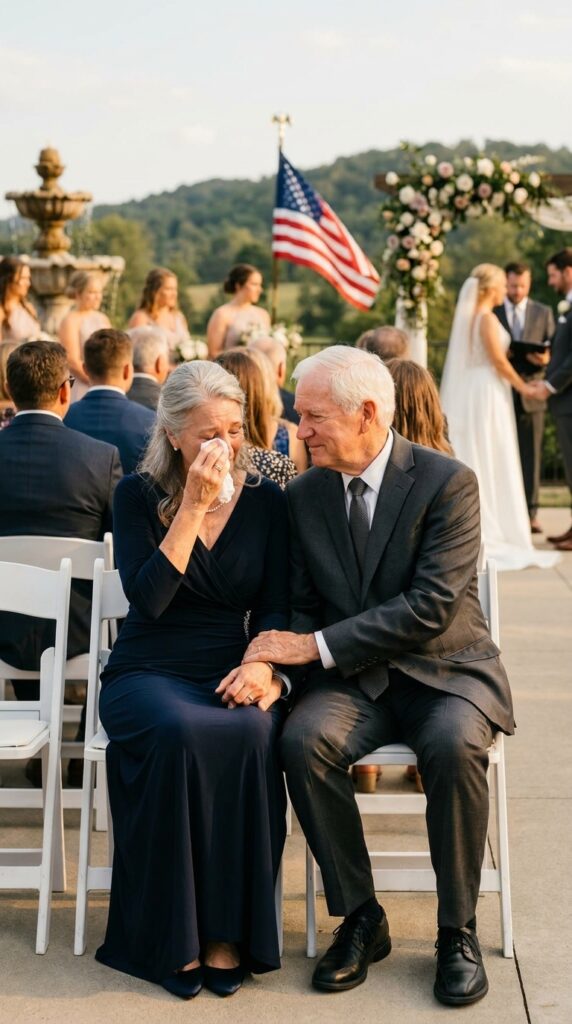
The estate in Aspen Grove looked like it belonged in a magazine. White chairs lined the garden in perfect rows. Polished stone paths curved around rose bushes trimmed with careful precision. A string quartet played softly near the fountain, and every guest seemed dressed for a photograph.
I wore my best navy dress.
It was simple, yes, but clean, pressed, and chosen with care. I had spent an hour smoothing my hair, adding the small pearl earrings my late husband once gave me, and telling myself that today was not about pride. It was about love.
My name is Judith Langley. I am sixty-eight years old, a retired English teacher, and for most of my life, I raised one child with quiet devotion.
That child was Andrew.
For years, he was my whole world.
I packed his lunches before sunrise. I stayed up late grading papers so I could pay for his school trips. I sat beside him through fevers, heartbreaks, exams, and every uncertain season of growing up. When his father and I had little, we gave Andrew everything we could.
Three years ago, I lost my husband.
Since then, the house had become too quiet. There were mornings when I still set out two coffee cups before remembering I only needed one. There were evenings when I sat at the kitchen table and listened to the old clock ticking louder than it ever had before.
So when Andrew’s wedding invitation arrived on thick cream paper, I held it longer than I should have.
The venue name was printed in gold lettering.
Aspen Grove Estate.
I had to read it twice.
I knew Andrew had built a different life now. He worked among people who spoke softly, dressed perfectly, and made everything look effortless. His bride, Lauren, came from a wealthy family with a name people seemed to recognize before she even entered a room.
Still, he was my son.
And I believed, perhaps foolishly, that a mother would always have a place.
When I arrived at the estate, a valet opened my car door with a polite nod. I stepped out carefully, smoothing the front of my dress. Around me, guests laughed lightly, kissed cheeks, compared watches, and moved through the garden as if they were used to places like this.
I was not.
But I lifted my chin and walked forward.
A wedding coordinator met me at the entrance with a clipboard and a practiced smile.
“Mrs. Langley?” she asked.
“Yes,” I said.
“Right this way.”
She led me past the first rows, where Lauren’s family sat beneath soft white flowers. She led me past the second and third rows, where Andrew’s colleagues were already seated, smiling and chatting with champagne glasses in hand.
I expected her to stop somewhere near the front.
She did not.
We kept walking.
Past the photographers.
Past the aisle arrangements.
Past almost everyone.
Finally, she stopped at the last row.
There were only a few chairs there, set apart from the others, almost hidden behind a tall floral arrangement.
“Here you are,” she said.
I looked at the small card on the chair.
Mrs. Judith Langley.
For a moment, I thought it had to be a mistake.
“This is my seat?” I asked quietly.
The coordinator’s smile did not change.
“Yes, ma’am. The family requested this arrangement for visual balance.”
Visual balance.
I stared at her, then toward the front where Andrew stood in his perfectly tailored tuxedo.
He saw me.
I know he did.
For one brief second, his eyes met mine.
Then he looked away.
That was the moment that hurt most.
Not the chair. Not the distance. Not even the whisper I heard from a woman near the aisle who leaned toward her friend and murmured, “They probably didn’t want the photos to look awkward.”
No.
What hurt was Andrew’s silence.
I sat down anyway.
Because dignity, I had learned, is not something other people give you. Sometimes it is the last thing you hold onto when everything else has been taken from your hands.
The music began.
Guests turned toward the aisle.
Lauren appeared beneath an arch of white flowers, glowing in a gown that shimmered every time she moved. She looked beautiful, confident, and completely sure she belonged at the center of the world.
Andrew watched her with a soft smile.
I tried to focus on that. I tried to tell myself that his happiness mattered more than my humiliation.
But as the ceremony continued, memories pressed against my heart.
Andrew at eight years old, running into my classroom after school with a paper crown on his head.
Andrew at twelve, falling asleep over a stack of books while I corrected his spelling homework.
Andrew at seventeen, standing in our small kitchen saying, “Mom, one day I’ll make you proud.”
I had been proud of him long before money, suits, or polished speeches.
I was still lost in those memories when the chair beside me shifted.
A man sat down.
He moved with calm confidence, as if no one had the right to question his presence. He wore a charcoal suit that looked perfectly made for him. His silver hair was neatly combed, and his expression was steady, composed, almost familiar in a way I could not explain.
He did not introduce himself immediately.
Instead, he rested his hand gently over mine.
I froze.
Then he leaned close enough for only me to hear.
“Do not sit like you are invisible,” he said.
My breath caught.
I turned slightly, but he kept his eyes forward.
“Who are you?” I whispered.
“Someone who remembers you before you were taught to make yourself small,” he said.
Before I could respond, he gave my hand a gentle squeeze.
“Your son is going to look over here soon,” he continued. “When he does, do not look away.”
Something in his voice made me listen.
I sat straighter.
I relaxed my shoulders.
I lifted my chin.
For the first time since arriving, I allowed myself to look like I belonged exactly where I was.
A quiet ripple moved through the guests.
People began glancing toward the back row.
At the altar, Andrew’s gaze finally swept across the ceremony.
It stopped on me.
Then it stopped on the man beside me.
Andrew went still.
His face changed so quickly that even Lauren noticed. Her smile faltered, and she followed his line of sight. When she saw the man beside me, confusion flickered across her face.
The man did not move.
He simply sat beside me, calm as stone, his hand still resting over mine like a promise.
The ceremony continued, but something had shifted.
Everyone felt it.
When the vows were finished and the guests rose for applause, I stayed seated for a moment, unsure whether to disappear quietly or try to find my place at the reception.
The man stood and offered me his arm.
“Walk with me, Judith,” he said.
Hearing my name in his voice made my chest tighten.
I looked up at him carefully.
“How do you know my name?”
His expression softened.
“Because once, you used to say mine.”
I took his arm, partly from confusion, partly because I was tired of standing alone.
We walked away from the ceremony chairs and into the garden, where guests gathered beneath strings of soft lights. Glasses clinked. Laughter floated through the air. The world went on celebrating, but around us, everything felt strangely quiet.
We stopped near a stone path lined with lavender.
I pulled my hand away gently.
“Please,” I said. “Tell me who you are.”
The man studied me for a long moment.
“Victor Sterling,” he said softly. “But you used to call me Vic.”
The name struck something deep inside me.
For a second, I could not speak.
Victor Sterling.
I had not heard that name in decades.
A young man with bright eyes and impossible dreams. A man who once waited for me outside the library with books under his arm. A man who had written poems on torn notebook paper and promised me a future that felt too large for the small town we came from.
Then one day, he vanished.
No goodbye.
No explanation.
No letter.
Nothing.
I had grieved him like a loss I was not allowed to name.
“That’s not possible,” I whispered.
Victor’s eyes filled with a sadness that had aged with him.
“I tried to reach you,” he said. “I wrote. I called. I came back twice.”
I shook my head.
“No. I never received anything.”
“I know,” he said. “I learned later that your mother stopped every letter before it reached you. She thought I had nothing to offer you. By the time I understood what had happened, your life had already moved forward.”
My knees felt weak.
All those years, I had believed he left because I had not been enough.
I looked away, trying to steady myself.
“My mother told me you changed your mind,” I said.
Victor’s jaw tightened, not with anger at me, but with the pain of too much time stolen.
“I never did.”
Before I could answer, footsteps approached quickly behind us.
“Mother.”
Andrew’s voice cut through the quiet.
I turned.
He was walking toward us with Lauren beside him. His face was tense, his mouth set in a line I recognized from childhood, the expression he wore when he wanted control over a situation slipping away from him.
Lauren’s smile was gone now.
Her eyes moved over Victor with sharp curiosity.
“Who is this man?” she asked.
Victor looked at her calmly.
“I am someone who has known Judith longer than either of you have known how to respect her properly.”
Andrew stiffened.
“That’s unnecessary,” he said.
Victor’s expression did not change.
“So was seating your mother in the last row.”
Lauren’s cheeks flushed.
“It was a seating arrangement,” she said quickly. “Weddings require planning. Everything needed to look a certain way.”
I felt those words land in the center of my chest.
Everything needed to look a certain way.
There it was.
The truth, dressed politely.
Andrew looked uncomfortable, but he still did not defend me.
“Mother,” he said, lowering his voice, “you could have spoken to me privately instead of creating attention.”
I stared at him.
“Creating attention?” I repeated.
He glanced toward the guests, several of whom were pretending not to watch.
“You know what I mean.”
“No,” I said quietly. “I don’t think I do.”
For years, I had softened my words for Andrew. I had excused his distance, his short calls, his missed visits, his careful way of keeping me separate from the more polished parts of his life.
But standing there in that garden, beside a man from my past who somehow saw me more clearly than my own son did, I could no longer pretend.
“I came here today because you are my son,” I said. “I came because I love you. I sat where I was told to sit. I smiled when people whispered. I stayed quiet when you looked away. What more did you want from me, Andrew? To disappear completely?”
His face changed.
For the first time that day, I saw shame pass across it.
Lauren crossed her arms.
“This is not the time,” she said.
Victor turned toward her.
“Then perhaps it should have been considered before Judith was treated like an inconvenience.”
Lauren opened her mouth, but Victor calmly reached into his pocket and made a brief phone call.
He did not raise his voice. He did not threaten. He simply spoke a few words and ended the call.
Minutes later, a black car pulled up near the edge of the garden.
The driver stepped out immediately and nodded respectfully.
“Mr. Sterling.”
A hush moved through the nearby guests.
Lauren’s eyes widened.
Andrew looked between Victor and the car.
Victor’s voice remained even.
“Lauren, your family’s business currently depends on several agreements connected to my firm. I will not discuss business at a wedding, but I will say this: how people treat those they think are powerless often reveals more than any contract ever could.”
Lauren’s confidence faltered.
For the first time, she looked unsure.
Andrew turned to me, panic and confusion mixing in his eyes.
“Mom, I didn’t know—”
I lifted a hand.
“Didn’t know what, Andrew? That I could know someone important? That I could be seen by someone else? Or that your silence would finally become too heavy for me to carry?”
He looked down.
The garden noise seemed far away now.
Victor stepped back, giving me space to decide for myself.
“You do not have to stay where you are not respected,” he said gently.
I looked at my son.
I still loved him.
That was the painful truth.
Love does not vanish just because someone disappoints you. A mother’s heart does not close like a door. But love also cannot survive forever if it is asked to kneel every time it enters the room.
“I hope your marriage teaches you kindness,” I said to Andrew. “And I hope one day you understand that success means very little if it makes you ashamed of the people who helped you reach it.”
His eyes filled, but I did not wait for an answer.
I took Victor’s arm.
Together, we walked away from the garden, past the flowers, past the rows of perfect chairs, past the people who had decided I did not belong near the front.
For the first time in years, I did not feel like I was leaving because I had been pushed out.
I was leaving because I had chosen myself.
That evening, Victor took me to a quiet restaurant far from Aspen Grove Estate. No photographers. No polished guests. No careful seating chart.
Just a small table near a window, warm lights overhead, and the strange comfort of speaking to someone who remembered a version of me I thought time had erased.
We talked for hours.
He told me about the letters he had written. The years he had spent building his company. The regret he carried not because life had moved on, but because a truth had been buried before either of us had the chance to understand it.
I told him about my husband, about Andrew, about widowhood, about the slow ache of becoming invisible inside your own family.
Victor listened without interrupting.
At one point, my phone began lighting up on the table.
Andrew.
Then again.
And again.
Messages appeared one after another.
Mom, please answer.
We need to talk.
I didn’t mean for it to feel that way.
Please don’t leave like this.
I’m sorry.
I stared at the screen.
For most of my life, I would have answered immediately. I would have comforted him before comforting myself. I would have made his regret easier to carry, even while my own heart was still aching.
But that night, I placed the phone face down.
Victor noticed, but said nothing.
I looked out the window at the city lights.
“I spent years believing that if I stayed patient enough, my son would eventually see me,” I said.
Victor’s voice was gentle.
“He sees you now. But you must decide whether he sees you with respect.”
I nodded slowly.
The next morning, I called Andrew.
Not because he demanded it.
Because I was ready.
His voice broke when he answered.
“Mom.”
I closed my eyes.
“I’m here,” I said. “But I need you to listen.”
And for the first time in a long time, he did.
I told him how it felt to be placed in the back row. How it felt to hear the reason hidden behind pretty words. How it felt to watch him choose silence when I needed him to stand beside me.
Andrew cried quietly.
Then he said the words I had waited years to hear.
“I was ashamed of where I came from,” he admitted. “And I let Lauren’s world make me forget what you gave up for me. I’m sorry, Mom. I’m so sorry.”
I did not forgive him completely in that single moment.
Real healing does not happen because someone says the right words once.
But I heard something real in his voice.
So I gave him a chance.
Not to erase what happened.
Not to pretend the wedding had not hurt me.
But to begin again, slowly, honestly, with boundaries I should have set long ago.
As for Victor, he did not sweep into my life like a fairy tale. We were not young people pretending time had not passed. We were older, wiser, carrying grief, history, and unfinished conversations.
But he called the next day.
And the day after that.
And one Sunday, he came over with coffee and a book of poems he had kept for forty years.
Inside the front cover was a note written in faded ink.
For Judith, who always deserved to be seen.
I cried when I read it.
Not because my life had suddenly become perfect.
But because, after years of shrinking to fit inside other people’s comfort, I remembered something important.
My life had never truly stopped.
It had only been waiting for me to stand up inside it again.
━━━━━━━━━━━━━━━━━━━━━━━━━━━━━━━━━━━━━━