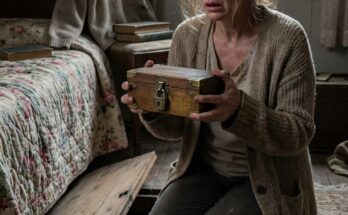
We hadn’t spoken in 15 years. When the hospice called, I refused to go. But the nurse said he left something for me, a single envelope with my name on it. She gave it to me after he passed.
I’ve been staring at it for three days. Part of me thinks it’s an apology, but the bigger part of me is terrified it will just confirm everything I always feared.
I don’t know if I’m strong enough to read his final words to me.
I had not spoken to my father in fifteen years.
Not on birthdays.
Not on holidays.
Not when I got promoted at work.
Not when I bought my first house.
Not even when my mother passed away and the church was filled with people pretending they knew what our family had been.
People always think silence happens suddenly, like a door slamming shut.
But silence can also build slowly.
One unanswered call at a time.
One painful memory at a time.
One sentence you wish you had never heard.
By the time my father and I stopped speaking, the silence between us already felt older than both of us.
His name was Richard Hale, but I had not called him Dad in years. Not out loud, anyway.
To everyone else, he was a quiet, hardworking man. A man who fixed his own truck, paid his bills on time, and nodded politely at neighbors. People respected him because he never caused trouble in public.
But inside our house, he was different.
He was not always cruel. That was the hardest part to explain. Some days, he could be gentle. He could make pancakes shaped like stars when I was little. He could carry me on his shoulders through the county fair. He could sit beside me during thunderstorms and tell me the sky was just “moving furniture around.”
Those memories made the painful ones harder to understand.
Because the same man who once taught me how to ride a bike also taught me how quickly a room could turn cold.
When I was a teenager, we argued constantly. He wanted obedience. I wanted an explanation. He believed feelings made people weak. I believed silence made people disappear.
The final argument happened when I was twenty-two.
I had come home for dinner after my mother begged me to “make peace.” I still remember the smell of roast chicken, the clinking forks, the way my mother kept smiling too brightly.
Everything was tense from the beginning.
Then my father asked why I had not applied for the job at his friend’s company.
I told him I had already accepted another offer.
He looked at me as if I had embarrassed him.
“You always think you know better,” he said.
I tried to stay calm. I really did.
“I just want to build my own life.”
His face hardened.
“You’ll come running back when that life disappoints you.”
Something inside me broke then.
Maybe it was not just that sentence. Maybe it was every sentence before it. Every time he made love feel conditional. Every time he turned my dreams into an insult. Every time I waited for him to say he was proud and heard only criticism instead.
I stood from the table.
“I’m done trying to earn love from someone who keeps moving the price.”
My mother whispered my name.
My father pushed back his chair.
“If you walk out that door,” he said, “don’t expect me to chase you.”
I looked at him, waiting.
Waiting for the softer part of him to return.
Waiting for the father from the county fair.
Waiting for him to say he did not mean it.
He said nothing.
So I walked out.
And he never chased me.
For fifteen years, I told myself that was proof.
Proof that I had been right.
Proof that I meant less to him than his pride.
Proof that whatever love he had for me was never strong enough to cross the distance he helped create.
Then the hospice called.
It was a Tuesday evening in January. Snow had been falling all afternoon, covering my driveway in a white silence that made the world feel paused.
I was in my kitchen, washing a mug, when my phone rang.
The number was unfamiliar.
I almost ignored it.
But something made me answer.
“Is this Daniel Hale?” a woman asked gently.
“Yes.”
“My name is Rebecca. I’m a nurse at Cedar Grove Hospice. I’m calling about your father, Richard Hale.”
My hand tightened around the phone.
For a moment, I said nothing.
“I’m sorry to call like this,” she continued. “Your father’s condition has changed. He asked us to contact you.”
The sound of water running from the faucet suddenly felt too loud.
I turned it off.
“He asked for me?” I said.
“Yes.”
I let out a small, humorless laugh.
“That’s surprising.”
The nurse did not respond to that. She had probably heard every kind of family pain in that place. Anger. regret. guilt. relief. All the emotions people carry when time begins to run out.
“He would like to see you,” she said.
I looked out the window at the snow.
For fifteen years, I had imagined this moment more times than I wanted to admit. I imagined him calling. I imagined him saying he was sorry. I imagined myself hanging up. I imagined myself forgiving him. I imagined showing up at his door older, stronger, untouched.
But real life did not feel powerful.
It felt heavy.
“I can’t,” I said.
The nurse was quiet.
“I understand,” she replied softly.
But I was not done.
“No,” I said, sharper than I meant to. “I don’t think you do. We haven’t spoken in fifteen years. He had time. He had years. If he wanted to say something, he could have said it before now.”
“I understand,” she said again, and somehow that made me angrier because she sounded like she truly did.
I ended the call before my voice could break.
That night, I did not sleep.
I kept seeing my father at the dinner table, his jaw tight, his eyes cold. I kept hearing the sentence that had followed me for years.
Don’t expect me to chase you.
By morning, I had convinced myself I had made the right choice.
Two days later, the hospice called again.
This time, I let it go to voicemail.
I listened to the message three hours later while sitting in my car outside a grocery store.
“Mr. Hale, this is Rebecca from Cedar Grove Hospice. I’m very sorry to tell you that your father passed away early this morning. Before he passed, he left something for you. It’s a sealed envelope with your name on it. He asked that you receive it personally. Please call when you’re ready.”
I sat there with my hands on the steering wheel while people walked past my car carrying bread, milk, and ordinary lives.
I did not cry.
That surprised me.
For years, I had wondered what I would feel when my father was gone. Sadness? Relief? Nothing?
But what I felt first was confusion.
Because death is supposed to close a door.
Instead, he had left one last thing behind.
The envelope arrived the next afternoon.
Rebecca brought it herself. She was a woman in her fifties with kind eyes and a tired face. She stood on my porch holding a small white envelope between both hands, as if it were fragile.
“I’m sorry for your loss,” she said.
I almost told her I was not sure it was a loss.
Instead, I nodded.
She handed me the envelope.
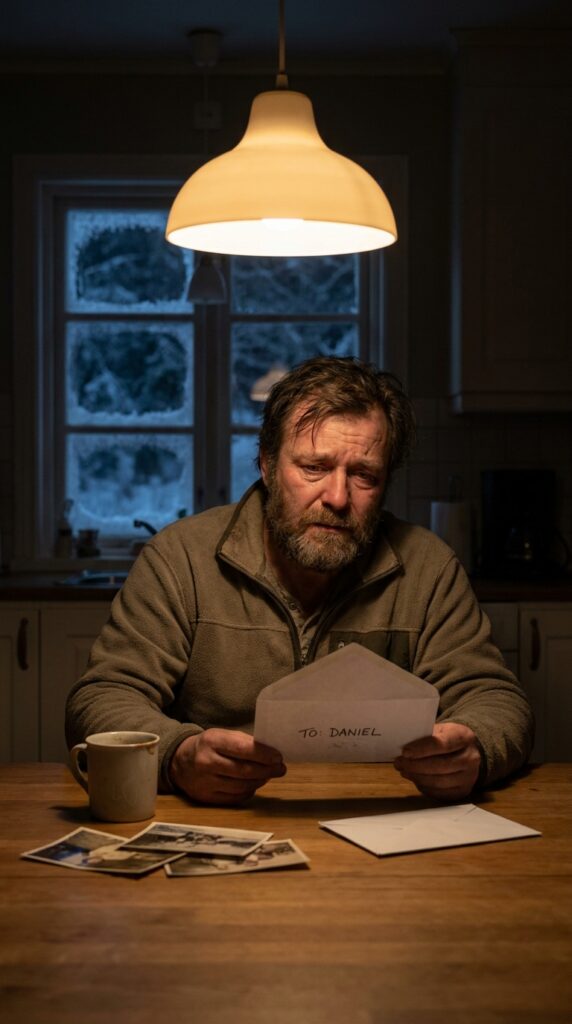
My name was written on the front in shaky handwriting.
Daniel.
Not Danny.
Not son.
Just Daniel.
I stared at it.
“He wrote it himself?” I asked.
She nodded. “It took him a while.”
I swallowed.
“Did he say anything before he passed?”
Rebecca hesitated, not dramatically, but carefully.
“He said he hoped you would read it. But he also said he understood if you didn’t.”
Those words unsettled me more than I expected.
For three days, I left the envelope on my kitchen table.
I moved around it like it was alive.
In the morning, I saw it beside my coffee cup.
At night, I saw it under the yellow kitchen light.
Once, I picked it up, felt the paper bend slightly under my fingers, then placed it back down as if it had burned me.
Part of me thought it might be an apology.
The smaller, quieter part of me wanted that more than I wanted to admit.
But the larger part of me was afraid.
Afraid he had used his final words to defend himself.
Afraid he had written something cold.
Afraid the letter would confirm what I had always feared: that my father had never truly loved me, only the version of me that obeyed him.
On the fourth night, I called my mother’s younger sister, Aunt Claire.
She was the only person in the family who had never tried to force forgiveness onto me. She had loved my mother deeply, tolerated my father politely, and always told the truth with a kindness that made it harder to ignore.
“I have his letter,” I told her.
She was quiet for a moment.
“Have you opened it?”
“No.”
“Do you want to?”
“I don’t know.”
“That usually means yes,” she said gently. “But not alone.”
I pressed my palm against my forehead.
“What if it makes everything worse?”
Aunt Claire sighed.
“Then you’ll know. And if it doesn’t, you’ll know that too.”
“I don’t want to forgive him just because he died.”
“You don’t have to,” she said. “Reading a letter is not the same as forgiving. It’s only receiving what was left.”
The next morning, I took the envelope to my mother’s grave.
I do not know why.
Maybe because she had spent years standing between us. Maybe because she had wanted peace so badly that she often confused it with silence. Maybe because part of me still needed her permission to feel whatever came next.
The cemetery was quiet. Snow rested on the grass in thin patches. I brushed some from her headstone and sat on the cold bench nearby.
For a long time, I held the envelope in my lap.
Then I opened it.
The paper inside was folded twice.
His handwriting was uneven, but I recognized it immediately. The same handwriting from birthday cards, school permission slips, and labels on old toolboxes in the garage.
Daniel,
I do not know if you will read this. I do not know if I deserve for you to read it.
I asked the nurse to call you, but I told myself not to expect anything. I said the same thing to you fifteen years ago, and I have regretted it longer than you know.
You walked out because I gave you no reason to stay.
I stopped after the first paragraph.
My breath trembled in the cold air.
For fifteen years, I had imagined his version of that night. In my mind, he always blamed me. He always called me ungrateful. He always made himself the wounded father and me the rebellious son.
But the letter did not begin with blame.
It began with the sentence I never thought he would understand.
I kept reading.
I was proud of you. I need you to know that first, even if knowing it now does not help.
I was proud when you left home. Proud when you got that job. Proud when your mother showed me the picture of your first house. Proud every time someone mentioned your name.
But pride was easier for me to feel than to say.
I came from a father who never praised anyone. I told myself I was stronger than him, better than him, but I repeated more of his ways than I ever wanted to admit.
That is not an excuse. It is only the truth.
I hurt you because I was afraid of losing control. I thought being a father meant shaping you into what I understood. When you became your own man, I treated it like disrespect instead of what it was.
It was courage.
My eyes blurred.
For a while, I could not see the page.
The wind moved gently through the bare branches above me.
I wiped my face with the back of my hand and continued.
The night you left, I wanted to call after you.
I stood by the window and watched your car pull away. Your mother cried in the kitchen. I told myself I was teaching you a lesson.
But the truth is, I was too proud to admit I was wrong.
The next morning, I picked up the phone three times.
I never called.
After that, every day made it harder.
A week became a month. A month became a year. Then I convinced myself you were better without me, because that was easier than admitting I was afraid you would reject me.
I failed you.
Not because I was imperfect.
Every father is imperfect.
I failed you because I let pride speak louder than love.
I pressed the letter against my chest and closed my eyes.
There was grief in me, yes.
But beneath it was something sharper.
Anger.
Because he had known.
All those years, he had known.
He had stood at the edge of the same silence I had stood on, and neither of us crossed it.
I wanted to hate him for that.
Part of me still did.
Then I read the last page.
I am not asking you to forget.
I am not asking you to tell people I was better than I was.
I am not asking you to forgive me because I am gone.
I am asking only one thing.
Do not let my silence become yours.
If there is someone you love, tell them. If there is a door you want to open, do not stand outside it for fifteen years like I did.
You deserved a father who knew how to come after you.
I am sorry I was not brave enough to be that father when it mattered.
I loved you, Daniel.
I loved you badly sometimes.
I loved you quietly too often.
But I loved you.
Dad
That last word broke me.
Dad.
I sat in the cemetery and cried in a way I had not cried since I was a boy.
Not because the letter fixed everything.
It did not.
It did not erase the years. It did not give me back the birthdays, the conversations, the simple comfort of having a father who knew how to say, “I’m proud of you.”
But it changed one thing.
It answered the question I had carried like a stone inside my chest.
Did he love me?
The answer was not perfect.
But it was real.
A week after the funeral, I went to his house.
It had been years since I stepped inside. The place smelled like dust, old wood, and the faint scent of motor oil from the garage. His boots were still by the back door. A coffee mug sat beside the sink. His jacket hung on the same hook it always had.
In the living room, I found a box with my name written on it.
Inside were things I did not know he had kept.
Newspaper clippings from my college graduation. A printed photo from my company website. A Christmas card I sent my mother years earlier with my return address circled lightly in pencil.
At the bottom was an old photograph.
I was six years old, sitting on his shoulders at the county fair, holding a paper cup of lemonade. He was looking up at me and laughing.
I sat on the floor for a long time holding that picture.
Aunt Claire came by later and found me there.
“You read the letter,” she said.
I nodded.
“And?”
I looked around the room, at the house that had held both love and pain, both warmth and silence.
“I don’t know what I feel,” I admitted.
She sat beside me.
“That’s honest.”
“I’m still angry.”
“You can be.”
“I miss someone I’m not sure I ever fully had.”
Her eyes softened.
“That’s grief too.”
In the months that followed, I learned that closure is not always a clean ending.
Sometimes closure is messy.
Sometimes it is reading a letter too late.
Sometimes it is crying for the child you were.
Sometimes it is admitting that love can be real and still not be enough to protect you from hurt.
I did not suddenly become a man who spoke about my father easily.
But I stopped pretending I felt nothing.
I framed the photograph from the county fair and placed it on a shelf in my office. Not because I wanted to rewrite the past, but because I wanted to remember all of it honestly.
The father who hurt me.
The father who loved me badly.
The father who waited too long to say what mattered.
And the son who finally opened the letter.
A year later, on January 12, I returned to the cemetery.
This time, I brought two cups of coffee.
One for me.
One for him.
It was foolish, maybe, but grief makes room for small rituals.
I stood by his headstone and looked at his name.
“I read it,” I said quietly. “I wish you had said it sooner.”
The wind moved through the trees.
Of course, there was no answer.
But for the first time, I did not feel like I was waiting for one.
I placed my hand on the cold stone.
“I’m still angry,” I whispered. “But I’m not carrying the question anymore.”
Then I walked away.
Not healed completely.
Not free from every memory.
Not suddenly full of forgiveness.
But lighter.
Because sometimes the final words we fear most are not the ones that destroy us.
Sometimes they are the ones that finally let us breathe.