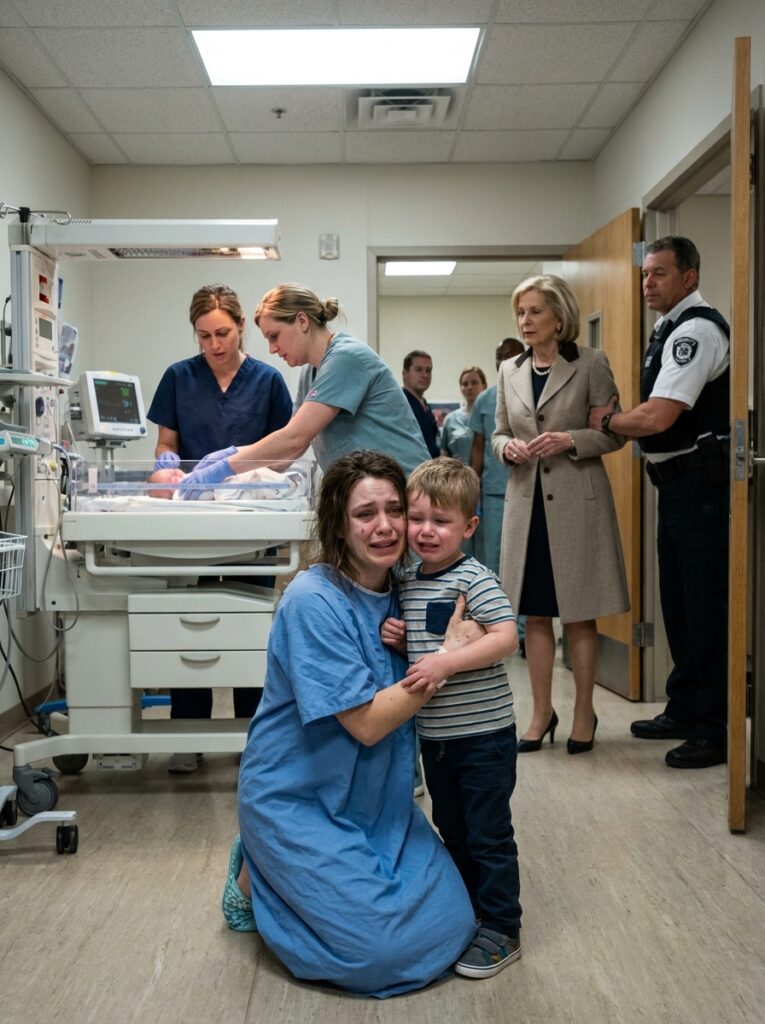
The hospital room felt too small for the pain inside it.
Only hours earlier, it had been a room of soft voices, whispered prayers, tiny blankets, and the fragile joy that comes when a new life enters the world. I had held my newborn son against my chest and counted his fingers through tears. I had kissed his warm forehead and promised him silently that I would protect him from everything.
But now the room felt cold.
Empty.
Wrong.
The air conditioner hummed above us, steady and emotionless, as if nothing had changed. The white walls seemed brighter than before, almost cruel. The bassinet beside my bed sat silent, its clear plastic sides reflecting the fluorescent lights. A small dent still marked the sheet where my baby’s head had rested.
My son, Evan, had been alive for only twelve hours.
Then the doctor stood beside my bed with tired eyes and a voice that sounded too gentle for the words he had to say.
“I’m sorry,” he said. “We did everything we could.”
For a moment, I did not understand him.
My mind refused to accept it.
A mother does not hear that sentence and believe it the first time. She waits for someone to correct it. She waits for a nurse to rush in and say there has been a mistake. She waits for a cry. A movement. Anything.
But no cry came.
No tiny hand moved.
No miracle arrived.
They mentioned possibilities in low voices. Sudden infant complications. A hidden heart condition. Something missed during the scans. Something no one could have predicted.
It did not matter what they called it.
My baby was gone.
I sat on the edge of the hospital bed, my legs hanging over the side, my body still weak from delivery. The thin hospital gown clung to me, useless against the cold spreading through my chest. My arms ached with the memory of holding him. My heart kept reaching for a baby who was no longer there.
Across the room stood Margaret Collins.
My mother-in-law.
She was by the window, wearing a beige cashmere cardigan, her silver hair shaped perfectly around her face. Everything about her looked controlled. Neat. Untouched.
She did not look like a grandmother who had just lost a grandson.
She looked like someone who had survived an inconvenience.
Beside her stood Claire, my sister-in-law, with the same polished coldness in her face. Claire had always looked at me like I had somehow wandered into the Collins family by mistake. Like my marriage to Daniel had been an error that proper people tolerated but never accepted.
Margaret leaned toward Claire.
Her voice was low, but the room was quiet enough for every word to cut through me.
“God saved this world from your bloodline.”
I froze.
For one terrible second, even my grief stopped moving.
The words did not just hurt. They entered me like ice.
Your bloodline.
That was what she had thought of me for five years.
Not Sarah.
Not Daniel’s wife.
Not the mother of her grandchildren.
A bloodline.
Something dirty.
Something beneath her.
Something she believed the world had been spared from.
I turned slowly toward my husband.
Daniel stood near the foot of the bed with his hands deep in his pockets. He had heard her. I knew he had heard her because his shoulders tightened the moment she said it.
“Daniel?” I whispered.
He did not look at me.
He stared out the window at the parking lot below as if the rows of cars were suddenly more important than his wife’s broken heart.
“Daniel,” I said again, my voice cracking. “Look at me.”
He turned his face away.
And somehow, that hurt almost as much as losing Evan.
Because in that moment, I realized I was not only grieving my baby.
I was also watching the man I loved choose silence.
Margaret had just insulted our dead child, and Daniel did nothing. He did not defend Evan. He did not defend me. He did not even tell his mother to stop.
He simply stood there.
Cowardly.
Still.
Absent.
Then a chair scraped softly against the floor.
I looked toward the corner.
My eight-year-old son, Noah, had been sitting there with a coloring book on his lap. He had been trying to make himself small all morning, the way children do when adults are drowning in something they cannot understand. His little shoulders were hunched. A blue crayon was clutched tightly in his hand.
Slowly, Noah slid down from the chair.
He walked into the center of the room.
His face was pale. His eyes were wide. But his voice, when he spoke, was clear enough to change everything.
“Mom?”
Every adult in the room turned toward him.
Noah swallowed.
“Should I give the doctor the powder Grandma put in the milk?”
The world stopped.
The nurse near the monitor froze with one hand still lifted. The doctor, who had been writing something on a clipboard, slowly looked up.
Margaret’s face changed first.
Her small, satisfied smile vanished. Fear flashed across her eyes so quickly that I almost missed it. Then outrage covered it like a curtain.
“What did you say?” she snapped.
Noah flinched but did not step back.
He pointed toward the nurse’s cart near the wall.
“The powder,” he said, his voice shaking now. “Grandma put it in Evan’s bottle. She said it was special vitamins. She told me not to tell Mommy because Mommy worries too much.”
“Noah,” I whispered.
My heart began to pound so hard it hurt.
Margaret stepped forward.
“He is lying,” she said loudly. “He is confused. He is a grieving child trying to get attention.”
Noah’s eyes filled with tears, but he kept pointing.
“She crushed it in that tissue,” he said. “Then she put it behind the gloves.”
The nurse moved before Margaret could.
Her name was Brenda, and she had been with me since I was admitted. She was warm, practical, and kind in a way that made me trust her immediately. But now her face hardened.
She stepped in front of Margaret and reached for the lower shelf of the cart.
Behind a box of gloves, tucked nearly out of sight, was a crumpled white tissue.
Brenda picked it up carefully.
She opened it.
Inside was a faint residue of white crystalline powder clinging to the paper.
“Doctor,” Brenda said, her voice tight. “There’s residue here.”
The doctor rushed forward.
Brenda continued, her eyes sharp now.
“And the baby drank from that bottle about twenty minutes before he stopped responding.”
The doctor’s face changed completely.
He dropped the clipboard.
“Get the crash cart back in here,” he shouted. “Now.”
Margaret’s voice rose in panic.
“No. No, leave him alone. He’s gone. Let him rest.”
The doctor ignored her and moved to the bassinet.
He placed his stethoscope against Evan’s tiny chest. His whole body went still as he listened.
Then he looked up.
“Code Blue,” he shouted. “Possible poisoning. Get NICU. Get toxicology. Now.”
The room exploded into motion.
Nurses rushed in. A security guard appeared in the doorway. Someone pulled Margaret back as she started screaming that I had turned Noah against her. Claire began sobbing. Daniel stood frozen against the wall, white-faced and useless.
But I was not watching them.
I was watching Noah.
My little boy stood in the middle of the chaos, trembling, still holding that blue crayon like it was the only thing keeping him standing.
“Did I do good, Mom?” he whispered.
I slid off the bed.
My legs nearly gave out, but I reached him. I wrapped my arms around him and held him as tightly as I could.
“Yes, baby,” I sobbed into his hair. “You did good. You did so good.”
They rushed Evan out of the room moments later.
I tried to follow, but a nurse gently stopped me. I was still weak. The police had been called. There were questions. Statements. Procedures.
But all I could hear was the sound of wheels racing down the hallway.
All I could think was:
Please.
Please let my baby still be in there somewhere.
Within minutes, two officers arrived. One stayed near the door. The other began speaking to Brenda and the doctor. Soon after, a detective came in.
Her name was Detective Miller. She had a calm, serious face and the kind of eyes that missed nothing.
She knelt in front of Noah.
“Noah,” she said gently, “I need you to tell me exactly what you saw. Take your time.”
Noah looked at me first.
I squeezed his hand.
“It’s okay,” I whispered. “Tell the truth.”
He nodded.
“Grandma came in when Mom was asleep,” he said. “Dad went to get coffee. The nurse left because someone called her from another room.”
Detective Miller nodded slowly.
“What did your grandmother do?”
“She took a little bag out of her purse,” Noah said. “She put something in a tissue and crushed it. Then she poured it into Evan’s bottle and shook it.”
My stomach turned.
“And did she say anything to you?” the detective asked.
Noah nodded again.
“She saw me looking,” he said. “She smiled at me. She gave me five dollars and said it was just special vitamins to make Evan strong. She said Mommy was tired and worried too much, so it should be our little secret.”
I covered my mouth.
I felt like I might be sick.
Margaret had not only harmed my baby.
She had tried to make my son carry the secret.
She had tried to bury the truth inside an eight-year-old child.
Detective Miller stood.
“Mrs. Collins,” she said to me, “does your mother-in-law take any medication?”
I wiped my face with the back of my hand.
“She has a heart condition,” I said. “She takes strong heart medication. I know she takes Digoxin. And something else for her blood pressure. Beta-blockers, I think.”
The detective’s expression sharpened.
Before she could answer, the door opened.
The doctor stepped in.
His face was damp with sweat. His hair was disheveled. He looked exhausted, but his eyes were alive with urgency.
I stood so quickly the room tilted.
“Please,” I whispered.
The doctor took a breath.
“We found a pulse.”
I screamed.
It came from somewhere deeper than my voice. Somewhere under my ribs. Somewhere grief had already dug its grave.
The doctor reached for my arm to steady me.
“It’s faint,” he said quickly. “But he is alive. His heart rate had dropped so low that it was almost impossible to detect during the initial emergency. Based on what your son told us and the residue we found, we treated him immediately for suspected Digoxin toxicity. He is in critical condition, but we have him on support. The next few hours are very important.”
Alive.
My baby was alive.
The word did not feel real.
I kept repeating it inside my head until it became the only thing holding me together.
Alive.
Alive.
Alive.
They allowed me to see Evan in the NICU after the police finished taking my statement.
He looked impossibly small inside the incubator.
Tubes surrounded him. Wires covered his tiny chest. Machines breathed and beeped around him. But his chest moved.
Up.
Down.
Up.
Down.
I pressed my hand against the glass.
“Fight, baby,” I whispered. “Please fight. Mommy is here.”
Noah stood beside me, his hand tucked into mine. He was too young to understand everything, but he understood enough.
“Is he going to be okay?” he asked.
I knelt beside him and pulled him close.
“I hope so,” I said. “And because of you, he has a chance.”
For the first time that day, Noah cried.
Not loud. Not dramatic. Just quiet little sobs into my shoulder.
I held him with one arm and kept my other hand pressed against the incubator glass.
Those were my sons.
One fighting to live.
One brave enough to speak.
And I knew then that my life had split into before and after.
Later that evening, I found Daniel sitting on a bench outside the NICU.
His head was in his hands. He looked up when he heard my footsteps.
“Sarah,” he whispered.
He stood and reached for me.
I stepped back.
His hand froze in the air.
“How is he?” Daniel asked.
“He’s alive,” I said. “No thanks to you.”
His face crumpled.
“I didn’t know,” he said. “You have to believe me. I didn’t know she would do something like this.”
“No,” I said quietly. “You didn’t know she would go that far. But you knew she hated me.”
He looked down.
“You knew she hated Noah,” I continued. “You knew she never accepted him because he wasn’t your biological son. You knew she called me trash when she thought I couldn’t hear. You knew she made comments about my family, my background, my job, my son, my worth.”
Daniel’s eyes filled with tears.
“She’s my mother,” he said weakly.
“And I was your wife,” I said. “Evan is your son. Noah is the child you promised to love when you married me. But every time she crossed a line, you looked away.”
“I was in shock,” he pleaded. “I didn’t know what to say.”
“That has always been your excuse,” I said. “You never know what to say when your mother is cruel. You never know what to say when I am humiliated. You never know what to say when Noah is made to feel unwanted. And because you never stopped her, she believed she could do anything.”
He shook his head.
“I’ll fix this.”
I stared at him.
“Fix this?” I said. “Daniel, your mother is in custody because she tried to take our baby from us. This is not a family argument. This is not something you solve with an apology over dinner.”
His face went pale.
“I’ll testify,” he said quickly. “I’ll tell them what I know.”
I searched his face.
And for one small moment, I wanted to believe him.
Then I remembered the hospital room.
The way he turned his back.
The silence.
The shameful silence.
“I want a divorce,” I said.
“Sarah, please,” he begged. “Not now. We need to stay together for the kids.”
“No,” I said. “I need to stay strong for the kids. There is a difference.”
He reached for me again, but I stepped away.
“You have one chance to do the right thing,” I told him. “Tell the police every threat, every comment, every hateful thing she has ever said. Tell the truth, Daniel. Not for me. For your son.”
He stared at me.
For one second too long.
In that second, I saw the old Daniel again. The man measuring scandal. Reputation. Inheritance. The Collins name.
That one hesitation told me everything.
I turned and walked back into the NICU.
Six months later, the trial began.
The entire city seemed to know about it.
Margaret Collins, the wealthy family matriarch who once hosted charity luncheons in pearls and cream-colored suits, now sat in a courtroom wearing prison orange. She looked smaller without her mansion behind her. Smaller without servants, money, and silence protecting her.
But not sorry.
Never sorry.
Her lawyers tried everything.
They claimed confusion. Stress. Age. A possible medical episode. They suggested she had never meant to harm Evan. They said she only wanted to help.
Then Noah took the stand.
My brave boy sat in that big wooden chair with his feet barely touching the floor. His hands shook, but his voice did not break.
The prosecutor asked, “Noah, what did your grandmother tell you about the powder?”
Noah looked at Margaret, then looked away.
“She said it was a secret,” he answered. “She said Mommy’s blood was bad. She said she had to fix the baby.”
A gasp moved through the courtroom.
Margaret’s mouth tightened.
Then came the recording.
I had forgotten about it until days after Evan stabilized. I had placed my phone near the bassinet that morning with a baby monitor app recording because I wanted to capture Evan’s first little sounds. I had wanted to save something sweet.
Instead, it saved the truth.
The courtroom went silent as the audio played.
There was the faint hum of the hospital room.
The soft rustle of clothing.
Then Margaret’s voice.
“Just a little, precious. We can’t have you growing up like her. Better innocent now than tainted later.”
Then the sound of a bottle being shaken.
That was the moment her defense collapsed.
Her lawyer lowered his head.
Claire cried in the back row.
Daniel sat behind me, looking broken and old. He had sent letters, flowers, apologies. He had left voicemails full of regret.
But regret is not the same as courage.
And love that arrives only after damage is done does not rebuild what silence destroyed.
During sentencing, I was allowed to speak.
I walked to the podium with Noah sitting behind me and Evan safe in my mother’s arms. Evan was still small. Still recovering. Still monitored by doctors. But he was alive.
I looked directly at Margaret.
For years, I had lowered my eyes around her. I had swallowed insults. I had made myself smaller for the sake of peace.
Not anymore.
“You spoke about my bloodline,” I said. “You said the world needed to be saved from it.”
Margaret looked away.
I continued.
“But my bloodline produced the child who saw the truth when adults refused to. My bloodline produced the boy who spoke up when your own son stood silent. My bloodline saved a life.”
My voice trembled, but I did not stop.
“Your bloodline tried to end one.”
The courtroom was still.
“So no,” I said. “God did not save the world from my bloodline. He used my bloodline to expose yours.”
The judge sentenced Margaret to twenty-five years.
Given her age and health, everyone knew what that meant.
She would never again stand in a hospital room and decide who was worthy of living.
Three years have passed since that day.
Evan is a bright, stubborn, joyful toddler now. He has a slight heart rhythm issue that doctors still monitor, a small shadow left behind by what happened to him. But most days, he is simply a little boy with muddy shoes, loud laughter, and an obsession with toy trucks.
Noah is eleven.
He is still quiet. Still observant. Still the kind of child who notices what others miss.
Some nights, he has nightmares. Some days, he asks questions no child should have to ask. We go to therapy together. We talk. We heal slowly, honestly, without pretending the past did not happen.
He says he might become a detective one day.
Or maybe a doctor.
I tell him he has time to choose.
As for Daniel, the divorce was painful, but necessary.
He fought for custody at first, more for his image than for the boys. In court, the truth followed him. His silence in that hospital room followed him. His years of allowing Margaret’s cruelty followed him.
I was granted full custody.
He was given supervised visits.
He does not always come.
And when he does, Noah is polite but distant. Evan barely knows him.
That is Daniel’s consequence.
Not because I poisoned my children against him.
Because children remember who stood still when they needed protection.
We live in a smaller house now.
A warm little bungalow far from the Collins estate, with a lemon tree in the yard and sunlight in the kitchen every morning. It is not grand. It does not have marble floors or iron gates or a family name carved into anything.
But it is peaceful.
And peace, I have learned, is worth more than any inheritance.
Some nights, after both boys are asleep, I stand in the hallway between their rooms.
I look at Evan curled under his blanket, breathing softly.
Then I look at Noah, sprawled across his bed with a book open beside him.
And I remember the hospital room.
The empty bassinet.
The words that were meant to destroy me.
God saved this world from your bloodline.
Margaret was wrong.
God did not save the world from my bloodline.
He used it.
He used a mother who refused to stop fighting.
He used a little boy brave enough to tell the truth.
He used the tiny heartbeat everyone almost missed.
And now, every morning, that heartbeat runs through my house, laughing, shouting, alive.
The poison is gone.
The silence is gone.
The fear is gone.
And our blood?
Our blood is strong.
THE END.