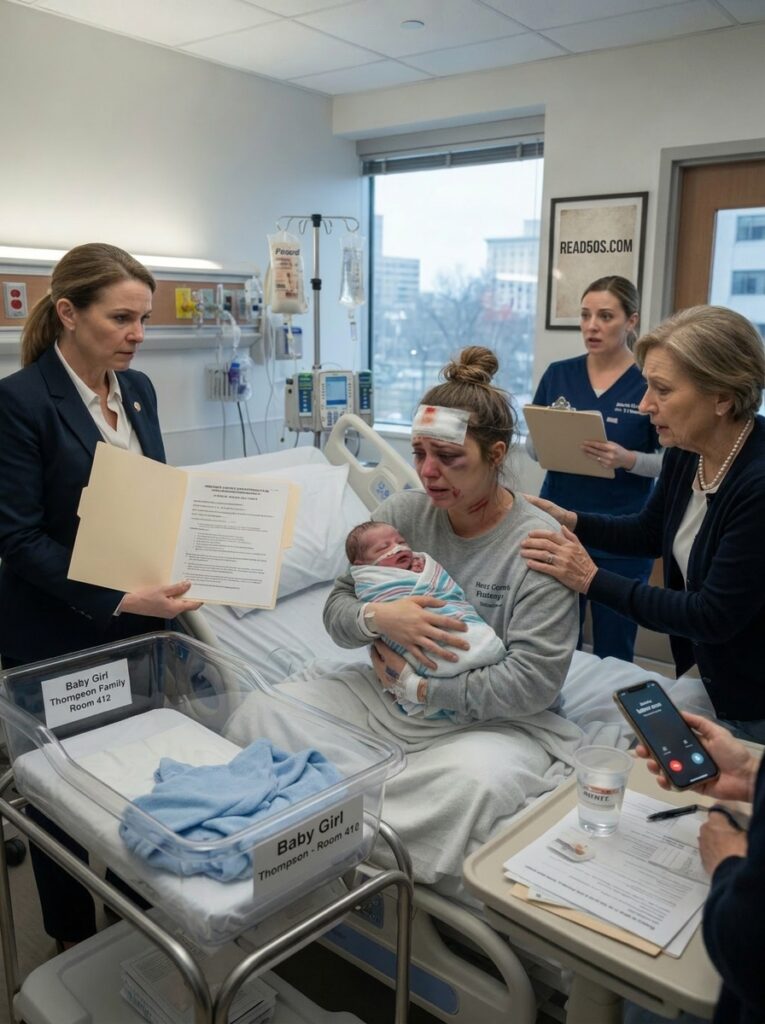
Ethan stopped in the doorway.
For the first time in years, I saw my husband without the expression he wore for other people.
Not charming.
Not concerned.
Not the calm, responsible man who spoke softly to nurses and remembered everyone’s name.
Just still.
Too still.
His eyes moved from my grandmother to Diane, then to the black portfolio on the table.
Then to the page beneath Diane’s hand.
“What is this?” he asked.
His voice was light.
Almost amused.
The kind of voice he used when he wanted me to feel foolish before I had even finished speaking.
Eleanor turned toward him.
“Come in, Ethan.”
He smiled faintly.
“I just came to see my wife and daughter.”
“No,” my grandmother said. “You came because you were notified that Diane accessed the Mercer account.”
That smile disappeared.
Only for a second.
But I saw it.
So did Diane.
So did my grandmother.
Ethan stepped into the room and closed the door behind him with a soft click.
Layla stirred against my chest.
My arms tightened around her.
“Naomi,” Ethan said gently, “you’re exhausted. Whatever this is, it can wait.”
I had heard that tone a thousand times.
When I asked about the account.
When I questioned why my card declined at the pharmacy.
When I cried over another bill.
When I said I felt like I was losing myself.
You’re tired.
You’re emotional.
You’re not thinking clearly.
But this time, the tone did not fold me back into doubt.
This time, I had paper on the table.
Numbers.
Signatures.
Dates.
And my grandmother sitting beside me like a wall.
“It can’t wait,” I said.
Ethan’s eyes flickered toward me.
Not with love.
With warning.
“Naomi.”
Just my name.
One word.
But it held everything he had trained me to hear.
Stop.
Be quiet.
Do not embarrass me.
Do not make a scene.
For the first time, I ignored it.
“What did you attach to Layla’s name?” I asked.
Diane lifted her hand from the page.
The document beneath it was a beneficiary designation attached to a financial instrument I did not understand at first. There were names, account numbers, a notarized section, and a line that made my vision blur.
Custodial control: Ethan James Mercer.
Contingent beneficiary: Layla Grace Mercer.
Eleanor took the document, scanned it once, and looked at Ethan with a kind of cold disbelief.
“You used the child,” she said.
Ethan’s face tightened.
“That is an outrageous accusation.”
Diane slid another page forward.
“This filing attempted to move funds from the household support account into a separate investment vehicle under Ethan’s control, using Layla’s name as the reason for the restructuring.”
I stared at her.
“I don’t understand.”
Diane’s expression softened.
“He created paperwork suggesting the money was being protected for Layla. But the structure gave him control. Not you. Not your grandmother. Him.”
My skin went cold.
Layla made one small sound in her sleep.
Ethan laughed once.
It was short and empty.
“This is ridiculous. I was planning for our daughter’s future.”
Eleanor did not blink.
“With forged documents?”
“I didn’t forge anything.”
Diane turned the first authorization form back toward him.
“Then Naomi signed away her own access while eight months pregnant, redirected all notices to your email, froze her card privileges, and forgot?”
Ethan looked at me.
For a moment, he did not even try to perform for the others.
He looked angry.
Not because he had hurt me.
Because I had let other people see it.
“Naomi,” he said softly, “tell them this is a misunderstanding.”
I stared at him.
This man had stood beside me at our wedding with tears in his eyes.
He had held my hands in front of two hundred guests and promised partnership.
He had told me he wanted a family, not a fortune.
He had kissed my forehead the first time I heard Layla’s heartbeat.
And all that time, money meant for freedom had become a leash in his hands.
“I never signed that,” I said.
Ethan’s jaw moved.
“Careful.”
The word came out before he could stop it.
Eleanor stood.
The air changed with her.
“No,” she said. “You be careful.”
Ethan turned toward her.
“I understand you’re upset, Eleanor, but this is a private matter between husband and wife.”
“My granddaughter worked night inventory shifts while pregnant because you told her there was no money.”
“She chose to work.”
“She hid a hospital bill under a magazine.”
“That was her anxiety.”
“She had no access to an account receiving three hundred thousand dollars a month.”
“That money was being managed.”
“By you,” Eleanor said.
“For our family.”
“For yourself.”
His face hardened.
“You don’t know anything about my business.”
“I know enough,” Eleanor said. “And by morning, so will my attorneys.”
For a second, nobody spoke.
Rain tapped against the window.
The baby monitor beside Layla’s bassinet blinked softly.
The normal sounds of the hospital continued beyond the door, as if other people’s lives had not just cracked open.
Then Ethan looked at me again.
His expression changed back to tenderness so quickly it made me feel ill.
“Naomi,” he said, stepping closer, “you just had a baby. You are vulnerable. Your grandmother is overwhelming you. Let’s talk alone.”
Alone.
That word landed in my chest like a stone.
Because alone was where Ethan did his best work.
Alone was where he made me feel ungrateful.
Alone was where every question became proof that I did not trust him enough.
Alone was where I apologized for noticing things.
“No,” I said.
His eyes narrowed.
I swallowed hard and said it again.
“No.”
The room seemed to hold its breath.
Eleanor moved closer to my bed.
Diane quietly placed the documents back into the portfolio, but she did not close it.
Ethan let out a slow breath.
“Naomi, don’t do this.”
“Do what?”
“Destroy our family because you don’t understand finances.”
Something inside me went very still.
For months, I had let him make me feel small.
For months, I had counted coupons, skipped appointments, worn old clothes, and blamed myself for wanting security.
For months, I had believed I was failing as a wife because I could not stretch nothing into enough.
But now I knew.
There had never been nothing.
There had been a river of money flowing past me while I stood thirsty beside it.
“I understand enough,” I said.
Ethan opened his mouth.
Then the door swung open.
A nurse stepped in, startled by the tension.
“Is everything okay?”
Eleanor answered before anyone else could.
“No. Please call hospital security.”
Ethan’s face changed.
“Are you serious?”
“Yes,” Eleanor said. “You are no longer welcome in this room.”
“I am her husband.”
“And I am the person who can prove you used forged authorization to restrict her access to funds, redirected financial notices, and filed documents involving a newborn child without the mother’s knowledge.”
Ethan looked toward me.
“Naomi, tell her to stop.”
I looked down at Layla.
Her tiny fingers had opened against my sweatshirt.
That was the moment the fear broke.
Not completely.
Not forever.
But enough.
“I want you to leave,” I said.
Ethan stared at me as if he had never actually considered that I could choose something without his permission.
Then his voice dropped.
“You’ll regret this.”
The nurse stepped back into the hallway and called for security.
Eleanor smiled then.
It was not warm.
“I believe you just made that easier.”
Security arrived within minutes.
Ethan did not shout.
He was too practiced for that.
He adjusted his sleeves, said there had been a family misunderstanding, and told the officers he would come back when his wife was “less emotional.”
But before he left, he looked at Layla.
Then at me.
And for the first time, I saw the full shape of what he had believed.
He thought marriage had made me accessible.
Motherhood had made me dependent.
Money had made me manageable.
He was wrong.
The moment the door closed behind him, my body started shaking.
Not small shaking.
Deep, uncontrollable tremors that made the IV tape tug against my skin.
Layla fussed.
The nurse reached for her.
I almost pulled back on instinct.
Then Eleanor touched my shoulder.
“Let her help you, Naomi.”
So I let the nurse take Layla long enough to check her.
The second my daughter was placed in the bassinet, I covered my face and sobbed.
Not quiet tears.
Not pretty tears.
The kind of crying that comes when your body understands danger before your mind knows what to call it.
Eleanor sat beside me and held my hand.
She did not tell me to calm down.
She did not tell me to be strong.
She just stayed.
Diane made calls from the corner of the room.
Attorneys.
Bank officers.
A forensic accountant.
A private security contact.
By noon, the household transfer account was frozen.
By three, Ethan’s access to any connected account had been suspended pending review.
By evening, Diane had uncovered more.
Much more.
The three hundred thousand dollars a month had not gone toward our mortgage the way Ethan claimed.
The house was behind on payments.
The hospital insurance premiums had nearly lapsed.
My car loan was overdue.
The “business delays” he blamed for our tight cash flow were partly real, but mostly convenient.
He had used the monthly transfers to cover failed investments, personal debts, luxury expenses hidden under consulting categories, and payments to companies Diane did not recognize.
Some were tied to Ethan’s business.
Some were tied to no obvious business at all.
And one recurring transfer went to a woman named Clara Vale.
I did not recognize the name.
For a moment, I thought my heart could not break any further.
Then Diane said quietly, “We don’t know yet what that is. Let the accountant confirm before you carry it.”
But I was already carrying too much.
I looked at Layla sleeping in the bassinet.
I thought of every night I had worked under fluorescent lights while pregnant, scanning inventory shelves and telling myself this was what good wives did during hard seasons.
I thought of Ethan asleep at home in clean sheets while I came in at dawn with swollen feet.
I thought of him kissing my belly and saying, “We just need to be careful a little longer.”
Careful.
That word had meant hunger.
It had meant fear.
It had meant silence.
But only for me.
The next morning, Ethan tried to come back.
Security stopped him.
Then he called.
I did not answer.
He texted.
You’re being manipulated.
Then:
Your grandmother wants control.
Then:
You can’t keep my daughter from me.
Then:
I did everything for this family.
Eleanor read the messages over my shoulder.
“Do not respond,” she said.
For once, I did not.
My grandmother’s attorneys moved quickly.
A temporary protective financial order was filed.
The bank opened an investigation into the forged authorization.
The attempted filing involving Layla was flagged.
A family attorney arrived at the hospital and spoke to me gently, clearly, without making me feel foolish for not knowing what Ethan had hidden.
That mattered.
Because shame is sticky.
Even when you learn someone lied to you, part of you still asks why you did not see it sooner.
The attorney must have seen that in my face.
“Naomi,” she said, “financial control works because it happens gradually. It does not begin with a locked door. It begins with someone offering to hold the key for you.”
I looked at Layla.
Then at my empty ring finger, because I had removed my wedding band sometime after midnight without realizing it.
“What happens now?” I asked.
“Now,” she said, “we protect you and your daughter. Then we recover what can be recovered. Then we make sure he does not get to rewrite this story.”
Ethan tried anyway.
He told mutual friends I was unstable after birth.
He told his parents my grandmother had poisoned me against him.
He claimed the money had been invested for our future.
He said the signature issue was a clerical misunderstanding.
But paperwork has a way of speaking when people stop interrupting it.
The bank logs showed where alerts were redirected.
The IP records showed access from Ethan’s office.
The notary stamp on one document traced back to a man who had done favors for Ethan before.
The “family stabilization” transfers led to accounts Ethan controlled.
The Clara Vale payments turned out not to be an affair, though that almost would have been simpler.
She was a consultant helping him move money through shell companies.
When investigators contacted her, she cooperated quickly.
Men like Ethan often believe loyalty can be rented.
They forget fear is a stronger negotiator.
By the time I left the hospital with Layla, I did not go home to the house I had shared with Ethan.
I went to my grandmother’s guest cottage behind her property, a small white place with ivy near the windows, a blue nursery chair, and a refrigerator full of food I had not had to justify buying.
The first night there, I stood in the kitchen holding Layla while she cried.
There was formula on my shirt.
My body hurt.
My milk had not come in the way everyone said it would.
I was exhausted beyond language.
And yet, for the first time in months, I was not afraid of a bill arriving.
That kind of relief made me angry.
No woman should feel wealthy simply because she can keep the lights on and feed her child without asking permission.
Eleanor found me by the sink.
“Come sit,” she said.
“I should have known,” I whispered.
“No.”
“I gave him everything.”
“You gave him trust,” she said. “He chose what to do with it. That is not the same thing.”
I looked at her then.
“Why didn’t you tell me about the money?”
Pain crossed her face.
“I thought I was respecting your marriage. I thought if I told you the exact amount too often, it would feel like interference. I told Ethan and confirmed the structure after the wedding. I assumed you both had access because that was the instruction.”
She looked older again.
“I made a mistake.”
It shocked me more than anything that day.
Eleanor Whitmore did not often admit mistakes.
But she did not look away.
“I cannot undo that,” she said. “But I can help you undo him.”
The legal process took months.
Real life does not deliver justice in one dramatic afternoon.
It arrives in meetings, signatures, court dates, affidavits, and quiet mornings when you still wake up expecting to be blamed for something.
Ethan fought hard at first.
Then the evidence grew.
The forged signature.
The redirected notices.
The attempted filing under Layla’s name.
The misused transfers.
The hidden accounts.
The shell payments.
The overdue mortgage on a house he had claimed was secure.
His version of the story became smaller every time another document surfaced.
Finally, his attorney advised settlement in the financial case, and the criminal investigation continued separately.
I cannot say the outcome erased what happened.
It did not.
Money could be recovered.
Accounts could be frozen.
Documents could be corrected.
But there is no easy refund for the months I spent believing I was a burden.
There is no wire transfer that gives back the peace a person steals by making you doubt your own needs.
Still, I rebuilt.
Not quickly.
Not perfectly.
But honestly.
The recovered funds were moved into a protected structure with independent oversight and direct access for me.
Layla’s name was removed from anything Ethan had tried to use.
A real trust was created for her future, one he could not touch.
I moved into my own house six months later.
Not a mansion.
Not a showpiece.
A warm brick house with a nursery full of sunlight, a kitchen where I bought strawberries without apology, and a front door Ethan did not have a key to.
On the day I signed the papers, Eleanor came with me.
She carried Layla while I held the pen.
Diane stood nearby with the final folder, smiling for the first time since she had walked into my hospital room.
When the last signature was done, Eleanor looked at me.
“How does it feel?”
I thought about it.
“Quiet,” I said.
She frowned slightly.
I looked around the room, at the empty walls, the clean floors, the windows waiting for curtains.
“Not lonely quiet,” I said. “Safe quiet.”
Eleanor nodded.
She understood.
One year after Layla was born, I found the old hospital billing envelope in a box of papers.
The magazine was still folded around it.
For a while, I just stared at it.
That envelope had once felt like proof that I was failing.
Now it looked small.
Almost harmless.
I took it outside to the patio, where Layla was sitting on a blanket, clapping at a plastic stacking toy while Eleanor watched from a chair in the shade.
I did not burn it.
That would have been dramatic, and life had given me enough drama.
Instead, I opened it, paid the remaining balance from my own account, and filed the receipt in a folder labeled:
Handled.
Then I picked up my daughter.
Layla grabbed the collar of my shirt and laughed.
A loud, bright laugh that belonged entirely to her.
Eleanor looked at us for a long moment.
Then she said, “You know, three hundred thousand a month was never the point.”
I smiled faintly.
“No?”
“No,” she said. “The point was choice.”
I looked at my daughter’s tiny hand resting against my chest.
Choice.
That was what Ethan had tried to take.
Not just money.
Not just access.
Choice.
The choice to rest.
The choice to get medical help without fear.
The choice to buy fruit.
The choice to say no.
The choice to leave.
The choice to protect my child before someone built a cage around her life too.
I held Layla closer.
“She’ll have it,” I said.
Eleanor’s eyes softened.
“So will you.”
And for the first time since my wedding, I believed that.
Ethan had built our marriage on a silent lie.
But silence was not where the story ended.
It ended in a house he could not enter.
With a daughter he could not use.
With a name I reclaimed.
And with the truth finally louder than every careful lie he had ever told me.
The End.