PART 2 — FULL CONTINUATION WITH COMPLETE ENDING:
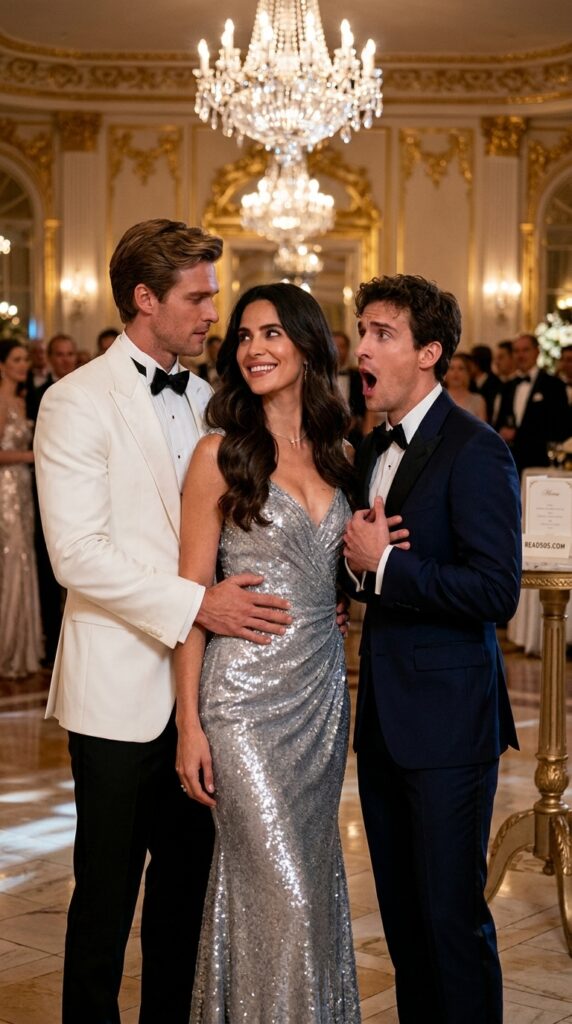
The room changed the moment Farah entered.
Not loudly.
Not with gasps or screams.
It changed in the quiet way power always announces itself.
Conversations slowed. Heads turned. Champagne glasses paused halfway to painted lips. Cameras shifted away from Richard Sterling and Vanessa Vale as if someone had silently rewritten the importance of the evening.
Farah Hayes stepped into the ballroom wearing a deep emerald gown that moved like water under the crystal lights. Her hair was pinned softly away from her face, and her expression carried no anger, no desperation, no need to prove anything.
That was what disturbed Richard most.
She looked peaceful.
She looked untouchable.
Beside her stood Fidelius Kensington, the billionaire investor whose name carried more weight in the technology world than most companies. He did not walk ahead of her. He did not guide her like decoration. He walked beside her like an equal.
Richard’s fingers tightened around his glass.
Vanessa leaned closer, her smile stiffening.
“Is that your ex-wife?” she whispered.
Richard did not answer.
He could not.
Because the woman walking into that ballroom was not the same woman he had imagined sitting alone in a small apartment, regretting the day she signed those papers.
Farah greeted people by name.
Not strangers.
Not hopeful introductions.
People knew her.
Investors. Founders. Board members. Engineers Richard had spent years trying to impress.
They leaned in when she spoke.
They listened.
Fidelius Kensington placed one hand gently at Farah’s back as they reached the center of the room. Then he took the microphone from the host.
“Ladies and gentlemen,” Fidelius said, his voice calm and rich enough to quiet the entire ballroom, “thank you for joining us tonight. Before we begin, there is someone I want to honor.”
Richard felt a strange coldness move through him.
Fidelius turned toward Farah.
“For years, this woman has built in silence. Not because she lacked a voice, but because the world often rewards the loudest person in the room before it recognizes the mind that made the room possible.”
A few people nodded.
Farah lowered her eyes for one second, but she did not look uncomfortable.
She looked ready.
Fidelius continued, “Tonight, Kensington Global is proud to announce our lead technology partner, principal architect, and co-founder of our new security intelligence platform…”
He paused.
Then he smiled.
“Farah Hayes.”
The applause came quickly.
Then louder.
Then thunderous.
Richard stood frozen as the ballroom rose to its feet.
Farah stepped forward and accepted the microphone.
For one brief moment, her eyes met Richard’s across the room.
There was no hatred in them.
That somehow made it worse.
“Thank you,” Farah said.
Her voice was steady, clear, and gentle, but every word carried.
“I spent a long time believing that being quiet would keep the peace. I believed that if I worked hard enough, gave enough, and stayed loyal enough, the people closest to me would one day value what I had built.”
Richard felt Vanessa shift beside him.
Farah did not look at him again.
“But life has a way of separating what is real from what was only pretending. Sometimes losing what people think is everything becomes the moment you finally protect what truly belongs to you.”
The room went still.
Farah smiled, not triumphantly, but with a kind of calm dignity Richard had never allowed himself to notice.
“Our platform, Aurelia Shield, was built to solve a problem the technology world has ignored for too long. It protects company systems from hidden internal misuse, stolen intellectual property, and fraudulent claim structures before they destroy businesses from the inside.”
Richard’s heart began to pound.
Aurelia Shield.
He knew that name.
Not from Farah.
From whispers in investor circles.
For weeks, Sterling Tech’s board had been nervous about a new platform that could expose insecure code, false ownership chains, and internal dependency theft. His engineers had told him that if Aurelia Shield gained major clients, Sterling Tech’s products would be questioned.
He had laughed it off.
Now Farah was standing beside Fidelius Kensington, introducing it to the most powerful people in Seattle.
Farah continued, “This technology is not only about protecting systems. It is about accountability. It is about proving that what is built in darkness does not stay hidden forever.”
Richard’s mouth went dry.
Vanessa whispered, “Richard… why does she sound like she’s talking about you?”
He looked at her sharply.
“Be quiet.”
But Vanessa had already seen his face.
After Farah’s speech, people surrounded her. They congratulated her. They asked for meetings. They smiled at her with the kind of respect Richard had spent years buying with suits, parties, and borrowed intelligence.
He could not stand it.
He crossed the room before Vanessa could stop him.
“Farah.”
She turned.
For the first time that night, she faced him fully.
“Richard.”
Her voice was polite.
That was all.
Fidelius stood beside her, calm, watchful.
Richard forced a laugh. “You made quite an entrance.”
Farah said nothing.
“I have to admit,” he continued, lowering his voice, “you surprised me.”
“I know.”
The simplicity of her answer irritated him.
Richard leaned closer. “Let’s not pretend. Whatever you’re doing here, whatever little project you built with Kensington money, it still came from what you learned at Sterling Tech.”
Farah’s face did not change.
Fidelius smiled faintly, but said nothing.
Richard mistook the silence for weakness, the same mistake he had always made.
“You signed away your claims,” he said. “Remember that. You took the settlement.”
Farah looked at him with a sadness so quiet it almost felt merciful.
“Yes, Richard. I signed away my claims to your company.”
His eyes narrowed.
“Your company,” she repeated softly. “Not mine.”
Something in her tone made him uneasy.
Farah reached into her clutch and removed a slim folder. She did not hand it to him at first. She simply held it between them.
“You should read more carefully before you celebrate.”
Richard snatched the folder.
Inside was a clean summary of intellectual property filings, company registrations, patent dates, and encrypted repository records.
His eyes moved over the pages.
Then stopped.
The earliest dates were older than Sterling Tech’s public launch.
Older than the marriage.
Older than him.
Farah watched him understand.
“The core architecture you built Sterling Tech on was never owned by Sterling Tech,” she said quietly. “I licensed certain modules to help stabilize the company during the early years. I never transferred ownership. You never asked because you assumed anything I created belonged to you.”
Richard’s face hardened.
“That’s impossible.”
“It is documented.”
“You hid this.”
“No,” Farah said. “I protected it.”
Fidelius finally spoke.
“Mr. Sterling, our legal team reviewed every filing, every timestamp, every licensing agreement, and every internal communication. Ms. Hayes has been extremely thorough.”
Richard looked around, suddenly aware that people were watching from a careful distance.
He lowered his voice to a sharp whisper.
“You think you can humiliate me?”
Farah’s eyes softened, but her spine remained straight.
“No. You did that yourself.”
For a moment, the mask slipped from Richard’s face. The polished, confident CEO disappeared, and beneath it stood a frightened man realizing that the foundation beneath his throne had never belonged to him.
Vanessa touched his arm.
“Richard, what is going on?”
He shook her off.
Farah saw the movement and remembered every dinner where he had dismissed her ideas. Every meeting where he had repeated her solutions as his own. Every night she had stayed awake fixing code while he slept beside his phone, waiting for messages from someone else.
But she no longer felt crushed by those memories.
They were evidence now.
Not wounds.
Richard stepped closer. “You are making a mistake.”
Farah did not step back.
“No, Richard. My mistake was believing loyalty could teach someone gratitude.”
His face flushed.
Before he could answer, a board member from Sterling Tech approached them. Leonard Miles, chairman of the board, was a narrow man with silver hair and a reputation for smiling only when money was safe.
“Richard,” Leonard said, his voice tight. “We need to speak. Now.”
Richard looked at him. “Not here.”
“Now,” Leonard repeated.
That was when Richard saw the phone in Leonard’s hand.
The screen showed a news alert.
KENSINGTON GLOBAL ANNOUNCES AURELIA SHIELD, LED BY FARAH HAYES — EARLY AUDIT RAISES QUESTIONS ABOUT STERLING TECH OWNERSHIP CLAIMS.
Richard felt the floor tilt beneath him.
“It’s already public?” he whispered.
Fidelius answered calmly. “The announcement went live during the speech.”
Vanessa took one step away from Richard.
Not much.
Just enough.
Farah noticed.
So did Richard.
The next morning, Sterling Tech’s stock began to fall.
At first, Richard told himself it was temporary. A reaction. A misunderstanding. A jealous market trying to punish his success.
By noon, three major clients requested audits.
By evening, two investors suspended pending funding.
Within forty-eight hours, the board demanded an emergency meeting.
Richard walked into that meeting expecting loyalty. After all, he had been the face of the company for years. His photograph hung in the lobby. His interviews filled the press page. His name was on the awards.
But money has a way of removing romance from business.
Leonard sat at the head of the table.
“Richard,” he said, “we have reviewed the preliminary reports.”
Richard placed both hands on the table. “This is a coordinated attack. Farah is angry about the divorce. Kensington is using her.”
One of the board members, a woman named Elise Porter, opened a folder.
“The issue is not her anger. The issue is documentation.”
Richard glared at her.
Elise continued, “There are code dependencies in our flagship products tied to systems Ms. Hayes appears to have created and retained ownership of prior to Sterling Tech’s commercial registration.”
“That is not theft,” Richard snapped. “She was my wife.”
The room went silent.
Elise looked at him with open disbelief.
Leonard sighed. “Marriage is not an intellectual property assignment, Richard.”
Richard’s jaw tightened.
His lawyer, seated beside him, whispered something, but Richard ignored him.
“She built those systems while we were together,” Richard said. “In our home.”
“Using her equipment,” Elise replied. “Her accounts. Her repositories. Her pre-existing architecture. Her licensing notes. Her timestamps.”
Richard looked from face to face.
No one defended him.
For the first time in years, he realized how little power he had when Farah’s work was removed from beneath him.
By the end of the week, Richard was placed on temporary leave.
By the end of the month, it became permanent.
Vanessa left before the official announcement.
She did not scream. She did not defend him. She simply packed her things from his penthouse and told him, “You said she was nothing. But everything you had was connected to her.”
That sentence stayed with him more than he wanted it to.
Farah did not celebrate Richard’s downfall.
People expected her to.
Reporters tried to pull bitterness from her.
“Do you feel vindicated?” one asked.
Farah paused before answering.
“I feel free,” she said.
That answer traveled farther than any insult could have.
Aurelia Shield became one of the most trusted platforms in enterprise security within six months. Farah did not become famous in the careless way Richard had wanted fame. She became respected.
There was a difference.
She built a company culture where engineers were credited by name. Where quiet people were invited to speak. Where no one’s work disappeared behind a louder person’s smile.
Fidelius Kensington remained beside her, not as the man who saved her, but as the partner who recognized what she had already built.
One evening, nearly a year after the gala, Farah stood on the balcony of her office overlooking Seattle. The city glowed beneath her, glass towers reflecting the last gold of sunset.
Fidelius joined her with two cups of tea.
“Big day,” he said.
Farah smiled. “Big year.”
He handed her a cup. “The final settlement cleared.”
She nodded.
Sterling Tech had been restructured. Richard had lost control of the company, but Farah had not taken pleasure in destroying it entirely. Too many ordinary employees had families, mortgages, and futures tied to that place.
So she made a choice Richard never would have made.
She allowed the company to license what it needed under strict oversight, with proper payment, full public correction of ownership records, and employee protections.
Richard lost his title, his illusion, and the false story he had sold the world.
But the innocent people who had worked under him did not lose everything because of his arrogance.
That mattered to Farah.
A week later, she received a letter.
Not an email.
A real letter.
Richard’s handwriting was stiff and uneven.
Farah almost threw it away.
Then she opened it.
The letter was short.
Farah,
I spent years calling myself a builder when all I knew how to build was an image. I took credit for your mind, your patience, and your work. I convinced myself you were quiet because you had nothing to say, when the truth was that you were carrying everything I did not understand.
I do not expect forgiveness.
But I know now that losing you was not the punishment.
The punishment was realizing you had always been the reason I was standing.
Richard
Farah read it twice.
Then she folded it carefully and placed it in a drawer.
Not because she wanted him back.
Not because the letter erased the past.
But because it was proof that truth had finally reached a place pride once guarded.
That night, Farah attended another gala.
This time, she was not introduced as someone’s wife.
Not as someone’s former wife.
Not as the quiet woman behind a powerful man.
She stepped onto the stage alone.
The room rose before she even spoke.
Farah looked out at the crowd — young founders, engineers, women who had learned to make themselves smaller in rooms that benefited from their silence, men who understood that respect was not weakness, and people who simply wanted proof that dignity could survive betrayal.
She took a breath.
“For a long time,” she said, “I thought being unseen meant I had failed.”
The room listened.
“But sometimes being unseen gives you the chance to build without applause, to grow without permission, and to protect the parts of yourself others would have taken if they knew their value.”
Her voice softened.
“So to anyone who has ever been told they are nothing without someone else, I hope you remember this: people who cannot see your worth do not get to define it.”
Farah paused.
Then she smiled.
“And sometimes the life they think they ruined is the life that finally sets you free.”
The applause rose around her like thunder.
Farah stood beneath the lights, no longer someone’s shadow, no longer someone’s secret, no longer the woman Richard Sterling thought he had erased.
He had signed papers believing he was ending her story.
But all he had done was remove himself from it.
And Farah Hayes, the woman he once called nothing, walked forward into a future that finally carried her name.