PART 2 — FULL CONTINUATION WITH COMPLETE ENDING:
Camila’s hands shook so hard the paper made a faint rattling sound in the doorway.
For one second, no one spoke.
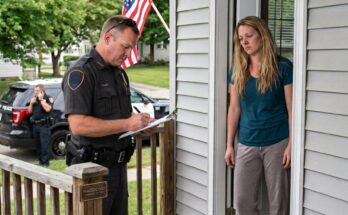
The military officer stood tall on the porch in his dress uniform, his cap tucked beneath one arm. The porch light reflected off the polished buttons on his jacket. His face was serious, but not cold.
Behind Camila, my stepsisters had stopped laughing.
I stood at the bottom of the stairs in the dress I had sewn from my father’s uniform, trying to understand why the room suddenly felt like the air had been pulled out of it.
Camila read the first line again.
I knew because her eyes moved back to the top of the page.
Then her face went pale.
“What is this?” she whispered.
The officer’s voice was calm.
“A letter from Staff Sergeant Daniel Hayes. He gave it to me before his final deployment and instructed me to deliver it to this address on the night of his daughter’s senior prom.”
My heart clenched.
My father.
His name spoken so formally.
So alive in someone else’s mouth.
Camila tried to fold the letter.
The officer stepped forward slightly.
“Ma’am, the letter is addressed to both you and Miss Emily Hayes. She has the right to hear it.”
Camila’s eyes flashed.
“She is a child.”
“I am eighteen,” I said.
My voice surprised me.
It did not sound strong exactly, but it did not sound afraid either.
The officer turned to me.
“You are Emily?”
I nodded.
His expression softened.
“I served with your father. My name is Major Thomas Reed.”
I had heard that name before.
Dad used to mention Reed in his stories. Reed who hated powdered eggs. Reed who could fix a radio with tape and luck. Reed who once carried Dad’s pack for two miles after he sprained his ankle and then pretended he had not.
“You knew my dad?” I whispered.
“Yes,” he said. “He was the best man I ever served with.”
That was when my eyes filled.
Not because of Camila.
Not because of the laughing.
Because for six years, people around me had spoken about my father like he was a closed chapter. A framed photo. A memory I was supposed to stop bringing up because it made everyone uncomfortable.
And here was someone standing at our door who had known him as a living person.
A brave person.
A person who had loved me enough to send a letter across time.
Major Reed looked at Camila.
“Please continue reading.”
Camila’s lips tightened.
“I don’t think this is appropriate right now.”
“Oh, it is,” Major Reed said.
His voice remained polite, but something in it changed.
A command hidden beneath manners.
Camila looked at him, then at me, then at her daughters standing frozen near the living room entrance.
Finally, she read.
“Camila, if this letter is being delivered, then I am not there to see Emily on the night I promised her I would never miss.”
Her voice trembled.
My chest hurt.
“She will likely tell you she does not need a fuss. Do not believe her. My daughter has spent her whole life trying to be brave for other people. Tonight, I want someone to be brave for her.”
I covered my mouth with one hand.
My father knew.
Even then, he knew me.
Camila swallowed and kept reading, faster now, like speed might lessen the meaning.
“I am trusting you with the most important part of my life. Not my name. Not my medals. Not my belongings. Emily. If you treat her as anything less than your own, then understand that I have made arrangements beyond your control.”
Camila stopped.
Major Reed’s eyes narrowed.
“Continue.”
She glared at him.
Then she read the next line.
“The house remains in a protected trust until Emily turns eighteen. Camila may reside there as guardian only if Emily is cared for properly and provided for using the benefits assigned to her.”
The silence that followed was so sharp I could hear my own heartbeat.
House.
Trust.
Benefits.
I looked at Camila.
“What does that mean?”
She did not look at me.
Major Reed answered.
“It means your father placed this home under a trust for you. It was never fully transferred to your stepmother.”
My stepsister Olivia whispered, “Mom?”
Camila snapped, “Quiet.”
Major Reed looked at me with gentle seriousness.
“Your father also arranged survivor benefits and an education fund. Some funds were meant specifically for your care, clothing, school needs, and eventual college expenses.”
My mind could not catch up with his words.
College fund?
Benefits?
Care?
For years, Camila told me money was tight because feeding me was expensive. She said every dollar spent on me was a kindness. She made me buy my own school supplies with tips from the diner where I worked weekends. She told me I should be grateful she kept a roof over my head.
But the roof had been mine?
The money had been meant for me?
A hot, shaking feeling moved through my body.
Not just anger.
Grief.
Because suddenly, every humiliation had a receipt.
Every old coat.
Every skipped school trip.
Every night I cooked dinner while her daughters sat on the couch with new laptops and new shoes.
My father had tried to protect me.
And Camila had hidden the protection.
The officer reached into a leather folder and removed another set of papers.
“Mrs. Whitfield,” he said to Camila, “I am also here because the trust attorney requested confirmation that Emily still resides here and has now reached legal adulthood.”
Camila took a step back.
“This is family business.”
“No,” he said. “This is legal business.”
Her daughters stared at her.
For the first time in all the years I had known them, they looked unsure of her.
Camila’s voice rose.
“I raised her. I fed her. I gave up years of my life—”
“You gave up nothing you did not use,” I said.
Everyone turned to me.
My throat was tight, but the words came anyway.
“You told me I was lucky you didn’t send me away. You told me I owed you for food, for electricity, for living in this house. But he left money for me, didn’t he?”
Camila’s face hardened.
“You have no idea what it costs to run a household.”
“I know what it costs to be unwanted in one.”
Major Reed’s expression shifted slightly, as if my words had struck him too.
Camila looked back at the letter, then suddenly crumpled it in her hand.
“No,” I said.
I moved before I thought.
I stepped forward and took the letter from her.
She tried to hold on, but Major Reed said, “Release it.”
She did.
I smoothed the paper carefully.
My father’s letter.
His last wish.
His voice.
I read silently from where Camila had stopped.
Emily, if you are reading this, then I am sorry, sweetheart. I wanted to be there. I wanted to be the embarrassing father taking too many pictures. I wanted to tell you your mother would have cried seeing you so grown. I wanted to dance one song with you in the kitchen before you left.
My tears fell onto the paper.
I tried to wipe them away before they blurred the ink.
But the ink did not run.
Neither did his love.
The letter continued.
If you made something out of my uniform, I hope you know I would not be angry. I would be honored. That uniform belonged to the Army, but the man inside it belonged to you.
A sob broke out of me.
For one terrible month, while sewing the dress, I had worried that maybe people would think it was disrespectful. That maybe my father would not have wanted his uniform cut and stitched into something new.
But he had known me.
He had known I might do it.
He had given me permission before I even needed it.
Major Reed’s voice softened.
“He talked about your prom for weeks before that deployment. Said if he couldn’t make it, he hoped you’d find a way to carry him with you.”
I pressed the letter to my chest.
Camila’s face twisted.
“This is ridiculous. She cannot just throw us out.”
The words snapped me back.
“Throw you out?”
She crossed her arms.
“This is our home.”
For years, I might have flinched.
Not that night.
Not in my father’s dress.
Not with his letter in my hands.
“No,” I said. “It is mine.”
My stepsister Madison looked at her mother.
“Is that true?”
Camila snapped, “It’s complicated.”
That meant yes.
Major Reed handed me a business card.
“Emily, the trust attorney is waiting for your call. I was asked to bring you safely to his office tomorrow morning if you wish. There are documents you need to review.”
Camila laughed bitterly.
“She has prom tonight.”
Major Reed turned to me.
“Your father wanted you to go.”
I looked down at my dress.
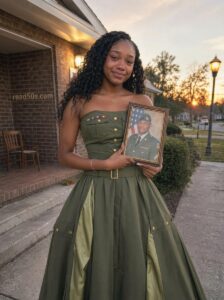
The green-gray fabric of the uniform had become a fitted bodice and a flowing skirt. I had kept one sleeve patch carefully sewn near my waist and turned the brass buttons into a line along the back. It was not perfect. Some stitches were uneven. The hem was not as smooth as a store-bought gown.
But it was mine.
It was his.
For the first time all night, I stood taller.
“I’m going,” I said.
Camila stared at me.
“You are not leaving this house dressed like that after embarrassing me in front of an officer.”
I almost smiled.
“You embarrassed yourself.”
Major Reed stepped aside and opened the door wider.
“I can escort you.”
My stepsisters said nothing.
Neither apologized.
Not then.
Their faces were too full of shock, fear, and the first cracks of understanding that the life they had enjoyed had been built partly out of what was taken from me.
I picked up my small purse from the entry table.
Then I looked at Camila.
“I’ll speak with the attorney tomorrow. Tonight, I am going to prom.”
She reached for me.
Major Reed moved one step.
She stopped.
The power in the room had changed.
I walked past her.
Out the door.
Onto the porch.
The night air was cool, and for a second, I could smell rain, cut grass, and the faint perfume I had dabbed behind my ears with shaking hands an hour earlier.
Major Reed walked me to his car.
Before opening the passenger door, he paused.
“Emily, there is one more thing.”
I looked at him.
He reached into his jacket and removed a small velvet pouch.
“Your father asked me to give this to you only if you chose to go to prom after receiving the letter.”
My fingers trembled as I opened it.
Inside was a small silver locket.
My mother’s locket.
I had seen it in photos but never held it. Camila once told me it had been lost years ago.
Inside were two tiny pictures.
My mother on one side.
My father on the other.
A folded slip of paper came with it.
In my father’s handwriting:
Now we both get to go with you.
I broke down completely then.
Major Reed stood quietly while I cried.
Not rushed.
Not uncomfortable.
Just present.
When I could breathe again, he helped me fasten the locket around my neck.
At prom, people stared.
Of course they did.
Not cruelly, though.
At least not most of them.
Some whispered. Some smiled. My best friend Ava covered her mouth and started crying the moment she saw me.
“Emily,” she whispered. “Your dress.”
“My dad came with me,” I said.
She hugged me carefully, as if she understood the dress was more than fabric.
Later that night, the principal asked if I would allow a photo for the school page. I hesitated, but Major Reed, who had waited respectfully near the entrance until he knew I was safe, nodded once.
So I agreed.
The photo showed me standing beneath a string of white lights, wearing a dress made from my father’s uniform and my mother’s locket at my throat.
The caption read:
Senior Emily Hayes honors her late father, Staff Sergeant Daniel Hayes, at prom.
By morning, the photo had been shared all over town.
By noon, Camila’s version of the story collapsed.
People began asking questions.
Teachers who had noticed I worked too many hours.
Neighbors who had seen me carrying groceries home while Camila’s daughters drove past.
The diner owner who knew I saved tip money for school supplies.
The trust attorney, Mr. Alvarez, did not waste time.
The next morning, Major Reed drove me to his office. I sat in a leather chair that felt too big for me while Mr. Alvarez explained what my father had arranged.
The house belonged to the trust, with me as beneficiary once I turned eighteen.
Survivor benefits had been managed through an account intended for my living expenses.
A college fund had been established separately, untouched by design—but not untouched in reality.
Some of the funds for my care had been used in ways that required investigation.
Mr. Alvarez did not call Camila a thief.
Lawyers use careful words.
Improper withdrawals.
Misuse of designated funds.
Breach of fiduciary duty.
But I understood.
Camila had used money meant for me.
And then made me feel guilty for needing food.
I wanted to be angry.
I was angry.
But beneath the anger was a deeper sadness.
My father had died believing he had left me safe.
And for six years, I had lived like an unwanted burden inside the protection he built.
“What happens now?” I asked.
Mr. Alvarez folded his hands.
“First, you decide where you want to live. Because you are eighteen, Camila is no longer your guardian. Second, we secure the property and accounts. Third, we pursue recovery of misused funds if you wish.”
“If I wish?”
“Yes. It is your decision.”
My decision.
Those words felt impossible.
My life had been orders for so long.
Cook this.
Clean that.
Be grateful.
Don’t complain.
Don’t embarrass us.
Now a lawyer was telling me I had choices.
“I don’t want to live with her anymore,” I said.
Major Reed, seated beside me, nodded once.
“Then you won’t,” Mr. Alvarez said.
By the end of the week, Camila and her daughters were legally required to vacate the house within a set period. It was not immediate, and it was not dramatic the way movies make it. There were notices, attorneys, inventories, and long conversations I was grateful not to handle alone.
Camila called me cruel.
She called me ungrateful.
She said my father would be ashamed.
That was the only time I raised my voice.
“My father knew exactly who he was protecting me from.”
She had no answer.
Madison, the younger stepsister, came to my room three days before they left.
She stood in the doorway, arms crossed, eyes red.
“I didn’t know,” she said.
I looked up from packing my father’s letters into a safe box.
“Didn’t know what?”
“That the money was yours.”
I waited.
She looked down.
“I thought Mom was just… strict with you.”
“Strict?” I asked.
Her face crumpled.
“I’m sorry.”
I wanted to reject it.
Part of me did.
Because apology after exposure is complicated. You wonder if they regret hurting you or regret finally seeing themselves clearly.
But Madison was seventeen. Old enough to know better, yes. Young enough to have been shaped by the same woman who had shaped the house.
So I said, “Thank you.”
She wiped her face.
“Olivia thinks you’re ruining everything.”
“Olivia can think whatever she wants.”
Madison nodded.
Then she looked at the uniform dress hanging carefully on my closet door.
“It was beautiful,” she whispered.
That was the first kind thing she had ever said to me.
I did not forgive everything that day.
But I remembered it.
Camila left the house furious.
Olivia left without looking at me.
Madison left a folded note on the kitchen counter.
I’m sorry I laughed. I should have stopped.
I kept the note.
Not because it erased anything.
Because it proved that at least one person in that house had begun to understand.
I moved into the main bedroom for exactly one night, then realized I hated it. It had been Camila’s space for too long. So I turned my childhood room into my own little apartment while the rest of the house was repaired, cleaned, and eventually rented to a military family through a housing program my father would have loved.
I left for college that fall.
My tuition was covered by the fund Dad had created.
On move-in day, Major Reed drove me to campus with three boxes, two suitcases, and a framed photo of my father in uniform. He had become something like family by then—not a replacement father, never that, but a living bridge to the man I lost.
Before leaving, he handed me one last envelope.
“I debated whether to give this now or later,” he said. “But I think your father would want you to have it today.”
Inside was another letter.
Emily,
If you are reading this at college, then you made it. I wish I could embarrass you by crying in the parking lot. Since I cannot, please imagine me doing exactly that.
Study hard. Make friends. Eat real meals. Do not let grief be the only thing you inherit from me.
You are not a burden. You are my greatest honor.
Dad
I sat on my dorm bed and cried into that letter while my roommate politely pretended to organize her desk.
Years passed.
I kept the prom dress.
Not in a box hidden away, but preserved properly in a shadow frame with the locket beside it and my father’s first letter displayed below.
I became a social worker for military families.
People always assume I chose that career because my father served.
That is only partly true.
I chose it because I knew what could happen when a child fell through the cracks after a parent in uniform never came home.
I knew how benefits could be misunderstood, misused, or hidden.
I knew how grief could make children quiet enough that adults stopped checking on them.
So I checked.
I became the person who asked the second question.
Not just, Are you okay?
But, Who controls the money?
Who signs the forms?
Do you have your documents?
Are you safe in the house?
Sometimes, that second question changed everything.
At twenty-six, I was invited to speak at a military family support event. Major Reed was there, older now, his hair almost fully gray. He sat in the front row.
I brought the prom dress.
Not to wear.
To show.
When I stood at the podium, I told the story of sewing grief into something beautiful. I told them about a father who knew he might not come home but still found a way to keep showing up. I told them about the officer who delivered a letter at exactly the right moment.
Then I said what I wished someone had told me at twelve years old:
“A child who loses a parent should not have to become invisible to survive the adults left behind.”
The room stood when I finished.
Major Reed wiped his eyes and pretended he had allergies.
Some things never change.
Years later, Camila wrote to me.
A real letter.
Not a demand.
Not an accusation.
An apology.
She admitted she had resented me because my father loved me in a way she never felt chosen by. She admitted she took money meant for my care and justified it as household expenses. She admitted she let her daughters treat me badly because it made her feel less guilty to pretend I deserved it.
She asked for forgiveness.
I sat with that letter for a long time.
Then I wrote back.
I am no longer angry every day. That is what I can give you.
It was not full forgiveness.
But it was honest.
Madison and I rebuilt a cautious relationship over the years. Olivia never reached out. That was her choice.
As for the house, I eventually sold it to a veteran’s nonprofit. The money went partly into my future and partly into a scholarship fund in my father’s name for children of fallen service members.
Every year, one student receives the Daniel Hayes Honor Scholarship.
The award letter includes one sentence from my father:
You are not a burden. You are someone’s greatest honor.
On the tenth anniversary of my prom night, I visited my father’s grave wearing the locket.
Not the dress.
That belonged safely in its frame.
I sat in the grass and told him everything.
College.
Work.
The scholarship.
Major Reed’s bad jokes.
Madison’s first baby.
The way my life had become larger than the house where I once felt trapped.
Then I thanked him.
Not only for the trust.
Not only for the money.
Not only for the letter.
For knowing me.
For knowing that I might turn his uniform into a dress because I needed to carry him into a room where he could not physically stand.
For telling me he would have been honored.
The wind moved softly through the trees.
For one moment, I almost felt him there.
Not as a ghost.
Not as a miracle.
As memory made warm.
I touched the locket at my throat and smiled.
Prom night did not go the way I dreamed when I was a little girl.
My father did not stand in the doorway taking too many pictures.
He did not tear up when he saw me.
He did not tell me to be home by midnight.
But he came anyway.
In a letter.
In a uniform transformed by my own hands.
In the officer who kept his promise.
In the truth that arrived just when I needed it most.
Camila laughed when she saw my dress because she thought it was made from old fabric.
She was wrong.
It was made from love.
From grief.
From courage.
From every promise my father kept even after he was gone.
And when I walked into prom wearing that dress, I finally understood something I had needed to know for six long years:
I had never been abandoned.
I had been protected.
And the proof had been stitched into every seam.