PART 3 — COMPLETE ENDING
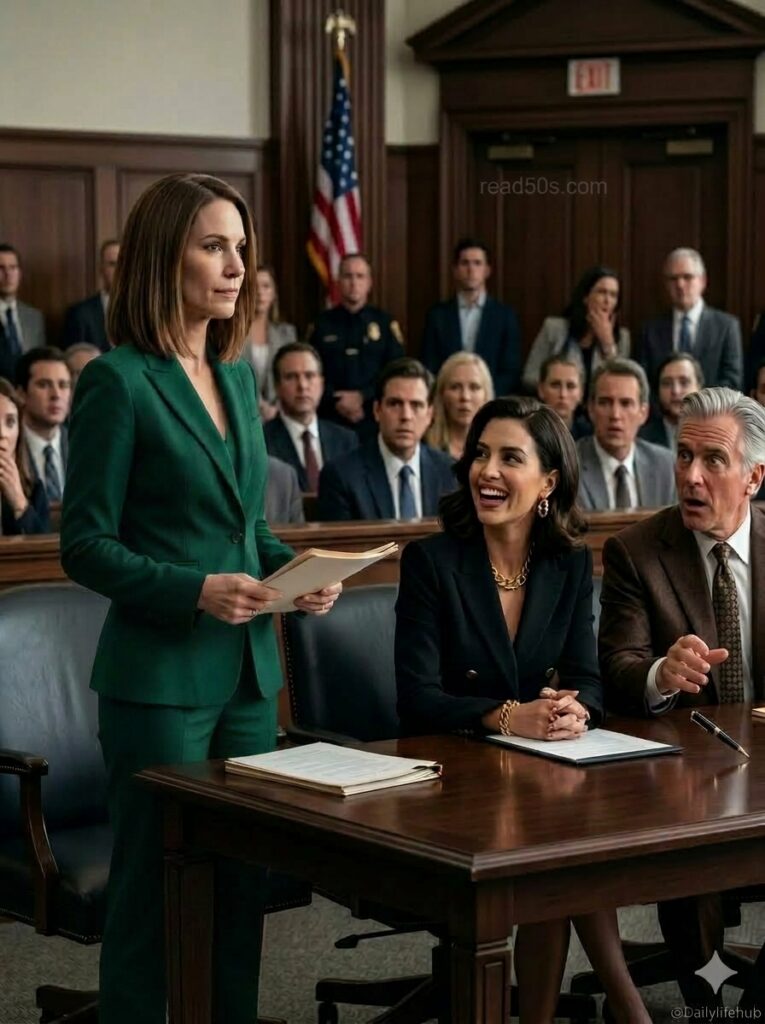
The hearing did not last much longer after that.
Blake Monroe stood behind his table with one hand resting on the back of his chair, but the confidence had drained out of him. The polished smile was gone. The courtroom charm was gone. Even his voice sounded different now, lower and careful, as if every word had become a trap he was afraid to step into.
“Your Honor,” he said, “given the serious nature of these allegations, I believe it would be appropriate for me to withdraw as counsel.”
The judge did not blink.
“Not until substitute counsel is arranged and this court has secured the original filings, declarations, and supporting materials submitted by your office.”
Blake’s jaw tightened.
Vanessa looked between him and the judge, finally understanding that the performance she had paid for had become evidence.
“I didn’t know,” she whispered. “I didn’t know any of this.”
The judge turned toward her.
“Ms. Arden, this court will determine what each party knew after review. But I suggest you listen carefully to your next attorney before making any more accusations.”
Vanessa’s lips parted, but nothing came out.
For once, she had no audience willing to reward her tears.
My attorney, Miriam Voss, stood beside me. She was calm in the way only truly prepared people can be calm.
“Your Honor,” Miriam said, “before the court rules on the emergency petition, we would like to submit one additional item for the record.”
Vanessa wiped her face quickly.
“What now?” she snapped.
Miriam did not look at her.
“It is a video statement recorded by Mr. Arden six weeks before his passing, in the presence of his estate attorney and hospice social worker.”
The room went still.
My chest tightened before the screen even turned on.
I knew the video existed. Dad had told me he had recorded something because he did not trust Vanessa to respect anything written on paper. At the time, I had begged him not to worry about legal matters. I wanted his final weeks to hold music, old movies, soup, and peace.
But my father had always understood Vanessa better than I wanted to.
The clerk dimmed the lights slightly.
Then Dad’s face appeared on the screen.
He was thinner than I remembered. His cheeks had hollowed. His shoulders looked smaller beneath the blue cardigan he wore every morning near the end.
But his eyes were clear.
His voice was weak, but steady.
“My name is Robert Arden,” he began. “I am making this statement freely, while I am of sound mind, because I know my daughters.”
A quiet breath moved through the courtroom.
Vanessa froze.
Dad looked directly into the camera.
“Vanessa, I love you. I have always loved you. But love is not ownership. You have often mistaken being loved for being owed.”
Vanessa covered her mouth.
Dad continued.
“I gave you money in my will because I wanted you to have a clean start. I left the house to Claire because Claire stayed. Claire cared. Claire managed my medicine, my appointments, my bills, and my fear when I was too proud to admit I was afraid.”
My throat burned.
I had not watched the full recording since Marianne sent it to Miriam. Hearing his voice in that room felt like losing him again, but also like having him stand beside me one last time.
Dad took a slow breath on the screen.
“This house is not a prize. It is not punishment. It is gratitude. Claire never asked for it. That is part of why I chose her.”
Vanessa began to cry.
Not softly.
Not the beautiful kind of crying she used at family gatherings when she wanted people to gather around her. This was angry, broken crying. The sound of someone hearing the truth after spending months shouting over it.
The video ended with Dad looking down at his hands.
Then he said one final sentence.
“Do not turn my death into another fight.”
The screen went black.
No one moved.
Even the reporters in the back row had stopped whispering.
The judge removed his glasses and set them on the bench.
“That statement will be admitted for the limited purpose of addressing intent and the credibility issues raised by the petition,” he said.
Then he turned to Blake.
“Mr. Monroe, the court finds serious questions regarding the authenticity of evidence submitted under your signature. This matter will be referred to disciplinary counsel. The disputed filings are to be preserved. No originals are to be destroyed, altered, or removed.”
Blake nodded once.
It was the smallest nod I had ever seen.
The judge continued.
“The emergency petition is denied. The request to restrain Ms. Claire Arden from occupying or managing the property is denied. The court further finds sufficient basis to consider sanctions for bad-faith litigation, pending evidentiary review.”
Vanessa let out a sound somewhere between a sob and a gasp.
The judge looked directly at her.
“Ms. Arden, you are ordered to pay Ms. Arden’s immediate legal fees associated with this petition, subject to final calculation.”
“My fees?” Vanessa cried.
“Yes,” the judge said. “Your fees.”
For the first time that day, my sister looked truly alone.
Blake did not comfort her.
He was too busy looking at the court officers who had quietly positioned themselves near the side door.
When the hearing ended, Blake gathered his files with trembling hands. One folder slipped from the table, spilling papers onto the floor. He bent down to collect them, but nobody rushed to help him.
Vanessa stared at him as if she had never seen him before.
“You said they were real,” she whispered.
Blake did not answer.
He walked out through the side door with two court officers behind him.
The reporters followed the movement like birds following a storm.
I stayed seated for a moment.
My knees felt weak. My hands were cold. I had imagined this day so many times, but in my imagination I always felt victorious at the end.
I did not feel victorious.
I felt tired.
I felt relieved.
And I felt sad in a way that surprised me.
Because even after everything Vanessa had done, part of me still remembered the little girl who used to crawl into my bed during thunderstorms. The sister who once braided my hair badly and said it looked beautiful. The girl who had not always been cruel.
Grief changes people.
But sometimes it only reveals what was already there.
In the hallway, Vanessa caught up to me.
Her mascara had run beneath her eyes. Her expensive blazer looked suddenly too bright for the moment.
“You set me up,” she hissed.
I stopped walking.
“No,” I said. “You hired a liar and assumed I was too stupid to notice.”
Her face twisted.
“I’m your sister.”
The words might have hurt me once. That day, they only sounded late.
“You were my sister when Dad was dying too.”
She flinched.
For a moment, I thought she might apologize. A real apology. Not the kind that begins with excuses and ends with asking for something.
But Vanessa looked away.
Then she said, “You always wanted him to yourself.”
That was when I finally understood.
There would be no sentence I could say that would make her love truth more than blame.
So I did not argue.
I walked away.
The months after court were quieter than I expected.
Blake Monroe resigned before the disciplinary hearing concluded. Officially, the statement said he was stepping away for personal reasons. Unofficially, everyone in that courthouse knew why.
The forged caregiver statements became part of a criminal investigation into his private investigator. The expired notary record opened another inquiry. Several of Blake’s old cases were reviewed, and more people began to come forward with stories that sounded painfully familiar.
Threatening letters.
Questionable witnesses.
Pressure to settle before the truth could breathe.
Vanessa hired a new attorney, a woman with tired eyes and a reputation for telling clients what they needed to hear instead of what they wanted to hear.
Three weeks later, Vanessa dropped the case.
No apology came with it.
Only a formal notice.
The lawsuit was dismissed. The emergency claims were withdrawn. The house stayed mine, exactly as Dad had written.
Not because I tricked anyone.
Not because I stole anything.
Because he chose me.
That was the truth Vanessa could not survive.
On the first warm morning of spring, I stood on the front porch with a small tray of lavender plants at my feet.
Dad loved lavender, though he never admitted it directly. He used to say the front steps smelled “less like city dust” when I planted it there. That was his way of asking me to keep doing it.
So I knelt beside the walkway and pressed the roots into the soil.
The house was quiet behind me.
Not empty.
Quiet.
There is a difference.
Inside, Dad’s old coffee mug sat on the kitchen shelf. His reading glasses were still in the drawer beside the crossword books. I had repainted the hallway, fixed the broken porch rail, and kept the chair where he used to sit near the front window.
I did not keep the house as a trophy.
I kept it as a promise.
My phone buzzed while I was watering the lavender.
A message from Vanessa.
We need to talk.
I stared at the screen for a long time.
Once, those four words would have pulled me right back into the old pattern. I would have answered. I would have listened. I would have softened. I would have found a way to make peace even if peace cost me another piece of myself.
But consequences had finally found her address, and now she wanted a conversation.
I looked at the lavender.
At the porch.
At the house my father trusted me to protect.
Then I deleted the message.
Maybe one day Vanessa would learn the difference between losing control and being wrong. Maybe one day she would understand that family does not mean handing someone a knife and calling it forgiveness when they cut you.
But I no longer needed to be present for every lesson life planned to teach her.
That afternoon, I made coffee in Dad’s kitchen and opened the windows.
Sunlight moved across the floorboards.
The house smelled like fresh paint, lavender, and the lemon soap Dad always liked.
For the first time in months, I sat in silence and did not feel hunted by my own family.
My sister had called me legally stupid outside a courtroom.
Her lawyer had smiled like he had already won.
But the truth did not need to be loud.
It only needed to be preserved.
And my father, even in his final weeks, had known exactly who could be trusted to preserve it.