PART 3 — COMPLETE ENDING
Preston stood there with both hands gripping the back of the chair in front of him.
For most of my life, my older brother had chosen comfort over courage. He avoided conflict the way some people avoided storms, by pretending the clouds were not real until the roof came off.
But that morning, in the Monroe County courthouse, he looked like a man who had been carrying a secret so long it had started to poison him.
My mother hissed his name again.
“Preston. Sit. Down.”
He did not move.
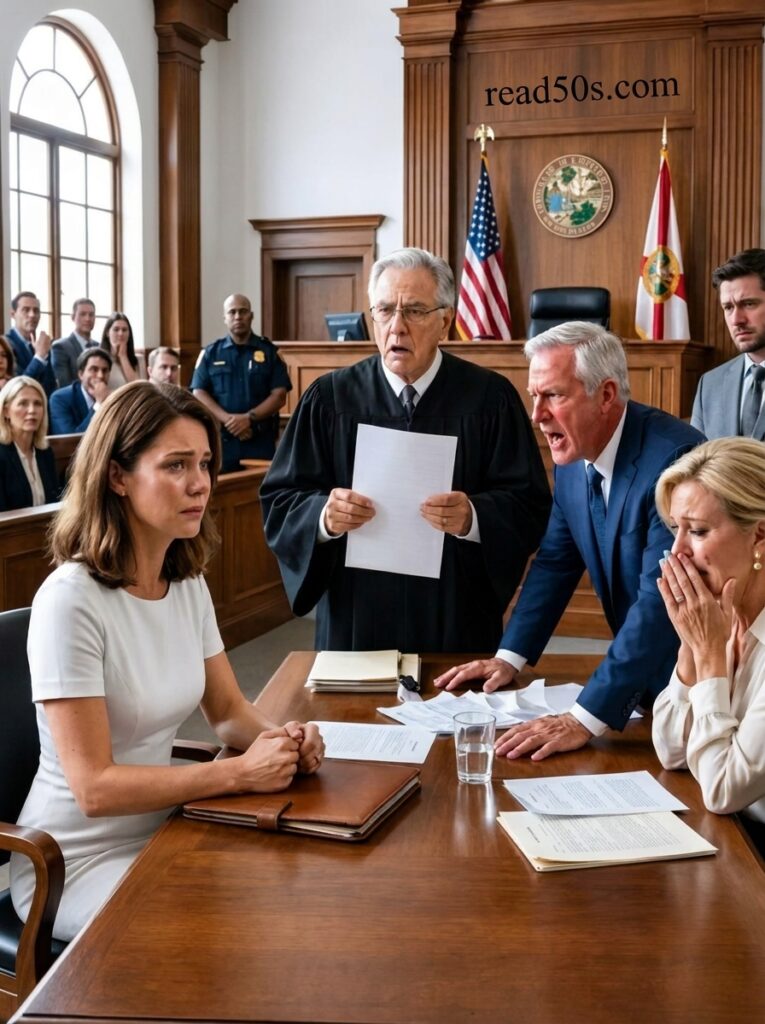
Judge Benton leaned forward slightly. “Mr. Whitaker, are you represented by counsel?”
Preston swallowed. “No, Your Honor.”
“Then choose your words carefully.”
Preston nodded, but his eyes stayed on me.
“I didn’t know what it was at first,” he said. “Dad brought papers to my condo last year. He said it was related to the trust taxes and that everybody had already agreed. He told me Nora had signed her part and I just needed to witness a copy for the accountants.”
My father’s face had gone stiff and gray.
Graham Phelps closed his eyes for half a second, as if he could already feel the case falling apart beneath his feet.
Preston continued. “Later, I saw Nora’s name on one of the pages. The signature didn’t look right. I asked Dad about it, and he told me to stop acting like I knew anything about business.”
The judge looked at my father.
“Mr. Whitaker, do not respond unless I ask you a direct question.”
My father’s mouth closed.
It was the first time in my entire life I had seen him silenced without a fight.
Judge Benton turned back to Preston. “Do you still have copies of what you signed?”
Preston nodded slowly. “I took pictures.”
My mother made a sharp sound.
This time, no one comforted her.
The judge ordered Preston to forward the images to the clerk immediately. While he did, the courtroom waited in the kind of silence that makes every breath feel too loud.
I sat there staring at the table.
For two years, I had wondered if I was losing my mind.
My parents had told relatives I was greedy. They told neighbors I had abandoned the family. They told business contacts I was unstable and ungrateful. They said I wanted the vacation homes only because rental income had grown after the renovations I spent years managing.
They made me sound like a stranger trying to steal from them.
But those homes were not just investment properties to me.
They were hurricane shutters I checked with my own hands.
Leaky roofs I fought insurance companies over.
Guest complaints I answered at midnight.
Broken air conditioners in August.
Sand in the entryways.
Salt on the windows.
My grandmother had trusted me with them because I understood that property was not just money. It was responsibility.
And now the truth was sitting in open court, page by page, louder than every lie they had ever told.
The clerk printed Preston’s photos and handed them to the judge.
Judge Benton studied the first page.
Then the second.
His expression grew colder.
“Mr. Phelps,” he said, “did your office prepare or submit these documents?”
Graham rose carefully. “Your Honor, I will need time to review the origin of these materials.”
The judge’s voice sharpened.
“That answer is becoming very familiar.”
Graham sat back down.
My father leaned toward him again, but stopped before speaking. His hands were clenched so tightly on the table that his knuckles had turned white.
My mother, for once, looked less angry than afraid.
Judge Benton ordered an immediate recess.
No one moved at first.
Then the bailiff announced it again, and the courtroom slowly emptied into the hallway.
Reporters gathered near the benches, whispering into phones. My mother kept her head high, but the color had not returned to her face. My father walked past me without looking in my direction.
Preston stayed behind.
For a moment, neither of us spoke.
Then he stepped closer.
“Nora,” he said, his voice low, “I’m sorry.”
I looked at him.
Those words should have mattered more. Once, I would have given anything to hear them. But pain has a strange way of aging inside you. By the time the apology arrives, sometimes it no longer fits the wound.
“You knew something was wrong,” I said.
His eyes filled.
“I suspected.”
“That is not the same as not knowing.”
He looked down.
“I was scared of Dad.”
“So was I,” I said. “But I still told the truth.”
He flinched, and I did not soften it.
Because for years, I had been the daughter expected to endure quietly so everyone else could stay comfortable. I had been the reliable one, the one who came home, the one who fixed things, the one who answered emergency calls, the one who could be insulted and still show up.
That woman had walked into the courthouse with me.
But she was not leaving with me.
When court resumed, Judge Benton’s patience had disappeared.
He ordered the alleged assignment document, the witnessing pages, and all trust amendments from the past five years placed under forensic examination. He froze every transaction connected to the seven homes, including rental distributions, refinancing attempts, management fee transfers, and any pending sale negotiations.
Then he ordered a full accounting of the Whitaker Coastal Trust.
Five years of income.
Five years of expenses.
Every payment to my parents.
Every payment to Preston.
Every management fee.
Every unexplained withdrawal.
My father finally spoke without permission.
“This is absurd. Those homes have always been family assets.”
Judge Benton stared at him.
“They still are, Mr. Whitaker. That is precisely why this court is interested in who has been treating them like personal property.”
My father sank back into his chair.
Graham asked for time to respond in writing.
The judge granted it, but his warning was clear.
“If the forensic review confirms a deceased notary’s seal was used, this matter will not remain only in civil court.”
My mother covered her mouth with trembling fingers.
That was the moment I understood something painful.
She had not believed they would get caught.
Not because she thought they were innocent.
Because she thought people like me never had proof.
Over the next three months, the truth came out slowly, then all at once.
The forensic examiner confirmed my signature had been forged.
The notary seal belonged to Denise Carver, who had died six months before the assignment was supposedly notarized.
Bank records attached to my grandmother’s letter showed that, before her death, my father had tried pressuring her to remove me from the trust. When she refused, he and my mother began moving rental income through side accounts labeled as maintenance reserves.
Those reserves did not repair roofs.
They paid for my mother’s jewelry.
My father’s boat.
Preston’s credit cards.
Graham Phelps tried to distance himself from the documents. He claimed he had relied on materials provided by his clients. But the judge referred the matter to investigators anyway, because some of the filings carried his certification.
The court appointed a neutral trustee to take control of the seven homes while the case continued. For the first time in years, the rental income went where it was supposed to go. Repairs were documented. Accounts were audited. Every property was inspected.
The homes looked beautiful from the outside.
Inside the books, they were bleeding.
At the final hearing, my father looked older.
Not humbled.
Just cornered.
My mother sat beside him with her purse clutched in her lap, refusing to look at me.
Preston testified.
His voice shook, but he told the truth. He admitted he had signed as a witness without reading carefully. He admitted Dad told him I had already agreed. He admitted he later suspected my signature was false and stayed silent.
When my grandmother’s video transcript was read into the record, I cried for the first time in that courtroom.
Margaret Whitaker had known exactly what was coming.
In her final statement, she wrote that the homes were meant to remain protected for all rightful beneficiaries, but that my share was never to be removed because I had earned her trust through years of work, not through flattery or entitlement.
Then came the line that broke me.
“Nora kept showing up when showing up was hard. That is the child I trust with what I built.”
I pressed my hand over my mouth.
For years, my parents had made me feel foolish for caring. They made my loyalty look like weakness. My grandmother had seen it clearly the whole time.
Judge Benton ruled that the assignment was invalid. My beneficiary interest was restored fully. My parents were removed from management authority over the trust. The court ordered repayment of misdirected funds, legal fees, and further review for possible criminal charges tied to the forged documents.
My father stared straight ahead as the ruling was read.
My mother cried, but not for me.
Not for my grandmother.
Not even for the damage they had done.
She cried because consequences had finally entered a room she could not decorate with excuses.
Afterward, in the courthouse hallway, my father approached me.
He looked smaller without the courtroom table between us.
“You have no idea what you’ve done to this family,” he said.
I looked at him for a long moment.
Then I answered, “No. I finally understand what this family did to me.”
His face hardened, but there was nothing left for him to threaten me with.
My mother stood behind him, waiting for me to break, to apologize, to make it easier for everyone.
I did not.
Preston came to me near the exit.
“I should have spoken sooner,” he said.
“Yes,” I replied. “You should have.”
He nodded, tears in his eyes.
“I know.”
That was all I could give him that day. Not forgiveness. Not hatred. Just the truth.
Six months later, the trust was stable again.
The homes were repaired properly. The rental accounts were transparent. A professional management company handled bookings, maintenance, insurance, and taxes. I kept my share, not as a trophy, but as proof that my grandmother’s wishes had survived every lie built against them.
I returned to Key West alone one evening and stood on the porch of the smallest house, the one with blue shutters and a crooked hibiscus bush near the steps.
Grandma Margaret used to sit there with iced tea and tell me that salt air could heal almost anything if you gave it enough time.
I used to believe her.
Now I understood she had left out the hardest part.
Salt air could not heal a wound you kept letting people reopen.
So I stopped.
I changed my number.
I stopped answering messages disguised as emergencies.
I stopped attending family dinners where everyone expected me to pretend betrayal was just a misunderstanding.
On the first anniversary of the ruling, I placed a framed copy of my grandmother’s letter in the office where the trust records were kept.
Not the whole thing.
Just one sentence.
Nora kept showing up when showing up was hard.
That was enough.
My parents walked into court believing I deserved nothing.
They thought a forged signature, a dead notary’s seal, and years of intimidation could erase me from what my grandmother had built.
But Margaret had known them better than they knew themselves.
And she had known me too.
In the end, the seven homes were not the real inheritance.
The real inheritance was the truth she left behind.
And this time, no one could sign my name and take it from me.