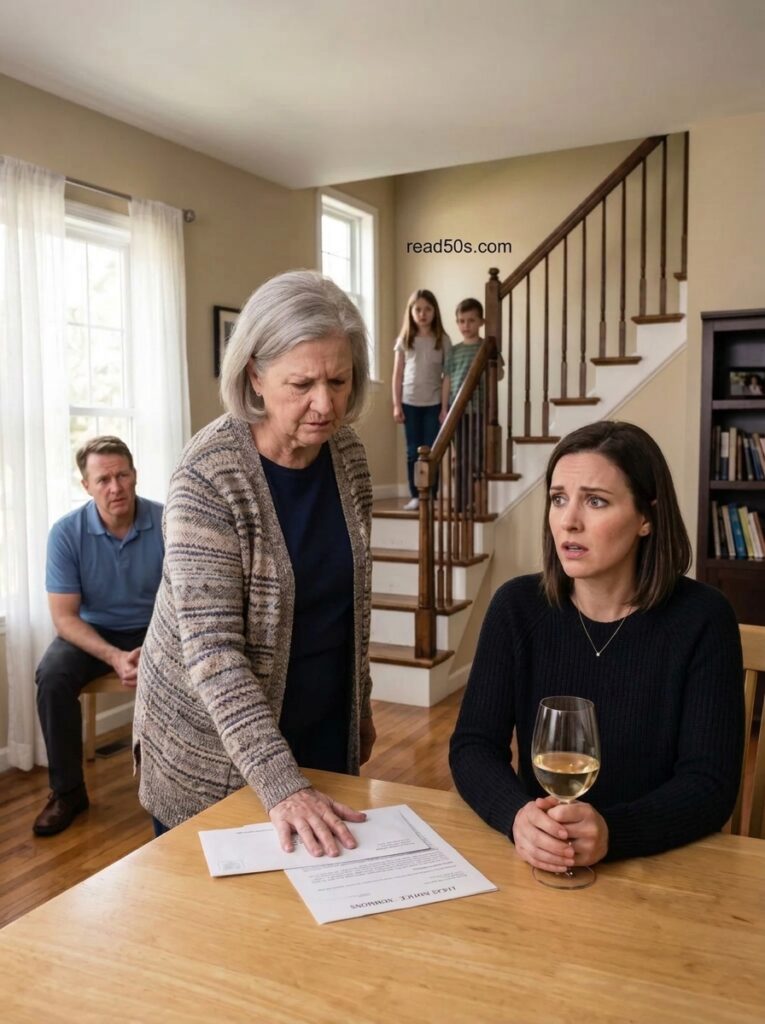
“Thank you for living here for so many years without paying a single cent, Margaret,” my daughter-in-law, Melinda, said as she raised her wine glass with a sharp, cold smile.
“Now that we have finally bought our own house, we simply do not need you anymore.”
A silence fell over the dinner table so sudden and heavy that even the soft clinking of forks against plates felt like an insult.
My son, Connor, lowered his eyes to his plate and kept cutting his meat as if he had not heard a single word his wife had just said.
My grandchildren, Jackson and Lily, sat perfectly still with that quiet alarm children have when they sense an adult has broken something invisible and precious.
I did not cry in front of them.
I did not even feel the urge to cry.
As I sat there, absorbing Melinda’s words, I felt something old and strong awaken beneath the layers of pain I had carried for years.
A strength that had been sleeping inside me while I played the role of the quiet guest.
I adjusted the cloth napkin on my lap, looked up at Melinda, and gave her a slow, calm, almost kind smile.
My reaction clearly confused her.
She had expected me to fall apart.
She had expected tears.
Shame.
Begging.
Maybe she expected me to ask for more time, or plead for a little compassion, or search for some tiny corner where I could eventually fade away and die.
Instead, I looked directly into her eyes.
“That is wonderful news,” I said. “I am genuinely glad you finally want a life of your own.”
Then I added, “Actually, I have some news of my own to share with everyone at this table.”
The heavy knife slipped from Melinda’s trembling hand and clattered against her ceramic plate.
Connor raised his head for the first time that evening, looking at me with confusion and exhaustion.
Jackson stared at me with those restless, intelligent eyes he had inherited from his grandfather.
Lily gripped her water glass tightly with both small hands.
“What kind of news could you possibly have?” Melinda asked.
Her posture had changed.
The arrogance was still there, but something else had entered the room with it.
Fear.
I took a deep breath.
I realized then that I had waited far too long to tell the truth.
But sometimes the truth chooses its own moment to fall like a heavy stone.
“This news concerns you more than anyone else sitting here,” I said.
I watched her body tense.
It began in her neck, then moved to her jaw.
Then she started breathing as if even the air in the room owed her obedience.
I let her sit in the weight of her own anxiety for a few more seconds.
I felt I owed myself that small justice.
Just minutes before dinner, while I was in the kitchen serving rice, I had overheard her on the phone.
She clearly believed I could not hear her over the sounds of the stove.
But her words were sharp and unmistakable as they echoed through the hallway.
“She is finally going to get out of this house,” Melinda had whispered with pure venom in her voice.
“You have no idea how much I hate her. She acts like she still owns the entire place.”
I had stood frozen by the counter.
Then she told the person on the other end that they would speak to the lawyer the next morning because she was certain Connor would finally sign the papers.
“If necessary, I will make sure the old woman signs them too,” she said with a cold laugh. “Even though she does not understand a thing about what is happening.”
She spoke about me as if I were useless.
A fading shadow.
Half blind.
Half stupid.
A burden occupying a room that did not belong to her.
She had no idea who I truly was.
She had no idea what I had buried deep inside my heart just to keep the foundation of that house standing all those years.
She did not know the weight of the promises I had made.
She did not understand the sacrifices I had carried silently through the night.
I leaned slightly toward the wooden table and spoke in a voice that was calm, but heavy with truth.
“Your years living in this house have not been free, Melinda,” I said. “But you should also know that my years here have not been free either.”
The room grew colder.
“And there is one thing you need to understand very clearly,” I continued. “This house does not belong to you.”
Connor put his fork down and looked at me with wide eyes, as if a sudden realization had struck him.
“What exactly are you saying, Mom?” he asked.
His voice sounded small.
Hollow.
I looked at him tenderly.
My son had the face of a man exhausted from carrying a burden he did not fully understand.
I wanted to reach across the table and hug him.
But the time for comfort would have to wait until the truth had finished speaking.
“I am saying this house was never in your name,” I said. “And it was certainly never in your father’s name either.”
Melinda’s face began to lose color.
“This house has been legally registered in my name, and my name alone, for the last twelve years.”
Melinda froze in her chair.
But the worst part for her was not simply realizing the house was not hers.
The worst part was understanding that I had overheard her secret plans in the kitchen just minutes before she decided to humiliate me in front of my grandchildren.
“That is a bold and pathetic lie,” she whispered.
But her voice was already beginning to break.
“No,” I said calmly. “It is the truth. And you will see it for yourself tomorrow when you look at the original deed and the will your father-in-law left for me.”
Connor turned pale.
“Dad really arranged it this way?” he asked. “Behind my back?”
I nodded slowly.
“Your father did it to protect this home,” I said. “And to protect his children from the uncertainty of the future.”
Then I looked at Melinda’s furious face.
“I suppose he also did it because he suspected something I took far too long to admit to myself.”
Melinda stood so abruptly that her chair scraped loudly against the floor.
“You cannot do this to me,” she screamed. “Not after everything I have done for this family.”
“No, Melinda,” I said, and there was no gentleness left in my voice. “You are the one who tried to do something unforgivable to this family.”
Then I stood and walked toward my room without another word, leaving the echoes of the truth hanging in the air like smoke.
Behind me, I heard a glass fall and shatter on the floor.
Then I heard Lily’s muffled, heartbroken sobs.
I barely slept that night.
I sat on the edge of my bed with the small wooden box Samuel had given me resting on my lap.
Samuel had given me that box two weeks before he passed away, when cancer was closing in on his body but had not yet touched his brilliant, protective mind.
“You must only open this if you ever feel our family is in danger,” he had told me. “Or if someone tries to take what we built.”
I did not open it during the first year after he was gone.
I did not open it when Connor asked me to move in with him and Melinda so I would not be alone.
I did not open it when the small humiliations began.
Or when the cruel jokes and poisonous comments, disguised as concern, slowly wore down my spirit.
I remembered the way Melinda would tell me to stay out of things because I was old and likely to get things mixed up in my head.
“Mrs. Reed, please do not interfere with our business,” she would say with a condescending pat on my hand. “This is how we have decided to raise our own children.”
I stayed quiet for the sake of the children.
For Connor.
For Samuel’s memory.
I kept trying to preserve peace in our home.
But that night, the weight of her cruelty had become too much to carry.
So I finally lifted the lid of the wooden box.
Inside, resting against the velvet lining, were the original deed to the house, the formal will, the mortgage payment receipts, and a letter written in my husband’s firm handwriting.
There was also a sealed document stating that months before he died, he had transferred the entire property into my name and my name alone.
I sat there and cried silently for the first time in a very long time.
Not from sadness.
From relief.
And fury.
Because I realized then that Melinda had not simply wanted to push me out of a shared house.
She had wanted to steal my home.
My security.
My husband’s final protection.
The next morning, I went to the kitchen and made a pot of coffee.
Then I placed a thick manila envelope in the center of the wooden table.
When Connor finally came downstairs with dark circles under his eyes, he looked at the envelope with dread.
“Everything you need to know is inside,” I said softly, pouring him a cup of coffee. “Take it with you.”
He did not open it there.
He tucked it under his arm and headed for the door.
Melinda tried to stop him.
“You should not check anything without a lawyer present, Connor,” she shouted. “Your mother is clearly trying to manipulate you.”
Connor did not answer her.
He did not even look at her.
He walked out and drove away into the morning mist of Blue Ridge Valley.
That day, I stayed in the shadows of the house and waited for the rest of her plan to unravel.
At midday, a man arrived at the front door wearing a cheap gray suit and carrying a black briefcase.
His eyes reminded me of a snake.
Melinda greeted him and led him into the guest room.
The same room where she had been hiding papers and loan forms for weeks.
I stayed behind the corner of the hallway, where the old walls of the house seemed to hold sound as if they wanted to protect me.
“Without your mother-in-law’s authentic signature on these papers, we cannot transfer the property into your name,” the man said in a dry, clinical voice.
He warned her that if she tried to forge the signature, she could face a long prison sentence for fraud.
“Then you need to tell me exactly how to get her to sign it,” Melinda said desperately. “My Uncle Roger won’t release the money for the company unless I give him the house as collateral.”
As I listened, every piece of the puzzle finally fell into place.
Connor had been anxious for months because he wanted to become independent from the corporate business where he had worked for a decade.
Melinda had filled his head with dreams of starting his own firm with a quick investment from her uncle.
But there had never been any real investment.
It was a trap.
A plan to mortgage my house behind everyone’s back and saddle my son with a debt that would give Melinda control over everything we owned.
This was not simply a fight between a mother and her daughter-in-law.
It was a calculated ambush against the future of the entire family.
After the man in the gray suit left, I locked myself in my room and made copies of every document.
Then I prepared a new folder for Connor.
I included the deed and the will.
I included Samuel’s letter.
And I included printed copies of several text messages Jackson had accidentally shown me weeks earlier on Melinda’s tablet.
In those messages, Melinda had written that the old lady would sign the papers without even realizing what she was doing.
“Connor does not need to know all the details of the arrangement as long as we secure the house in our names,” she had written to her uncle.
I placed everything in a plain white envelope.
Then, in the early hours of the morning before the sun had risen, I left it on the front doormat.
At dawn, I heard Connor’s voice echo through the house before I even had time to get out of bed.
“What is the meaning of this?”
His voice was filled with shock and rising anger.
Melinda came running out of her room, disheveled and frantic, with the scent of pure hysteria clinging to her like a shroud.
“Please do not open anything that comes from your mother,” she pleaded, trying to grab the envelope. “She is just trying to destroy our marriage.”
I stood in my bedroom doorway and remained silent.
There was no longer any need for me to defend myself.
Connor opened the envelope and took out Samuel’s letter first.
He recognized his father’s handwriting instantly.
I saw something break in his expression before he even finished the first page.
The letter warned him that if anyone ever tried to divide the family or take away what we had built, he must use those documents to protect me.
“The house belongs to her,” Samuel had written. “Take care of it. Take care of her. And take care of my grandchildren.”
The letter also warned him to be careful of anyone who stood beside him out of self-interest instead of genuine love and respect.
Connor stopped reading because his hands were trembling so violently that the paper rustled in the quiet hallway.
Melinda lunged toward him.
“You do not even know when that letter was written,” she shouted. “You do not know if your father was in his right mind.”
My son looked up at her.
For the first time in years, his eyes were clear.
Free of fear.
Free of habit.
Free of blindness.
“And what about these messages, Melinda?” he asked, holding up the printouts from the tablet.
“Did my father somehow write these too? The messages where you talked about tricking my mother into signing away her life’s work?”
She went speechless.
Her mouth opened, searching for a lie large enough to cover the truth.
“Connor,” she finally stammered, taking a step back. “I was only doing it for us. For our future. For a successful family.”
“Were you really going to mortgage my mother’s house and put all of us at risk for your greed?” he asked.
His calmness was more frightening than any shout could have been.
Melinda began to cry.
But the sound was no longer convincing.
It was only the noise of a brittle mask cracking apart.
“How could you do this to me?” Connor asked, quiet tears moving down his face. “How could you do this to our children?”
He swallowed hard.
“You did not do this for us. You did it because you wanted control over every part of our lives.”
At that exact moment, Jackson and Lily came downstairs.
Their faces were pale as they witnessed the collapse of their mother’s lies.
Lily ran straight to me and wrapped her arms around my waist.
“Grandma,” she asked, her lip trembling, “you are not really leaving us, are you?”
I knelt to her level and kissed her forehead.
“No, sweetheart,” I promised. “I am not going anywhere. This house will always be our home.”
Connor closed his eyes for a long second.
When he opened them again, he looked like a man who had finally stepped out of a long, dark tunnel.
“Melinda,” he said, “I need you to pack your things and leave this house immediately.”
The finality in his voice left no room for argument.
She looked at him as if she no longer understood the language he was speaking.
“You are seriously throwing me out?”
“Leave today,” he said. “I cannot look at you without seeing the betrayal you planned for my mother.”
She started crying again.
First begging.
Then promising.
Then blaming me for everything that had gone wrong in her life.
But no one was listening anymore.
Because that is the truth about truth.
Once it settles into a room, no lie sounds the same again.
Melinda went upstairs.
An hour later, she came back down with one suitcase.
She looked older.
More tired than I had ever seen her.
At the front door, she stopped and fired one final arrow of spite.
“One day, you will all realize how much you needed me.”
I looked at her calmly.
“I think we will find that we needed the truth far more than we ever needed you.”
She walked out.
When the door clicked shut behind her, I felt the entire house take a deep, long-awaited breath.
It was as if the walls themselves were finally releasing years of silence, tension, and hidden cruelty.
Jackson ran to open the windows and let in the fresh spring air.
Lily turned on soft music that filled the rooms with warmth.
Connor sat across from me at the kitchen table and buried his face in his hands.
“I am so sorry, Mom,” he whispered. “I was blind.”
I held his face in my hands the way I had when he was a little boy.
“You do not need to apologize to me,” I told him.
“You just had to find your way back to yourself. And I am glad you are finally here.”
We sat together in the quiet of our home.
Several months have passed since that morning.
The house no longer creaks under the weight of fear or hidden agendas.
Connor started therapy to work through the years of emotional manipulation, and he has become a man who speaks more clearly and listens with his heart.
The children have started laughing again without checking over their shoulders to see if their mother is watching with disapproval.
I still water my plants every morning in the garden.
Sometimes, when sunlight pours into the kitchen, I speak softly to Samuel’s memory.
“We did it, Samuel,” I tell him with a smile. “We protected what belonged to us. We protected our legacy.”
I do not carry deep hatred for Melinda.
Hatred takes up too much valuable space in a happy home.
I simply understand now that some people confuse love with possession.
They confuse family with a business transaction they can control.
I survived poverty.
I survived my husband’s long illness.
I survived grief.
I survived being underestimated by people who mistook age for weakness.
And I survived the humiliation of being treated like a guest in my own home.
A woman does not become weak simply because she grows older.
Now, in the quiet afternoons, my grandchildren sit at the same table where Melinda once tried to cast me out, and they do their homework in peace.
Connor makes coffee on Sunday mornings just like his father used to do, and the smell fills the house with continuity.
As I fold laundry or set the table for dinner, I look around and feel a peace deeper than anything I have known in years.
Not because our lives are perfect.
Not because we are free from every challenge.
But because the truth has finally returned to its rightful place.
This house, which is mine and also ours, has finally become a true home again for the people who truly love it.