“Lucy,” Caroline whispered into the phone, all the sweetness gone from her voice.
“It says the payment is overdue.”
I stood on the balcony outside our suite in the Bahamas and watched my son dive into the turquoise water with his snorkel mask pushed up on his forehead.
He surfaced laughing, smoothing his wet hair back with both hands, completely unaware that three states away, my sister was finally facing the consequences of her own words.
“It says the automatic payment was removed,” Caroline repeated, louder this time, as though raising her voice could change what she saw on the screen.
“Paused,” I corrected.
The silence that followed lasted only a second, but it was long enough for me to hear everything inside it.
Her panic.
Her calculation.
Her immediate search for a way to make herself the victim.
“Lucy, no,” she said.
“No, no, no.
“You cannot do this because of Thanksgiving.”
“Not because of Thanksgiving,” I replied.
“Because of Luke.”
A man shouted in the background.
Her husband, Brent.
His voice was muffled at first, then became sharper.
“What did she say? Ask her how many notices we have before foreclosure. Caroline, ask her.”
I could picture the kitchen without seeing it.
The marble island Caroline insisted on displaying in every Christmas photograph.
The oversized pendant lights.
The bowls of decorative fruit no one ever ate.
The carefully staged life she had built so convincingly that half the family believed she was the successful one and I was simply the quiet backup plan standing off-camera with a checkbook.
“Brent wants to know whether this is a mistake,” Caroline said.
“It is not.”
“You promised you would help until we recovered.”
“I did help,” I replied.
“For three years.”
My voice remained calm.
That was what unsettled her most.
Caroline knew how to fight tears, shouting, guilt, and begging.
She had no defense against stillness.
She immediately switched tactics.
“You would hurt my children just to prove a point?”
I looked down at Luke again.
He was kicking through the shallow end, chasing a bright orange dive ring and moving with the carefree joy only children should have.
“You hurt a child to entertain a room,” I said.
“The difference is that I am ending financial support for a household with two adults in it.
“You targeted a ten-year-old at the dinner table.”
She began crying then, loudly and efficiently, the way she always did when she needed a witness.
Sure enough, I heard my mother in the background a moment later.
“What happened? Caroline? Give me the phone.”
I almost laughed.
Of course my mother had found her voice now.
There was a rustling sound, another muffled exchange, and then my mother’s strained whisper came through the phone.
“Lucy, honey, what is going on?”
“You know exactly what is going on.”
“Caroline says you canceled a payment.”
“I paused the mortgage payment.”
My mother inhaled so sharply that I could hear it through the phone.
“Lucy.”
Her tone shifted, a warning wrapped in pleading.
“That is not something you do in anger.”
“No,” I said.
“Humiliating a child over turkey is something someone does in anger.
“Quietly ending a financial arrangement after years of disrespect is something someone does when she is finished.”
My mother became silent.
I had lived with that silence all my life.
It had a shape.
A temperature.
A weight.
It was the same silence she wore when Caroline lied in high school and I took the blame.
The same silence she wore when Caroline borrowed money and conveniently forgot to repay it.
The same silence she used whenever keeping the peace required my dignity as the sacrifice.
“Mom?” I said.
“Did you hear what she said to Luke?”
“I heard enough,” she replied weakly.
“No.
“You heard all of it.
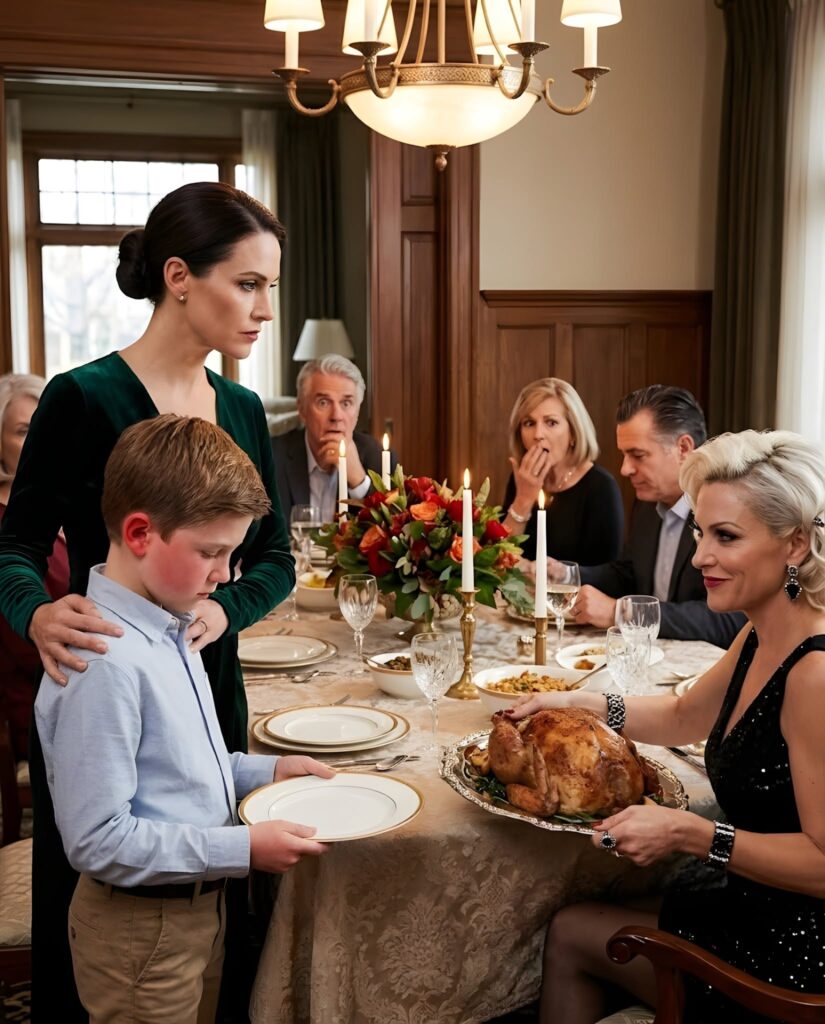
“You watched my son stand there holding his plate while your daughter told him the turkey was for family.
“I want you to say the words.”
She did not.
Instead, she whispered, “People make mistakes during the holidays.”
I closed my eyes for one second.
There it was.
The family religion.
Not kindness.
Not truth.
Comfort.
“I am finished financing that belief system,” I said.
I ended the call before she could answer.
Luke climbed the pool steps and waved at me from below.
“Mom! Did you see that?”
“I did,” I called back with a smile.
“You looked like a professional.”
He grinned and ran back toward the water.
That night, after room service, a long shower, and one more round of diving for orange rings, Luke fell asleep with sun-reddened cheeks and one arm wrapped around a hotel pillow.
I sat in the darkness beside the balcony doors and allowed the quiet to settle around me.
Then my phone lit up again.
Brent.
I almost ignored it.
But something inside me wanted to hear his voice without Caroline softening it.
When I answered, he did not bother saying hello.
“You blindsided us.”
“You built your budget around money that did not belong to you.”
“That arrangement was understood.”
“No,” I replied.
“That arrangement was a favor.”
He exhaled heavily through his nose.
“We are two payments away from serious trouble.”
That caught my attention, although not in the way he had hoped.
Caroline had always told the family they were financially stable now.
She said my support was temporary.
She claimed they barely needed it anymore.
I had suspected she was lying, but hearing Brent say it aloud turned suspicion into fact.
“Two payments?” I asked.
He realized his mistake too late.
“It is none of your business,” he snapped.
“It became my business three years ago when you allowed my sister to arrive at my door crying over foreclosure notices.”
He went silent.
I remembered that night clearly.
Caroline stood on my porch wearing a cashmere sweater, her makeup smeared, clutching an unopened envelope from the lender as though it were a death certificate.
Brent remained in the car because he was too ashamed to come inside.
Their variable-rate mortgage had increased, his business had collapsed, and the polished life they displayed online had been held together by credit card minimum payments and lies.
I had enough savings to help, although not without making sacrifices.
Enough to cover the shortfall while they recovered.
I told myself I was doing it for their children.
I told myself family should not lose a home if I could prevent it.
I told myself that if I established clear conditions, my help would mean something.
I asked for only one condition.
“You never make Luke feel like he is less than anyone else,” I had told Caroline that first night.
“Not in front of me.
“Not behind my back.
“Not at birthdays, Christmas, or anywhere else.
“If I do this, my son is treated like family in every room.”
She had grabbed my hands and sworn to me.
I could still hear her.
“Of course he is.
“Lucy, he belongs to all of us too.”
It was the easiest lie she had ever told.
Back in the Bahamas, Brent lowered his voice.
“Tell me what it will take to turn the payments back on.”
There it was.
Not an apology.
A transaction.
“It will take the truth,” I said.
“What does that even mean?”
“It means that tomorrow evening, I want everyone who attended Thanksgiving gathered at Mom and Dad’s house.
“Everyone who sat in that room.
“I want Caroline to repeat exactly what she said.
“I do not want anyone calling it a joke.
“I want Luke to hear the adults in this family acknowledge what happened to him without minimizing it.
“Then I will decide what happens next.”
“You are extorting us.”
I almost admired his nerve.
“No,” I said.
“I am ending a subsidy for people who used my son as a target.”
He muttered something under his breath.
“We cannot have a scene,” he said.
“You already created one,” I replied.
“I am simply asking the witnesses to finally tell the truth.”
He ended the call.
I slept better than I had in months.
The following afternoon, while Luke and I ate lunch on the beach, my mother sent me a single message.
Tonight.
7:00 p.m.
Join by video.
There was no apology.
No warmth.
But she was giving ground, and in my family, that was almost revolutionary.
At seven, I propped my phone against a water glass on the balcony table and joined the video call.
Luke was inside watching a nature program and building a tower from sugar packets he had collected from the breakfast tray.
I kept the balcony door mostly closed.
He did not need to hear the first part of the conversation.
The screen filled slowly.
My mother sat at one end of the dining room table.
My father was beside her, his face gray and closed.
My uncle and aunt were there.
Caroline and Brent.
Even my cousin Mallory, who had laughed first and then spent the rest of Thanksgiving pretending she had not.
No one smiled at me.
Good.
“You wanted everyone here,” my father said.
“We are here.”
I nodded.
“Then say what happened.”
Caroline crossed her arms.
Her eyes were swollen from crying, but her posture still carried that familiar stiffness, the one suggesting she considered accountability a personal insult.
“You are destroying my family because of one bad comment,” she said.
“Say it,” I repeated.
My mother tried to intervene.
“Things became tense—”
“No.”
I held up my hand.
“Not a summary.
“Not diplomacy.
“The exact sentence.”
No one moved.
I had expected that.
So I did the one thing they never believed I would do.
I showed them proof.
Not proof of the mortgage payments.
Proof of Thanksgiving.
I shared an audio clip.
My father blinked.
“What is that?”
“Luke’s smartwatch records voice notes when he forgets to stop the timer function,” I explained.
“He accidentally activated it while waiting for dinner.”
I had discovered the recording in the car after he fell asleep during the drive home from Thanksgiving with the watch still on his wrist.
I listened to it once.
Then twice.
Then I sat in the driveway shaking while the room replayed itself in perfect audio.
Caroline’s voice came through the phone speaker, bright and cruel.
“Sweetheart, Thanksgiving turkey is for family.”
Then came the laughter.
Mallory’s laughter.
My uncle coughing.
The sound of a serving fork striking porcelain.
Luke’s quiet whisper:
“Yeah.
“It is okay.”
Then came the sound of my chair scraping backward.
For a long moment after the recording ended, no one on the screen appeared to breathe.
Mallory covered her mouth.
My aunt stared down at the table.
My father closed his eyes.
Caroline’s face turned white.
“This is unbelievable,” she said.
“You recorded us?”
“No,” I replied.
“My son accidentally recorded the room that humiliated him.”
That distinction mattered.
For the first time, there was no room for interpretation.
No family version.
No claim that I was too sensitive.
There was only evidence.
Brent leaned toward the camera.
“Delete it.”
I stared at him.
“You should be ashamed that deleting the evidence was your first concern.”
He leaned back.
My mother began crying softly.
Real tears this time, or something closer to sincerity than she usually allowed herself.
“I should have stopped it,” she whispered.
“Yes,” I said.
My father spoke next, his voice rough.
“I should have stopped it too.”
I waited.
Caroline still said nothing.
So I mentioned the one thing she valued more than dignity.
“The automatic payments remain paused until the truth is spoken plainly.”
She flinched as though the sentence had struck her.
Then rage took over.
“Oh, so now this is noble?” she snapped.
“You have always loved pretending to be a saint.
“Quiet Lucy.
“Dependable Lucy.
“Writing checks so everyone can see what a hero she is.”
“There it is,” my uncle muttered before he could stop himself.
Everyone turned toward him.
He swallowed, then spoke more firmly.
“She is right about one thing.
“Lucy writes the checks.
“The rest of us simply allow her to.”
It was the first honest sentence that man had spoken at a holiday gathering in twenty years.
Caroline stared at him in disbelief.
He did not look away.
My father slowly straightened in his chair.
“How much have you been paying?” he asked me.
I told him.
I watched the number strike the room like shattered glass.
Not because it was enormous by the standards of billionaires.
Because it was enough.
Enough over three years to fund college savings, renovations, two new cars, or an entirely different life.
Enough to make every smug family photograph Caroline had posted look as though it had been staged inside a home paid for with my money.
My mother covered her mouth with one hand.
“You told us Brent had turned everything around,” she said to Caroline.
“We were getting there,” Caroline snapped.
Brent interrupted.
“That is not fair.”
“To whom?” I asked.
He looked at me, and I think for the first time he saw what Caroline had seen on my doorstep years earlier and mistaken for softness.
It had not been weakness.
It had been control.
“You made us dependent,” he said.
“No,” I replied.
“Dependence is what happens when two adults build a life they cannot afford and expect gratitude from the person financing it.”
Inside the hotel room behind me, Luke laughed at whatever he was watching.
The sound floated through the balcony door, light and alive.
Every adult on the call heard it.
I lowered my voice.
“That child asked me in the car whether he was part of this family.”
No one on the screen could meet my eyes.
“Answer him,” I said.
My mother straightened first.
“Yes,” she said, looking directly into the camera.
“Luke is family.
“He always was.
“And I failed him.”
My father followed.
“I failed him too.”
Mallory wiped her face.
“I laughed because I was uncomfortable.
“I am sorry.”
One by one, the people in that room finally did what they should have done before the turkey became cold.
Everyone except Caroline.
She sat rigidly, her jaw tight and her tears drying into anger.
“I am not performing for your son because you arranged some kind of guilt tribunal.”
That was the moment I knew the money had to remain stopped.
Not for leverage.
For clarity.
“You still believe this is a performance,” I said.
“That is why you are losing everything.”
Brent turned on her right there in front of everyone.
“Apologize,” he hissed.
She looked at him as though he had struck her.
“Do not dare do that now,” she said.
“Say it!” he shouted.
The panic in his face made the entire room understand how close they truly were to losing the house.
Caroline stood so quickly that her chair fell backward.
“This is your fault too!” she screamed at him.
“You knew we needed her money.”
The room went completely silent.
Brent’s expression changed.
He was no longer angry.
He was exposed.
My father spoke as though every word cost him something.
“You allowed your wife to humiliate Lucy’s child while she was paying your mortgage?”
Brent said nothing.
That silence was answer enough.
I ended the call ten minutes later, but not before making one final decision clear.
I would not restart the automatic payments.
Not after forced apologies.
Not after exposure.
Not after panic.
Some arrangements, once contaminated, cannot be restored.
When Luke and I returned home two days later, I did not take him to my parents’ house.
I took him out for pancakes.
Then we went to the aquarium.
Afterward, we returned home, where I helped him unpack seashells, snorkeling photographs, and the ridiculous souvenir shark he insisted needed its own seat on the airplane.
That evening, someone knocked on my door.
My mother and father stood outside.
They carried no casserole.
No flowers.
No props.
Only themselves.
My father looked older than he had a week earlier.
“We came to apologize to Luke,” he said.
I allowed them inside.
They sat with him in the living room.
My mother’s voice shook as she told him she should have spoken the moment Caroline made that comment.
My father told him that no child in the family should ever have to question whether he belonged.
They did not use the word joke.
They did not ask him to make them feel better.
Luke listened quietly and seriously.
Then he nodded once.
“Okay,” he said.
It was not exactly forgiveness.
It was permission for them to continue trying.
That was more grace than they had earned, but it belonged to him to give.
Over the following month, the family rearranged itself in ways I had stopped believing were possible.
Not perfectly.
Families built on silence do not become courageous overnight.
But the center shifted.
My mother began calling Luke directly to ask about school.
My father attended one of his weekend soccer games and stood on the sidelines in the cold with a thermos of coffee, shouting far too loudly when Luke scored.
Mallory sent an apology letter without excuses.
Even my uncle, awkward as ever, took Luke fishing and managed to avoid saying anything foolish for almost two hours.
Caroline did not attend Christmas.
Neither did Brent.
In January, I heard from my father that they had listed their house for sale.
Not because the bank had already taken it.
Because the bank was getting close, and reality had finally caught up with their pride.
The listing photographs were polished, sterile, expensive-looking, and somehow small.
That was what struck me most.
Once you know the truth about a house, it changes size.
One month later, Caroline sent me her first message since the video call.
I am selling the house.
I hope you are happy.
I stared at the message for a long time.
Then I replied:
I am relieved.
Because happy was too simple a word.
I was sad that it had come to this.
I was angry that it had required so much.
I was grateful that I had finally stopped confusing rescuing someone with loving them.
Most of all, I was clear.
That spring, Luke received a school assignment asking him to write about what family meant.
He sat at the kitchen table chewing the end of his pencil while I prepared pasta and pretended not to watch him.
Finally, he looked up.
“Can family be the people who act like you matter even when it is inconvenient?” he asked.
I turned off the stove and looked at him.
“Yes,” I said.
“That is exactly what family is.”
He nodded as though he had settled something inside himself and returned to his work.
Weeks later, my father asked whether I thought Caroline would ever change.
“I do not know,” I told him.
That was the truth.
Some people survive shame and become softer.
Others can survive it only by rewriting the story until they appear innocent again.
Caroline had spent her entire life treating love like a hierarchy and generosity like an entitlement.
Losing the house might have humbled her.
Or it might have become one more thing she blamed on me.
I could not control that.
What I could control was the table I set.
The following Thanksgiving, I hosted dinner at my house.
Nothing extravagant.
Only warm food, extra chairs, too many rolls, soft butter on the counter, and Luke helping me baste the turkey while pretending to be the head chef.
My parents arrived early to set the table.
My uncle brought a pie.
Mallory brought sparkling cider and genuine remorse.
The room was smaller than Caroline’s old house and kinder by miles.
When the turkey was ready, Luke stood beside me holding the carving fork, proud and smiling.
“Who gets the first piece?” my father asked.
Luke looked at me, then around the table.
I handed him the plate.
“You do,” I said.
No one laughed.
That was how I knew the truth had finally entered the room and decided to stay.
End.