A SIX-YEAR-OLD CRAWLED SEVEN BLOCKS TO SAVE HIS LITTLE SISTER
Peter Calder had been working on the loose hinge of his front door for nearly an hour when the screwdriver slipped from his hand.
It struck the porch boards with a sharp metallic crack, bounced once, and rolled toward the top step.
The repair should have taken ten minutes.
Peter had fixed more difficult things before breakfast, but that morning, his hands kept slowing whenever his thoughts returned to Aaron.
His younger brother had been gone for three years.
A sudden heart attack at thirty-five had taken Aaron on an ordinary morning—the kind that began with coffee, a shower, and plans for the weekend.
By nightfall, Peter was standing beneath the soft lights of a funeral home, staring at Aaron in a dark suit he would have hated.
Aaron had always looked more natural in worn jeans, work boots, and an old shirt with paint on the shoulder.
He was the brother who laughed too loudly on Peter’s porch, drank root beer directly from the bottle, and behaved as though serious trouble belonged to other families.
Then trouble walked straight through their door.
Aaron left behind two children.
Drew was three, old enough to ask when his father was coming home but too young to understand why every adult stopped talking whenever he entered the room.
Lily was still a baby.
Aaron also left behind Reena, his wife and the children’s stepmother, who stood beside the casket telling everyone she wanted stability for them.
Peter believed her because he needed to.
Grief makes people reach for the least painful explanation, even when the facts keep pressing against it.
During the weeks after the funeral, Peter called almost every day.
He offered to take Drew to the park, bring groceries, mow the lawn, repair the steps, or stay with the children while Reena rested.
At first, she thanked him and promised to call.
Then the excuses began.
“They’re sleeping.”
“They have a stomach virus.”
“Drew becomes upset after you leave.”
“You remind them too much of their father.”
Peter questioned her once.
Reena stopped answering for several days.
When she finally called, she told him his visits were preventing the children from adjusting.
That sentence stayed with him.
He didn’t want to become the uncle who made everything harder because he couldn’t manage his own grief.
So he backed away.
He continued sending birthday gifts.
He left grocery cards inside envelopes.
Sometimes he drove slowly past the house, hoping to see the children through an open curtain.
Most days, the curtains remained closed.
The most important thing Peter gave Reena wasn’t money, a key, or a legal document.
It was space.
He believed she would use that space to help two children heal.
She used it to hide them.
On the morning everything changed, the air was already warm enough to make the porch railing hot beneath Peter’s palm.
A lawn mower buzzed somewhere down the street.
A delivery truck stopped at the corner and moved on.
Peter tightened one screw, tested the hinge, and heard a faint scraping sound behind him.
He paused.
The sound came again.
It wasn’t footsteps.
It wasn’t a bicycle tire.
Something was dragging against the pavement.
Peter turned toward the porch steps.
For one second, his mind refused to understand what his eyes were seeing.
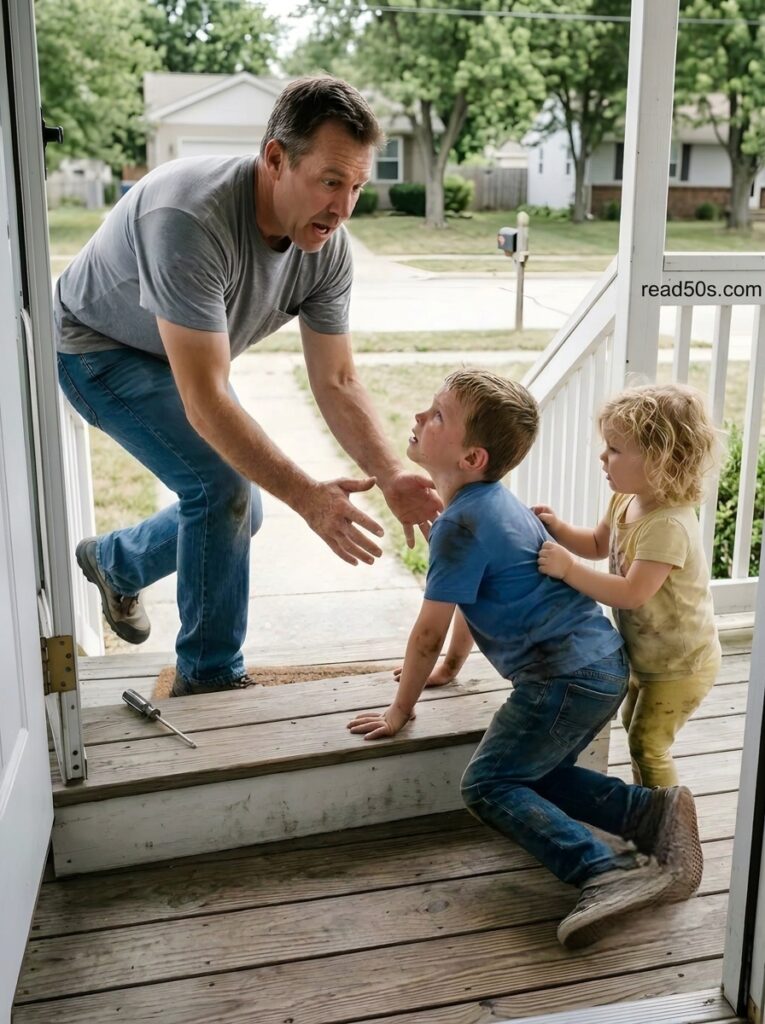
Drew was on the walkway, pulling himself forward with both hands.
He was six now, but he looked smaller than Peter remembered.
His dark hair clung to his forehead with sweat.
Dirt covered his face, and dried tears had left pale lines across his cheeks.
One leg dragged stiffly behind him.
Every time he moved, it shifted at an angle that made Peter’s stomach tighten.
Lily clung to the back of his shirt.
She was three, with tangled blond curls, a dirty face, and eyes that looked too large for her thin cheeks.
Her fingers were twisted into Drew’s shirt as though the fabric were the only secure thing left in the world.
Peter didn’t remember crossing the porch.
One moment, he was standing beside the open door.
The next, he was rushing down the steps as Drew’s arms began to shake.
He caught the boy before his face struck the boards.
“Drew,” Peter said. “What happened?”
Drew lifted his head.
His lips were dry, and his voice was almost gone.
“She locked us downstairs again.”
Peter heard the entire sentence, but one word struck harder than the others.
Again.
He looked at Lily and then back at Drew.
“Who locked you downstairs?”
“Reena.”
Drew took a thin breath.
“I had to get Lily out. She was really hungry.”
Peter’s chest went cold despite the heat.
He lifted Lily first because she was beginning to slip sideways.
She weighed almost nothing.
Her body felt warm and fragile against him.
When Peter carried her inside, she didn’t ask where they were going.
She only continued reaching toward Drew.
Peter placed her on the couch, grabbed a blanket, and hurried outside again.
Drew hadn’t moved.
His hands gripped the edge of the step, and his jaw was clenched tightly.
Peter placed one arm behind his shoulders and the other beneath his uninjured leg.
“I’m going to lift you,” he said. “I’ll move slowly.”
Drew nodded.
The moment Peter lifted him, the boy bit his lower lip hard enough to leave a bright red line.
He didn’t scream.
He didn’t even whimper.
That frightened Peter more than noise would have.
Children cry when they believe someone will come.
Drew had learned to conserve his strength.
Inside, Peter placed him on the couch and kept the injured leg as still as possible.
He wrapped both children in blankets even though the room was warm.
Lily noticed a sleeve of crackers on the coffee table.
She reached for it with both hands, tore the package open, and pushed two crackers into her mouth at once.
“Slow,” Drew whispered.
Despite the pain, he reached over and rubbed her back.
“Slow, Lily. Chew first.”
Peter stood beside the couch, unable to speak.
A six-year-old should never have to become a parent because the adults around him chose not to look closely.
He removed his phone from his pocket.
“I’m calling for help.”
Drew’s eyes widened.
“She’ll be mad.”
Peter knelt so the boy could see his face clearly.
“She is not touching either of you again.”
The words sounded steady.
Peter didn’t feel steady.
His hands shook so badly that he entered the emergency number twice.
When the dispatcher answered, he forced himself to speak only in facts.
“My nephew and niece just arrived at my house.”
He gave his address.
“The boy is six. His leg appears badly injured. The girl is three and looks severely underfed.”
Peter looked directly at Drew before saying the next part.
“They told me their stepmother locked them in a basement.”
The operator asked whether the children were conscious.
They were.
Was Drew bleeding heavily?
No.
Was the person responsible nearby?
No.
Could Peter keep the children safe and still until responders arrived?
“Yes,” Peter said. “I’m not leaving them.”
The dispatcher remained on the line.
Peter looked at the clock because the questions made every second feel official.
Three minutes later, sirens rose at the end of the street.
It felt like three hours.
Paramedics entered first, carrying medical bags and a folded stretcher.
A woman with gray strands in her hair crouched beside Drew and introduced herself before touching him.
She asked where the pain was worst.
Drew pointed toward his lower leg but continued watching Lily.
Another paramedic checked Lily’s pulse, temperature, breathing, and hydration.
Lily held a cracker in one hand and stared fearfully at the blood-pressure cuff.
Peter remained where both children could see him.
“I’m right here.”
He repeated it when the paramedics stabilized Drew’s leg.
He repeated it when Lily began trembling.
He repeated it when two police officers entered and asked what the children had said.
The officers recorded the names, ages, emergency-call time, and Reena’s address.
Peter gave them the address of the same house where he had delivered birthday gifts.
The same porch where Reena had told him the children were asleep.
The same door that had closed before he could hear their voices.
One officer asked when Peter had last seen the children in person.
The answer embarrassed him.
He gave it anyway.
There are moments when guilt encourages a witness to protect himself.
Peter refused.
He explained every unanswered call, every excuse, and every time he had accepted Reena’s explanation because challenging her felt intrusive.
The officer didn’t accuse him.
That almost felt worse.
At the hospital, Drew was taken for X-rays.
Lily received bloodwork, fluids, and a complete examination.
Peter sat beneath fluorescent lights with a paper cup of coffee cooling untouched between his hands.
The waiting room smelled faintly of disinfectant and burned coffee.
A television mounted in one corner played a daytime program with the volume low.
Peter could see medical workers moving beyond the glass doors but couldn’t hear what they were saying.
He kept replaying the porch.
Drew’s hands scraping against the pavement.
Lily’s fingers locked in his shirt.
Again.
That word wouldn’t leave him.
Peter remembered Aaron rocking Lily in an old recliner when she was an infant.
He remembered his brother saying Reena handled difficult situations well.
“She’s got them,” Aaron once told him. “If anything happens to me, she’ll take care of them.”
That was the terrible lie Aaron had carried to his grave.
Not that life would remain easy.
Not that grief would spare the family.
He believed the woman beside him would protect his children.
A doctor finally entered the waiting room carrying Drew’s chart.
He was middle-aged, careful, and angry in the restrained way professionals become angry when the facts are worse than the language available to describe them.
“Mr. Calder?”
Peter stood.
“Drew has a spiral fracture of the tibia,” the doctor said. “It appears to be at least two weeks old.”
Peter’s hands went cold.
“Two weeks?”
“Yes.”
The doctor turned a page.
“It was never treated.”
Peter looked through the glass toward the room where Drew lay.
The cast material around his leg had begun to harden.
Lily slept curled against his side, her small body tucked close as though even while unconscious she didn’t trust distance.
“What about Lily?”
“She is significantly underweight and dehydrated,” the doctor explained. “We are documenting everything. Child Protective Services is already on the way.”
The words documenting everything mattered.
The X-rays mattered.
The intake notes mattered.
The children’s measurements, bloodwork, and statements made to medical professionals mattered.
Emotion could be dismissed as a family disagreement.
Records were harder to erase.
Peter leaned against the wall.
For a second, he thought he might be sick.
Then he looked at the children again.
Something inside him settled.
It wasn’t calm.
It wasn’t forgiveness.
It was a decision.
When Drew woke, Peter sat beside his bed.
The boy blinked slowly, disoriented by the white walls and the weight of the cast.
Then he saw Lily sleeping nearby and relaxed slightly.
Peter leaned forward.
“Hey, buddy.”
Drew studied his face.
“Are you mad at me?”
The question nearly broke him.
“No. Why would I be mad?”
“For leaving.”
Drew lowered his voice.
“Reena said if we told anyone, they would take Lily away.”
His fingers tightened around the blanket.
“She said Dad would be ashamed of me.”
Peter had spent three years refusing to criticize Reena because he believed the children had already lost enough.
Now he understood how that silence had been used against them.
Reena hadn’t only locked a basement door.
She had built fear around Aaron’s memory and taught Drew that loving his father meant remaining quiet.
Peter moved closer and carefully took the boy’s hand.
“Your dad would be proud of you.”
Drew’s mouth trembled.
“You saved your sister,” Peter continued. “You were brave. You were smart. None of this is your fault.”
Drew tried to keep his expression still.
He had been holding too much inside for too long.
The crying began with one sharp breath.
Then it turned into deep, exhausted sobs that shook his shoulders.
Peter leaned over him carefully, avoiding the cast and medical lines.
“I’ve got you,” he whispered.
Drew pressed his face against Peter’s shirt.
“Both of you.”
A Child Protective Services investigator arrived carrying an intake folder.
She spoke quietly with the doctors before approaching Peter.
She asked about his relationship with the children, how often he had tried to contact them, what Reena had told him, and whether he was willing to remain available.
Peter answered every question.
He didn’t soften the details that made him look careless.
He didn’t claim he had known something was wrong.
He didn’t pretend he had done enough.
“I believed Reena’s excuses because I wanted to respect their grief,” he admitted.
Then he said the sentence that mattered more.
“I should have looked closer.”
The investigator glanced through the glass toward Drew and Lily.
“What matters now is what you do next.”
Peter already knew.
He would remain through every examination.
He would answer every call.
He would sit beside every hospital bed and repeat the truth until both children believed it.
They weren’t in trouble.
They hadn’t betrayed anyone.
Aaron wouldn’t be ashamed of them.
By late afternoon, the sunlight outside the hospital windows had softened.
Lily woke and asked for water.
Peter held the cup while she drank slowly.
Drew watched her with the same careful attention he had shown on the couch.
“Easy,” he murmured.
Peter placed one hand on his shoulder.
“You don’t have to do all of that by yourself anymore.”
Drew looked at him as though the sentence belonged to a language he almost remembered.
Peter knew one promise couldn’t undo years of fear.
Safety would have to be proven through ordinary actions.
A meal arriving when expected.
A door that didn’t lock from the outside.
An adult returning after leaving the room.
A telephone call being answered.
A night without footsteps descending the basement stairs.
A morning when Drew could be six instead of responsible for keeping another child alive.
Police officers searched Reena’s home that afternoon.
They found the basement room Drew had described.
It contained two thin blankets, several empty food packages, and a lock fitted to the outside of the door.
The hospital records confirmed the children’s condition.
Drew’s statements remained consistent.
Lily quietly repeated that Reena had left them downstairs for long periods and that Drew always gave her part of his food.
Reena was taken into custody while the investigation continued.
She denied intentionally hurting the children.
She claimed Drew’s injury had been an accident and that the basement was only used when they became “difficult.”
But the physical evidence told a different story.
The untreated fracture.
Lily’s severe dehydration.
The locked door.
The repeated efforts to keep Peter away.
The investigators didn’t rely on Reena’s explanation.
The children were placed under emergency protective care while Peter completed background checks and a home inspection.
He spent every available hour at the hospital.
He brought Drew books and puzzles.
He brought Lily soft pajamas and a stuffed rabbit.
Most importantly, he returned every time he said he would.
When Drew asked whether Peter would still be there after the nurse changed his bandage, Peter waited outside the room and entered again the moment the nurse finished.
When Lily woke from a nap crying for Drew, Peter carried her to the chair beside his bed.
Every ordinary promise became evidence of safety.
Several weeks later, Peter was granted temporary guardianship.
He prepared two bedrooms inside his house.
Drew’s room had blue curtains and a low shelf filled with books.
Lily’s room had a night-light shaped like a moon.
Peter removed every lock that could be operated from outside a bedroom.
He stocked the kitchen with food the children could reach without asking.
The first evening they stayed with him, Lily stood in front of the open pantry for several minutes.
“You can choose something,” Peter told her.
She looked toward Drew before reaching for a small package of crackers.
Drew automatically took one and handed the rest to her.
Peter sat beside them.
“There is enough for both of you.”
Drew didn’t believe him immediately.
Peter didn’t expect him to.
Trust rarely returns because someone makes a speech.
It returns through repetition.
Breakfast appearing every morning.
Peter answering when Drew called from the next room.
Lily learning that she didn’t have to hide food beneath her pillow.
Drew discovering that he could fall asleep without listening for someone approaching the door.
Healing was slow.
There were medical appointments, interviews, therapy sessions, court hearings, and difficult questions Peter couldn’t always answer.
Sometimes Drew apologized for needing help.
Sometimes Lily cried when a door closed too loudly.
Peter learned that love wasn’t only feeling protective.
It was showing up consistently enough that frightened children no longer had to test whether protection was real.
He couldn’t change the seven blocks of pavement Drew had crossed.
He couldn’t erase the two untreated weeks shown on the X-ray.
He couldn’t recover the years he had spent accepting a closed door.
But he could stop mistaking distance for respect.
He could stay.
He could speak.
He could ensure that every doctor, officer, investigator, and judge heard the same clear account.
Most importantly, he could make certain that Drew and Lily never had to earn protection again.
Months later, Drew’s cast was removed.
He still needed therapy to strengthen his leg, but he could walk without assistance.
On the afternoon he took his first full lap around Peter’s backyard, Lily followed him, laughing while holding the stuffed rabbit beneath one arm.
Drew turned several times to ensure she was still behind him.
Peter watched from the porch.
“Drew,” he called gently.
The boy stopped.
“You don’t have to keep checking every second. She’s safe.”
Drew looked at Lily.
Then he looked back at Peter.
“You promise?”
Peter nodded.
“I promise.”
Drew considered the answer.
Then, for the first time, he ran several careful steps without looking behind him.
That evening, Peter sat between their beds while Drew held his hand and Lily curled beneath her blanket.
The room was quiet except for the soft hum of the air vent.
Peter thought of Aaron sitting on the porch with a root beer in his hand, laughing as if serious trouble only happened to other families.
He wished his brother had known the truth.
He wished he had recognized it sooner.
But regret wasn’t a plan.
So Peter held Drew’s hand, watched Lily breathe, and remained exactly where both children could see him.
For the first time since Aaron’s funeral, he understood what his life was supposed to be about.
Not making speeches.
Not endlessly punishing himself.
Not pretending that love was enough when it never showed up at the door.
It was about being there whenever either child reached for help.
And making certain there would never have to be another seven-block journey.