By the time you’ve worn a patrol uniform around an elementary school in West Portland for several years, you begin to believe you’ve seen every kind of problem a child can bring you.
Lost lunch boxes.
Playground arguments.
“My sister took my tablet.”
“I missed my bus.”
That was why I remembered the day Marcus approached me so clearly.
It didn’t feel like any of those ordinary problems.
It was dismissal time at Evergreen Elementary.
Parents waited in idling cars along Cedar Street. Teachers waved from the front steps while children hurried between minivans, their backpacks bouncing behind them.
I was speaking to a girl about her new soccer cleats when I became aware of someone silently waiting beside me.
I turned.
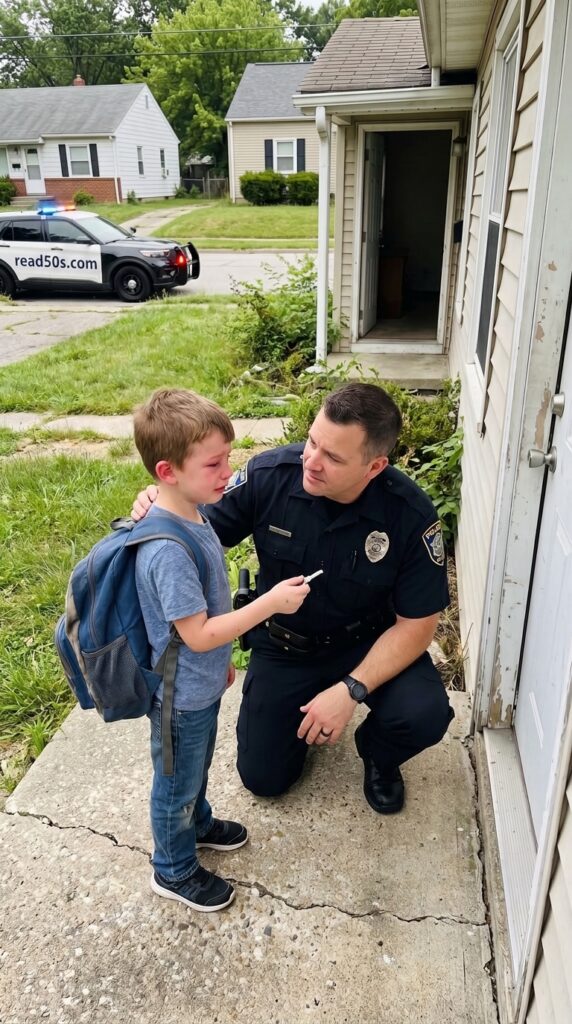
He was seven years old, perhaps eight at most.
His backpack looked too large for his narrow shoulders. His shoes appeared too small, and his hair had been cut unevenly, as though someone had used dull clippers at home.
He didn’t smile.
He didn’t ask to see my radio or touch my badge.
He simply looked at me with an expression that didn’t belong on a child’s face.
“Officer Dunham?” he asked, pronouncing my name as though he had practiced it. “Can you walk me home after school? I need you to see something, but I can’t say it here.”
In police work, you learn to hear the spaces between a child’s words.
The things they are too frightened to say aloud.
I knelt so we were at eye level.
“Is someone bothering you? A neighbor? Another child?”
He shook his head.
His eyes moved toward a row of small houses several blocks away.
“They all think it’s normal,” he said quietly. “If I tell them, they’ll say I’m causing problems. But if you see it yourself, they can’t say that. Right?”
I stood.
“Let’s walk.”
We traveled through a neighborhood that most of Portland never truly noticed.
Some lawns were overgrown. A sedan sat partly on the curb. Wind chimes rattled against the roof of a sagging porch.
The boy remained close to my side.
He didn’t chatter the way most children did around police officers. He didn’t ask about handcuffs, sirens, or police cars.
He watched doorways as though he had memorized which ones mattered.
Sometimes the most serious cases don’t arrive through a radio call.
They arrive wearing sneakers and carrying a backpack that looks far too heavy.
“Does your father know you’re asking me for help?” I asked.
“He thinks this is just how families are,” the boy replied. “Everyone I know thinks this is how families are.”
We stopped outside a small, one-story house I had driven past hundreds of times while on patrol.
The blinds were tightly closed even though the afternoon sun was still shining.
There were no toys in the yard.
No bicycles.
Only a mailbox leaning slightly to one side and a welcome mat that didn’t appear to have welcomed anyone for a very long time.
The boy reached into his pocket and removed a house key.
His fingers trembled so badly that the metal clicked against his palm.
“Before I open it,” he whispered, “can you promise me something?”
I had been asked many things during my career.
I had never been asked this.
“If I show you what’s inside, you won’t let them tell me to go back and pretend everything is fine, right?”
My hand rested near the doorknob.
My radio remained quiet.
Somewhere down the street, a dog barked. A television played inside another house. Life continued like any ordinary weekday afternoon.
But I understood that whatever waited beyond that door was about to turn a routine walk home into a case I would remember for the rest of my career.
HIS NAME WAS MARCUS
His name was Marcus Pruitt.
Not Marc.
Not a nickname.
Marcus.
He said it the way a child says his name when the adults around him always use the full version.
He was seven and a half, and he made certain I understood the half.
He was in second grade at Evergreen Elementary, in Mrs. Calloway’s class, at the third desk from the window.
He had given me those details during our walk as though he were completing an official form.
Organized.
Careful.
As though he had spent time deciding exactly what information a police officer would need.
That frightened me more than almost anything else.
I asked how he knew my name.
Marcus told me he had been watching me for two weeks.
“Not in a strange way,” he explained quickly.
He had been trying to decide whether I was the kind of officer who truly listened or the kind who smiled and sent children back to class.
He had seen me sit on a curb beside a crying fourth-grader whose parents were getting divorced.
I had stayed there for ten minutes.
I hadn’t offered advice.
I hadn’t told the child to stop crying.
I had simply remained beside him.
“That’s when I decided,” Marcus said.
I didn’t know what to say.
So I continued walking.
The neighborhood was called Birchwood Heights, a name probably created for a real-estate advertisement thirty years earlier.
There were no birch trees.
The streets were named Elm, Cedar, and Martin.
The houses stood close together behind chain-link fences. A corner shop displayed a handwritten sign advertising phone cards.
It wasn’t an especially dangerous neighborhood.
It wasn’t an especially prosperous one either.
It was simply a place where people woke up, went to work, returned home, and repeated the same routine the next day.
Marcus walked with his hands inside his pockets.
His shoulders leaned slightly forward, and his head remained lowered at a particular angle.
I had seen that posture before.
It was the posture of a child who had learned to occupy as little space as possible.
THE HOUSE ON MARTIN STREET
The address was 4117 Martin Street.
As I said, I had passed the house many times.
There had never been a disturbance call.
No welfare checks.
Nothing inside our system that would have caused it to stand out.
The house was small, perhaps nine hundred square feet.
Its white exterior paint had faded to gray.
The lawn had been cut recently enough to avoid attention, although grass grew knee-high along a narrow strip beside the fence.
One front window was cracked and covered from the inside with clear packing tape that had turned yellow with age.
Marcus stopped at the front step.
“My grandma is inside,” he said. “My dad too.”
“Is your father home now?”
“He works until six. Grandma is always home.”
He said the word always in a flat voice that communicated far more than the word itself.
I asked whether he was ready.
Marcus nodded, placed the key in the lock, and opened the door.
The smell reached me first.
It wasn’t rotting food or garbage.
Nothing that immediately announced an emergency.
It was stale, trapped air—the smell of a house whose windows hadn’t been opened in years.
It reminded me of a car that had been parked inside a garage for months.
Then my eyes adjusted.
The living room had a path running through it.
Not an open room.
An actual path, perhaps two feet wide, leading from the front door toward the kitchen and branching into the hallway.
On both sides of that path were piles stacked to chest height.
Cardboard boxes.
Plastic containers with cracked lids.
Tied garbage bags balanced on top of one another.
Newspapers and magazines bundled with string.
A broken floor lamp.
Laundry baskets filled with clothing that still had store tags attached.
A microwave inside its original box.
Two more microwaves outside their boxes.
The couch was somewhere beneath everything.
I could see one armrest.
I had entered homes like this before.
Not many.
Enough.
Marcus stood just inside the doorway, studying my face.
“See?” he said.
There was no triumph in his voice.
Only exhaustion.
I asked where his grandmother was.
Marcus pointed toward the hallway.
“Grandma?” he called. “The officer is here. The one I told you about.”
For several seconds, there was no response.
Then I heard a chair scraping.
Something was slowly moved aside.
Footsteps navigated a path I couldn’t see from the front room.
A woman appeared in the hallway.
Her name was Loretta.
She was around sixty-five, heavyset, dressed in a housecoat and slippers, with her hair pinned loosely above her head.
She had the same steady eyes as Marcus.
She looked at me without surprise or embarrassment.
Her expression reminded me of someone who had been bracing for an impact for a very long time and was finally watching it arrive.
“He told me he was going to do this,” she said. “I told him he should.”
I asked her to repeat herself.
“I told him he should bring you here,” she said. “I can’t stop myself. I know that now. I’ve known it for a while.”
Her eyes moved toward the piles surrounding us.
“I can’t make my son see it. I can’t make myself fix it. And this boy should not be living like this.”
Marcus stood beside me.
For one second, he reached over and took my hand.
Then he released it.
WHAT MARCUS HAD UNDERSTOOD
Think about the structure of what that seven-year-old had done.
Marcus couldn’t drive to a government office.
He didn’t know which hotline to call.
He couldn’t write a formal complaint and trust that the right person would read it.
He had tried speaking to his teacher indirectly.
She told him it sounded as though his family simply needed to do some cleaning.
He tried telling his aunt Paulette, his father’s sister, who lived in Gresham.
She said Loretta had always collected too many things and that it wasn’t anyone else’s business.
So Marcus observed.
For two weeks, he watched me.
He learned my name and studied my behavior.
Then he created a plan that was airtight in the way only a desperate person’s plan can be.
Don’t report it.
Don’t describe it.
Don’t give anyone the opportunity to dismiss your words.
Bring a witness inside.
Make the witness stand in front of the truth.
At seven years old, Marcus understood that people could argue with words.
They couldn’t argue with what was directly in front of them.
I had worked with experienced investigators who didn’t think that clearly under pressure.
I crouched beside him.
“How long has the house been like this?”
He considered the question carefully.
“It was like this when I was little,” he said. “But I think it got worse. There used to be more room.”
He pointed toward one corner where the piles almost reached the ceiling.
“That used to be where I did my homework.”
I looked around again.
The narrow pathways were surrounded by unstable stacks.
Newspapers and cardboard crowded electrical outlets.
Objects blocked access to windows and doors.
Marcus had grown up believing he needed to turn his body sideways simply to cross his own living room.
His father thought it was normal.
His relatives said it was a private family matter.
His teacher believed the house merely needed cleaning.
Marcus was the only person who had understood that someone outside the family needed to see it.
WHAT HAPPENED NEXT
I radioed for a welfare check and requested contact with social services.
My supervisor, Dwight Kaminski, arrived approximately twenty minutes later.
The house was documented and photographed.
Adult Protective Services came the following morning.
Loretta underwent physical and psychological assessments.
Physically, she was stable.
Mentally, she was lucid and cooperative.
She knew the house was unsafe.
She also understood that she had lost the ability to control her need to keep acquiring and saving objects.
Loretta signed a voluntary agreement to receive intervention services.
She wasn’t forcibly removed from her home.
The goal wasn’t to punish her.
It was to make the home safe and ensure she received help.
Marcus’s father, Gary, arrived from work at 6:15 that evening.
He stopped in the front doorway.
He stood there for a long time without speaking.
Then he sat on the porch step, placed his face in his hands, and began to cry.
Gary wasn’t an evil man.
That was one of the most difficult parts.
He was a tired man who had watched his mother’s house fill with belongings for fifteen years.
Over time, he had learned not to see it, the same way someone stops noticing a sound that never ends.
He told himself Marcus had enough room.
He told himself the pathways were wide enough.
He told himself the stacks were stable.
He told himself it wasn’t as serious as other people might think.
He had told himself many things because the truth felt too overwhelming, expensive, and painful to confront.
But ignoring something dangerous doesn’t make it harmless.
It only leaves a child to carry the truth alone.
Marcus stayed with his aunt Paulette in Gresham for six weeks while the house was cleared and repaired.
A professional cleanup service worked for four days.
They removed eleven tons of material.
Eleven tons.
When my supervisor told me that number, I thought about Marcus’s narrow shoulders beneath his oversized backpack.
I thought about how much weight he had already been carrying before he ever walked over to me outside his school.
Loretta began receiving treatment and support.
Gary attended counseling and completed a safety plan before Marcus returned home.
Smoke detectors were replaced.
Windows and doors were cleared.
Electrical hazards were addressed.
The cracked window was repaired.
The rooms were cleaned until sunlight could finally reach areas that had remained buried for years.
But the physical cleanup was only one part of what needed to change.
Gary had to learn that loving his mother didn’t require him to pretend her condition wasn’t harming his son.
Loretta had to learn that accepting help wasn’t the same as losing everything.
And the adults around Marcus had to understand that a seven-year-old should never need to design his own investigation simply to make someone believe him.
THE THIRD DESK FROM THE WINDOW
I returned to Evergreen Elementary the following month.
I went to Mrs. Calloway’s classroom.
The third desk from the window was empty because Marcus was still staying with Paulette.
Mrs. Calloway told me he was doing better.
He was talking more.
He had begun raising his hand during class instead of waiting to be called on.
He was eating lunch with other children rather than sitting at the edge of the cafeteria.
She had also learned something.
When a child tries to describe a problem indirectly, adults shouldn’t always provide the easiest explanation.
Sometimes “there’s no room at home” doesn’t mean the bedroom is small.
Sometimes “Grandma keeps everything” isn’t an innocent family habit.
Sometimes “everyone thinks it’s normal” is a child’s only way of saying that every adult has already failed to listen.
I left before school ended that afternoon.
I stood on the front steps for several minutes beneath the cold October sky, watching Cedar Street.
I thought about what Marcus had said during our walk.
Everyone I know thinks this is just how families are.
But Marcus had known it wasn’t.
At seven years old, without anyone telling him, he understood that home wasn’t supposed to feel like a place slowly closing around him.
He didn’t need someone to give a speech.
He didn’t need someone to tell him he was brave.
He needed one person to walk beside him.
One person to cross the threshold.
One person to stand inside the house and see what he saw.
That was all he had asked from me.
Several weeks later, Marcus returned to school.
I was outside Evergreen during dismissal when I saw him walking down the steps.
His backpack still looked too large, but his shoulders weren’t folded forward anymore.
He noticed me near the curb and stopped.
For a moment, neither of us spoke.
Then he walked over.
“Did they fix it?” I asked.
He nodded.
“There’s a table now.”
“A table?”
“In the living room. I can do my homework there.”
He said it as though having a table in his own home were an extraordinary privilege.
Perhaps, to him, it was.
“How is your grandmother?”
“She’s getting help.”
“And your dad?”
Marcus considered the question.
“He opens the windows now.”
I smiled.
“That’s a good beginning.”
He looked toward the line of waiting cars.
“Do you remember what you promised?”
I did.
That if he showed me what was inside, I wouldn’t allow anyone to send him back and pretend everything was fine.
“Yes.”
“You kept it.”
Then Marcus did something he hadn’t done the first day he approached me.
He smiled.
It was small and uncertain, as though smiling was another thing he was learning to trust again.
He joined the other children and climbed into his aunt’s car.
I watched them drive away.
During my career, I responded to louder emergencies.
House fires.
Violent confrontations.
Traffic collisions that closed entire streets.
But the case I remembered most clearly began without a radio call.
It began with a seven-year-old standing quietly beside me after school.
A child who had watched the adults around him accept the unacceptable and had decided to create a witness they couldn’t ignore.
Marcus understood something many adults spend their lives avoiding:
A harmful situation doesn’t become normal simply because it has continued for years.
A family problem doesn’t stop mattering because addressing it is difficult.
And asking for help isn’t betrayal.
Sometimes it is the bravest way a child can protect himself—and the people he loves.