My parents left my grandfather to die alone in a small Montana hospital because they said he was “too difficult.” They skipped his funeral, sold his house three weeks later, and assumed the old silver ring I saved from his bedroom was worthless.
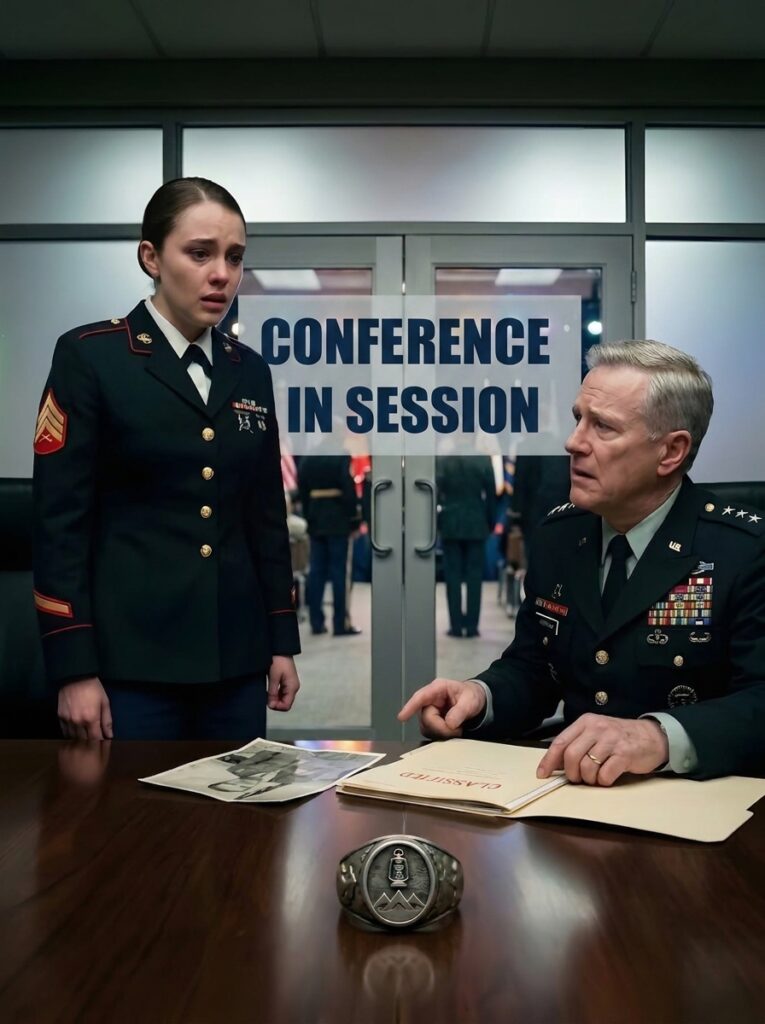
The military attorney entered the locked conference room carrying a leather case in one hand and a sealed envelope in the other.
The general did not take his eyes off my phone.
My mother’s voice still seemed to echo from the speaker.
That ring belongs to the estate. Give it back before your father reports you for theft.
For a few seconds, no one spoke.
Then General Adrian Mercer placed my phone facedown on the table beside Grandpa’s silver ring.
His expression had changed.
At first, when he saw the ring on my hand, he had looked shocked. Then grief-stricken. Then almost afraid.
Now he looked angry.
Not loud angry.
Controlled angry.
The kind of anger that had learned how to wait.
The attorney set the leather case on the table and looked at me.
“Sergeant Claire Hail?”
“Yes, ma’am.”
“I’m Colonel Miriam Sloane, retired. I represent the surviving legal interests of the Lantern unit and the estate instructions left by Thomas Hail.”
I looked from her to the general. “My grandfather had a military attorney?”
General Mercer’s mouth tightened. “Your grandfather had many things your family never bothered to ask about.”
Colonel Sloane sat down beside me and opened the case. Inside were several folders, a small recorder, and a document sealed in a plastic sleeve.
“Before we discuss the estate,” she said carefully, “I need to confirm something. Did Thomas Hail die alone?”
The question hit me harder than I expected.
I looked down at the ring.
“No,” I said. “Not at the end.”
The general lowered his eyes.
I told them everything.
The neighbor’s call at 2:17 in the morning. The emergency leave. The county hospital room with dim lights and untouched coffee beside the bed. Grandpa’s hand in mine. His whisper when he realized I had come.
Guess you’re the one who didn’t forget me.
I told them my mother said hospitals made her anxious.
I told them my father said the roads were bad.
I told them my brother had an important meeting.
I told them about the funeral.
Six people.
One priest.
Two neighbors.
An elderly nurse.
A man from the hardware store.
And me.
My parents had not come.
My brother had sent two words.
Busy week.
When I finished, Colonel Sloane’s face had gone very still.
General Mercer looked away toward the closed door.
For a moment, he was not a four-star general standing in a formal ceremony hall.
He was the young man in the old photograph.
The one my grandfather had carried down a mountain.
“He deserved better,” the general said quietly.
“Yes,” I said. “He did.”
Colonel Sloane reached into the leather case and removed an old envelope.
My name was written across it.
Not in legal print.
In Grandpa’s handwriting.
To the one who kept the ring.
My throat tightened.
“He wrote this?” I asked.
“Seven years ago,” Colonel Sloane said. “He updated it twice after that. The final copy was recorded and witnessed six months before his death.”
“My parents never mentioned any of this.”
“They were never meant to control it.”
Before I could answer, my phone buzzed again.
A message from my father.
Do not embarrass this family. Bring the ring back today.
I stared at the words.
All my life, my father had spoken about family like it was a business.
Something to manage.
Something to protect.
Something to profit from quietly.
I slid the phone toward Colonel Sloane.
She read the message once.
Then she placed it next to the recorded will.
“Useful,” she said.
The general gave a short, humorless breath. “Thomas always said his son loved paperwork more than people.”
I looked up sharply. “You knew my father?”
“I met him once,” General Mercer said. “After Thomas came home.”
“What happened?”
He looked at Colonel Sloane, and she gave a small nod.
The general opened the gray folder.
Inside were maps, radio transcripts, typed statements, and photographs so faded some of the faces looked like ghosts.
A mission summary sat on top.
OPERATION CINDER PASS.
CLASSIFICATION REMOVED.
Thirteen men had been sent across a border in 1972 to locate a missing aircraft and recover intelligence before enemy forces reached it. The mission had never been publicly acknowledged. Every man involved had signed silence orders.
Grandpa had been twenty-four years old.
A sergeant.
Trained in field medicine, communications, and survival.
His official record made him sound ordinary.
The statements inside the folder did not.
On the second night, their extraction helicopter was hit before it could land. The senior officer was lost. Supplies were scattered. Several men were injured across a steep mountain ridge.
Lieutenant Adrian Mercer had a shattered leg and a serious wound near his ribs.
Two others could not walk.
The radio operator sent one broken transmission before the equipment failed.
Command ordered the men who could move to reach the secondary extraction point.
Grandpa refused.
General Mercer pushed one page toward me.
A red line had been drawn under a radio transcript.
LANTERN TWO: NEGATIVE.
WE LEAVE TOGETHER OR NOT AT ALL.