The clock on my nightstand showed 5:02 a.m. when my phone rang on Thanksgiving morning.
It did not buzz.
It rang.
The noise cut through the kitchen so sharply that even the pie knife beside the sink seemed to vibrate.
The house smelled of pumpkin pie, black coffee, cinnamon, and butter.
Ice tapped against the windows.
Outside, the small American flag my husband had hung years earlier snapped in the November wind.
I remember those useless details because fear preserves strange things.
I had been awake since before sunrise, baking pies and pretending a quiet holiday was the same as a peaceful one.
My daughter, Chloe, was expected around noon.
She had promised to bring sweet potatoes because she claimed I always made them too soft.
That was Chloe.
Twenty-eight.
An engineer.
The kind of daughter who could tease my cooking while carrying three grocery bags in one hand and a toolbox in the other.
Her calmness made people underestimate how deeply she felt.
When her father died, she organized the meal schedule herself because she said I should not have to answer another call.
When her first apartment flooded, she sorted every damaged box by room and insurance category before allowing herself to cry.
She never fell apart publicly.
She rarely asked for help unless everything was already burning.
So when Marcus’s name appeared on my phone, my hand turned cold before I answered.
My son-in-law never called early.
He rarely called kindly either.
Marcus was thirty-two, sharply dressed, newly promoted, and possessed by the quiet arrogance of a man who confused income with character.
His mother, Sylvia, had taught him that respect was something people with less money owed them.
For three years, I had watched them carve pieces from Chloe while smiling.
They criticized her cooking.
Her clothes.
Her work schedule.
If Chloe laughed loudly, Sylvia corrected her.
If she became quiet, Marcus called her cold.
If she worked late, they called her selfish.
If she took time off, they questioned her ambition.
Some families hurt you long before anyone raises a hand.
They simply make every version of you wrong.
They rarely showed much interest in me.
To them, I was Eleanor.
Widowed.
Retired.
Quiet.
The woman who drove a ten-year-old SUV, carried coupons in her purse, and baked pies on holidays.
They never asked what I had retired from.
I answered.
There was no greeting.
No apology.
Only Marcus’s flat voice.
“Come pick up your garbage.”
The kitchen seemed to disappear for a moment.
I braced one hand against the counter until my voice became useful again.
“Marcus. Where is Chloe?”
“Downtown bus terminal.”
He sounded bored.
That detail never left me.
“Your daughter decided last night was the perfect time to have a hysterical breakdown. I’m hosting my CEO for Thanksgiving dinner, and I don’t have time for trash in my house.”
A woman laughed behind him.
Sylvia.
“Tell her to take that pathetic girl back where she came from,” Sylvia shouted. “And tell her I expect payment for my Persian rug.”
“What happened?” I asked.
Marcus sighed.
“Go get her, Eleanor. The caterers arrive in four hours. Do not bring her back.”
Then the call ended.
For one terrible second, I wanted to call him back and scream.
I wanted to tell him exactly who he had spoken to.
But anger is a match.
Evidence is a furnace.
I had spent years learning the difference.
I took my coat.
My keys.
Then opened the hall closet and removed a small lockbox that had remained untouched for years.
Inside were an old credential holder and proof of the career Marcus knew nothing about.
Before becoming the soft-spoken widow with pies cooling on her counter, I had spent years as a federal prosecutor.
I had faced people who believed fear made them untouchable.
I knew how cruelty sounded when it assumed no important person was listening.
And I knew the first hour mattered.
The first call.
The first timestamp.
The first witness.
The first piece of evidence before anyone had time to change the story.
At 5:19, I backed my SUV out of the driveway.
By 5:43, I reached the downtown terminal.
The building stood beneath buzzing fluorescent lights.
The air smelled of wet wool, burned coffee, cigarettes, and metal.
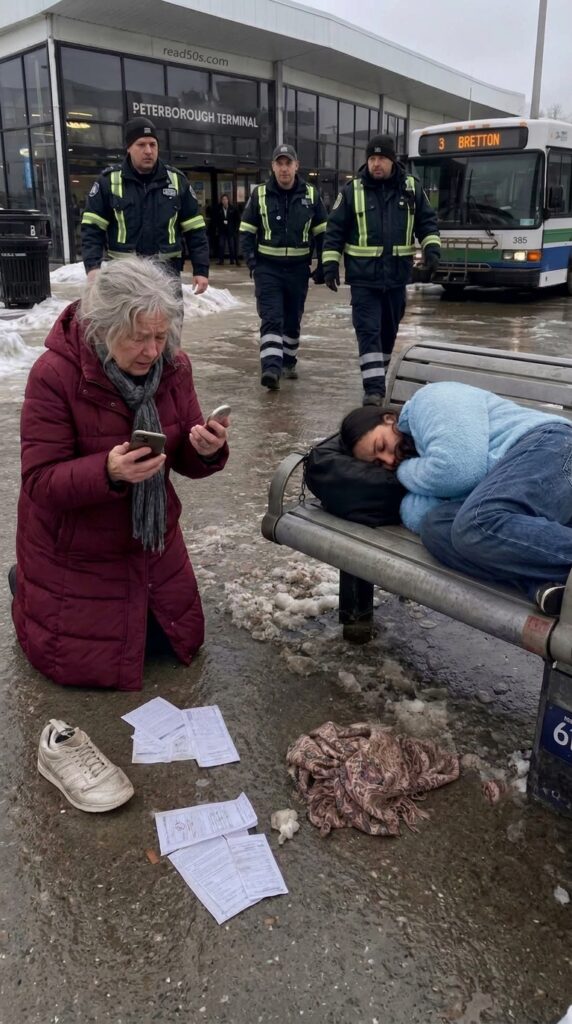
I found Chloe outside Bay 6.
She was curled on a metal bench beneath a broken streetlight.
No coat.
One shoe missing.
Blue fingers.
A bruised face.
A torn sweater.
For one second, my mind refused to recognize her.
Then she whispered:
“Mom.”
I dropped to my knees.
“Baby, look at me. Stay with me.”
Her hand found my coat and gripped it weakly.
“They hurt me,” she whispered.
“Who?”
“Marcus… and Sylvia.”
The answer entered me with perfect clarity.
“What happened?”
“He has someone else. Sylvia said I had to leave so she could sit at the table. His mistress.”
The terminal doors opened behind us.
Warm air rolled outside and disappeared into the freezing morning.
“Who brought you here?”
“Marcus.”
She struggled to breathe.
“Sylvia cleaned everything. They said nobody would believe me.”
Then she whispered:
“They said you were only… an old woman.”
Her eyes rolled backward.
Her body went limp in my arms.
At 5:47, I called 911.
I requested immediate medical help and police assistance.
Then I opened the lockbox.
Marcus had always thought I was powerless because he had never bothered to learn who I had been.
That morning, power was the least important thing.
What mattered was preserving the truth.