My son looked at his grandmother and asked:
“Did I do something wrong, Grandma?”
Instead of answering, she grabbed his shoulder, pulled him out of the family photograph, and snapped:
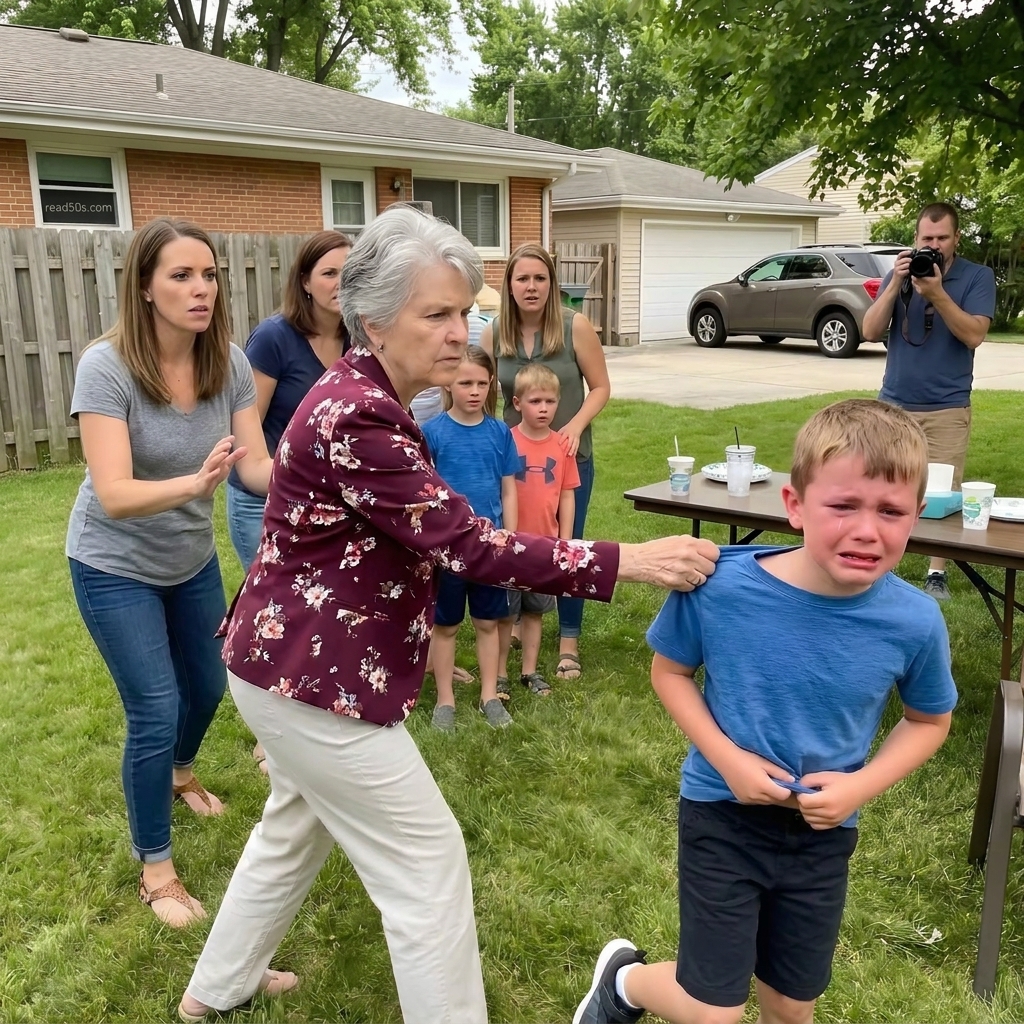
“Stop ruining everyone’s day.”
He burst into tears in front of the entire family.
Then my sister—the mother of Grandma’s favorite grandchildren—removed her own children from the picture.
“If he doesn’t belong,” she said, “neither do we.”
The photographer lowered his camera.
Ice shifted inside the paper cups on the backyard table.
No one reached for them.
I knelt beside my son and pulled him against me.
His face was hot.
His fingers had twisted the bottom of his T-shirt into a tight knot.
“Can we go home?” he whispered.
Before I could answer, Grandma pointed toward my sister.
“Put those children back. You’re turning this into a spectacle.”
My sister stared at her.
“You planned the spectacle.”
Then she took out her phone.
A message sent by Grandma that morning was still on the screen.
Come early. I want the grandchildren picture finished before they arrive.
Below it was another.
Keep your kids in the middle. I’ll handle him if he makes a scene.
My son read enough to understand that “him” meant him.
This had never been about his behavior.
Grandma folded her arms.
“He always looks miserable in pictures. He distracts the other children and makes every gathering harder than it needs to be.”
“He asked where to stand,” I said. “You answered by dragging him away.”
Grandma looked toward the relatives around us as though someone might rescue her version of events.
“I wanted one decent family picture. Is that really such a terrible thing?”
My sister’s oldest daughter stepped beside my son and took his hand.
“He is family.”
Her younger brother joined them without being asked.
The children had understood something the adults had spent too long avoiding.
A family picture was not really about matching clothes, good lighting, or getting everyone to smile at once.
It was a record of who had been invited to stand close and who had been told to move away.
I stopped arguing with Grandma.
I asked my son the only question that mattered.
“Do you want to stay?”
He shook his head.
I gathered our belongings.
“We won’t come back until you apologize directly to him. Not to me. Not through the family group chat. To him.”
Grandma’s jaw tightened.
“Anyone who walks out over this should not expect to come back for the holidays.”
My sister picked up her children’s jackets.
“Okay.”
Grandma’s expression changed.
She had expected me to leave.
She had not expected her favorite grandchildren to choose us.
We started toward the driveway.
Then my sister caught my arm.
“You need to know something before we go,” she said quietly.
“This isn’t the first family picture she tried to keep him out of.”
I stopped.
My son pressed against my side.
“What do you mean?”
My sister looked back toward the house.
“Last Thanksgiving, she asked him to take the picture instead of being in it.”
I remembered that afternoon.
Grandma had handed my son her phone and told him he had steadier hands than the adults.
She made it sound like a compliment while everyone else crowded together near the fireplace.
He took six photographs.
When he finally asked whether someone could take one with him included, Grandma said the food was getting cold and the moment had passed.
I had believed her.
Or perhaps I had chosen to believe her because the alternative required me to confront my own mother.
My sister continued.
“At the summer cookout, she told him to stand at the end. Then she posted the only picture where he had stepped away to get a drink.”
I remembered that too.
Grandma had uploaded a neat row of smiling grandchildren and written about how grateful she was for family.
My son’s blue sleeve was barely visible at the edge.
When I asked why she chose that photograph, she said I was being sensitive.
The explanations had always been small enough to dismiss separately.
A bad angle.
A child who moved.
A rushed moment.
A photograph that did not turn out.
Standing in the driveway, I finally understood that the excuses only worked because I had never placed them beside one another.
My son looked up at me.
“Did she not want me in those either?”
My sister crouched before him.
“She was wrong,” she said. “You did nothing wrong.”
Her oldest daughter squeezed his hand.
“We wanted you there.”
Her younger brother nodded.
Grandma came down the driveway before we reached our cars.
She was no longer shouting.
But her lowered voice was not an apology.
“This has gone far enough,” she said. “Everyone is upset, and we’re supposed to be celebrating.”
My sister stood and placed herself between Grandma and the children.
“You sent me those messages this morning.”
Grandma’s eyes flicked toward the phone.
“They were private.”
“That doesn’t make them better.”
“I was trying to avoid a problem.”
“You decided a child was the problem before he even arrived.”
Grandma turned toward me.
Usually, this was where I would ask everyone to calm down.
This time, I asked one question.
“Why didn’t you want him in the picture?”
Her answer came immediately.
“He never looks happy.”
My son’s fingers tightened around his shirt again.
“I’m not saying he’s a bad child,” Grandma continued, “but he changes the mood. Everyone has to work around him.”
“He asked where to stand.”
“He was already sulking.”
“He was nervous because you kept moving him.”
“I wanted one nice photograph.”
“You wanted a photograph that made it look like he wasn’t part of this family.”
For a moment, Grandma did not deny it.