I don’t check homework first.
I check fingertips.
Blue means the heat might be off at home. Purple means they probably walked to school in the cold. Red and stiff means they tried to hide it because even six-year-olds know how to pretend they’re fine.
My name is Mrs. Reed, and I teach first grade in the Midwest. My contract says I teach reading, phonics, handwriting, and basic addition. But any teacher will tell you the truth: some days, we are also nurses, counselors, social workers, comforters, and the only warm adult in a very cold system.
It was November, and the wind outside felt like it could strip paint from siding.
That morning, Jayden stood near his desk, staring down at his sneakers. His small body was trembling, but not in the normal way children shiver after recess.
He was vibrating.
“Mrs. Reed,” he asked without looking up, “are we staying inside for recess?”
He wore a thin windbreaker, the kind meant for a rainy spring afternoon, not a bitter November day. The zipper looked tired. The sleeves barely reached his wrists.
“No indoor recess today, bud,” I said gently.
I watched his shoulders fall.
By Halloween, many of my students already knew too much about the adult world. They knew the price of gas. They knew that “inflation” was why Mom cried quietly in the kitchen when she thought no one could hear. They knew why they were wearing an older sibling’s coat, even when the sleeves hung down past their hands.
But Jayden didn’t even have an older sibling’s coat.
During circle time, he sat on his hands. At lunch, he told me he wasn’t hungry because his hands were “too tired” to hold his sandwich.
That was the line for me.
That afternoon, I didn’t go home at 3:00. I drove to the local thrift shop with forty dollars in my wallet. That money was supposed to go toward my car insurance, but I spent every dime.
I didn’t buy stickers. I didn’t buy classroom decorations. I didn’t buy extra crayons.
I bought coats.
A puffy blue one. A red one with a heavy hood. A camo-print jacket that looked almost new. A purple parka I later brought from my own attic. A few pairs of stretchy gloves from the dollar bin.
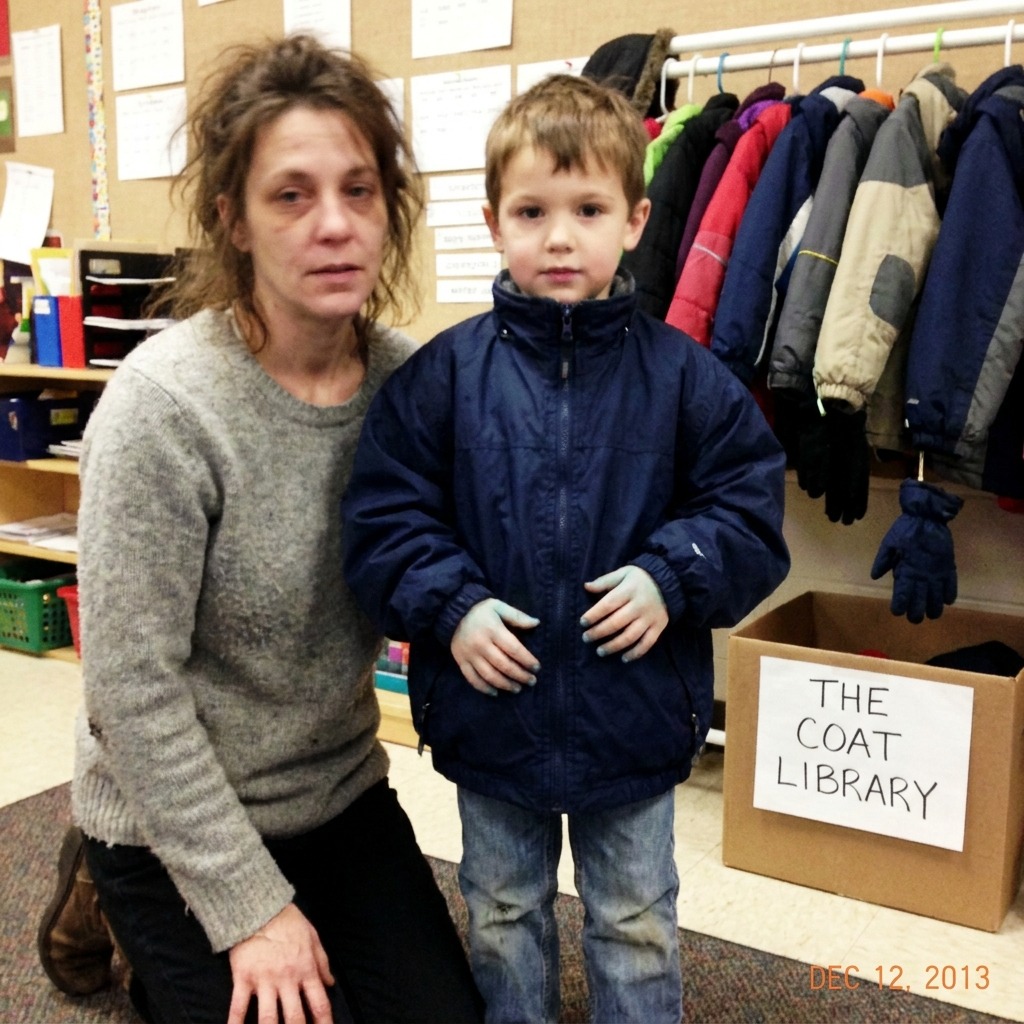
The next morning, I dragged an old clothing rack from the lost-and-found into the back of Room 104. I hung up the coats. I placed a small bin of gloves underneath.
Then I made a sign.
I didn’t write “Charity Bin.”
Even young children understand shame before they have the words for it. They know when something marks them as different. They know when adults are trying to be kind but accidentally make them feel small.
So I wrote:
THE COAT LIBRARY
Rules:
Borrow what you need.
Return it when you’re warm.
No library card required.
For two days, no one touched it.
The children looked at the rack like it might be a trick. They had already learned that free things often came with questions, forms, rules, or someone watching too closely.
Then the temperature dropped to single digits.
Jayden was the first.
During independent reading, he walked quietly to the back of the room. He glanced at me.
I pretended to be very interested in the papers on my desk.
He reached for the blue puffer coat, put it on, and returned to his seat.
For the first time all week, he stopped trembling.
By Friday, the Coat Library was nearly empty.
A little girl who usually spent recess huddled beside the brick wall was running across the playground in the red hood. Two boys were taking turns with the camo jacket, one wearing it outside and the other wearing it on the way back in.
“Rock, paper, scissors for the hood,” I heard one whisper.
They were negotiating warmth like it was currency.
Then came the moment that broke my heart.
A new student arrived in our class. Her name was Mia. Her family had just moved from a warmer state after rent became too high where they had been living. She came in wearing a denim jacket over a T-shirt. Her lips were pale, and her hands were tucked tight under her arms.
She stood in front of the coat rack. Only one coat remained—the purple parka I had brought from home.
She reached for it, then pulled her hand back.
“I don’t have a card,” she whispered.
I walked over slowly. “A card?”
“My mom says we can’t sign up for anything else,” Mia said, her voice barely above a breath. “We don’t have the papers.”
She thought warmth was something she had to qualify for.
She thought she needed permission not to freeze.
I knelt in front of her.
“Mia, look at me.”
Her eyes widened, as if she was afraid she had done something wrong.
“The Coat Library isn’t like other libraries,” I told her. “You don’t need papers. You don’t need money. You don’t need a card. You just need to be cold.”
She put the coat on.
Then she buried her face in the collar and simply breathed.
I thought that would be the end of it.
I was wrong.
Kindness spreads faster than the flu in a first-grade classroom.
The next Monday, I unlocked my classroom door and almost tripped over a black garbage bag. It smelled like fabric softener. Inside were five winter coats, all in good condition.
There was a note scribbled on the back of a utility bill envelope.
“My son said the library was low on stock. We don’t have much, but we have extras. — A Mom.”
By Wednesday, the janitor rolled in a second rack.
“Found it in the basement,” he said with a wink. “Figured you’re expanding.”
By Friday, we had boots, snow pants, hats, scarves, and a box of hand warmers dropped off by the guys from the auto shop down the street.
The children didn’t call it charity.
They called it the library.
Jayden helped Mia zip her coat one morning and said seriously, “It’s a library. That means we share.”
I had to turn away so they wouldn’t see my eyes fill.
For a little while, Room 104 felt like a tiny country with simple laws.
If you were cold, you got a coat.
No forms. No judgment. No politics.
Just warmth.
Then the Mayor’s office called.
They had heard about the “Coat Teacher.” They wanted to come to the school, take a picture, maybe give me a certificate. They said they wanted to celebrate how “resilient” our community was.
I told them no.
I told them we were busy learning compound words.
What I didn’t tell them was the truth: I didn’t want a certificate. I wanted my students’ parents to be able to afford heat. I wanted a world where a six-year-old didn’t have to borrow a coat to survive recess.
But until that world existed, Room 104 would stay open.
At least, that was what I thought.
The following Tuesday, I walked into my classroom and found a note on my desk.
Not from a child.
From the office.
PLEASE CALL THE PRINCIPAL DURING YOUR PREP.
That sentence can make a teacher’s stomach drop, even if the worst thing she has done is forget to send home a permission slip.
The kids began arriving in a wave of wet boots, cold cheeks, and noisy little voices. Jayden came in first, as usual. His shoulders were hunched, his eyes scanning the room the way some children do when they have learned to check for danger before comfort.
He was wearing the blue puffer coat.
It was still too big. The sleeves still swallowed his hands.
But he was warm.
He caught my eye and gave me a small smile, like we shared a secret.
I smiled back.
Then I saw what was taped to my classroom door.
A printed screenshot.
Someone had posted a photo of my coat rack online. My sign was clearly visible. My handwriting. My classroom.
Under the photo, someone had written:
THIS TEACHER IS DOING MORE THAN THE WHOLE DISTRICT.
There were hundreds of comments. Thousands of shares.
Half of them praised the idea.
The other half turned it into an argument.
“Protect this teacher at all costs.”
“Where are our taxes going?”
“This is what happens when parents stop doing their job.”
“Teachers are not saviors.”
“She’s probably embarrassing those kids.”
“Why is she buying coats instead of teaching?”
“This is basically political messaging in a classroom.”
I stood there holding my keys, feeling heat crawl up my neck.
Not pride.
Dread.
Because I hadn’t done this to be seen.
I had done it because Jayden’s fingertips were turning blue.
During morning meeting, I kept my voice steady. We sang the days-of-the-week song. We practiced “th” sounds. We counted plastic bears into little piles because first grade is where the world still makes sense if you can group it by color and number.
But I caught Mia staring at the coat rack.
She was already wearing the purple parka, zipped to her chin, but she looked at the rack like it might disappear.
Jayden noticed too.
He leaned toward her and whispered, “It’s okay. It’s a library. Libraries don’t close.”
His confidence nearly broke me.
Because in the real world, libraries close all the time.
During my prep period, I walked to the principal’s office. The door was already shut. The principal’s smile was tight and careful.
Beside her sat a woman I had never met. Sleek hair. Sharp blazer. Folder in her lap.
“This is Ms. Reed,” the principal said.
The woman nodded. “District Office. Student Services.”
I sat down slowly.
The principal cleared her throat. “We need to talk about the coats.”
The district woman opened her folder. Inside were printed screenshots, posts, comments, and emails.
“We’ve received several calls,” she said.
“Calls?” I repeated.
She slid a paper toward me.
CONCERN: TEACHER DISTRIBUTING ITEMS WITHOUT APPROVAL.
Another.
CONCERN: STUDENTS BEING IDENTIFIED AS LOW-INCOME.
Another.
CONCERN: INAPPROPRIATE POLITICAL MESSAGING IN CLASSROOM.
I blinked. “Political?”
She pointed to one of the comment threads. Strangers were arguing about parents, budgets, taxes, rent, and responsibility.
None of those comments were mine.
None of those arguments belonged to my six-year-olds.
But apparently, because my coat rack existed, I had become part of a war.
“I didn’t post that,” I said.
“We understand,” the district woman replied. “But your classroom is the subject of the post.”
“So I’m in trouble because someone else shared a picture of coats?”
The principal’s expression flickered with sympathy, but also fear.
“It’s not trouble,” she said quickly. “It’s liability.”
That word landed like a brick.
Liability.
Not: Are the children warm?
Not: How can we help?
Liability.
The district woman flipped another page. “There are concerns about health and safety. Coats could have allergens. There could be lice. A zipper could break. A child could claim something went missing. Parents might demand accountability.”
I stared at her.
I thought about Jayden trembling at his desk.
I thought about Mia whispering that she didn’t have the papers.
And this woman was talking about zippers.
“Do you want me to stop?” I asked quietly.
The woman hesitated. For a moment, I saw that she was not cruel. She was part of a machine. She had rules, policies, and a job that required her not to feel too deeply.
“We want it managed,” she said. “Official. Approved. Controlled.”
Then she slid a packet of forms across the desk.
Inventory list. Donation tracking. Parent permission. Distribution guidelines. Liability waiver.
A whole stack of paper that essentially said warmth had to be administered properly.
I let out one short, humorless laugh.
“You want a six-year-old to get a waiver before borrowing mittens?”
Her voice softened. “When something goes viral, it becomes complicated.”
There it was.
The problem wasn’t the coats.
The problem was that people had seen them.
That afternoon, my phone buzzed nonstop.
Teachers from other schools messaged me.
“Are you okay?”
“District is asking questions.”
“Someone mentioned you at the staff meeting.”
A parent sent a long message full of hearts and prayer emojis.
Another sent only one sentence:
STOP MAKING OUR TOWN LOOK BROKE.
I read that twice.
As if my coat rack made the town look broke.
As if the cold wasn’t already outside, pressing against apartment windows where the heat was off.
At dismissal, I watched Jayden pull his sleeves down over his hands. Mia tucked her gloves into her pockets like they were expensive jewelry. Two boys negotiated whose turn it was to wear the snow pants during recess.
They were negotiating survival the way adults negotiate rent.
At the end of the day, I stood in my empty classroom and stared at the Coat Library.
It was fuller now. Coats hung in neat rows. Boots stood under the rack. A cardboard box marked HATS sat beside the reading nook.
All of it had been donated by parents and neighbors who didn’t wait for a committee or a press release. They simply saw a need and helped.
And now the district wanted to put the whole thing into a system.
I understood why.
Systems exist for a reason.
But sometimes, systems make adults feel safe while children stay cold.
I picked up the packet of forms and imagined handing one to Jayden.
Before you borrow warmth, please have your guardian sign here.
Tears stung my eyes.
I set the forms down.
Then I did what teachers do when the world outside becomes too loud.
I prepared tomorrow’s lesson.
Two days later, the controversy reached my classroom in a way I could not ignore.
It happened after recess.
The children came in red-faced and loud, stomping snow from their boots and laughing.
Everyone except Mia.
She came in last, eyes wide, mouth trembling. She walked straight to me and grabbed my sleeve.
“Mrs. Reed,” she whispered, “my mom said we might have to give the coat back.”
My heart sank.
“Why?”
Mia swallowed. “She said people online are mad. She said maybe we’re taking something we shouldn’t. She said maybe we’re bad.”
I crouched to her level.
“Mia,” I said softly, “you are not bad.”
“But my mom cried,” she said, her eyes filling. “She said she doesn’t want people thinking she can’t take care of me.”
There it was.
The real weapon was not the cold.
It was shame.
Shame keeps people from asking for help. Shame makes parents choose silence over warmth. Shame teaches children, at six years old, that needing something can make them a target.
I took Mia’s small hands in mine.
“That coat is yours as long as you need it,” I said.
“Really?”
“Really. And if anyone has a problem with that, they can talk to me.”
She nodded, but she didn’t look fully convinced.
Because she was six.
And she already knew adults sometimes promise things they cannot control.
That night, I made a mistake.
I opened the post again.
I scrolled until my chest hurt.
People were arguing like it was a sport.
“If you can’t afford a coat, don’t have kids.”
“So children should just freeze?”
“Why is it the teacher’s job?”
“Where are the parents?”
Then I saw a comment that stopped me.
“I know that classroom. My niece is in that class. The teacher is kind, but it’s humiliating. Kids know who takes what. This is not okay.”
I stared at it for a long time.
Because I had tried so hard to make it not humiliating.
But what if I was wrong?
What if even with a gentle name and simple rules, the Coat Library still made children feel seen in a way they did not want to be seen?
The next morning, I changed it.
No announcement.
No speech.
I moved the rack behind the reading nook. I hung a curtain from the supply closet in front of it, a silly one with cartoon stars.
Then I placed a basket near the door with a new sign.
TAKE WHAT YOU NEED.
No “borrow.”
No “return.”
No “library card.”
Just take.
Because maybe borrowing still implied a debt.
And children like mine already felt like they owed the world for existing.
For about a week, it worked.
Then the cold snap hit.
It was the kind of cold that made the sky look brittle. The kind where car doors stuck shut and eyelashes turned white in the wind.
On Monday morning, the classroom felt different. Warmer than the hallway, but still not right. The heater clicked and groaned like it was tired too.
The children came in bundled tight.
Then Jayden walked through the door.
Something was wrong.
His coat was unzipped. His face was pale. His hair was damp, like he had showered and had no time to dry it. He didn’t run to his seat. He didn’t smile.
He just stood there, blinking hard.
I walked toward him.
“Hey, bud,” I said gently. “You okay?”
He nodded too quickly. “Yep.”
His voice cracked.
I knelt down. “Jayden. Look at me.”
He wouldn’t.
Then I noticed the smell.
Not body odor.
Not cheap laundry detergent.
Smoke.
A sharp, burnt-plastic smell that made my stomach turn.
“Jayden,” I said quietly, “did something happen at home?”
His lip trembled.
He shook his head.
Then his eyes finally met mine, and they were full of a fear no child should have to carry.
“We slept in the car,” he whispered.
I went very still.
“What?”
“Our heat stopped,” he said. “And then the thing in the kitchen made a noise. Mom said we had to go. She said we couldn’t stay.”
His voice got smaller.
“So we slept in the car.”
I kept my face calm because teachers learn that if you look scared, children feel like the world is ending.
“Thank you for telling me,” I said softly.
He looked down.
“Don’t tell,” he whispered. “Mom said don’t tell because people will talk.”
Not because it wasn’t safe.
Not because they didn’t need help.
Because people would talk.
That day, I followed every protocol I had been trained to follow. I reported it to the counselor. The counselor contacted the appropriate people. The appropriate people made the appropriate calls.
Everything was careful.
Everything was documented.
Everything was slow.
Meanwhile, Jayden sat at his desk trying to sound out words like snowman and together while his small body still carried the cold from the night before.
At lunch, he didn’t eat.
He said his stomach hurt.
He laid his head on his arms and closed his eyes like a child twice his age.
That was when I realized the Coat Library had never been the whole solution.
It was a bandage.
A good bandage.
A necessary bandage.
But the wound was deeper.
The wound was a world where a child could do everything right—come to school, try hard, be polite—and still end up sleeping in a car because warmth had become something a family could lose.
The next evening, there was an emergency school board meeting.
Not emergency like fire alarms.
Emergency like reputations.
The board had heard about the viral post. They had heard the complaints. They had heard that a teacher was “running a donation program” from her classroom without district oversight.
They wanted to “address community concerns.”
The gym was packed.
Parents sat in folding chairs with crossed arms. Some looked angry. Some looked exhausted. Some looked like they had come straight from work, still wearing uniforms, their faces drawn and tired.
The superintendent spoke first.
He talked about community values. Student dignity. Proper channels.
He never said the word cold.
Then public comments began.
A man stood and said, “I work two jobs. Nobody gave me a coat. My parents made it work.”
A woman stood and said, “My daughter came home crying because she thinks she’s poor.”
Someone else said, “Why are teachers spending their own money? That isn’t what we pay them for.”
Another voice called from the back, “Maybe if rent wasn’t so high, children wouldn’t need help like this!”
Someone shouted back, “Don’t make it political!”
And suddenly, the gym became the internet.
Only louder.
And real.
Faces reddened. Voices overlapped. Hands waved in the air.
The superintendent raised his hands. “Please. We can have different opinions without hostility.”
Different opinions.
The phrase landed wrong.
Because one side was arguing about pride.
And the other side was arguing about children staying warm.
Those were not equal things.
Then the superintendent looked at his papers.
“And now,” he said, “we’ll hear from Ms. Reed.”
My throat tightened.
I had not asked for this. I did not want to speak. I wanted to teach compound words and read picture books and help children hold pencils correctly.
But I stood anyway.
I walked to the microphone.
The gym went quiet in that tense way crowds do when they are ready to judge.
I gripped the sides of the podium.
For a moment, I considered saying the safe thing.
I understand the concerns.
I will follow the policy.
We will use proper channels going forward.
Then I thought of Jayden.
Sleeping in a car.
Breathing smoke.
Trying not to tell because people would talk.
Something steady settled inside me.
“My name is Mrs. Reed,” I said. “And I teach first grade.”
A few people nodded.
“I started the Coat Library because I had students whose fingertips were turning blue.”
The room shifted.
“I didn’t do it to shame parents,” I continued. “I didn’t do it to make the district look bad. I didn’t do it to send a message.”
I paused.
“I did it because my students were cold.”
A man in the second row muttered, “That’s the parents’ job.”
I looked at him.
“I agree,” I said calmly. “Parents should be able to keep their children warm. That should be normal. That should be basic.”
Some heads nodded.
“And yet,” I said, “here we are.”
The gym quieted.
“People have said this is humiliating. People have said it is political. People have said it is not a teacher’s job.”
I nodded.
“You are right about one thing. It is not a teacher’s job.”
The room leaned in.
“It is not my job to provide coats. It is not my job to fill the gap between wages and rent. It is not my job to make sure six-year-olds don’t learn shame before they learn to read.”
My voice trembled, but I kept going.
“But it is my job to notice when a child cannot focus because their body is fighting the cold. It is my job to see what they bring into my classroom—not just in their backpacks, but on their backs, in their stomachs, and in their eyes.”
I swallowed.
“And if a child is cold, and I have a coat, I am going to give them the coat.”
A few people clapped.
Then a few more.
Not everyone.
Some sat with hard faces and crossed arms.
And that was the controversy right there.
Do we help?
Or do we protect the idea that people should never need help?
I reached into my pocket and pulled out a piece of paper.
A child’s drawing.
“We did an assignment last week,” I said. “The prompt was: Draw something you need to feel safe.”
I held it up.
It was simple. A stick figure. A little house. A sun.
And in large uneven letters, one word:
WARM.
My throat tightened.
“This child did not draw a toy,” I said quietly. “They did not draw a video game. They did not draw candy.”
I looked across the gym.
“They drew warmth.”
The paper trembled slightly in my hand.
“So here is my question,” I said. “If a first grader is asking for warmth as a safety need, what exactly are we arguing about?”
Silence.
Then a woman in the back stood up.
She looked tired in a way that went deeper than one bad day.
“My child brought home gloves from that room,” she said, her voice shaking.
Everyone turned.
“And do you know what else he brought home?”
She held up a crumpled envelope.
A utility bill envelope.
On the back, in messy handwriting, were words I recognized immediately.
We don’t have much, but we have extras.
My breath caught.
It was the note from the first bag of donated coats.
The anonymous mom.
“That was me,” the woman said. “And I’m one of the people you’re all talking about like we’re a problem.”
The gym went completely still.
“I had two extra coats because my sister moved away and left hers behind,” she said. “I gave one because a teacher made it possible without making my child beg.”
Her voice cracked.
“We are not rich. We are just surviving. But my son came home warm. Warm and proud. Like he had done something kind instead of something shameful.”
Tears ran down her face.
“And all of you are arguing about policy,” she said, “while children are cold.”
The superintendent opened his mouth, but no words came out.
For a moment, the silence in the gym felt almost sacred.
Then someone clapped.
Then someone else.
Soon, applause filled the room.
Not for me. Not for the district. Not for any speech.
For the truth.
Because most of the time, the people holding up a community are the same people barely holding themselves up.
Later that night, I sat alone in Room 104.
The building was quiet. The heat rattled softly. The Coat Library stood behind its curtain, still and waiting.
I checked my phone.
The story had grown again. Someone had recorded my speech. Someone had recorded the mother speaking. The comments were still arguing.
“Teachers shouldn’t have to do this.”
“Parents need to take responsibility.”
“This is what community looks like.”
“This is embarrassing.”
“Why is this even controversial?”
That last comment made me laugh softly.
Because everything becomes controversial when compassion is treated like a debate.
Somewhere along the way, we turned basic human needs into moral tests.
I thought about Jayden. I thought about Mia. I thought about the way first graders share without turning it into a speech. They hand each other gloves like it is obvious.
Jayden once told Mia, “It’s a library. That means we share.”
Six-year-olds understood something many adults kept forgetting.
Warmth is not a reward.
It is a starting point.
The next morning, Jayden walked into class looking better. His cheeks had color. His coat was zipped.
He paused by my desk.
“Mrs. Reed?” he said quietly.
“Yes, bud?”
“My mom said thank you.”
My throat tightened.
“You tell her she’s welcome.”
He nodded, then looked toward the curtain covering the coats.
“Mrs. Reed?”
“Yes?”
“Libraries don’t close,” he said, as if reminding me of something important.
I stood up.
I walked to the reading nook and pulled the curtain back.
The coats hung there in neat rows. Gloves waited in baskets. Hats were stacked beside the boots.
Quiet.
Ready.
I looked at Jayden.
“Not on my watch,” I said.
His whole body seemed to relax.
Then he ran to his seat.
For the first time in a long while, I felt something steady settle in me. Not pride. Not anger. Not even hope, exactly.
A decision.
Room 104 would stay open.
Not because I was a hero.
Not because the district approved it.
Not because the internet clapped.
But because outside our classroom, the wind was still cold. Families were still struggling. Children were still learning what kind of world they lived in.
And if I could teach them anything—phonics, addition, compassion—it would be this:
You do not need to earn warmth.
You do not need to qualify for dignity.
If you are cold, you get a coat.
No forms.
No judgment.
No politics.
Just warmth.
And if that makes people argue, let them.
Because maybe the real controversy was never that a teacher gave out coats.
Maybe the real controversy is that we live in a world where a story like this can exist at all.
━━━━━━━━━━━━━━━━━━━━━━━━━━━━━━━━━━━━━━