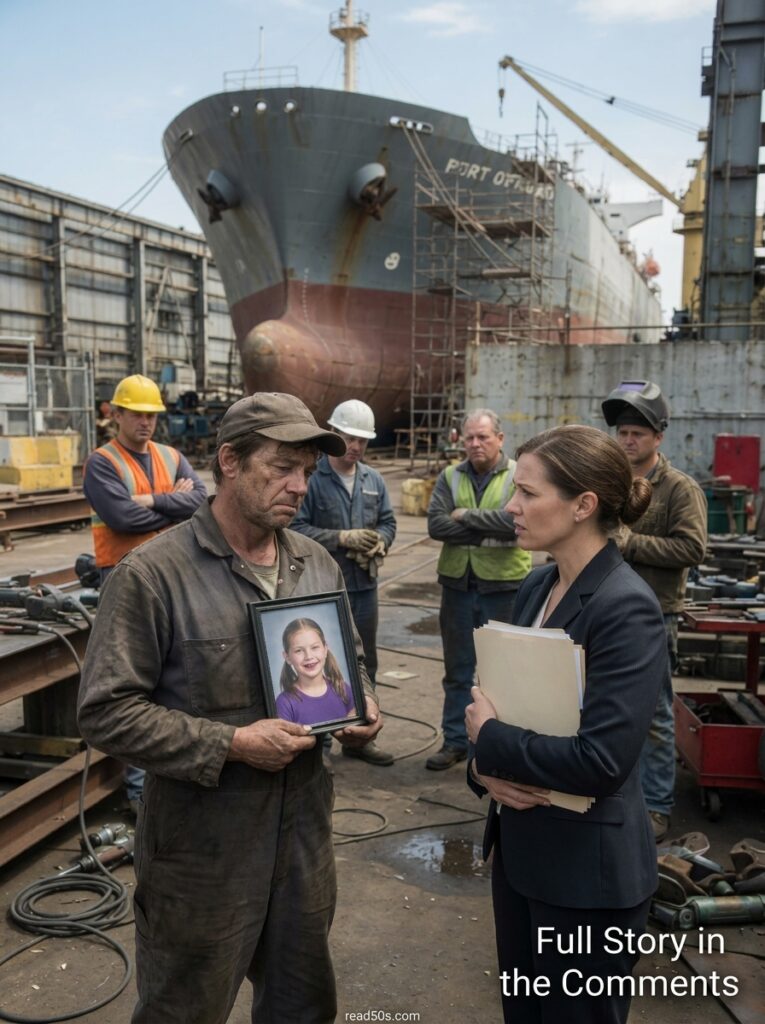
Mateo Herrera didn’t say a single word when the CEO fired him in front of everyone.
He simply took off his gloves.
Placed them on the metal table.
And walked toward his locker like a man who had already survived things far worse than public humiliation.
The main shipyard of Puerto del Golfo, in Veracruz, was usually too loud for silence.
Rusty cranes moved slowly over the docks. Welders sent bright sparks flying against steel hulls. Engines growled. Chains clanged. Men shouted over the sound of machines, and the air smelled of salt, diesel, hot metal, and the kind of sweat people carried home in their clothes after a long day.
Mateo had worked there for almost eight years.
Before that, he had spent ten years in the Mexican Navy as a propulsion systems technician.
He knew engines the way other men knew their own hands.
He could listen to a vibration for three seconds and tell which bearing was about to fail. He could touch a warm pipe and know whether the pressure inside was dangerous. He could look at a system that seemed fine to everyone else and find the one small detail that might become a serious problem at sea.
But Mateo never bragged.
He never talked about his certifications.
He never told anyone he was authorized to inspect special naval systems.
He never reminded people that officers still called him when they needed an answer no manual could give.
He simply arrived early, greeted people with a quiet nod, put on his worn boots and gloves, and did the work no one else wanted to do.
And one fact could not be denied.
No vessel Mateo inspected had ever returned with a major failure.
Not one.
But to Valeria Castañeda, the new CEO of the shipyard, Mateo was a problem.
Valeria had arrived fourteen months earlier with a mission from the board of directors.
Cut costs.
Speed up production.
Make the company profitable again.
She was brilliant, polished, ambitious, and cold enough that grown men lowered their voices when she walked past them.
She installed digital dashboards.
Weekly performance reports.
Hourly productivity tracking.
Every worker was measured by speed, number of completed orders, and average repair time.
On paper, Mateo looked terrible.
He took too long.
He checked parts that had already been approved.
He refused to sign off on repairs unless he personally inspected every important component.
In Valeria’s reports, his name appeared again and again in red letters.
LOW EFFICIENCY.
REPEATED DELAYS.
BOTTLENECK AT DOCK 7.
What the reports did not show was simple.
Mateo was slow because Mateo was careful.
And Mateo was careful because he knew what happened when people rushed machines that carried lives across open water.
That Monday morning, Valeria entered the main repair area with a folder in her hand and two Human Resources employees behind her.
The shipyard was full.
A cargo vessel was being repaired at Dock 3.
A crane was moving an engine block at Dock 5.
At Dock 7, Mateo was bent over the transmission system of a fishing boat, his hands covered in grease, listening closely to a sound no one else had noticed.
Valeria did not wait for him to finish.
“Herrera,” she called.
The noise around them slowly faded.
Mateo straightened and wiped his hands with a rag.
Valeria opened the folder.
“Effective immediately, your contract is terminated.”
No one moved.
A welder slowly lowered his mask.
A young mechanic turned off her tool.
Several workers looked at each other, stunned.
Valeria continued reading as if she were announcing a routine schedule change.
“The company has documented low performance, repeated delays, and an inability to adapt to the new productivity standards.”
Mateo looked at her.
Calm.
Silent.
Almost sad.
Valeria lifted her chin.
“Collect your belongings and report to Human Resources before leaving. Thank you for your services.”
That last sentence echoed through the yard louder than any insult.
Because everyone there knew Mateo.
Many had learned from him.
Some had been saved from dangerous mistakes because of him.
They knew that when Mateo approved a machine, it could cross open water without causing harm.
But Mateo did not defend himself.
He did not beg.
He did not argue.
He simply took off his gloves and placed them on the table.
Then he headed to his locker.
Inside, he took out three things.
A small backpack.
An old photo of his daughter.
And a worn notebook full of technical notes no one else in the shipyard could understand.
He closed the locker carefully.
Then he walked toward the exit.
The only sound was his boots hitting the cement floor.
Valeria watched him leave.
Then she turned to Human Resources.
“Reassign his pending orders,” she said. “We need to recover the time he made us lose.”
One of the HR employees hesitated.
“Do you want to review his personnel file one more time?”
Valeria’s eyes narrowed.
“I already reviewed the performance report.”
“He had special clearance notes attached to his file,” the woman said quietly.
Valeria looked annoyed.
“This is a private shipyard. We are not running a museum for old honors and past careers.”
The HR employee lowered her gaze.
Valeria turned back toward the workers.
“Everyone return to work.”
No one moved at first.
Then tools slowly started again.
But the sound was different now.
Heavier.
Uncertain.
Valeria believed the decision was simple.
Efficient.
Necessary.
She believed she had just removed an obstacle.
Ten minutes later, the sky began to tremble.
At first, the workers thought it was thunder.
Then the sound grew louder.
Deeper.
Closer.
Every person in the shipyard looked up.
A military helicopter was descending over the yard.
The wind whipped papers across the cement. Dust rose in circles. Hard hats nearly flew off. The sound of the blades swallowed every machine in the place.
Valeria came outside, covering her face with one hand, her expression shifting from irritation to confusion.
The helicopter landed near the main dock.
Two Navy officers stepped down.
They were not smiling.
One of them, an older officer with gray at his temples, walked directly toward Valeria.
His voice stayed calm, but something beneath it tightened the air around the dockyard like a cable pulled too hard.
“Where is Mateo Herrera?”
The entire shipyard went silent again.
But this time, no one looked amused.
Valeria straightened slowly, brushing dust from her blazer while the helicopter blades continued roaring behind the officers.
“I’m sorry,” she answered carefully, forcing professionalism into her voice. “He no longer works here.”
The older officer blinked once.
Then he looked toward the younger lieutenant beside him, whose jaw visibly tightened.
“Where did he go?” the lieutenant asked immediately.
Valeria crossed her arms, suddenly aware that dozens of mechanics had stopped pretending to work and were openly listening.
“He left approximately ten minutes ago,” she said.
The older officer removed a folded paper from inside his jacket and compared something written there with growing disbelief.
“Señora Castañeda,” he said slowly, “do you understand who Mateo Herrera is?”
A crane somewhere behind them screeched against metal.
Nobody answered.
Valeria maintained her posture, though something inside her chest had begun to shift in an uncomfortable direction.
“He was a senior mechanic,” she said.
The older officer’s eyes hardened.
“No,” he replied. “He is one of the few civilian-certified former Navy technicians in this region authorized to inspect and approve emergency propulsion repairs on naval support vessels.”
Valeria’s face changed.
Just slightly.
But everyone saw it.
The lieutenant stepped forward.
“We contacted your office three times this morning. We were told Herrera was on site.”
Valeria glanced toward the HR employees behind her.
One of them turned pale.
“I was not informed,” Valeria said.
The older officer’s voice lowered.
“Then let me inform you now. A naval medical support vessel is preparing to depart within hours. It is carrying supplies for coastal communities after last night’s storm damage. Its secondary propulsion system is showing an irregular vibration pattern. Herrera inspected a similar system here last week. He identified the same issue before it became critical.”
The workers began looking at each other.
Dock 7.
The delays.
The parts Mateo refused to approve.
Valeria swallowed.
“Our engineers can assist you,” she said. “We have qualified staff.”
“With respect,” the lieutenant said, though his tone held very little warmth, “your engineers already missed the issue.”
That sentence landed harder than the helicopter.
The older officer opened the folded document.
“Herrera submitted a technical warning about Dock 7 three days ago. According to this, he recommended a full halt on a transmission system because a vibration reading indicated internal fatigue.”
Valeria’s voice tightened.
“That repair was delaying delivery.”
“That repair may have prevented a failure at sea,” the officer said.
The workers were completely still now.
Valeria looked toward Dock 7.
The fishing boat Mateo had been working on sat silent, its open transmission waiting exactly where he had left it.
On the metal table, his gloves still rested where he had placed them.
The lieutenant spoke again.
“We need Herrera immediately.”
Valeria forced herself to remain calm.
“I can have someone call him.”
The older officer gave her a long look.
“You fired him in front of his coworkers, and now you want him to come back because the Navy needs him?”
No one in the yard breathed.
Valeria’s mouth opened, but no answer came.
A mechanic named Tomás stepped forward slowly.
“I know where he went.”
Valeria turned sharply.
Tomás did not look at her.
“He always stops at the daycare first,” he said. “Then the clinic. His daughter has therapy on Mondays.”
The lieutenant looked at him.
“Therapy?”
Tomás nodded.
“His little girl, Elena. She has a condition that makes walking difficult sometimes. Mateo raises her alone.”
The words hit the yard quietly but deeply.
Single father.
Clinic.
Daycare.
Long shifts.
Early mornings.
And Valeria had called him a burden.
Not loudly enough for the whole yard to hear.
But enough.
She had said it in the office two days earlier when reviewing his file.
“He slows the team down. His personal life is becoming a burden to this company.”
Now, standing beneath the shadow of a Navy helicopter, the word came back to her like a slap.
A burden.
The older officer turned to the lieutenant.
“Get the address.”
Tomás gave it immediately.
Within minutes, the lieutenant and one officer left in a vehicle.
The helicopter remained on the dock.
So did the silence.
Valeria stood in the center of the yard, surrounded by people who no longer looked afraid of her.
They looked disappointed.
And somehow, that was worse.
She turned to the HR employee.
“Why wasn’t I told about the Navy calls?”
The woman’s voice trembled.
“They were marked urgent, but you were in the board meeting. We sent the messages to your assistant.”
Valeria looked toward the office building.
For the first time that morning, the dashboards and reports seemed very small.
She had measured Mateo by speed.
But the Navy measured him by trust.
She had seen delays.
They saw lives protected.
She had seen a mechanic who took too long.
They saw a man they trusted enough to send a helicopter for.
Across town, Mateo Herrera sat on a low bench outside a small therapy clinic with his daughter beside him.
Elena was six years old, with dark eyes and two pink clips in her hair. Her small legs rested carefully in braces, and she held a paper boat she had folded from an old clinic flyer.
Mateo had not told her he had lost his job.
Not yet.
She leaned against his arm.
“Are you tired, Papá?”
Mateo smiled gently.
“A little.”
“Did the engines make too much noise today?”
He looked down at his hands.
Even after washing them, grease remained under his nails.
“No,” he said softly. “Today was quieter than usual.”
Elena studied his face with the seriousness only children can have when they know adults are hiding pain.
“Did someone make you sad?”
Mateo looked away toward the street.
A bus passed, leaving dust behind.
“Sometimes people don’t understand the work someone does,” he said.
Elena nodded as if that explained everything.
“My therapist says slow steps still count.”
Mateo’s eyes softened.
“Yes, mi niña. They do.”
That was when the Navy vehicle stopped in front of the clinic.
The lieutenant stepped out first.
Mateo stood immediately.
Old training returned to his body before thought did.
“Lieutenant.”
The young officer approached with urgency and respect.
“Herrera, we need you.”
Mateo glanced toward Elena.
“What happened?”
“Medical support vessel. Secondary propulsion vibration. We believe it matches the issue you flagged at Dock 7.”
Mateo’s expression changed.
Not fear.
Focus.
“Who authorized the inspection after I left?”
“No one. That’s why we’re here.”
Mateo looked down at Elena.
She gripped his hand.
“Papá?”
He crouched in front of her.
“I need to help some people.”
“Like when engines are sick?”
A small smile touched his face.
“Yes. Like that.”
“Then go,” she said.
Mateo hesitated.
“I can’t leave you alone.”
The clinic door opened behind them. Elena’s therapist, who had overheard enough to understand, stepped forward.
“I can stay with her,” she said. “As long as needed.”
Mateo looked at his daughter.
Elena lifted her paper boat.
“Make sure the real boat gets better.”
Mateo kissed her forehead.
“I will.”
When Mateo returned to the shipyard in the Navy vehicle, every worker turned.
Valeria stood near Dock 7.
The two Navy officers waited beside the helicopter.
For a moment, Mateo looked at the gloves still on the table.
Then he looked at Valeria.
She seemed smaller now, though nothing about her had physically changed.
“Herrera,” she said.
Her voice was different.
No sharpness.
No command.
Only something close to shame.
“I need to apologize.”
Mateo did not answer.
The entire yard waited.
Valeria took a breath.
“I judged your work through a report that did not understand your work. I dismissed your warnings. I embarrassed you in front of your colleagues. And I said things I had no right to say.”
Mateo’s face remained calm.
The older Navy officer stepped in before the moment became too heavy.
“We are short on time.”
Mateo nodded.
“Show me the readings.”
Just like that, he became the man everyone knew.
No anger.
No drama.
Only purpose.
The Navy engineers brought tablets, printouts, and vibration logs. Mateo studied them quickly, then walked to Dock 7 and crouched beside the open system he had been inspecting before he was fired.
He touched the casing.
Listened.
Asked for a manual rotation.
Then he looked at one of the younger mechanics.
“Bring me the inspection mirror, a torque wrench, and the small light. Not the large one. The small one.”
The young mechanic ran.
Valeria watched as the shipyard seemed to reorganize itself around Mateo.
No dashboard could have measured this.
No weekly report could have explained it.
Men and women who had been afraid to speak under her leadership now moved with total trust because Mateo had asked them to.
He removed a panel and pointed to a thin line along the inner coupling.
“There,” he said.
The Navy engineer leaned in.
“At first glance, it looks cosmetic.”
Mateo shook his head.
“Not cosmetic. Stress fracture beginning under load. If you push this vessel at full output, the vibration will climb after forty minutes. Maybe less in rough water.”
The lieutenant’s face tightened.
“And then?”
Mateo looked at him.
“Then you lose propulsion when you need it most.”
No one spoke.
The older officer turned to Valeria.
“Your repair team cleared this component yesterday.”
Valeria closed her eyes briefly.
Mateo continued.
“It needs replacement. Not adjustment. Not tightening. Replacement.”
“How long?” the lieutenant asked.
Mateo looked at the system, then at the workers around him.
“With the right people? Three hours.”
Valeria stepped forward.
“You have the right people.”
Mateo looked at her.
Then at the mechanics.
Tomás nodded.
The young mechanic lifted the tools.
A welder raised her mask.
Another worker said, “Tell us what to do.”
Mateo put his gloves back on.
And the yard came alive.
For the next three hours, Puerto del Golfo moved differently.
Not faster.
Better.
Mateo directed each step with quiet precision. He corrected angles, checked torque readings, listened to rotations, and made everyone slow down when slowing down mattered.
Valeria watched from a distance at first.
Then she removed her blazer, rolled up her sleeves, and began carrying documents, calling suppliers, signing approvals, and clearing every administrative block that stood in the team’s way.
No one praised her for it.
That was not the point.
By late afternoon, the repaired system was ready.
The Navy engineer ran the test.
The vibration dropped into safe range.
Then stabilized.
Then held.
The lieutenant released a breath.
The older officer looked at Mateo.
“You just saved us from turning back in open water.”
Mateo wiped his hands with a rag.
“You would have found it eventually.”
“Not before departure.”
Mateo said nothing.
He only looked toward the exit, thinking of Elena waiting at the clinic with her paper boat.
The older officer extended his hand.
“On behalf of the Navy, thank you.”
Mateo shook it.
Then Valeria approached.
The yard quieted again.
But this silence was not like before.
It was waiting.
Valeria stopped in front of Mateo.
“I was wrong,” she said.
No folder.
No prepared statement.
No corporate tone.
Just the words.
“I treated your care as inefficiency. I treated your responsibility as weakness. I treated your daughter as if she made you less valuable to this company.”
Mateo’s jaw tightened slightly.
Valeria’s voice shook, but she did not look away.
“She does not. And you are not a burden.”
The words settled over the yard.
Mateo looked at her for a long moment.
Then he said quietly, “My daughter is the reason I show up carefully.”
Valeria nodded.
“I understand that now.”
“No,” Mateo said, not harshly, but firmly. “You see it now. Understanding takes longer.”
Several workers lowered their eyes.
Valeria accepted the correction.
“You’re right.”
She took a breath.
“I would like to offer you your position back. With full back pay for today, a formal apology in writing, and a review of how this company measures safety work.”
Mateo looked toward Dock 7.
Then at the workers.
Then at the Navy helicopter.
“I don’t want my job back the way it was,” he said.
Valeria stayed silent.
“If I come back, safety inspections stop being treated as delays. No mechanic gets punished for refusing to approve work they believe is unsafe. And no parent here should have to choose between keeping a job and caring for their child.”
The workers looked at Valeria.
For once, the CEO did not answer quickly.
Then she nodded.
“Agreed.”
Mateo studied her face.
“And I want it written before I return.”
A small smile touched Tomás’s face.
Valeria nodded again.
“You’ll have it.”
The older Navy officer stepped forward.
“There is another option, Herrera.”
Mateo turned.
“We have an open civilian advisory role for propulsion safety inspections. Better hours. Better pay. Less emergency dock work.”
The workers reacted quietly.
Valeria went still.
Mateo looked down at his hands.
For years, he had carried everything alone.
Bills.
Clinic visits.
Night shifts.
School meetings.
Fear.
He had told himself that work was work, and dignity meant enduring.
But that afternoon, after being dismissed as a burden and called back as a necessity, he realized something.
His daughter needed more than a father who survived.
She needed a father who came home with enough strength left to smile.
“What would the hours be?” Mateo asked.
The officer answered.
“Stable. Mostly weekday inspections. Some emergency calls. But far fewer than shipyard shifts.”
Mateo thought of Elena’s braces.
Her therapy.
Her folded paper boats.
Then he looked at Valeria.
“I’m grateful for the apology,” he said. “But I think my time here is finished.”
A wave of emotion moved through the workers.
Tomás looked down.
The young mechanic wiped her eyes quickly and pretended it was sweat.
Valeria’s face showed pain, but she nodded.
“You’ve earned better than what I gave you.”
Mateo picked up his worn notebook from the table.
Then he handed it to the young mechanic.
She stared at it, shocked.
“Señor Mateo, I can’t take this.”
“Yes, you can,” he said. “You listen before you tighten. That matters.”
Her eyes filled.
He turned to the others.
“Machines speak before they fail. Don’t let anyone make you too rushed to hear them.”
No one forgot that.
That evening, Mateo returned to the clinic.
Elena was asleep in a chair, Pancho the stuffed dog from the clinic’s toy shelf tucked under one arm and her paper boat still in her hand.
Mateo crouched in front of her.
“Elena.”
Her eyes opened slowly.
“Did the boat get better?”
Mateo smiled.
“Yes.”
“Did you fix it?”
“With help.”
She smiled, sleepy and proud.
“Then you’re not sad anymore?”
Mateo lifted her carefully into his arms.
“I’m still a little sad,” he admitted. “But something good happened.”
“What?”
He carried her toward the door.
“I think Papá is going to have a new job.”
“Will the engines be loud?”
“Sometimes.”
“Will you come home earlier?”
Mateo paused.
Then smiled.
“Yes, mi niña. I think I will.”
She rested her head on his shoulder.
“Then I like that job.”
Weeks later, changes began at Puerto del Golfo.
Valeria stood in front of the entire workforce and publicly corrected the record.
She admitted the company had failed to understand the difference between delay and diligence.
She ended the ranking system that punished safety checks.
She created a new review board led by experienced technicians.
And on the wall outside Dock 7, she had a sign installed.
Speed matters. Safety matters more.
Some workers believed she changed because the Navy embarrassed her.
Others believed she changed because Mateo’s silence had shown her what her pride would not allow her to see.
Maybe both were true.
But the shipyard changed.
And Mateo changed too.
His new role with the Navy gave him better hours and enough pay to stop counting every peso before buying Elena’s medicine.
He still wore the same old boots.
Still carried the same small backpack.
Still never bragged.
But now, every Monday afternoon, he picked Elena up from therapy himself.
One day, months later, the Navy medical support vessel returned to Veracruz after completing its mission along the coast.
The captain invited Mateo and Elena to visit.
Elena stepped carefully onto the deck, holding her father’s hand.
The crew greeted Mateo with respect.
Not loud praise.
Not performance.
Just the kind of respect that meant more because it was real.
Elena looked up at the huge vessel.
“This is the boat you helped?”
Mateo nodded.
“It helped many people after that.”
She smiled.
“Because you listened to the engine?”
“Yes.”
“And because you were slow?”
Mateo laughed softly.
“Yes. Because I was slow.”
Elena thought about that.
Then she squeezed his hand.
“My therapist was right. Slow steps still count.”
Mateo looked out across the water.
The wind smelled of salt and diesel, just like the shipyard.
But this time, it did not feel heavy.
It felt open.
He looked down at his daughter and smiled.
“Yes, mi niña,” he said. “They do.”
And far away, at Dock 7, the workers of Puerto del Golfo still remembered the morning a CEO fired a single father and called him a burden.
Ten minutes later, a Navy helicopter landed.
And by sunset, everyone understood the truth.
Mateo Herrera had never been the reason the shipyard was falling behind.
He was the reason its vessels kept coming home.
━━━━━━━━━━━━━━━━━━━━━━━━━━━━━━━━━━━━━━