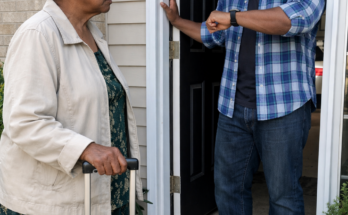
“I can’t pause my career for a hypothetical,” Ryan said, checking his passport while I sat doubled over on the sofa.
I stared at him, one hand pressed against my swollen belly, the other gripping the cushion beneath me.
“Ryan, I’m already four centimeters dilated,” I whispered. “The doctor said things could move fast.”
He didn’t even look at me.
His phone buzzed in his hand. His carry-on stood beside the door like it mattered more than I did.
“Caldwell wants the management team in Dallas by eleven,” he said. “I can’t call and say my wife is uncomfortable.”
“Uncomfortable?” My voice cracked. “I’m about to have our baby.”
Ryan sighed as if I were making traffic on purpose.
“Babies are usually late, Claire. If something real happens, call me. Dallas is a short flight.”
Then he walked out.
The door clicked shut behind him.
For a few seconds, I just sat there in the silence of our Chicago apartment, trying to convince myself he would turn around. That maybe guilt would catch him in the hallway. That maybe the man who once promised to love me through everything would remember I was not a meeting he could reschedule.
He did not come back.
At 1:43 a.m., I woke to a sharp wave of pain that stole the air from my lungs.
Then my water broke.
Not gently.
Not like in the movies.
It happened fast and frighteningly, and suddenly the room felt too large, too dark, too empty.
I grabbed my phone with shaking hands and called Ryan.
One ring.
Two.
Voicemail.
I called again.
Voicemail.
I sent a message.
Ryan, my water broke. The contractions are real. Please answer. I need you.
Nothing.
I tried to stand, but another contraction bent me forward until I could barely breathe. I knew I couldn’t drive myself to the hospital. I couldn’t even make it across the living room without holding the wall.
My fingers trembled as I scrolled through my contacts.
Then I saw one name.
Eli Dawson.
Apartment 14B.
The neighbor Ryan always mocked as “the hermit.”
Eli kept to himself. He wore old flannel shirts, avoided building parties, and carried groceries up the stairs when the elevator was crowded. Ryan thought that made him strange.
But I had seen Eli help Mrs. Alvarez with her bags during a power outage. I had seen him fix the lobby door when the superintendent ignored it. Quiet did not mean cold.
I pressed call.
He answered on the second ring.
“Claire?”
“My water broke,” I gasped. “Ryan’s gone. I don’t know what to do.”
“I’m coming,” he said.
No hesitation.
No questions.
Just that.
Three minutes later, he was at my door in jeans, boots, and a winter coat thrown over a T-shirt. Snow clung to his shoulders as he stepped inside.
He took one look at me and became calm in a way I had never seen before.
“Hospital bag?”
“Bedroom.”
“Phone charger?”
“Kitchen.”
“Can you stand?”
“I think so.”
“You don’t have to think. I’ve got you.”
He helped me to his truck through the freezing Chicago wind. I cried through every contraction on the way to Northwestern Memorial, while Eli kept one hand steady on the wheel and the other hovering near me whenever the pain became too much.
At the hospital, the intake nurse looked at Eli, then at me.
“Is he the baby’s father?”
“No,” Eli said quietly. “I’m her neighbor.”
Another contraction hit, and I grabbed his sleeve so hard my fingers cramped.
“He stays,” I said.
The nurse checked me. Her expression changed.
“She’s seven centimeters. We need to move now.”
Everything became motion.
A wheelchair.
Bright lights.
A room being cleared.
Nurses calling instructions.
Eli stayed beside me through all of it.
He stayed when they changed my gown. He stayed when the monitors started beeping faster. He stayed when the doctor said the baby’s heartbeat was dipping and they needed me to focus.
When I reached blindly for a hand, it was his I found.
He did not let go.
At 5:18 a.m., after hours of pain, fear, and prayer, my daughter entered the world.
A girl.
Tiny.
Fierce.
Alive.
Her cry filled the room, and for one perfect second, nothing existed except her warm little body against my chest.
Then Ryan arrived.
Not during the long hours when I needed him.
Not when I was afraid.
Not when the doctor warned that waiting could have placed both of us at risk.
He arrived ninety minutes after our daughter was born, wearing his airport blazer and the irritated expression of a man delayed by traffic.
He walked past me.
Past the bassinet.
Past Eli, who was sitting in the corner with exhaustion on his face.
Then Ryan looked at the nurse and said, “Run a paternity test.”
The room went silent.
I stared at him, too tired to understand the cruelty at first.
The nurse blinked. “Sir?”
Ryan pointed toward Eli.
“He was here. She called him. He stayed in the delivery room. I want the test done.”
Eli stood slowly.
Not angry.
Still.
That was worse.
I should have shouted. I should have thrown every word in my heart at Ryan. But I was holding our newborn daughter, and my body felt emptied of everything except pain and disbelief.
The nurse looked at me.
I closed my eyes.
Then I said, “Run it.”
Ryan folded his arms as if he had already won.
Two hours later, the results came back.
Ryan tore open the envelope himself.
He read the first line.
Then the second.
All the color drained from his face.
The nurse, Dana, stepped forward.
“Mrs. Mercer,” she said gently, “the result confirms Mr. Ryan Mercer is the biological father.”
There it was.
Not an apology.
Not joy.
Not a father’s first loving words.
A result.
A number.
A piece of paper proving what I already knew.
Ryan swallowed hard and tried to recover. I watched the mask return to his face—the polished corporate calm, the straightened shoulders, the attempt to turn humiliation into control.
“Fine,” he said. “Then we can put this behind us.”
I looked at him.
“Put this behind us?”
He glanced at Eli. “The circumstances were unusual. I had concerns. The test answered them.”
My daughter shifted against my chest. Her tiny mouth opened and closed, searching.
For the first time since entering the room, Ryan looked at her.
“So,” he said, stepping closer, “where is my daughter?”
Dana moved slightly between him and the bed.
“She is with her mother.”
Ryan frowned.
“Claire, let me hold her.”
I looked down at my baby.
She had fought her way into the world while her father’s phone went straight to voicemail.
“No,” I said.
Ryan froze.
“Excuse me?”
“No.”
“Don’t be dramatic.”
Something inside me became very calm.
Maybe it was exhaustion. Maybe it was shock. Maybe it was the moment a woman finally runs out of room to absorb another person’s selfishness.
“I was dramatic at 1:43 this morning,” I said. “When my water broke and you didn’t answer. I was dramatic in the truck when Eli drove through snow because I couldn’t sit upright. I was dramatic when our daughter’s heartbeat changed. I was dramatic when I delivered her without you. Right now, I’m being clear.”
Ryan’s face flushed.
“This is not the time.”
“You made it the time when you walked into my hospital room and asked for a paternity test before asking if I was okay.”
He looked around the room, suddenly aware of witnesses.
“Lower your voice.”
That sentence had worked before.
At dinners.
At work events.
During arguments where he called my feelings irrational until I apologized just to restore peace.
But my daughter was asleep on my chest.
And I understood something then.
Every time I swallowed my voice, I was teaching her a language she might one day inherit.
“No,” I said again.
Ryan turned to Eli.
“You need to leave.”
Eli stood fully.
“That’s up to Claire.”
Ryan gave a bitter laugh. “You’re the neighbor. You’ve done enough.”
Dana’s voice sharpened.
“Yes. He has.”
Ryan snapped, “I’m the father.”
“And this is a postpartum patient’s room,” Dana replied. “She decides who stays with her unless there is a safety concern.”
“I’m her husband.”
“Then act like one,” Eli said.
The silence that followed was heavy.
Ryan stepped toward him, but Dana pressed a button near the bed. Two hospital security officers appeared moments later.
Ryan looked at me, waiting for me to protect him from the consequences of his own words.
I looked at my daughter.
Then I looked at the officers.
“I don’t feel safe with him here,” I said.
Ryan’s face changed.
For the first time, he looked truly shocked.
Not because he had done nothing wrong.
Because he had never believed I would stop covering for him.
They escorted him out.
When the door closed, I finally broke.
Dana came to my side. Eli stepped back, unsure whether comfort from him would be too much.
But I reached for his hand.
He came immediately.
“I’m sorry,” I whispered.
“For what?”
“You shouldn’t have been dragged into this.”
He shook his head.
“Claire, I drove you to the hospital. That’s not being dragged in. That’s being a neighbor.”
Dana placed my daughter back on my chest.
“She needs her mom,” she said.
Her mom.
Those words steadied me.
“What’s her name?” Eli asked softly.
Ryan and I had argued about names for months. He wanted polished names that sounded good beside Mercer. I wanted something gentle, something that felt like breath after a storm.
I looked at my daughter’s dark hair and tiny mouth.
“Lily,” I said.
Then, after a pause, “Lily Grace Langley.”
Eli looked at me.
Langley was my maiden name.
The name I had given up when I still believed love meant shrinking to fit inside someone else’s world.
Dana smiled.
“Beautiful.”
Later that morning, a social worker named Maribel came in. She asked questions no one had ever asked me directly.
Did I feel safe with Ryan?
Had he controlled money?
Had he isolated me from people?
Had he made me feel small for being emotional?
Each answer felt like pulling a nail out of a boarded window.
“Yes,” I said quietly.
And then I said the words that changed everything.
“I’m not going home with him.”
My brother Daniel arrived from Milwaukee that night with red eyes, a duffel bag, and enough anger to warm the whole hospital room. When he saw me, the anger cracked into tears.
He hugged me carefully.
“I’m okay,” I said.
“No, you’re not.”
I looked down at Lily.
“No,” I admitted. “But she is.”
With Daniel’s help, I called an attorney named Priya Shah. She came to the hospital in snow boots and a wool coat, listened without interrupting, and said exactly what I needed to hear.
“Do not respond to Ryan without counsel. Do not discharge with him. Do not let him take the baby out of this room.”
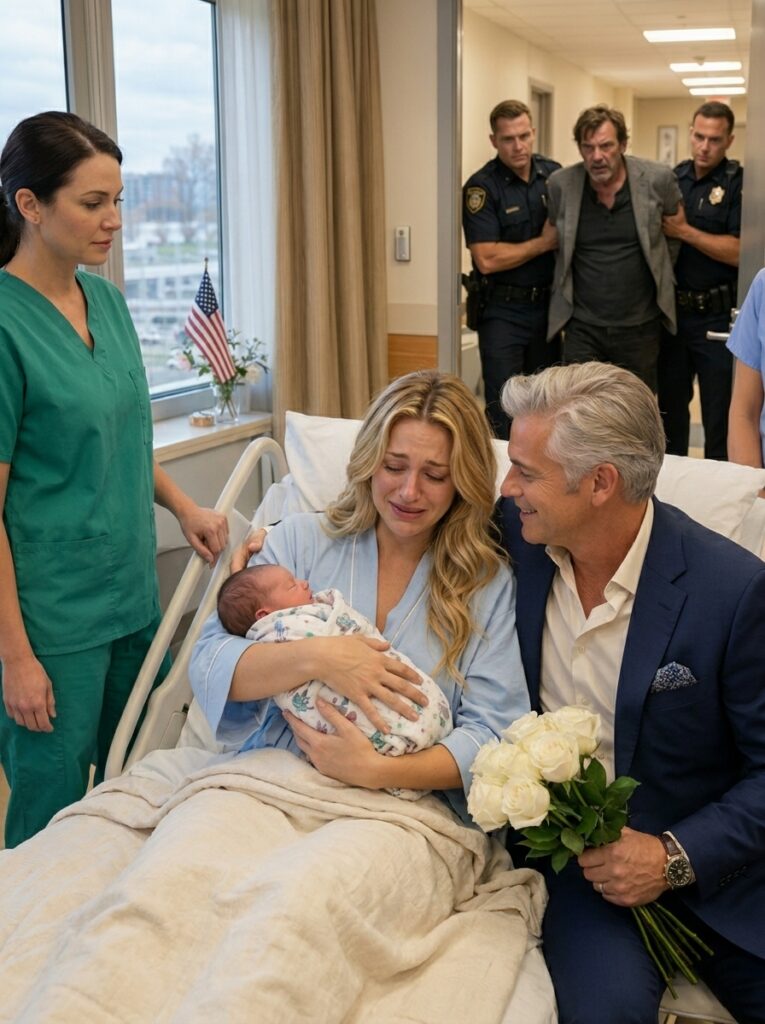
When Ryan returned with white roses and a polished apology, he found Daniel, Eli, Dana, and Priya all present.
“Claire,” he said carefully, “can we talk alone?”
“No,” Priya answered.
His eyes narrowed.
“And you are?”
“Claire’s attorney.”
The word hit him harder than the paternity test.
He tried to apologize, but even his apology blamed me.
“I shouldn’t have asked for the test that way,” he said. “But you have to understand what it looked like.”
I stared at him.
“You mean it looked like I called the man who answered.”
Ryan’s jaw tightened.
Priya handed him a letter outlining boundaries. He could see Lily under supervision, but he could not speak to me privately, take Lily alone, or pressure me about returning home.
Ryan looked at me with cold disbelief.
“You’re making a mistake.”
I looked at Lily.
“No,” I said. “I already made one. I married you. I’m correcting it.”
When he left, Daniel threw the white roses in the trash.
“The vase might be useful,” I said weakly.
He pulled the vase back out, rinsed it, and muttered, “Fine. The vase can stay.”
For the first time, Eli smiled.
The next day, I left the hospital with Lily and went to Daniel’s apartment instead of the condo I had shared with Ryan. Daniel had turned his guest room into a safe place with a bassinet, diapers stacked like a fortress, and a handwritten sign above the light switch:
CLAIRE + LILY SAFE ZONE
No Ryan.
No judgment.
No white roses.
I cried when I saw it.
Eli carried the bags inside and lingered at the door.
“I’ll head back,” he said.
Panic rose in me—not because I wanted him to replace Ryan, but because Eli had become proof that when I reached out, someone might actually come.
“You’ll text?” I asked.
“If you want.”
“I want.”
He crouched beside the car seat and smiled at Lily.
“Goodbye, Lily Grace. Take care of your mom.”
“She’s a newborn,” I said.
“Then mostly emotionally.”
Daniel snorted.
The weeks that followed were hard.
Ryan sent messages through my attorney, then tried emailing me directly. Some sounded sorry. Others sounded angry. Most sounded concerned about his reputation.
Priya filed for temporary custody protections. The hospital notes mattered. Dana’s statement mattered. Maribel’s report mattered. Eli’s statement mattered.
Ryan had tried to turn me into a woman on trial.
Eli described me as a woman in medical crisis who had been left alone.
There was a difference.
In court, Ryan’s attorney suggested I was too emotional, too influenced by others, and too close to “a male neighbor.”
When asked whether I had an emotional relationship with Eli Dawson, I answered honestly.
“Yes,” I said. “Gratitude.”
The judge granted me temporary primary custody, ordered supervised visits for Ryan, and required monitored communication.
Outside the courtroom, Ryan approached me.
“This is what you wanted?” he asked bitterly.
I looked at him.
“No,” I said. “I wanted you to answer your phone.”
That was the first time I saw the truth land.
Months passed.
Lily grew from a furious newborn into a round-cheeked baby with solemn eyes and a talent for launching pacifiers across the room. Ryan attended supervised visits. He learned some things. He resisted others. He wanted fatherhood as a title before he understood it as responsibility.
Eli stayed in our lives, but not like a fairytale hero.
He brought groceries, medicine, books, and quiet support. One day, he gave Lily a children’s book that had belonged to his late wife, Anna.
That was when I learned the truth about him.
His wife had been pregnant when she passed away after an accident during bad weather. Eli had been driving them to the hospital. He had once been a paramedic, but after losing Anna and their unborn child, he could not handle sirens or hospitals.
Yet when I called, he came.
“Why?” I asked him.
His answer was simple.
“Because no one came fast enough for Anna.”
That was the day I understood that Eli had not hidden from people because he was strange. He had hidden because grief had made the world too loud.
We did not fall in love quickly. We did not confuse rescue with romance.
We became friends first.
Real friends.
He learned how I took tea. I learned he hated elevators. He learned Lily calmed only when bounced twice and shushed once. I learned Anna had painted birds badly and joyfully, and Eli kept one crooked blue jay painting above his sink.
When Lily was five months old, I filed for divorce.
I became Claire Langley again.
Lily remained Lily Grace Langley.
Ryan fought the name at first, of course. But paternity gave him rights, not ownership. That distinction became the line I lived by.
Years passed.
Ryan slowly became a less harmful father. Not perfect. Not magically changed. But better, with boundaries, court orders, therapy, and time. He remained in Lily’s life, but he no longer controlled mine.
Eli became Uncle Eli before he became anything else.
He came to birthdays. He fixed shelves. He let Lily paint his fingernails blue because she said his hands looked “too serious.” He returned to emergency medical training as an instructor, slowly learning to live with sirens again.
When Lily was four, she asked to visit Anna’s grave after hearing that Anna liked birds. She placed a painted stone there and patted Eli’s shoulder when he cried.
“Crying is okay,” she told him.
He laughed through tears.
“Your mom teach you that?”
“Yes,” Lily said. “Also Uncle Daniel, but he cries at dog commercials.”
That day, walking back to the car, Eli took my hand.
No rescue.
No debt.
No confusion.
Just two people who had survived different storms and found each other on the other side.
We began slowly.
Carefully.
Years later, Eli and I married quietly at the courthouse. Lily wore sparkly shoes and called herself the “flower manager.” Daniel cried. Dana, Maribel, and Priya came too, because the women who helped us deserved to witness the life we built.
Ryan was not invited.
When he learned about it through the custody app, he wrote one word.
Noted.
Maybe that was growth.
Maybe exhaustion.
Either way, I accepted the peace.
As Lily grew older, I told her the truth in pieces. Not too much. Not too soon. But enough.
When she was seven, she found an old cracked panda mug in the kitchen.
“Why keep this?” she asked.
“That mug was there the morning before you were born,” I said.
“Tell the story.”
So I did.
I told her that Ryan made a bad choice and left when I needed help. I told her Eli lived next door and came when I called. I told her she came fast and strong.
“Did Eli save us?” she asked.
Eli, standing by the counter, shook his head gently.
“I helped your mom get to the people who saved you both.”
“Was Ryan sorry?” Lily asked.
I answered carefully.
“He was sorry about some things later. But sorry does not always fix what happened.”
She accepted that in the quiet way children sometimes accept difficult truths better than adults.
When Lily turned sixteen, she asked for something unusual.
“A birth day dinner,” she said.
“A birthday dinner?”
“No. Birth day. I want everyone who was there to tell the story properly.”
So we invited Dana, Maribel, Priya, Daniel, and Eli. Ryan came later for dessert with his second wife, Elise, who had become a steady presence in Lily’s life.
The cracked panda mug sat in the center of the table, filled with yellow tulips.
One by one, everyone told their part.
Dana told how Lily cried like a tiny opera singer.
Maribel explained that safety plans for newborns are also safety plans for mothers.
Priya said the law can be slow and imperfect, but sometimes it becomes a shield.
Daniel told his version with too much drama and not enough volume control.
Eli spoke last.
He looked at Lily.
“Your mom called,” he said. “I came. That’s the important part.”
Lily shook her head.
“That’s not the whole thing.”
“No,” Eli said softly. “But it is the part people should remember. When someone calls and you can come, you come.”
Then Lily stood beside the panda mug.
“I used to feel strange about how I was born,” she said. “Like my story started with people fighting over me. But that’s not really true.”
She looked at me.
“My story started with Mom surviving.”
Then she looked at Eli.
“And someone answering.”
Then she looked at Ryan.
“And someone failing, then learning that being a father is not just a lab result.”
The room went still.
Ryan’s eyes filled, but he did not defend himself. He did not interrupt. He simply took the truth.
Lily lifted her glass.
“To the people who stayed.”
We all raised our glasses.
Even Ryan.
Especially Ryan.
That night, after everyone left, I found the old paternity test paper in a drawer.
For years, I had kept it because it represented the worst moment of my life after Lily’s birth. Ryan’s suspicion. My humiliation. Love reduced to probability.
But now, it was only a fact.
Ryan Mercer: biological father.
That was all.
Not a verdict on me.
Not a definition of family.
Not a measure of fatherhood.
Just biology.
I folded the paper and slipped it beneath an old refrigerator manual.
Eli laughed softly.
“That seems disrespectful.”
“Exactly,” I said.
Years later, when Lily left for college, she packed the cracked panda mug.
“It’s practically an artifact,” I protested.
“Exactly,” she said. “It belongs in the museum of me.”
“It has a crack.”
“So do most important things.”
I had no answer.
After we helped her move into her dorm, she hugged me and whispered, “Promises count.”
I held her tightly.
“Yes,” I whispered. “They do.”
A week later, she sent me a photo from her dorm desk. The panda mug was holding pens. Beside it was a sticky note in her handwriting:
Not a hypothesis.
I laughed until I cried.
Then I forwarded it to Eli, Daniel, Dana, Maribel, and Priya.
Lily sent it to Ryan herself.
His reply came later.
You never were. I’m sorry I acted like you were.
Lily stared at the message for a long time.
“That’s probably the best he can do,” she said.
“Maybe,” I answered.
“Is it enough?”
“For what?”
She thought about it.
“For now.”
I smiled.
“For now, maybe.”
That is what I learned.
Enough changes shape.
Some apologies are enough for peace, but not for trust.
Some people are enough for biology, but not for safety.
Some endings are enough because they leave everyone where they belong.
Ryan belonged in Lily’s life with boundaries.
Eli belonged beside me by choice.
Daniel belonged everywhere, loudly.
Lily belonged to herself.
And I belonged to the life I built after the night I thought I had no one.
The paper shattered Ryan’s ego.
But it did not save me.
What saved me was the answered phone.
The nurse who believed what she saw.
The social worker who asked the right question.
The brother who made a safe room.
The attorney who turned fear into protection.
The neighbor who said, “I’m coming.”
And the woman who finally believed she was worth coming for.
That woman was me.
That baby was Lily.
And the man who once walked past us to demand proof spent the rest of his life learning what the paper could never give him.
A child may share your blood.
But fatherhood begins when you show up before anyone makes you prove it.
THE END
━━━━━━━━━━━━━━━━━━━━━━━━━━━━━━━━━━━━━━