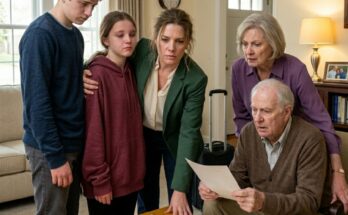
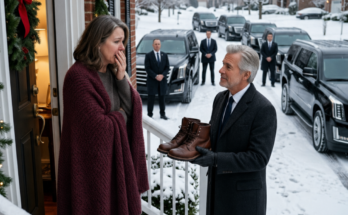
For thirty years, I believed I knew the man sleeping beside me.
I knew how he liked his coffee in the morning—black, no sugar, no matter how many times I told him it tasted like burnt regret. I knew the way he cleared his throat before saying something difficult. I knew the old scar on his left wrist from a childhood accident he always joked about. I knew which chair he would choose in any restaurant, how he folded his newspaper, and how he hummed quietly whenever he was nervous.
For thirty years, I believed I knew the man sleeping beside me.
I knew how he liked his coffee in the morning—black, no sugar, no matter how many times I told him it tasted like burnt regret. I knew the way he cleared his throat before saying something difficult. I knew the old scar on his left wrist from a childhood accident he always joked about. I knew which chair he would choose in any restaurant, how he folded his newspaper, and how he hummed quietly whenever he was nervous.
At least, I thought I knew.
His name was Richard Ellis.
To most people, he was a kind man. A dependable man. A devoted husband. The sort of man neighbors trusted with spare keys and coworkers described as honest. At church, people called him gentle. At family gatherings, they called him steady.
To me, he was my life.
We never had children. Not because I didn’t want them, but because life had not allowed it. After years of appointments, quiet heartbreak, and prayers that seemed to disappear into the ceiling, we accepted that our family would be the two of us.
Richard always told me that was enough.
“Evelyn,” he would say, taking my hand across the kitchen table, “you are more than enough for one lifetime.”
I believed him.
I believed him through every anniversary dinner, every quiet Christmas morning, every long drive to the coast, every night he came home late and said work had been difficult. I believed him when he disappeared for weekends to “help an old friend.” I believed him when his phone rang and he stepped outside to answer it. I believed him because love, when it lasts long enough, can turn trust into habit.
Then Richard passed away suddenly on a cold October morning.
One moment, he was standing in the kitchen, reaching for his coffee mug. The next, he was on the floor, his hand pressed weakly against his chest, trying to say my name.
By the time the ambulance arrived, the home we had built together had changed forever.
The funeral was held three days later.
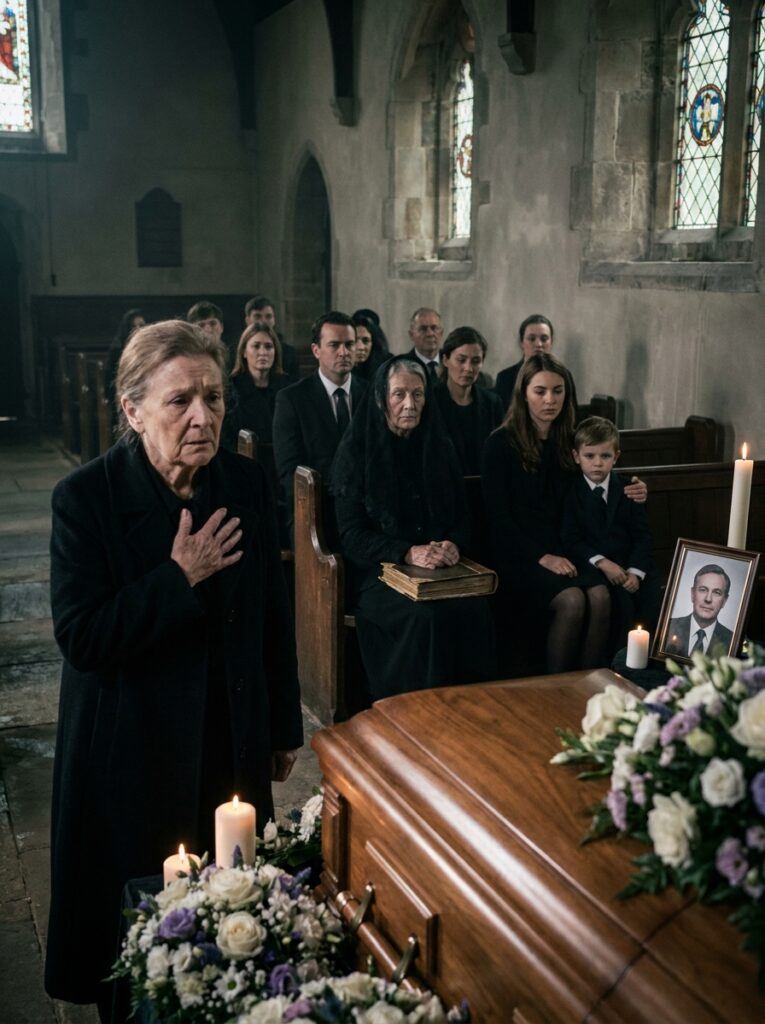
I remember standing near his casket with numb hands and a face that felt too tired to cry. People came in soft waves—neighbors, old coworkers, church friends, distant cousins. They hugged me, whispered kind words, and told me Richard had been a good man.
A good man.
I held onto that phrase like a blanket.
Then I saw them.
They were sitting in the back row.
Two women I did not know.
One appeared to be around my age, maybe a few years younger. Her hair was silver at the temples, and she wore a black dress that looked carefully chosen but old. Beside her sat a younger woman, perhaps in her late twenties, holding the hand of a boy who could not have been more than eight.
The boy had Richard’s eyes.
That was the first thing I noticed.
Not the women. Not their tears. Not the way they sat stiffly, as if they were afraid someone might ask who they were.
The boy’s eyes.
Gray-blue. Serious. Too old for his small face.
My breath caught, but I told myself grief was playing tricks on me. Funerals make people see ghosts in strangers. Pain creates meaning where there may be none.
Still, I could not stop looking.
During the service, the older woman cried silently. Not polite tears, not the kind shed by distant acquaintances. She cried like a widow.
That thought struck me so hard I nearly lost my balance.
No, I told myself.
No.
Richard was my husband.
Mine.
After the final prayer, people began leaving the chapel. They touched my shoulder, kissed my cheek, promised to call. I nodded without hearing most of them.
The two women remained seated.
So did the boy.
Finally, when the room had grown almost empty, the older woman stood. Her hands trembled as she picked up a worn brown photo album from the pew beside her. The younger woman whispered something to the boy, then guided him toward the doors.
But the older woman came toward me.
Each step felt like the beginning of something I could not stop.
When she reached me, she looked at Richard’s casket first. Then at me.
“I’m sorry,” she said.
Her voice broke on the second word.
I stared at her. “Do I know you?”
She lowered her eyes.
“No,” she whispered. “But I knew him.”
Something cold moved through my chest.
Before I could ask what she meant, she placed the photo album in my hands.
“I didn’t come to hurt you,” she said. “I came because I thought you deserved to know.”
Then she walked away.
No explanation. No argument. No demand.
Just the album.
I stood there holding it while the room seemed to tilt around me.
My sister, Linda, came to my side and asked if I was all right. I told her I needed a moment. I don’t remember walking to the small side room beside the chapel. I only remember sitting down, placing the album on my lap, and staring at the cracked leather cover.
My hands refused to open it.
Some part of me already knew.
Some part of me had known the moment I saw that little boy’s eyes.
When I finally lifted the cover, the first photograph stole the air from my lungs.
It was Richard.
Younger. Smiling.
Standing beside the older woman from the back row.
She wore a simple cream-colored dress. He wore a dark suit.
Between them was a small bouquet.
Behind them, a courthouse sign.
On the back of the photo, written in Richard’s handwriting, were the words:
June 14, 1998. Our beginning.
Our beginning.
But Richard and I had married in 1996.
Two years before that photograph.
I stared at the date until the numbers blurred.
The next photo showed Richard holding the woman’s face between his hands, kissing her forehead.
The next showed them sitting at a kitchen table with a small cake.
The next showed the younger woman as a child, sitting on Richard’s shoulders.
My fingers went numb.
A child.
Richard had a child.
I turned page after page, each one taking something from me.
Birthdays.
Christmas mornings.
School plays.
A fishing trip.
A hospital room where Richard held a newborn baby wrapped in a blue blanket.
The same boy from the funeral.
On the back of that photo, he had written:
My grandson, Caleb. A second chance at joy.
I closed the album so quickly it slipped from my lap and hit the floor.
Linda rushed in when she heard the sound.
“Evelyn?” she asked.
I looked at her, but I could not speak.
How do you tell someone that the man you buried an hour ago had buried your entire life under a lie?
That evening, I sat alone at my kitchen table with the album open in front of me.
The house was quiet in a way I had never heard before. Not peaceful. Not calm.
Empty.
Every room suddenly felt like a stage set for a marriage that had not been real.
The coffee mug Richard had used that morning still sat beside the sink. His reading glasses rested on the arm of his chair. His coat hung by the door.
Ordinary things.
But now they looked like evidence.
I went through the album again, slower this time. There were notes tucked between pages. Birthday cards. Small drawings from a child named Anna. A letter from the younger woman thanking Richard for helping with college tuition.
Anna.
His daughter.
And the older woman?
Her name appeared on several envelopes.
Margaret.
I remembered the weekends Richard had left town.
“Margaret’s husband passed years ago,” one note said in Richard’s handwriting. “She says I saved her, but the truth is, she saved a part of me I thought was gone.”
A part of him?
What part had I been given?
The convenient part? The respectable part? The part that came home to the wife everyone knew about?
I found bank statements hidden in the back pocket of the album. Copies, carefully folded. Payments made over many years. Rent. School fees. Medical bills. A small house in another town.
Richard had supported them.
Loved them.
Visited them.
Lived with them in pieces while I waited at home, believing he was tired from work.
The next morning, Margaret came to my house.
I had not invited her, but somehow I knew she would come.
She stood on my porch holding her purse in both hands, her face pale with worry.
“I can leave,” she said quickly. “I only wanted to explain.”
I almost shut the door.
I wanted to hate her. I wanted to blame her because blaming the living is easier than screaming at the dead.
But the boy’s face flashed in my mind.
Richard’s eyes.
So I stepped aside.
Margaret sat at the kitchen table across from me, the same table where Richard had told me I was enough.
For a long moment, neither of us spoke.
Then she said, “I didn’t know about you at first.”
I let out a bitter laugh. “At first?”
She flinched, and I hated that I noticed her pain looked real.
“I met him in 1998,” she said. “He told me he was divorced. He said his marriage had ended quietly, that there were no children, no family left to hurt.”
My throat tightened.
“He lied to both of us,” she continued. “By the time I found out, Anna was already three.”
“Then why stay?” I asked.
It came out sharper than I intended.
Margaret’s eyes filled.
“Because I was afraid,” she said. “Because I loved him. Because Anna loved him. Because every time I tried to walk away, he told me he would make it right. He said he would tell you. He said he just needed time.”
Time.
Richard had taken thirty years of mine.
I looked toward the hallway where our wedding photo still hung on the wall.
“Did he love you?” I asked.
Margaret covered her mouth.
That was answer enough.
I wanted her to say no. I wanted her to tell me he had only helped her out of guilt, that she had misunderstood everything, that the photos meant less than they looked.
But life does not always offer mercy.
“Yes,” she whispered. “But I don’t think he knew how to love without hurting someone.”
I closed my eyes.
For the first time since the funeral, tears came.
Not quiet tears. Not dignified tears. The kind that shake the body because something inside has finally broken open.
Margaret cried too.
Two women at the same kitchen table, mourning the same man for entirely different reasons.
For days, I lived inside questions.
Was any of it real?
Did he love me when he kissed my forehead before bed? Did he think of them when he sat across from me at dinner? Did he compare our quiet house to the laughter in theirs? Did he pity me? Did he feel guilty? Did he ever plan to tell the truth?
Or had he planned to carry the secret into the ground?
The answer was obvious.
He had almost succeeded.
A week after the funeral, Anna came to see me.
She was the younger woman from the chapel, Richard’s daughter. She stood on my porch with Caleb beside her, both of them nervous.
“I’m sorry,” Anna said before I could speak. “I didn’t want to come to the funeral. Mom said we should. I thought it was wrong.”
Her voice cracked.
“I didn’t know how to look at you.”
I looked at her face carefully.
She had Richard’s eyes too.
Not exactly the same as Caleb’s, but close enough to hurt.
“You knew about me?” I asked.
Anna nodded, ashamed.
“Not when I was little. Later. When I was sixteen. I found letters. I confronted him. He told me the situation was complicated.”
I almost laughed at the word.
Complicated.
Such a small word for destruction.
Anna looked down. “He told me you were fragile. That telling you would ruin you.”
There it was.
The final insult wrapped in concern.
He had made my ignorance sound like kindness.
I invited them in.
I don’t know why.
Maybe because Caleb was looking at me with frightened eyes. Maybe because Anna was not responsible for the choices that created her. Maybe because I had spent thirty years without children, and now the truth had placed a child at my door who carried my husband’s blood and none of his blame.
Caleb sat quietly in the living room, staring at Richard’s photograph on the mantel.
“Grandpa said you liked roses,” he said softly.
My heart clenched.
I looked at him. “He told you about me?”
Caleb nodded.
“He said you were kind.”
For some reason, that hurt more than anything.
Richard had spoken of me.
He had not erased me completely.
He had simply divided us.
Anna opened her bag and pulled out a small envelope.
“I found this after he passed,” she said. “It has your name on it.”
My hands shook as I took it.
Richard’s handwriting was on the front.
Evelyn.
I wanted to throw it away.
Instead, I opened it.
Inside was a letter dated two months before his passing.
My Evelyn,
There is no gentle way to say what I should have told you years ago. I have failed you in a way that cannot be excused. I built a life outside our marriage, and every year I told myself I would confess. Every year I became more afraid of losing you, more ashamed of what I had done, and more trapped by my own choices.
You deserved the truth. Margaret deserved the truth. Anna deserved the truth. Caleb deserved a grandfather who was not hidden in shadows.
I loved you. That is the part that will sound impossible, but it is true. I loved you, and still I betrayed you. I loved another family too, and because I was too weak to choose honesty, I caused pain to everyone.
I do not ask for forgiveness.
I only ask that you do not let my cowardice turn your heart cold. You were the best part of my life, even when I was the worst part of yours.
Richard
I read the letter once.
Then again.
Then I placed it on the table and walked outside.
The garden was full of roses.
Richard had planted them for our tenth anniversary. He said they reminded him of me because they looked delicate but survived storms.
I stood among them until the sun dropped low and the air turned cold.
I wanted the letter to fix something.
It did not.
A confession written too late is not courage. It is only the echo of a truth someone refused to speak while it still mattered.
But it did answer one question.
He knew.
He knew exactly what he had done.
In the weeks that followed, I made decisions slowly.
I took down some of the photographs, but not all. I moved his clothes out of the closet, but kept his old watch in a drawer. I met with a lawyer, not out of revenge, but because the truth had made everything practical and painful at once.
There were accounts I had not known about.
Payments.
Policies.
Documents.
Richard had left money for Margaret, Anna, and Caleb. He had also left everything in our shared home to me.
Even in death, he had tried to divide his guilt neatly.
But grief is not neat.
One afternoon, Margaret called and asked if she could bring Caleb to the cemetery.
I almost said no.
Then I surprised myself.
“I’ll meet you there,” I said.
We stood together beside Richard’s grave.
Three generations of heartbreak gathered around one stone.
Caleb placed a small toy car near the flowers.
“He promised he’d teach me how to fix an engine,” the boy whispered.
Margaret began to cry.
Anna put an arm around her mother.
I looked at the name carved into the stone.
Richard James Ellis.
Beloved Husband.
The words twisted inside me.
Beloved husband.
Beloved father.
Beloved grandfather.
Beloved liar.
All of it was true.
That was the hardest part.
People want betrayal to make love disappear, but it does not work that way. Love remains, and that is what makes the betrayal so cruel.
I still missed him.
I missed the version of him I had known. I missed his laugh in the hallway, his hand reaching for mine at night, the way he used to warm my side of the bed before I got in.
And I hated him.
Sometimes in the same breath.
Months passed.
The world expected me to move on because the funeral was over and the casseroles had stopped arriving. But I was not grieving one loss. I was grieving three.
The husband who died.
The marriage I thought I had.
And the woman I had been before the album opened.
Slowly, I began building a life from what remained.
Margaret and I did not become friends in the simple way people might imagine. There was too much history, too much pain, too much silence between us.
But we became something.
Two women connected by the damage one man left behind.
Anna visited sometimes with Caleb. At first, I told myself it was for their sake. Then one day Caleb ran into my house and hugged me without hesitation, and I realized some doors open even after others are destroyed.
He started calling me Miss Evelyn.
Then Grandma Evelyn.
The first time he said it, I went into the kitchen and cried where he couldn’t see.
Not because it healed everything.
Because it reminded me that life can still place something tender in the middle of ruins.
On the first anniversary of Richard’s passing, I returned to the cemetery alone.
I brought no flowers.
Only the photo album.
I sat beside his grave and opened it to the first page—the courthouse photo. Richard smiling beside Margaret, two years after promising forever to me.
For a long time, I stared at it.
Then I spoke aloud.
“You broke my heart,” I said. “But you do not get to break the rest of my life.”
The wind moved softly through the trees.
There was no answer.
There never would be.
I closed the album and stood.
I did not leave it there. I took it home.
Not because I wanted to keep his secret alive, but because it was no longer a secret. It was part of the truth now. And truth, no matter how painful, is firmer ground than a beautiful lie.
Today, I still do not know what to call Richard.
My husband.
Their father.
Caleb’s grandfather.
The man who loved me.
The man who betrayed me.
Maybe he was all of those things.
Maybe people are not always one thing, even when we desperately need them to be.
But I know who I am now.
I am not the woman standing beside a casket, confused by strangers in the back row.
I am not the wife who waited at home while her husband lived another life in secret.
I am Evelyn Ellis.
A woman who was hurt, but not ended.
A woman who learned the truth too late, but still chose not to let bitterness become her home.
And every Sunday afternoon, when Caleb comes over to help me water the roses, I look at those gray-blue eyes and feel two things at once.
The ache of what Richard hid.
And the quiet miracle of what the truth finally gave back.