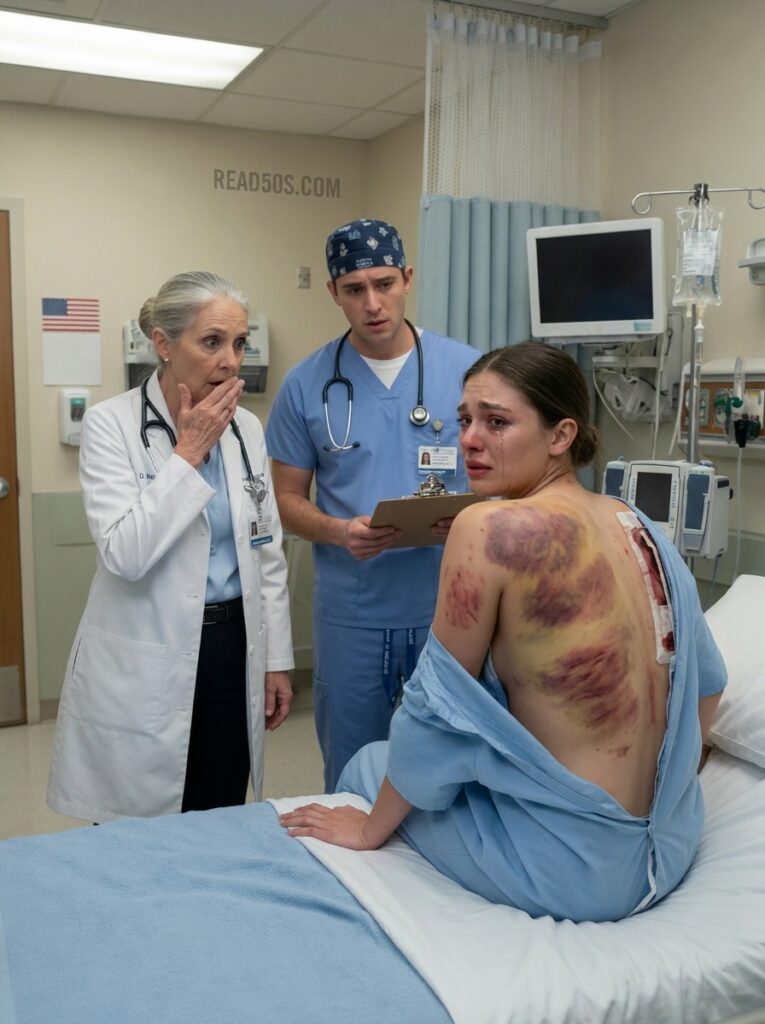
Margaret Hale had spent forty years inside operating rooms, where panic was useless and hesitation could cost a life.
She had learned to read the body the way other people read letters: color, swelling, pressure, rhythm, silence. Every mark told a story. Every pause meant something. Every injury had a history, even when the patient was too afraid to speak.
At sixty-eight, Margaret was retired from surgery and known around town as a quiet widow. She brought lemon cakes to charity auctions, wrote careful checks to hospital foundations, and wore soft shoes that made almost no sound when she entered a room.
People liked that version of her.
It was gentle.
It was convenient.
It let them forget the woman who had once opened human chests and held beating hearts in both hands.
Her daughter, Anna, had married Daniel six years earlier. He was handsome, polished, and attentive in public. He carried chairs without being asked. He remembered birthdays. He called Margaret “Mom” after the first Thanksgiving.
Margaret had trusted him more than she liked admitting later.
She let him drive Anna home after family dinners. She let him bring wine to her table. She let him speak for Anna when Anna went quiet.
That was the signal Daniel learned to use.
He discovered that Margaret valued manners. He discovered that Anna hated scenes. He discovered that if he smiled warmly enough, people would hesitate before questioning him.
The change did not happen all at once.
Anna stopped dropping by without calling. Then she stopped staying long. Then she began canceling lunches with explanations that sounded borrowed.
Daniel always had a reason.
Anna was tired.
Anna had a migraine.
Anna was overwhelmed.
Anna was sensitive.
The words sounded caring until Margaret noticed how often they placed Daniel between Anna and everyone else.
Still, there had been dinner that evening.
Daniel had smiled like a saint across Margaret’s table, sleeves rolled neatly, voice pleasant, asking about hospital renovations and pouring Anna water before she reached for the pitcher.
Anna had worn a long cardigan though the house was warm.
Once, when Daniel touched her shoulder, she flinched so slightly that Margaret almost convinced herself she had imagined it.
Almost.
After they left, Margaret washed two wineglasses by hand and stood at the sink longer than necessary.
Rain tapped against the window. The house was silent. But something in her chest stayed unsettled, a small pressure she knew better than to ignore.
The call came at 11:47 p.m.
“Margaret,” Dr. Ellis said, his voice low. “It’s Anna. She’s in my emergency room.”
Ellis had been her colleague for twenty-eight years. He had seen emergencies, broken families, impossible nights, and the kind of fear that changes a person’s face. He did not frighten easily.
But that night, he sounded shaken.
Margaret’s hand tightened around the phone.
“What happened?”
There was a pause.
“You need to come.”
“Is she conscious?”
“Yes.”
“Is she safe?”
Another pause.
“She is here. But you need to witness this yourself.”
Margaret did not ask another question.
She grabbed her coat, slid her feet into the nearest shoes, and drove through the rain with the controlled focus that had once carried her through midnight surgeries. Her hands did not tremble. Her breathing did not change.
But inside, something old and cold had already begun to move.
She reached St. Catherine’s in eight minutes.
Dr. Ellis met her outside trauma bay three. His surgical cap was crooked. His face looked gray beneath the fluorescent lights.
“Margaret,” he said quietly.
She looked at him once and knew.
Whatever waited behind that curtain was worse than he wanted to say.
“Show me,” she said.
Ellis pulled the curtain back.
Anna lay on her stomach, face turned toward the door. Her lips were swollen. One eye was partly closed. Her breathing was shallow, but steady.
Then Margaret saw her daughter’s back.
For one second, the hospital disappeared.
There were marks layered over older marks. Faint yellow shadows beneath fresh purple bruising. A small burn near her shoulder. Finger-shaped marks along her ribs. A pattern no fall could explain.
Margaret had seen bodies after accidents. She had seen injuries caused by stairs, ice, careless driving, and terrible luck.
This was not terrible luck.
This was a history.
Anna opened her good eye.
“Mom,” she whispered. “Don’t let him take me home.”
Those seven words broke something cleanly inside Margaret.
Not loudly.
Not dramatically.
Cleanly.
She crossed the room and touched Anna’s hair.
“You are safe,” she said.
Behind her, a man laughed softly.
Daniel stood near the nurses’ station in an expensive coat, his hair wet from rain, his phone in his hand as if he could control the room with it.
“My wife is clumsy,” he said. “She fell. Again.”
Margaret turned slowly.
Daniel smiled wider.
“And before you start playing detective, remember you’re not her doctor. You’re retired.”
Dr. Ellis stepped forward. “Daniel, you need to leave this area.”
Daniel ignored him.
“Anna gets emotional,” he said. “You know how she is. And Margaret here…” He looked her up and down. “She’s grieving. Lonely. Dramatic.”
Anna flinched at his voice.
That was enough.
Margaret looked at Daniel, really looked at him. Not as a mother. Not as a widow. Not as a woman he believed he could dismiss.
She looked at him the way she had once looked at infection before removing it from the body.
“You should go home,” she said softly.
Daniel blinked.
Then he smirked.
“That’s it?”
“For tonight.”
He gave a small laugh, as if disappointed that she had not made a scene.
Cruel people often mistake calm for surrender.
Daniel stepped closer, lowering his voice just enough for her to hear.
“She is my wife.”
Margaret did not move.
“And she is my daughter.”
For the first time, his smile tightened.
Ellis signaled to security. Daniel noticed, rolled his eyes, and backed away.
“This is ridiculous,” he said. “You’ll see. She’ll calm down by morning.”
Then he turned and walked down the hallway, still holding his phone, still convinced he had control.
When he disappeared around the corner, Margaret turned back to Ellis.
“Did you photograph everything?”
His eyes met hers.
“Yes.”
“Every visible injury?”
“Yes.”
“Medical notes?”
“Already started.”
“Good,” Margaret said. “Then let’s begin.”
Anna closed her eye and began to cry without sound.
Margaret sat beside her bed and took her hand.
For the next hour, Anna spoke in pieces.
At first, only fragments came out.
The first time Daniel pushed her into a wall, he cried afterward and said it would never happen again.
The second time, he blamed stress.
The third time, he said Anna had made him lose control.
Then the apologies stopped.
After that came rules.
No lunch with friends unless he approved.
No visits to Margaret without him.
No phone calls after nine.
No wearing certain clothes.
No disagreeing in public.
No telling anyone what happened inside their house.
“He said no one would believe me,” Anna whispered. “He said everyone loved him.”
Margaret did not interrupt.
She had learned long ago that a wounded person needed space to speak without being rushed. So she listened.
Anna told her about excuses Daniel had taught her to use. Stairs. Cabinets. Slipping in the bathroom. Migraines. Anxiety.
She told her about the cardigan she wore to dinner, not because she was cold, but because she was hiding what he had done days before.
Margaret’s throat tightened, but her face stayed steady.
Inside, grief moved through her like a blade.
She thought of every dinner where Anna had gone quiet.
Every canceled lunch.
Every time Daniel had smiled and answered for her.
Every time Margaret had sensed something wrong but had accepted silence because she did not want to intrude.
A mother’s guilt can become its own prison.
But Margaret did not let it trap her that night.
Guilt would not help Anna.
Action would.
By two in the morning, Ellis had called the hospital social worker. A patient advocate arrived. A quiet nurse named Celia brought warm blankets and stayed near Anna like a guard.
Margaret asked for copies of every report. She knew the system. She knew which words mattered. She knew how vague language could erase truth.
“Document patterns,” she told Ellis. “Not just injuries. Patterns.”
Ellis nodded.
“I already did.”
Anna squeezed her mother’s hand.
“Mom,” she said, barely above a whisper, “I’m scared he’ll come back.”
Margaret leaned closer.
“He may try,” she said. “But he will not take you from here.”
By sunrise, Daniel tried.
He returned wearing a different coat and a calm expression. He carried coffee and flowers from the hospital gift shop.
The flowers made Margaret feel colder.
He approached the desk with a tired smile.
“I’m here for my wife,” he said. “She had a rough night. I’ll take her home now.”
The nurse at the station looked at him politely.
“She is not being discharged to you.”
Daniel’s smile faded.
“Excuse me?”
Margaret stepped from the doorway of Anna’s room.
Daniel saw her and laughed under his breath.
“You’re really doing this?”
“I’m not doing anything,” Margaret said. “Anna is speaking for herself.”
His eyes flickered.
“Anna is confused.”
“No,” came a soft voice from behind Margaret.
Anna stood inside the doorway, wrapped in a hospital robe, one hand gripping the frame. Her face was pale, but her eyes were clear.
“I’m not going home with you.”
For a moment, Daniel looked genuinely stunned.
Then his expression changed.
Not much.
Just enough.
The charm slipped.
“You need to think carefully,” he said.
“I have,” Anna replied.
“You’re embarrassing yourself.”
“No,” Anna said, her voice shaking but present. “I’m finally telling the truth.”
People in the hallway slowed.
Daniel noticed them and quickly put his smile back on.
“This is a private family matter,” he said.
“No,” Margaret said. “It stopped being private when she asked for help.”
Security stepped closer.
Daniel looked at Margaret with a kind of hatred she had seen before in men who believed power belonged to them until someone took it back.
“You don’t know what you’re starting,” he said.
Margaret held his gaze.
“I know exactly what I’m starting.”
The police report was filed that morning.
A protective order followed.
Anna did not return to Daniel’s house. Margaret brought her to her own home instead, to the quiet white guest room at the end of the hall where morning light fell gently across the floor.
For the first three days, Anna slept.
She slept like someone who had been holding her breath for years.
Margaret stayed nearby but did not hover. She made soup. She washed Anna’s clothes. She changed bandages. She answered calls Anna was not ready to answer.
Daniel called forty-three times the first day.
Then the messages began.
Apologies.
Accusations.
Promises.
Warnings disguised as love.
Margaret saved all of them.
Anna sat at the kitchen table one evening, wrapped in a blanket, watching her mother organize printed screenshots into folders.
“You don’t have to do all this,” Anna said.
Margaret looked up.
“Yes, I do.”
“I should have told you sooner.”
Margaret’s face softened.
“No.”
Anna’s eyes filled.
“I lied to you.”
“You survived,” Margaret said. “There is a difference.”
Anna pressed a hand over her mouth.
Margaret moved around the table and sat beside her.
“I should have seen more,” she said quietly. “And I will carry that. But you are not responsible for what he chose to do. Not then. Not now.”
For the first time since the hospital, Anna leaned into her mother and sobbed.
The weeks that followed were not simple.
Stories like Anna’s do not heal in one dramatic moment. They heal in mornings when coffee tastes normal again. In nights when footsteps in the hallway no longer cause fear. In the first laugh that surprises everyone. In the first day without checking the window.
Daniel tried to protect his reputation.
He told friends Anna had suffered a breakdown. He told his coworkers Margaret was controlling. He told anyone who would listen that he was the real victim of a “family misunderstanding.”
But evidence is patient.
Evidence does not care about charm.
The photographs spoke.
The medical reports spoke.
The messages spoke.
The pattern spoke.
And finally, Anna spoke.
In court, she sat beside Margaret with her hands folded in her lap. She wore a soft blue dress and no cardigan.
Daniel arrived with an attorney and the same polished smile he had worn for years.
He looked at Anna as if he expected her to shrink.
She did not.
When the judge asked if she wanted to make a statement, Anna stood slowly.
Her voice trembled at first.
Then steadied.
“For years,” she said, “I thought silence would keep things from getting worse. I thought if I behaved better, smiled more, stayed quieter, he would stop. But silence did not protect me. It protected him.”
Daniel looked down.
Anna continued.
“My mother saw what I could not hide anymore. The doctors documented what I was afraid to say. And for the first time in years, I was believed.”
Margaret lowered her eyes, tears gathering despite her effort to hold them back.
Anna turned slightly toward her mother.
“I am alive because someone finally looked closely enough to see the truth.”
The courtroom was silent.
The judge granted continued protection, ordered Daniel to stay away, and allowed the case to move forward through the proper channels.
Daniel’s smile did not return after that.
Outside the courthouse, rain had started again, light and silver against the stone steps.
Anna stood beside Margaret under the awning.
For a long moment, neither of them spoke.
Then Anna said, “I don’t know who I am without fear.”
Margaret took her hand.
“Then we’ll find out slowly.”
Months passed.
Anna began therapy. She changed her number. She moved into a small apartment near the park, with yellow curtains and a kitchen window full of basil plants.
At first, she called Margaret every night.
Then every other night.
Then sometimes just to say, “I made pasta,” or “I slept eight hours,” or “I bought a red sweater because I wanted to.”
Each small choice became a kind of victory.
Margaret returned to volunteering at the hospital, but she was different now. Quieter in some ways. Sharper in others.
When younger doctors joked that retirement had made her soft, Ellis only smiled.
He knew better.
One Saturday afternoon, Anna came to Margaret’s house for lunch. She wore short sleeves.
It was the first time in years.
Margaret noticed but said nothing.
They ate on the back porch while sunlight moved through the trees. Anna laughed at something ridiculous the neighbor’s dog did, and the sound startled Margaret with its brightness.
After lunch, Anna helped wash dishes.
At the sink, she looked out at the garden and said, “Do you think I waited too long?”
Margaret dried a plate slowly.
“No.”
Anna turned to her.
Margaret set the plate down.
“You came back to yourself as soon as you were able. That is not late. That is brave.”
Anna’s eyes shone, but she smiled.
That evening, after Anna left, Margaret found a note tucked beneath the lemon cake plate.
It was written in Anna’s careful handwriting.
Mom,
That night in the hospital, I thought my life was over.
But when you touched my hair and told me I was safe, I believed you.
Thank you for seeing me.
Thank you for staying calm when I was falling apart.
Thank you for helping me come home to myself.
Love,
Anna
Margaret read the note three times.
Then she folded it carefully and placed it inside the drawer where she kept her old surgical watch.
For forty years, people had thanked her for saving lives.
But this was different.
This was her daughter.
This was the life she had almost missed losing.
Margaret stood in the quiet kitchen, listening to the soft hum of the refrigerator, the rain beginning again at the window, and the steady beat of her own heart.
She was still a retired surgeon.
Still a widow.
Still a woman with white hair and quiet shoes.
But now, when people looked at her and saw fragility, Margaret no longer cared.
Because the night she saw her daughter’s back, she remembered who she had always been.
A woman who knew how to recognize damage.
A woman who knew how to stop the bleeding.
A woman who knew that sometimes, the most important surgery is not done with a scalpel.
Sometimes, it begins with evidence.
Sometimes, it begins with a daughter whispering, “Don’t let him take me home.”
And sometimes, it ends with that same daughter standing in sunlight, wearing short sleeves, finally free.
━━━━━━━━━━━━━━━━━━━━━━━━━━━━━━━━━━━━━━