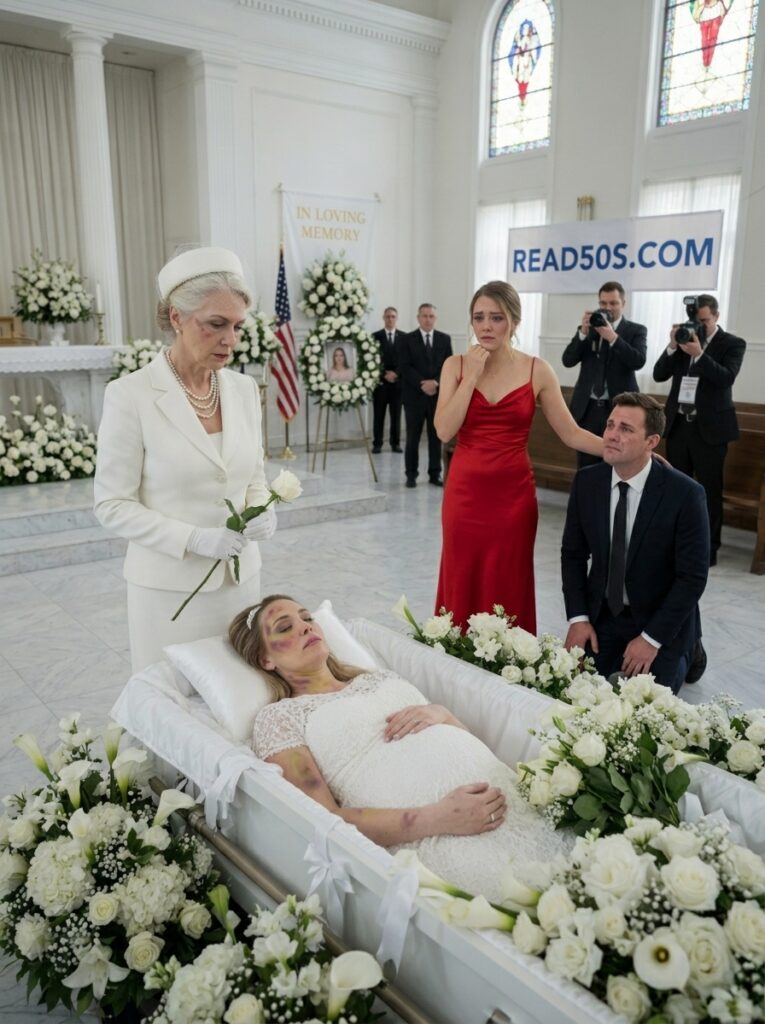
The black mahogany casket in the center of the sanctuary felt like a hole in the world.
It absorbed the candlelight, the whispers, the trembling prayers, and every ounce of warmth Margaret had left inside her body.
Her daughter, Emma, lay inside it, still as porcelain beneath the soft church lights. Her hands rested gently over her belly, the same place she used to press her palms whenever her baby moved.
Margaret could not stop staring at those hands.
Only weeks earlier, Emma had stood in her kitchen, laughing through tears as she guided Margaret’s hand to her stomach.
“There,” Emma had whispered. “He kicked. Did you feel him?”
Margaret had felt it.
A small, impossible flutter.
Life answering life.
Now both were gone.
Emma was twenty-nine weeks pregnant when she passed. Margaret had stopped counting after that because numbers had become cruel things. They belonged to appointment cards, ultrasound dates, nursery plans, and the tiny knitted cap Emma had chosen but would never use.
The church had been prepared for mourning, but it felt too polished for the kind of grief Margaret carried. Every pew shone with old varnish. Every candle burned steadily. White lilies filled the air with their heavy scent.
Emma had hated lilies.
She used to wrinkle her nose and say they smelled like hospitals pretending not to be hospitals.
Margaret remembered that at the worst possible moment, standing beside the casket of her daughter and grandson.
Then a sound cut through the silence.
Not a sob.
A laugh.
Rich, low, careless.
Margaret turned slowly.
Evan Vale, her son-in-law, stood at the back of the sanctuary as if he had arrived at a social event. His suit was tailored. His shoes shone. His expression carried just enough sadness to look acceptable from a distance.
But his left hand rested on the waist of Celeste Marrow.
The woman who had quietly walked through Emma’s marriage like a shadow.
Celeste wore a fitted black dress and high heels that clicked against the church floor with each step, sharp and confident, as though the aisle belonged to her.
Margaret felt something rise in her chest.
Not a scream.
Not yet.
Something colder.
Evan approached the casket with the smooth confidence of a man who expected everyone to move around him.
“Margaret,” he said, his voice soft and polished. “Terrible day.”
Terrible day.
As if rain had spoiled a picnic.
As if Margaret’s only child was not lying a few feet away, silent forever.
Celeste leaned close, the scent of jasmine cutting through the lilies.
“Looks like I win,” she whispered.
Her red lips curved slightly.
Margaret’s whole body went still.
For one sharp second, she imagined turning, shouting, demanding the entire church hear what kind of woman would say such a thing beside a young mother’s casket.
But then Margaret looked back at Emma.
Still.
Pale.
Gone.
Evan wanted her to break.
She saw it then.
He wanted the grieving mother to lose control in front of the congregation. He wanted witnesses. He wanted the cameras outside the church to capture her pain and turn it into proof that she was unstable, bitter, confused.
He wanted to stand there as the calm widower.
The wounded husband.
The innocent man surrounded by difficult women.
Margaret swallowed the scream and turned it into ice.
Evan thought her gray hair meant weakness.
He thought grief had made her foolish.
He was wrong.
Before Emma married Evan, she had been soft in the best way. Not weak — never weak — but gentle with people. She remembered birthdays. She cried at old movies. She apologized to waiters when they brought the wrong order, as if the mistake had somehow been hers.
After her father died, Emma became quieter. Lonelier. She was still young, but grief had put shadows under her eyes.
That was when Evan arrived.
Polished shoes. Expensive watches. Flowers delivered to her office. Dinner reservations at places Emma would never have chosen for herself.
He called Margaret “Mom” too quickly.
Margaret had not trusted that.
Real love did not need to announce itself so loudly.
But Emma wanted to be loved. She wanted a home, a family, a future that felt safe after losing her father. Evan offered all of that with perfect timing.
By the time Margaret noticed how often Emma apologized for things she had not done, the marriage had already become a house with closed doors.
Evan corrected Emma gently in public.
He embarrassed her quietly.
He made control look like concern.
“Emma’s tired,” he would say when she tried to speak.
“Emma gets emotional,” he would add with a little smile.
“Emma worries too much.”
At first, Margaret argued with herself. Maybe she was being overprotective. Maybe grief had made her suspicious. Maybe no man would ever seem good enough for her daughter.
Then Celeste appeared.
At first, Celeste was Evan’s associate.
Then his friend.
Then the woman whose name Emma stopped saying whenever Margaret entered the room.
Emma never used the word mistress. She could not bring herself to make the humiliation that real.
Instead, one evening, with swollen eyes and trembling hands, she said, “She knows exactly where to stand.”
Margaret understood.
Celeste stood too close in photographs. She laughed too loudly at Evan’s jokes. She touched his sleeve in front of Emma with the calm confidence of someone testing how much pain a wife would swallow before making a scene.
Emma did not make scenes.
That was one of the ways Evan trapped her.
If she cried, he called her dramatic.
If she confronted him, he called her jealous.
If she stayed quiet, he called that proof nothing was wrong.
When Emma became pregnant, Margaret hoped things might change. She hoped Evan would soften. She hoped the child would remind him what mattered.
Instead, he became colder.
The baby, he said, was a Vale heir.
Not Emma’s son.
A Vale heir.
He began discussing names without asking her. He hired decorators for the nursery Emma had dreamed of painting herself. He dismissed her doctor’s concerns. He told everyone Emma was fragile, emotional, overwhelmed by pregnancy.
Margaret heard the word fragile again and again until it began to sound like a warning.
Three weeks before Emma died, she came to Margaret’s house without calling first.
Her face was pale. Her coat was buttoned wrong. She carried a folder under one arm and kept looking over her shoulder before stepping inside.
“Mom,” she whispered, “if something happens to me, don’t let him raise my son.”
Margaret’s heart nearly stopped.
“What happened?”
Emma shook her head, tears gathering but not falling.
“I need you to listen. I need you to promise.”
Margaret took her hands. “Emma, tell me.”
But Emma looked toward the window.
“He always finds out when I talk too much.”
Margaret wanted to call the police that night. She wanted to pack Emma’s things and drive until sunrise. But Emma was afraid, and fear does not move in straight lines. It circles. It hesitates. It asks what if he gets worse? What if no one believes me? What if I lose everything?
So Margaret promised the only thing Emma would let her promise.
“I will protect your child,” she said.
Emma pressed the folder into her hands.
“Mr. Halden has the rest,” she whispered. “If anything happens before the baby comes, he knows what to do.”
Margaret wanted answers, but Emma only hugged her hard, as though she was memorizing the shape of her mother’s body.
Two days later, Emma stopped answering calls.
One week later, Margaret found out she had been taken to the hospital.
By the time Margaret arrived, her daughter was already gone.
Evan told everyone it was a sudden medical tragedy.
He stood in the hospital hallway with his perfect grief and said doctors had done everything they could.
Celeste was not there that day.
But Margaret saw a pale mark on Evan’s collar that looked like lipstick poorly wiped away.
She said nothing.
Not because she believed him.
Because Emma had told her Mr. Halden knew what to do.
Now, in the church, as Evan and Celeste stood near the casket like victors, the side door opened.
Emma’s attorney, Mr. Halden, stepped into the sanctuary.
He was a tall, narrow man in a dark suit, with silver hair and a face that looked as though it had forgotten how to smile. In his hands was a thick ivory envelope sealed with red wax.
The room shifted.
Whispers moved through the pews.
Evan frowned.
Mr. Halden walked to the front of the church and faced the congregation.
“According to the precise legal instructions of the deceased,” he said, his voice clear and sharp, “before the burial may continue, the last will and testament of Emma Vale must be read here, before those assembled.”
Evan laughed under his breath.
“This is absurd,” he said. “Emma didn’t have anything that wasn’t marital property.”
Mr. Halden did not look at him.
He broke the seal.
Margaret watched Evan’s mouth bend into a smirk.
Then Mr. Halden read the first name.
“To my mother, Margaret Whitmore…”
Evan’s smirk weakened.
Mr. Halden continued.
“…I leave full control of all personal assets held in my separate trust, including the Whitmore inheritance established by my late father before my marriage.”
The sanctuary went silent.
Evan’s face changed.
Margaret’s breath caught.
Emma had never told her the full amount. After her father died, Margaret knew he had left Emma something, but Emma had always lived modestly. Evan had often joked that Emma had “sentimental little accounts,” nothing worth serious attention.
Mr. Halden turned the page.
“The trust has never been combined with marital property. It remains separate, protected, and legally beyond the control of my husband, Evan Vale.”
A sound moved through the church.
Celeste’s fingers tightened around Evan’s arm.
Mr. Halden read on.
“In the event of my passing before the birth of my child, no portion of my estate, trust, investments, insurance holdings, property rights, or personal effects shall pass to my husband.”
Evan stepped forward.
“You can’t read this here.”
Mr. Halden lifted his eyes.
“I can. She required it.”
Evan’s jaw clenched. “She was not in her right mind.”
Mr. Halden’s voice remained calm.
“Her capacity was evaluated and documented twice.”
Margaret stared at the casket.
Emma, my brave girl.
You were afraid.
But you were not powerless.
Mr. Halden continued.
“I further state that if my death occurs under circumstances requiring review, my attorney is instructed to release all personal recordings, written statements, medical concerns, financial records, and private correspondence to the proper authorities.”
Evan went very still.
Celeste let go of his arm.
That small movement told Margaret everything.
Mr. Halden reached into the envelope and removed a smaller sealed packet.
“There is also a letter,” he said. “It is addressed to Margaret Whitmore, but Emma requested that portions be read aloud today.”
Evan’s face lost color.
“No,” he said.
Mr. Halden opened the letter.
Margaret gripped the edge of the pew.
Then her daughter’s words filled the church.
“Mom, if this is being read, then I am not here to say the truth myself. I need you to know I tried. I tried to leave quietly. I tried to protect my baby. I tried to collect enough proof so no one could call me jealous, emotional, or confused.”
A broken sound escaped someone in the back pew.
Margaret pressed a hand to her mouth.
Mr. Halden continued.
“Evan made me feel small for so long that I nearly believed him. Celeste helped him do it. She wanted my place, my home, and the life she thought came with my name. But what neither of them understood is that my father protected me before he died. He left me a trust Evan could never touch.”
Evan whispered something under his breath.
Mr. Halden’s voice sharpened.
“I have included copies of messages, recordings, and records documenting the pressure, humiliation, threats, and manipulation I endured during my marriage. I have also included evidence of Evan’s financial attempts to access my trust and Celeste’s involvement in those attempts.”
Celeste backed away one step.
Evan turned on her. “Don’t move.”
The entire church heard him.
The mask slipped.
For one second, everyone saw the man Emma had lived with.
Mr. Halden folded the letter but did not put it away.
“And finally,” he said, “Emma left one instruction regarding today.”
He looked directly at Evan.
“She requested that if Evan Vale arrived with Celeste Marrow, both names be added to the formal complaint packet already prepared for law enforcement.”
Evan’s mouth opened.
Nothing came out.
The church doors opened again.
Two officers stepped inside.
This time, the whispers became gasps.
Evan turned toward Margaret, rage flashing beneath the surface of his face.
“You did this.”
Margaret stood slowly.
Her knees trembled, but her voice did not.
“No,” she said. “Emma did.”
For the first time since entering the church, Evan looked afraid.
Not sad.
Not wronged.
Afraid.
The officers approached him quietly. Mr. Halden handed them the packet. Celeste tried to speak, but her voice shook too badly to form the polished cruelty she had carried in with her.
Margaret watched as the two people who had walked into her daughter’s funeral smiling were led out under the eyes of everyone they had hoped to impress.
No one clapped.
No one cheered.
It was not that kind of victory.
A mother still stood beside her daughter’s casket.
A grandson would never open his eyes.
Nothing could undo that.
But the lie did not get to win.
When the church doors closed behind Evan and Celeste, the sanctuary seemed to breathe again.
Mr. Halden walked to Margaret and handed her the rest of Emma’s letter.
“She wanted you to read this privately,” he said.
Margaret’s hands shook as she unfolded the pages.
Mom,
I know you will blame yourself. Please don’t. I hid more than I should have because I was embarrassed. Because I thought love meant enduring. Because I kept hoping the man I married would become the man he pretended to be.
But you taught me strength. Even when I forgot how to use it, it was still inside me.
If my son survives me, raise him with kindness. If he does not, then remember that he was loved every second he existed. Tell Dad I tried. Tell yourself I knew you loved me.
And Mom, please live.
Do not let my story end with what they did to me.
Let it end with what the truth did to them.
Margaret folded the letter against her chest and closed her eyes.
For the first time that day, she cried.
Not the kind of tears Evan had wanted.
Not wild. Not broken.
Honest.
The burial happened after that.
No cameras were allowed near the graveside. No speeches were made for show. Only the people who had truly loved Emma stood beneath the pale May sky as Margaret placed one hand on the casket and whispered goodbye to her daughter and grandson.
In the weeks that followed, the investigation widened.
Emma’s documents exposed more than cruel messages and betrayal. They showed Evan’s attempts to pressure her into signing over control of her trust. They showed Celeste’s messages mocking Emma’s pregnancy while discussing what would happen “after.” They showed meetings, transfers, plans, and a pattern of emotional pressure that could no longer be dismissed as marital conflict.
Evan’s public image collapsed first.
Then his business partnerships.
Then the carefully built version of himself he had worn like a suit.
Celeste tried to claim she had only been a bystander, but Emma’s evidence told a different story. She had not merely stood too close. She had helped push, pressure, and plan.
Margaret attended every hearing she could.
She did not go because she wanted revenge.
She went because Emma no longer could.
Months later, the court confirmed what Emma had written in her will: her trust belonged fully under Margaret’s control, with instructions to fund a foundation in Emma’s name.
Margaret used the money exactly as her daughter had asked.
The Emma Whitmore Foundation began quietly, with one office, one phone line, and a mission to help women trapped in controlled marriages find legal help, safe housing, financial advice, and someone who would believe them before it was too late.
On the wall of the foundation’s waiting room, Margaret hung no portrait of Emma. She did not want women to walk in and see a memorial first.
Instead, she hung a simple framed sentence from Emma’s letter.
Let the truth finish what fear could not.
One year after the funeral, Margaret returned to the church.
There were no lilies this time.
She brought pale blue hydrangeas, Emma’s favorite, and placed them near the small memorial plaque the church had installed in the garden.
Emma Whitmore Vale and Baby Noah.
Beloved daughter. Beloved mother. Beloved child.
Margaret stood there for a long time, feeling the wind move gently through the trees.
She still missed Emma every morning.
She missed her voice, her laugh, her way of saying “Mom” when she needed comfort but did not want to admit it.
Grief had not become smaller.
But Margaret had grown stronger around it.
She looked at the names on the plaque and touched the folded copy of Emma’s letter in her coat pocket.
“You were right,” she whispered. “Your story did not end with them.”
Then she turned and walked toward the foundation office waiting down the street, where another frightened woman had an appointment at two o’clock.
Margaret would be there early.
She would listen.
She would believe her.
And because Emma had been brave enough to leave the truth behind, someone else might still have time to walk out alive, free, and heard.
━━━━━━━━━━━━━━━━━━━━━━━━━━━━━━━━━━━━━━