The July heat in West Texas did not simply sit in the air.
It pressed down.
It covered everything like a heavy, invisible blanket, thick with the smell of hot asphalt, exhaust fumes, dry dirt, and motor oil. By noon, the sun turned the roads silver, made the metal handles on truck doors burn to the touch, and sent waves of heat trembling above the parking lot.
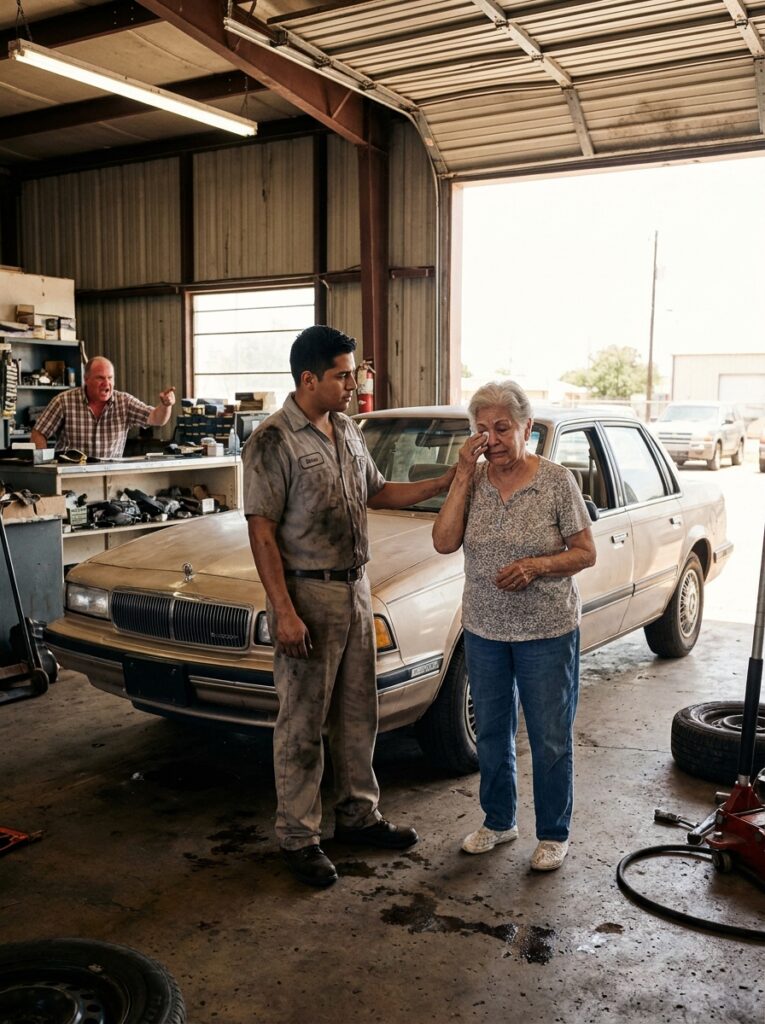
Inside Miller’s Auto Repair, it was even worse.
The corrugated metal roof trapped the sun until the garage felt like an oven. Fans spun lazily from the corners, moving hot air from one side of the shop to the other without cooling anything. The concrete floor was stained with years of oil, brake fluid, and sweat.
Luis Rivera stood under the open hood of a Ford pickup, both hands buried near the engine block.
He was twenty-four years old, but exhaustion had already begun to leave its quiet marks on him. His face was young, yet his eyes carried the tired weight of someone who had learned too early that life did not get easier just because you worked hard.
His hands were rough and scarred.
Burn marks across his knuckles.
Calluses on his palms.
Small cuts that never fully had time to heal before another sharp edge opened them again.
He wiped sweat from his forehead with a rag already blackened by oil.
“Rivera!”
The shout came from the air-conditioned glass office overlooking the service bays.
Luis did not need to look up to know who it was.
Frank Miller.
Owner of Miller’s Auto Repair.
Frank was a large man with a red face, a heavy gold watch, and a voice that always sounded like an accusation. He believed everything had a price. Time had a price. Labor had a price. Kindness had a price if he could find a way to put it on an invoice.
“Hurry it up on that Ford!” Frank barked. “Customer’s been waiting twenty minutes!”
Luis tightened the last bolt and called back, “Almost done, Mr. Miller.”
He kept his voice respectful.
Not because Frank deserved it.
Because Luis needed the job.
Three miles away, in a small apartment with thin walls and a window unit that rattled more than it cooled, his mother Elena was waiting.
Two years earlier, Elena Rivera had been the kind of woman who filled a room with sound. She cooked with salsa music playing from an old radio, danced while stirring rice, and sang off-key just to make Luis laugh.
Then came the diagnosis.
A complicated illness with a long name and an even longer list of medications.
There were heart pills.
Insulin.
Special food.
Appointments they could not miss.
Bills that arrived in envelopes with urgent red letters stamped across the front.
Every paycheck Luis earned disappeared almost before he touched it.
Rent.
Electricity.
Medicine.
Groceries.
Gas.
There was never enough.
But every morning, Luis got up before sunrise, kissed his mother’s forehead, and went to work because she was all he had.
Around eleven o’clock, a shadow crossed the open bay door.
A car sputtered into the lot.
It was a 1992 Buick Century, faded beige, long and heavy like something from another time. The paint was peeling along the hood. One hubcap was missing. The engine rattled loudly, coughing and shaking as if every mile had become an argument.
The car rolled forward another few feet, then died with a tired wheeze right at the entrance.
The driver’s door creaked open.
An elderly woman stepped out.
She was tiny, perhaps in her eighties, wearing a faded floral dress and sensible shoes that had clearly been repaired more than once. Her white hair was pinned neatly back, though several wisps had escaped and stuck to her damp forehead. She clutched a worn leather handbag in both hands.
She looked lost.
And embarrassed.
Luis set down his wrench immediately and walked over.
“Good morning, ma’am,” he said, softening his voice. “Having some trouble?”
The woman looked up at him.
Her eyes surprised him.
Clear blue.
Sharp.
Alive.
“Oh, hello, young man,” she said. Her voice trembled slightly. “I think my Betsy has finally given up on me. She started shaking a few miles back, and now she won’t say a word.”
“Betsy?” Luis asked with a small smile.
“The car,” she said, patting the hot hood gently. “She’s been with me since my husband passed. She’s the only way I get to the grocery store.”
Luis nodded.
He understood that.
Some people kept old things because they could not afford new ones.
Others kept them because they were the last piece of a life that once felt whole.
“Let’s see what Betsy has to say,” Luis said.
He popped the hood and leaned over the engine.
Heat rose from the block in waves. He checked the belts, battery terminals, hoses, wires, and plugs. It did not take long to find the problem.
A vacuum hose had slipped loose.
An alternator wire was corroded and barely holding.
It looked worse than it was.
A dishonest mechanic could have turned it into a full diagnosis, a new alternator, a labor charge, maybe even a tow fee.
Frank would have.
Luis knew exactly what Frank would say.
Minimum diagnostic fee.
Parts markup.
Labor.
Shop supplies.
Taxes.
But Luis also saw the woman standing beside the car, twisting the handle of her handbag between fragile fingers.
“Is it bad?” she asked quietly. “I should tell you, son, I’m on a fixed income. My pension check doesn’t come until next Tuesday.”
Luis looked at her dress.
At the frayed collar.
At the handbag worn smooth from years of use.
At the shoes polished carefully but cracked near the sole.
And he saw his mother.
He imagined Elena stranded on the side of a road somewhere, frightened, hot, and ashamed, hoping someone would choose mercy over profit.
He glanced toward Frank’s office.
Frank was on the phone, feet up on his desk, laughing.
Luis turned back to the woman.
“It’s catastrophic,” he said seriously.
Her face fell.
“Oh, dear.”
Luis smiled.
“Catastrophically simple. Loose hose and a bad wire connection. I’ve got scrap wire in my toolbox and a clamp that’ll work. Won’t cost a dime.”
The relief that washed over her face almost broke him.
“Are you sure?” she whispered. “I don’t want to be a burden.”
“You’re not a burden, ma’am,” Luis said. “Sit in the shade over there. I’ll have Betsy running in twenty minutes.”
The woman lowered herself onto the bench near the office, clutching her handbag in her lap.
Luis worked quickly.
He stripped the corroded wire, replaced the clamp, reconnected the hose, and checked the battery. Then, because he could not help himself, he topped off her wiper fluid, checked the oil, and filled her tires with air.
When he turned the key, the Buick coughed once, then roared back to life.
It did not sound new.
But it sounded steady.
Luis shut the hood and grinned.
“There she is,” he said. “Betsy’s ready to dance.”
The woman rose slowly and walked toward him.
She opened her handbag and peered inside.
Luis could see there was almost nothing in it.
A tissue.
A coin purse.
A folded photograph.
Her cheeks flushed.
“I must have left my wallet on the kitchen counter,” she said.
It was a lie.
A kind, embarrassed lie.
Luis knew it.
She knew he knew it.
He shook his head gently.
“Ma’am, please. I told you. Scrap wire. No inventory. No charge.”
Her eyes filled.
“Young man…”
“Drive safe,” Luis said. “That’s all.”
The woman reached for his grease-stained hand and squeezed it with fingers as light as paper.
“What is your name?”
“Luis Rivera.”
“Luis,” she repeated, as if committing it to memory. “You have a kind heart. That is rare these days.”
Luis looked down at his boots, suddenly uncomfortable.
“My mother raised me right.”
“Does she know what a good son she has?”
His throat tightened.
“She’s sick,” he said. “I just try to do right by her.”
The old woman’s face softened.
“Then she is blessed.”
For a moment, in the middle of that suffocating garage, the world felt gentle.
Then Frank Miller’s voice shattered it.
“Rivera!”
Luis turned.
Frank stormed out of his office, face flushed red, gold watch flashing on his wrist. He waved a blank invoice in one hand like evidence in court.
“What do you think you’re doing?” Frank barked.
Luis stepped slightly in front of the elderly woman.
“Just a quick fix, Mr. Miller.”
Frank slapped the blank invoice against his palm.
“I saw the ticket. Nothing on it. No labor. No diagnostic. No parts. You letting people walk out of here free now?”
“It was a loose wire and a hose,” Luis said calmly. “Took ten minutes. I used scrap.”
“Time is money!” Frank shouted. “My shop rate is ninety dollars an hour. Minimum diagnostic is fifty. You just gave away a hundred and forty dollars of my money.”
Luis lowered his voice.
“She didn’t have it.”
Frank looked past him at the woman with open disgust.
“That isn’t my problem.”
“I’ll work an extra hour tonight,” Luis said. “No pay. Make it even.”
“No,” Frank snapped. “That is not how this works.”
The elderly woman stepped forward, trembling.
“Sir, please. Do not punish him. I will find the money and bring it back to you.”
Frank turned on her.
“Lady, get that piece of junk off my lot before I call the police for theft of services.”
The woman flinched.
Luis’s jaw tightened.
“Frank,” he said quietly, “don’t talk to her like that.”
Frank’s eyes narrowed.
“What did you say?”
“I said don’t talk to her like that.”
The garage fell silent.
The other mechanics stopped working. Even the fan seemed to slow.
Frank stepped closer and jabbed a thick finger into Luis’s chest.
“You’re soft, Rivera. That’s your problem. You think a business runs on feelings? You think bills get paid with sympathy?”
Luis said nothing.
Frank leaned in.
“That’s why I own the shop, and you turn wrenches.”
He took one step back and raised his voice so everyone could hear.
“Actually, you don’t turn wrenches here anymore.”
Luis felt the words coming before Frank said them.
“You’re fired.”
The sound landed in Luis’s chest like a stone.
“What?”
“You heard me. Pack your tools. Get out. I don’t employ thieves who give away my services.”
The elderly woman covered her mouth.
“No,” she whispered. “Please. This was my fault.”
Luis looked at Frank.
For one moment, he thought about begging.
He thought about Elena’s medicine.
The rent due Friday.
The insulin running low.
The bank account that never had enough.
He thought about swallowing his pride, apologizing, asking Frank to reconsider.
Then he looked at the old woman.
She stood there humiliated, frightened, blaming herself for receiving one small act of kindness.
Something inside Luis went still.
He took off his shop cap and placed it on the workbench.
“You’re right, Frank,” he said quietly. “I don’t belong here.”
He packed his toolbox in silence.
Every wrench felt heavier than it had that morning.
The other mechanics watched without speaking. Some looked ashamed. Some looked afraid. No one said a word.
Luis walked the woman to her Buick.
Tears trembled in her eyes.
“I ruined everything,” she whispered.
“No, ma’am,” Luis said, opening her door. “You showed me exactly what kind of man I was working for.”
“But your job…”
“I’ll find another.”
He tried to say it like he believed it.
She looked at him for a long time.
Then she said softly, “Kindness is never wasted, Luis Rivera.”
He closed her door.
Betsy rolled out of the parking lot and onto the road, her old engine humming steadily under the Texas sun.
Luis watched until the Buick disappeared.
Then he lifted his toolbox and began the long walk home.
The sun beat down on his back.
Sweat ran into his eyes.
And the tears he refused to let fall dried before they reached his jaw.
That night was the hardest night of Luis Rivera’s life.
His mother sat at the small kitchen table, eating the soup he had made before dawn. The apartment smelled of cumin, chicken broth, and the faint chemical scent of medicine.
“You look tired, mijo,” Elena said.
Luis forced a smile.
“Long day, Mama.”
She studied him with the eyes only mothers have.
“Did something happen?”
“No,” he lied. “Just heat.”
She reached across the table and touched his hand.
“You work too hard.”
He almost laughed.
As if hard work had ever been optional.
Later, when Elena slept, Luis sat on the edge of his bed and opened his banking app.
$142.17.
That was everything.
Rent was due in four days.
His mother’s medication refill was due in five.
He applied for jobs on his phone until past midnight.
Mechanic openings.
Warehouse work.
Delivery driver.
Anything.
But he knew how the world moved.
Applications disappeared into systems.
Managers took weeks to call.
Bills did not wait.
He sat there in the dark, phone glowing in his hand, and for the first time in a long time, Luis wondered if Frank had been right.
Maybe the world did not reward good hearts.
Maybe kindness was a luxury for people who could afford consequences.
Maybe being decent was just another way poor people got punished.
Three days passed.
Luis sold his old guitar at a pawn shop for groceries.
It hurt more than he expected. The guitar had belonged to his father, who had died when Luis was thirteen. But Elena needed food more than Luis needed music.
On the third day, Luis walked back to Miller’s Auto Repair to collect his final paycheck.
He hated that he had to do it.
Frank would make him wait.
Frank would make him feel small.
But Luis had no choice.
By noon, he reached the shop lot.
Then he stopped.
Three black SUVs were parked in front of the bay doors.
They were polished, expensive vehicles with tinted windows and silent authority. Men in dark suits stood near them, scanning the property.
Luis froze.
For one wild moment, he wondered if Frank had been arrested.
IRS.
State inspectors.
Maybe someone had finally caught him overcharging customers.
Frank stood near the office door, sweating through his shirt, wearing the fake smile he used for wealthy clients.
“Gentlemen,” Frank was saying, hands spread wide, “we are the premier shop in the county. Fleet maintenance, commercial contracts, luxury vehicles—we handle everything.”
One of the men ignored him and opened the back door of the middle SUV.
A woman stepped out.
Luis’s breath caught.
It was her.
The elderly woman with the Buick.
But she was not wearing the faded floral dress now.
She wore a cream-colored suit with perfect tailoring, pearls at her throat, and sunglasses that one of the men carefully took from her hand. Her white hair was styled elegantly. In one hand, she held a cane with a silver handle—not like something she needed, but like something she commanded.
Frank stared.
He did not recognize her at first.
She looked too powerful.
Too polished.
Too impossible.
“Ma’am?” Frank said uncertainly. “Can I help you?”
The woman did not look at him.
Her sharp blue eyes searched the shop.
Then they found Luis.
Her face brightened.
“Luis!”
Frank turned so quickly his neck seemed to snap.
“Rivera?” he barked. “What are you doing here? I told you to get lost.”
The woman slammed her cane against the concrete.
The sound cracked through the garage like a judge’s gavel.
“Silence.”
Frank’s mouth closed.
The men in suits moved closer.
The woman walked to Luis.
“I hoped I would find you here,” she said. “I went to your apartment first, but your neighbor said you had walked this way.”
Luis stared at her.
“Ma’am… who are you?”
She smiled.
“My name is Eleanor Vance.”
Frank made a choking sound.
“Vance?” he said. “As in Vance Industries?”
Eleanor turned her head slightly.
“Yes, Mr. Miller. That Vance.”
Frank’s face drained of color.
Vance Industries owned oil fields, trucking companies, construction contracts, commercial real estate, and half the industrial property in the county. Everyone knew the name. Everyone wanted a contract with them.
Luis looked at the elegant woman in front of him, then toward the street where he had watched her old Buick drive away.
“But the car,” he said softly. “The dress. Betsy.”
Her smile became sadder.
“Betsy is real,” she said. “She belonged to my late husband. I drive her once a month.”
“Why?”
“To remember who I was before money changed how people spoke to me,” Eleanor said. “And to learn who people are when they think I have nothing to offer.”
She looked toward Frank.
“I visited five shops this month. Three tried to overcharge me. One refused to even look at the car. But you, Mr. Miller…”
Her voice hardened.
“You fired a man for helping an old woman who could not pay.”
Frank lifted both hands.
“Mrs. Vance, please. It was a misunderstanding. A personnel issue. I was teaching protocol. Rivera is a good kid, but he has to learn business. You understand business.”
“I understand business very well,” Eleanor said. “I also understand greed.”
Frank swallowed.
“He gave away shop services.”
“He used scrap wire and ten minutes of compassion.”
Frank’s mouth opened, but no words came out.
Eleanor signaled to one of the men. He stepped forward with a folder.
“Do you know who owns the land under this garage, Mr. Miller?”
Frank blinked.
“The leasing company.”
“Vance Commercial Real Estate Holdings,” she said. “Mine.”
Frank’s face went gray.
Eleanor took the folder and placed it on a nearby oil drum.
“Your lease is up for renewal next month. I am declining to renew it. You have thirty days to vacate.”
Frank staggered back.
“You can’t do that,” he whispered. “This is my business. My livelihood.”
Eleanor’s expression did not soften.
“When Luis asked you to show mercy, you told him time was money. When he offered to work extra to cover your imaginary loss, you still chose cruelty. You wanted to teach him a lesson.”
She stepped closer.
“Now I am teaching one to you.”
Frank looked around, as if expecting someone to help him.
No one moved.
The mechanics watched in stunned silence.
Some looked at Luis with something like respect.
Others looked at Frank and seemed to realize, perhaps for the first time, that men like him only seemed powerful until someone more powerful held them accountable.
Eleanor turned back to Luis.
“Now,” she said, her voice warming, “I have a problem.”
Luis wiped his palms on his jeans.
“Yes, ma’am?”
“I have a fully equipped garage with no future tenant,” she said. “I also have two hundred company vehicles in this district that need honest maintenance. Trucks, vans, service cars, heavy equipment.”
Luis blinked.
“I don’t understand.”
Eleanor reached into the same old leather handbag he had seen three days earlier.
This time, she pulled out a set of keys.
“I need someone I can trust to run this place.”
Luis stared at the keys in her palm.
His throat closed.
“Mrs. Vance…”
“I want to rename it Rivera Automotive,” she said. “Unless you prefer something else.”
Frank made a strangled noise behind them.
Luis shook his head quickly.
“I don’t have money to buy a shop. I don’t even have rent money right now.”
“The rent,” Eleanor said, “will be one dollar a year for the first five years. After that, we renegotiate fairly. You will receive the Vance fleet contract, paid monthly. You will hire who you choose. You will set the rules.”
Luis looked down at the keys.
They blurred.
Tears filled his eyes before he could stop them.
“I don’t know what to say.”
“Say yes,” Eleanor said softly. “And promise me one thing.”
“Anything.”
“Never become him.”
She did not need to point at Frank.
Luis closed his fingers around the keys.
“Yes,” he whispered. “I promise.”
Eleanor smiled.
“And one more thing.”
Luis looked up.
“My personal physician is Dr. Aris. He is the best specialist in the state for your mother’s condition. She has an appointment tomorrow morning. All expenses covered.”
Luis’s knees weakened.
The garage disappeared.
The men in suits.
Frank’s pale face.
The heat.
The humiliation.
All of it vanished.
All Luis could see was his mother dancing again in the kitchen. His mother breathing easier. His mother having a chance.
He dropped to his knees before he could stop himself.
Eleanor stepped forward, startled, but Luis only bowed his head and cried.
“Thank you,” he choked out. “Thank you. Thank you.”
Eleanor rested one hand gently on his hair.
“No, Luis,” she whispered. “Thank you.”
He looked up through tears.
“You fixed more than my car that day,” she said. “You reminded me that good people still exist when nobody is watching.”
Within thirty days, Frank Miller was gone.
Some said he tried to open another shop two counties over. Others said he ended up washing cars in Oklahoma. Luis did not care enough to confirm either story.
He had work to do.
The sign came down on a Monday morning.
MILLER’S AUTO REPAIR disappeared from the front of the building.
Two days later, a new sign went up.
ELENA’S GARAGE.
Luis named it after his mother because everything he did had begun with her.
On opening day, Elena sat in the front office in a blue dress, her hair pinned back, a plate of homemade cookies beside the register. Her hands still shook from illness, but her eyes were bright.
Every customer who came in was greeted like family.
Luis hired two mechanics who had been rejected elsewhere—one older man with a bad knee and too much experience to be treated like a burden, and one young woman who had been told too many times that cars were not for girls.
He paid them fairly.
He taught them what he knew.
And above the office door, he hung a small handwritten sign:
A CAR CAN BE FIXED WITH TOOLS.
A BUSINESS CAN ONLY BE BUILT WITH TRUST.
Elena received the treatment she needed.
Not a miracle cure.
Life was rarely that simple.
But she got better care. Better medication. Better food. More time. Less fear.
She lived ten more years.
Ten beautiful years.
She watched her son become a respected business owner. She watched him buy a small house with a porch. She watched him train young mechanics who came from families like theirs. She watched him turn a place of greed into a place of dignity.
And every Tuesday afternoon, a perfectly restored 1992 Buick Century rolled into Elena’s Garage.
Betsy.
No longer peeling and tired, but polished to a deep shine, engine tuned, seats restored, chrome gleaming under the Texas sun.
Eleanor Vance would step out with her silver-handled cane and old leather handbag.
Luis would stop whatever he was doing, wipe his hands, and meet her at the door.
They drank coffee in the office while Elena served cookies.
Eleanor always offered to pay.
Luis always refused.
Some debts, he told her, were too sacred to turn into invoices.
Years later, after Elena passed peacefully in her sleep, Luis found a note in her recipe box.
It was written in her careful hand.
Mijo, kindness did not make you weak. It made you strong enough for God to trust you with more.
Luis framed the note and hung it beside the sign over the office door.
On the anniversary of the day he was fired, Luis closed the shop early.
He stood alone in the center of the garage, listening to the quiet.
The same concrete floor.
The same metal roof.
The same Texas heat pressing against the walls.
But everything else had changed.
The place no longer smelled only of oil and exhaust.
It smelled of coffee, cookies, honest work, and second chances.
Luis looked at the keys in his hand—the same keys Eleanor had pressed into his palm years earlier.
Then he smiled.
Frank had fired him because he believed kindness had no place in business.
But Frank had been wrong.
Kindness had built this place.
Kindness had saved his mother.
Kindness had turned a broken Buick into a new life.
And whenever someone came into Elena’s Garage worried, ashamed, or short on money, Luis remembered the old woman in the floral dress and the lesson she brought with her.
You never really know who is standing in front of you.
So treat them like they matter.
Because they do.
The End.