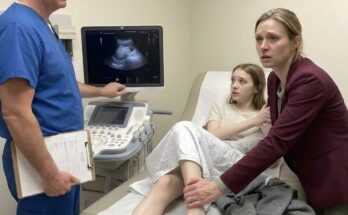
I used to believe love proved itself during the hardest moments.
I believed that when fear came, love would answer.
When pain came, love would stay.
When the world narrowed down to one desperate breath at a time, love would be the hand reaching for mine.
That belief almost cost me my life.
My name is Rachel Monroe, and the night my daughter was born was the night I finally understood the difference between attachment and devotion.
Attachment keeps you hoping.
Devotion shows up.
The first contraction came at 9:42 p.m.
I remember the exact time because I was standing in the laundry room, folding a tiny white onesie with yellow ducks on the front, when a deep ache tightened across my lower back and wrapped itself around my stomach like a fist.
I froze with the onesie still in my hands.
For a moment, I told myself it was nothing.
I was thirty-eight weeks pregnant. Everyone had warned me about false alarms. Braxton Hicks. Back pain. Pressure. Discomfort. All the normal things that made late pregnancy feel like living inside someone else’s body.
So I breathed through it.
Slowly.
Carefully.
When it passed, I finished folding the onesie and placed it on top of the little stack of baby clothes beside the dryer.
Then another pain came.
This one was sharper.
Lower.
More certain.
I gripped the edge of the dryer and closed my eyes.
By 10:10 p.m., the pain had a pattern.
Every few minutes, it rose inside me, stole my breath, and left me bent over with my palms pressed against my thighs. I tried counting the seconds, but my mind kept slipping. The house was too quiet. The nursery door was open down the hall, and the soft yellow night-light glowed against the wall where Andrew had hung the shelves crooked and promised to fix them later.
He never had.
That should have told me something.
I sat on the edge of our bed and reached for my phone with trembling fingers.
My husband, Andrew Monroe, answered on the fourth ring.
“What’s up?” he asked.
Not worried.
Not warm.
Distracted.
Like I had interrupted a television show.
“Andy,” I said, breathing through another tightening wave, “I think I’m in labor.”
There was a pause.
Then he sighed.
“Already?”
Already.
As if I had scheduled it at an inconvenient time.
“Yes,” I said, closing my eyes. “I’m serious. I need you to come home.”
“Rachel,” he replied, using that slow, tired tone he always used when he thought I was exaggerating, “you’re probably just uncomfortable. It’s your first time. Try lying down.”
“I can’t lie down,” I whispered. “It hurts too much.”
“First labors take forever,” he said. “You know that.”
Another contraction started to build, and I pressed my hand against the mattress.
“Where are you?” I asked.
“With my parents,” he said casually. “We’re leaving early for the trip.”
For a few seconds, I could not understand what he had just said.
The trip.
His parents’ weekend trip to the lake house.
A trip I had begged him to cancel because I was due any day.
A trip he promised he would not take unless I felt completely fine.
“You’re leaving?” I asked slowly.
“We haven’t left yet,” he said. “But we’re packing the car.”
“Andrew,” I said, my voice breaking, “I can’t do this alone.”
He laughed.
It was short.
Small.
Dismissive.
That laugh would stay with me longer than the pain.
“You can get to the hospital yourself,” he said. “The hospital is twenty minutes away. Just drive carefully.”
I stared at the dark bedroom wall.
For a moment, I felt like I had slipped outside my own body and was watching myself from somewhere far away.
A woman in labor.
A husband on the phone.
A plea hanging between them.
And his answer was: drive carefully.
“I’m scared,” I admitted.
I hated how small I sounded.
I hated that I was begging my own husband to care.
“You’re being dramatic,” Andrew said. “Call me when you’re checked in.”
Then the line went dead.
I sat there with the phone still pressed to my ear.
The house felt enormous around me.
The nursery light glowed down the hall.
The tiny clothes waited in perfect stacks.
And I realized I was completely alone.
The next contraction tore through me hard enough that I cried out. Not a soft little sound. Not a controlled breath like the birthing class videos showed.
A real cry.
A frightened cry.
The kind that comes when your body knows something your mind is still trying to deny.
I do not remember deciding to leave.
I remember grabbing my hospital bag from beside the bedroom door.
I remember walking slowly down the hallway, one hand pressed to my belly, the other against the wall.
I remember fumbling with the front door lock.
Then I was in the driver’s seat, shaking so badly I could barely slide the key into the ignition.
“Just get there,” I whispered to myself. “Just get to the hospital.”
I made it three blocks.
Then pain exploded across my body with such force that my foot slammed on the brake. A car behind me honked once, then swerved around. I could not even lift my hand to apologize.
The road blurred.
The streetlights stretched into long golden lines.
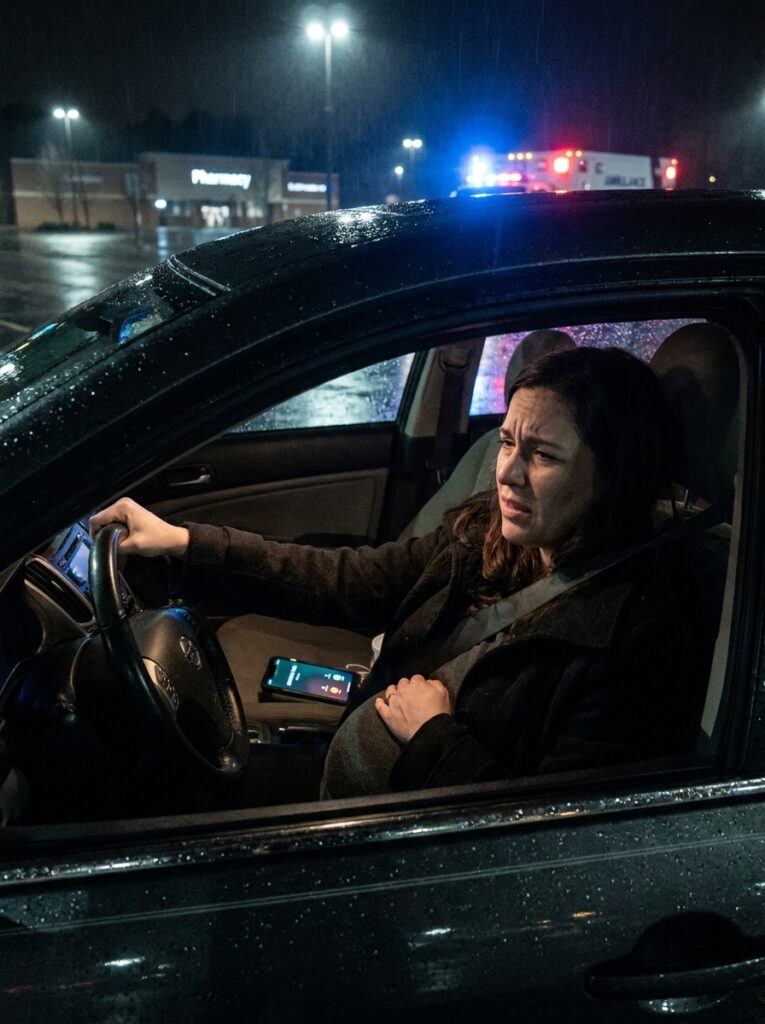
I managed to turn into the parking lot of a closed pharmacy on the corner of Westfield and Pine.
The lot was dark except for one flickering light near the entrance.
The pharmacy windows were black.
The street was empty.
Too empty.
I put the car in park and leaned forward until my forehead rested against the steering wheel.
I tried to breathe the way they taught us.
In through the nose.
Out through the mouth.
Slow.
Controlled.
But my body did not care about instructions.
My body had already taken over.
I called my sister first.
No answer.
I called my closest friend.
Voicemail.
I called Andrew again.
Straight to ringing.
No answer.
That was when fear truly entered the car.
Not the nervous kind of fear.
Not the fear of pain.
A deeper fear.
The kind that whispers: something could happen here, and no one would know until it was too late.
I called the hospital labor line.
A nurse answered, calm and professional.
“I’m in labor,” I gasped. “I’m alone. I’m in my car. I can’t drive.”
Her tone changed immediately.
“Are you safe right now?”
I looked around the empty parking lot.
At the locked pharmacy.
At the darkness.
At my shaking hands.
“I think so,” I lied.
“Where are you?”
“At the pharmacy on Westfield and Pine,” I said. “I just need a minute. I thought I could drive, but I can’t.”
“How far apart are the contractions?”
“I don’t know,” I cried. “They’re close. They’re really close.”
“Rachel,” she said firmly, “I want you to call emergency services. Right now. Do not try to drive.”
I nodded even though she could not see me.
“I will,” I said.
But I did not call right away.
I was still waiting for Andrew.
That is the part I am ashamed to admit.
Even after he dismissed me.
Even after he left me.
Even after he laughed while I begged him to come back.
Some broken part of me still believed he would realize what he had done.
I kept thinking he would call and say, “I’m coming.”
I kept thinking love would finally show up.
The clock on the dashboard crawled past midnight.
The pain got worse.
My body shook so hard my teeth chattered. Sweat ran down my neck. My back felt like it was being split open from the inside.
And still, my phone stayed silent.
Until 1:06 a.m.
Then it rang.
Andrew.
His name lit up the screen.
For a moment, everything inside me stopped.
I stared at it.
I could imagine his voice before I even answered. Frantic now. Worried now. Maybe his mother had convinced him it looked bad. Maybe he had finally checked his phone. Maybe guilt had caught up with him somewhere on the highway.
The phone kept ringing.
My hand hovered above it.
But I did not answer.
Because in that moment, something inside me became clear.
If I picked up, he would make himself the center of the emergency.
He would ask where I was as if my silence was the problem.
He would say he was turning around as if that erased the moment he chose to leave.
He would speak, and I would listen, because I had always listened.
I had spent years accepting late apologies as if they were the same as care.
I had spent years believing excuses because the truth hurt too much.
Not that night.
Not while my child and I were fighting through something he had chosen not to witness.
The phone rang until it stopped.
Then it rang again.
And again.
A text appeared.
ANDREW: Where are you? Answer me. I’m turning around.
I laughed once.
It came out broken and bitter.
Turning around.
As if love could make a U-turn hours after abandonment and call itself devotion.
Another contraction slammed into me, so intense that I screamed.
The sound filled the car and bounced back at me from the windows.
That was the moment I finally stopped waiting for him.
I called 911.
“I’m in labor,” I sobbed as soon as the operator answered. “I’m alone in my car. I can’t drive. I’m at the pharmacy on Westfield and Pine.”
The operator’s voice was calm.
Steady.
Human.
“Rachel, help is on the way. I’m going to stay with you. Are your doors locked?”
“I don’t know.”
“Lock them for me if you can.”
I reached with shaking fingers and pressed the button.
“Good,” she said. “Now breathe with me. You’re not alone anymore.”
You’re not alone anymore.
I held onto those words like a rope.
Headlights flooded the parking lot minutes later.
An ambulance.
A patrol car.
Red and blue lights flashed against the pharmacy windows, turning the dark glass into something alive.
A female paramedic opened my car door and knelt beside me.
She had kind eyes, dark hair pulled into a tight bun, and a voice so steady it made me cry harder.
“Hi, sweetheart. I’m Tanya. What’s your name?”
“Rachel,” I whispered.
“Rachel, I’m here now,” she said. “We’ve got you.”
She placed one hand over mine.
Not rushed.
Not dismissive.
Present.
That hand did more for me than my husband had done all night.
They moved me into the ambulance. The lights were too bright. Everything smelled like antiseptic and plastic. Tanya’s partner checked my vitals, asked questions, and exchanged looks with her that made my stomach tighten.
“How far along?” Tanya asked.
“Thirty-eight weeks.”
“First baby?”
I nodded.
My phone buzzed again.
Andrew.
Tanya glanced at the screen, then looked at me.
“Is that your support person?”
I swallowed hard.
“He was supposed to be.”
She did not ask anything else.
She just nodded once.
“Okay,” she said. “Then we focus on you.”
The ambulance doors closed.
For the first time that night, I let myself stop pretending I was fine.
By the time we reached the hospital, my contractions were coming so close together that time no longer made sense. The doors burst open. Voices moved around me. Hands guided the stretcher down a hallway that felt too bright and too fast.
Then I saw him.
Andrew stood near the nurses’ station.
His hair was messy. His face was pale. His eyes were wide with panic.
“Rachel!” he shouted. “Why didn’t you answer? I’ve been calling you!”
I lifted my head.
Even through the pain, even through the fear, something in me became still.
“I needed you,” I said.
He stepped closer.
“I know, I’m sorry, I—”
“You laughed,” I said.
The hallway went quiet around us.
At least, it felt that way.
Andrew’s mouth opened, but nothing came out.
A contraction hit, and I cried out, gripping the side of the stretcher.
Tanya moved beside me.
“She needs to go in now,” she said firmly.
Andrew tried to follow.
A nurse stopped him.
“Not until she says you can.”
He looked at me.
For years, that look would have worked.
The helpless face.
The apology waiting behind his eyes.
The silent request for me to make things easier for him.
But I was done making pain easier for the person who caused it.
I turned my face away.
They took me into the delivery room without him.
The next hours were a storm.
Pain.
Pressure.
Lights.
Voices.
A nurse named Megan held my hand and told me I was doing beautifully. Tanya stayed longer than she needed to, standing near the wall until another emergency called her away.
Before she left, she squeezed my shoulder.
“You’re stronger than you know,” she said.
I wanted to tell her I did not feel strong.
I felt terrified.
I felt abandoned.
I felt like every dream I had built around my family was cracking open right beside my body.
But then the doctor told me to push.
And there was no room left for heartbreak.
Only survival.
Only breath.
Only my daughter.
When she finally cried, the sound ripped through the room like sunlight breaking through a locked door.
Sharp.
Fierce.
Alive.
They placed her on my chest, warm and slippery and perfect, and I broke.
Not politely.
Not quietly.
I sobbed so hard my whole body shook.
“Hi,” I whispered against her damp little forehead. “Hi, my baby. I’m here. Mommy’s here.”
Her tiny fingers curled against my skin.
That was the first time in hours I felt my body belong to me again.
Not fully.
But enough.
Enough to know I had made it.
Enough to know she had made it.
Enough to know that whatever happened next, I would never again beg someone to love us properly.
Later, after the room had quieted and my daughter slept against my chest, Andrew came in.
He looked destroyed.
His eyes were red. His hands shook. He stood at the foot of the bed like a man approaching something sacred after breaking it.
“Rachel,” he whispered. “I am so sorry.”
I looked down at our daughter.
Her small mouth moved in her sleep.
“I panicked,” he said. “My mom kept saying first labor takes hours. I thought you were just scared. I thought I had time.”
I looked up then.
“You thought you had time,” I repeated.
He wiped his face.
“I made a mistake.”
“No,” I said quietly. “You made a choice.”
He flinched.
“I came back.”
“After I begged you,” I said. “After I told you I was scared. After I told you I needed you. You left anyway.”
“I know,” he said. “I hate myself for it.”
His voice cracked, but I felt strangely calm.
There are moments when pain becomes so large that it burns away confusion.
I was tired.
Weak.
Heartbroken.
But I was no longer uncertain.
“This is not something you fix with words,” I said.
He nodded quickly.
“I’ll do anything.”
I looked at him for a long time.
The man I had loved.
The father of my child.
The person I once believed would be my safest place.
And I understood something that felt both devastating and freeing.
I could forgive him one day.
Maybe.
But forgiveness would not turn him into someone I could trust.
That night, I did not leave Andrew.
My body was too tired. My daughter needed me. There were forms to sign, feedings to learn, stitches to heal, and a tiny life to keep close.
But I left something.
I left the version of myself who begged for basic care and called it marriage.
I left the woman who thought being chosen once meant being protected forever.
I left the hope that Andrew would become the husband I needed if I only explained my pain clearly enough.
In the weeks after our daughter was born, Andrew tried.
He brought flowers.
He made breakfast.
He changed diapers at midnight.
He apologized again and again.
But every time my phone rang, I remembered sitting alone in that dark parking lot, watching his name light up my screen after hours of silence.
Every time he reached for my hand, I remembered reaching for him first and finding nothing there.
Trust does not always break loudly.
Sometimes it breaks quietly, in the space between one unanswered plea and the next.
Three months later, I filed for divorce.
I did it on a Tuesday morning while my daughter slept in her crib and sunlight spilled across the kitchen floor. My hands did not shake when I signed the papers.
That surprised me.
I thought leaving would feel like failure.
Instead, it felt like breathing.
Andrew cried when I told him.
He said he loved me.
I believed him.
That was the hardest part.
Because love can be real and still not be enough.
Love without presence is only a feeling.
Love without responsibility is only a word.
And I refused to raise my daughter in a home where a woman’s fear had to be proven before it was respected.
The divorce was painful, but quiet.
Andrew asked for shared custody, and I did not fight him out of anger. I only asked the court for what was safe, stable, and fair. He became a better father than he had been a husband, and for our daughter’s sake, I was grateful for that.
But we were never us again.
Some doors do not close because you are cruel.
They close because you finally understand what you deserve.
Today, my daughter is three years old.
Her name is Lily.
She has Andrew’s eyes and my stubborn little chin. She laughs with her whole body. She dances in grocery store aisles. She asks for bedtime stories, then interrupts every two minutes to add her own ending.
Sometimes, when she falls asleep in my arms, I think about the night she came into the world.
I think about the cold steering wheel under my forehead.
The empty parking lot.
The phone ringing and ringing.
The choice I made not to answer.
For a long time, I thought that unanswered call was the moment I became hard.
Now I know it was the moment I became free.
Because I did not ignore Andrew out of revenge.
I ignored him because I had finally heard myself.
My fear mattered.
My pain mattered.
My life mattered.
My daughter’s life mattered.
And no apology could erase the fact that when I needed love to show up, it sent me alone into the dark.
I still believe love shows up during the hardest moments.
But now I teach my daughter something more important.
Love is not proven by promises.
It is proven by presence.
It is not the person who calls after the danger begins to matter.
It is the person who never leaves you facing it alone.
And every time my phone rings, I remember the call I let go unanswered.
Not because I stopped loving him in that second.
But because, for the first time in my life, I chose not to abandon myself.
THE END.