Patricia Miller had worked at the National Bank in downtown Chicago for twenty-three years.
In that time, she had seen almost every kind of person walk through the glass doors.
Business owners with loosened ties and tired eyes, begging for emergency loans.
Newlyweds opening joint accounts, still smiling as if money could never become a reason to fight.
Elderly widows clutching envelopes of insurance papers with trembling hands.
Nervous teenagers opening their first savings accounts with birthday money and proud parents standing behind them.
Banks saw people at their most hopeful and their most desperate.
Patricia knew how to read a room before anyone spoke.
But on that Thursday morning, just after nine o’clock, the usual rhythm of the lobby broke.
The automatic doors slid open.
A boy walked in.
He could not have been more than eight years old.
He was thin, sun-tanned, and wearing a faded blue T-shirt tucked loosely into pants that had been washed too many times. His white sneakers were clean, but worn down at the edges. One lace had been tied in a knot because it was too short.
But it was not his clothes that made people stare.
It was the old yellow cloth bag he held against his chest.
The bag looked tired.
Its corners were dark with age. One handle had been repaired with thick black thread. The fabric had faded into a color that looked like it had once been bright but had survived too many years of rain, dust, and hard floors.
Customers looked up.
A woman in pearl earrings frowned.
A man in a navy suit glanced at the boy’s shoes and laughed under his breath.
Another customer whispered, “Is he lost?”
Daniel Ramirez heard them.
Every look felt like a needle against his skin.
But he remembered his grandfather’s voice.
“Chin up, kid. Dignity isn’t something you buy. It’s something you protect.”
So Daniel lifted his chin.
He held the bag tighter and walked straight to the main counter.
From her desk near the side office, Patricia saw him approaching.
Her first thought was simple.
He is lost.
Her second thought came just as quickly.
Or he is here to beg.
She stood, smoothing the front of her blazer, and walked toward him with the professional smile she used when handling uncomfortable situations gently.
“Sweetheart,” she began, “this is a bank. Are you looking for someone?”
Daniel did not answer immediately.
He stopped at the counter.
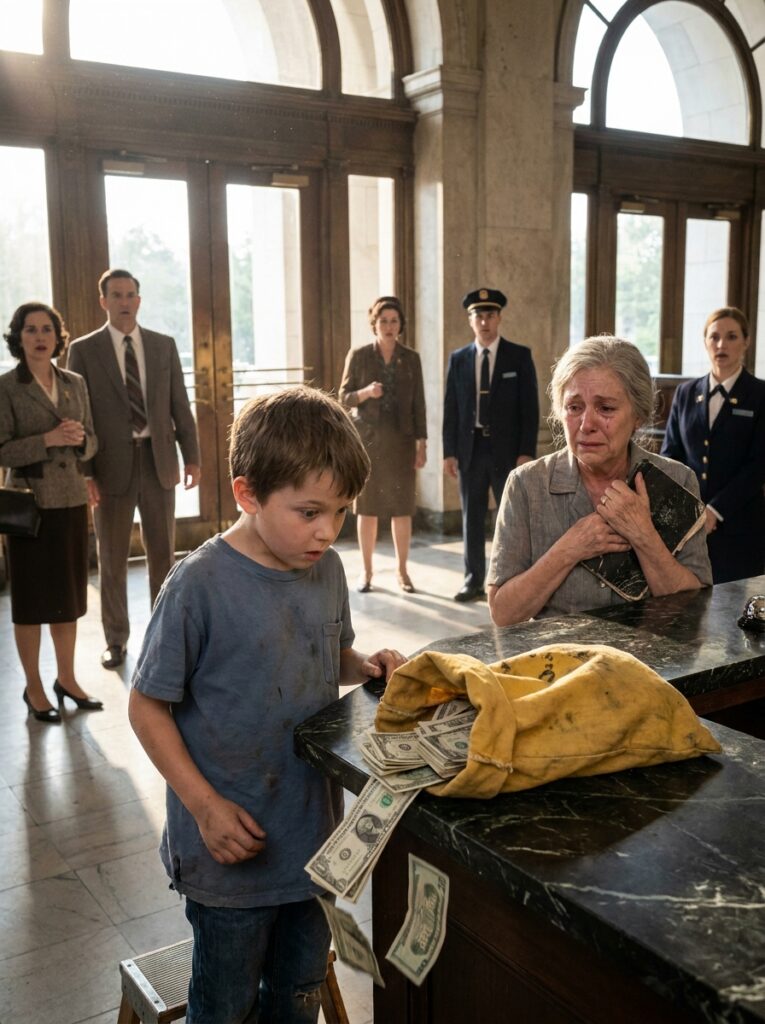
He set the old yellow bag on the polished marble like it was something sacred.
Then he took a deep breath.
His small hands trembled as he opened it.
At first, there was only the dry sound of fabric scraping stone.
Then money spilled out.
Bills.
Hundreds of them.
Thousands.
Some were old and softened from years of being folded. Some were newer, crisp, and clean. Green bills tumbled over one another across the marble counter, spreading like an impossible river.
The entire lobby froze.
The woman in pearls stopped frowning.
The man in the suit stopped laughing.
A teller’s mouth opened slightly.
Even the security guard near the door straightened.
Daniel stood on his toes to see over the counter.
His face was pale, but his voice was steady.
“I’d like to open a savings account,” he said.
No one spoke.
Patricia stared at the money, then at the boy.
“How…” Her voice came out softer than she intended. “Where did all this money come from?”
The silence broke into whispers.
“That has to be stolen.”
“A scam.”
“Where are his parents?”
The man in the suit murmured, loud enough for everyone to hear, “Probably drug money.”
Daniel’s face flushed red.
His fingers curled against the edge of the counter.
But he did not cry.
He remembered another thing his grandfather had always told him.
“If you tell the truth, you don’t have to memorize a story.”
So Daniel looked Patricia directly in the eye.
“It belonged to my grandfather,” he said. “Robert Ramirez. He kept it under his mattress for more than forty years.”
Before Patricia could respond, the branch manager stepped out of his glass office.
Mr. Henderson was a tall man with a sharp tie, a sharper voice, and very little patience for anything that disrupted order.
“Patricia,” he said, approaching quickly, “what is going on here?”
His eyes landed on the pile of cash.
Then on Daniel.
His expression hardened.
“Son,” he said, “we are going to have to call the police. You cannot walk into a bank with a bag full of cash and expect us not to ask questions.”
Daniel’s throat tightened.
Mr. Henderson stepped closer.
“Who did you take this from?”
The words hit Daniel harder than laughter.
His grandfather had spent a lifetime protecting every dollar in that bag.
Every bill had cost him something.
A meal.
A ride.
A coat.
A night of rest.
And now, before anyone had even listened, they had already decided a poor boy could only have money if he had stolen it.
Daniel reached back into the bag.
The security guard’s hand moved toward his belt.
Several customers stepped away.
But Daniel did not pull out anything dangerous.
He pulled out a small black notebook.
Its cover was cracked and peeling. Duct tape held the spine together. Rubber bands wrapped around it to keep the pages from falling out. It smelled faintly of motor oil, dust, and old paper.
Daniel placed it carefully beside the money.
“My grandfather didn’t trust banks,” he said. “He said banks forget people like us. But he didn’t want me to forget.”
He pushed the notebook toward Patricia.
“He wrote it all down.”
Patricia hesitated.
Then she opened it.
The pages were yellow and brittle. The handwriting was rough, uneven, and sometimes faded. Some entries were written in pencil, others in blue ink, others in black pen that had bled slightly through the paper.
Patricia read the first page silently.
Then something in her face changed.
She swallowed.
“June 12, 1982,” she read aloud. “Five dollars. Walked home instead of taking the bus. Feet hurt, but the boy will need books one day.”
The lobby grew quieter.
Patricia turned another page.
“November 1989. Twelve dollars. Skipped lunch all week. The money is growing. Slowly.”
She turned another.
“July 1995. Fifty dollars. Fixed Mrs. Higgins’ roof in the rain. Cold, but worth it.”
Her voice began to tremble.
“August 2001. Two hundred dollars. Sold my gold watch. I don’t need to know the time. I just need him to have a future.”
Patricia stopped reading.
The bank was completely silent now.
Not suspicious.
Not mocking.
Ashamed.
Daniel wiped his cheek with the back of his hand, but another tear followed.
“He was a gardener,” Daniel whispered. “And a janitor. And sometimes he fixed cars behind our building. He died last week.”
His little voice cracked.
“He told me to bring the money here. He said, ‘Daniel, don’t put this under your mattress. Put it somewhere it can grow. Go to college. Be the man I couldn’t be.’”
Mr. Henderson looked down at the notebook.
He saw what everyone else was beginning to see.
Not a pile of suspicious cash.
A lifetime.
A man’s hunger written in dollars.
A grandfather’s love recorded in coins.
A future built one sacrifice at a time.
The man in the navy suit, the same man who had laughed earlier, lowered his eyes. Slowly, he picked up his briefcase and moved to the back of the line.
“We need to count this,” Patricia said softly.
Daniel nodded.
“It might take a while,” she added.
“I can wait,” he said.
Mr. Henderson looked at the boy.
Then at the notebook.
Then he rolled up his sleeves.
“I’ll help.”
For the next hour, the bank did not feel like a bank.
It felt like a church.
Tellers counted the bills carefully. Some of the notes were old. Some were nearly too worn to read. Every stack was handled with unexpected gentleness, as if the employees understood they were not counting money.
They were counting years.
The total came to sixty-two thousand dollars.
Sixty-two thousand.
Not a fortune to the millionaires who walked through that bank every week.
But to Daniel Ramirez, it was an empire.
An empire built by Robert Ramirez, a man who had never worn a suit, never had an office, never signed his name on anything important, but had still managed to build a bridge from poverty to possibility.
Patricia opened the savings account.
When she printed the deposit slip and handed it to Daniel, her fingers trembled.
“Your grandfather was a great man,” she said.
Daniel took the slip with both hands.
Then he carefully placed the tattered black notebook back into the old yellow bag.
“I know,” he said.
For the first time that morning, he smiled.
“He was rich. He just didn’t have much money.”
Daniel walked out of the bank into the bright Chicago sun.
The yellow bag was empty now.
But his heart was full.
And behind him, inside the National Bank, nobody was laughing anymore.
Twenty years passed.
The National Bank changed with time.
The marble counters were replaced with sleek glass. The paper forms gave way to digital screens. The old hum of printers and typewriters became the soft tapping of keyboards and the occasional beep of an ATM.
Patricia Miller remained.
Her hair was fully silver now, pulled back into a neat bun. She was sixty-three years old, and on the corner of her desk sat a small cardboard box filled with framed photos, farewell cards, and the little things a person collects over a lifetime of work.
It was her final week before retirement.
Outside, a cold Chicago rain tapped against the windows.
Patricia was sorting through old files when the automatic doors slid open.
A man walked in.
Tall.
Confident.
Wearing a tailored charcoal suit that fit him perfectly.
He carried a leather briefcase and moved through the lobby with the quiet authority of someone used to being taken seriously.
The security guard stepped forward, but the man raised one hand politely.
“I have an appointment,” he said.
Patricia looked up from her desk.
“I’m sorry, sir. I don’t see anyone on my calendar.”
The man smiled.
“I didn’t make it in the system,” he said. “I made it twenty years ago.”
Patricia froze.
There was something about his eyes.
Something about the straightness of his posture.
Something about the way he held his chin high, as if protecting something invisible.
The man stepped closer.
“You probably don’t recognize me,” he said. “I looked a little different without the dirty T-shirt.”
Patricia’s heart skipped.
“Daniel?” she whispered. “Daniel Ramirez?”
His smile widened.
“Yes, ma’am.”
Patricia stood so fast her chair rolled back.
Professionalism disappeared.
She walked around the desk and embraced him like family.
Daniel laughed softly, hugging her back.
“Look at you,” Patricia said, pulling away with tears already in her eyes. “You look wonderful.”
“I’m an architect now,” Daniel said. “I build skyscrapers. Libraries. Community centers. Things that are meant to last.”
“Your grandfather would be so proud.”
Daniel’s eyes softened.
“He is.”
He set the leather briefcase on her desk.
“I finished college,” he continued. “I used every cent of that money. I didn’t buy cars. I didn’t waste it at parties. I lived on noodles, worked part-time, studied until my eyes hurt, and every time I wanted to quit, I read his notebook.”
He touched the briefcase gently.
“I knew what that money cost him.”
Patricia looked down.
“Do you still have it?”
Daniel opened the briefcase.
Inside, protected in a clear sleeve, was the old black notebook.
The duct tape was peeling. The rubber bands had been replaced. But it was still there.
Robert Ramirez’s ledger of love.
Daniel opened it to a page near the middle.
“Fixed roof in rain. Fifty dollars,” he read quietly. “I read that whenever I forget what sacrifice looks like.”
Patricia wiped her eyes.
Daniel turned to the very last page.
There, in Daniel’s own strong handwriting, was a new entry.
October 24, 2023. Five hundred thousand dollars. For the next boy with a dirty bag.
Patricia gasped.
“Daniel…”
He reached into the briefcase and pulled out a cashier’s check.
Half a million dollars.
“I want to open a trust,” Daniel said. “The Robert Ramirez Scholarship Fund.”
The bank slowly quieted around them.
Even the younger employees who did not know the story began to turn and listen.
“It will be for children of gardeners, janitors, mechanics, cleaners, cooks, caregivers,” Daniel continued. “For the children of people who work until their hands ache so someone else can have a better life. I want it to pay for trade schools, college, books, tools, housing—whatever gives them a chance.”
Patricia held the check with both hands.
“This is incredible.”
Daniel shook his head.
“It isn’t me. It’s him.”
He looked at the notebook.
“My grandfather planted something. I’m just letting it grow.”
Then Daniel reached into his pocket and pulled out a small velvet box.
“I know there are rules about gifts,” he said. “But you retire in two days, and this is not from a client. It is from a friend.”
Patricia opened the box.
Inside was a gold watch.
On the back, engraved in small letters, were the words:
For the time you gave me. — D.R.
“My grandfather sold his watch so I could have a future,” Daniel said. “I thought someone should give time back to the woman who helped me begin it.”
Patricia cried openly then.
Right there in the lobby.
The same lobby where people had once laughed at a poor boy with an old bag.
Daniel smiled through his own tears.
“Chin up, Ms. Miller,” he said softly. “We did good.”
Ten more years passed.
By then, Daniel Ramirez was forty-eight.
His hair had begun to gray at the temples. Lines of work, grief, laughter, and responsibility marked his face. His name was on buildings across Chicago, but the building he cared about most had no steel frame.
The Ramirez Foundation.
Every year, the Robert Ramirez Scholarship Fund helped students who would have otherwise been overlooked.
Students with average grades but extraordinary courage.
Students who worked nights.
Students who translated bills for their parents.
Students who carried family burdens no application form could measure.
One rainy afternoon, Daniel sat at the head of a long conference table while the scholarship committee reviewed finalists.
The board loved polished candidates.
Perfect essays.
Perfect grades.
Perfect recommendation letters.
Daniel respected those students, but he always asked the same question.
“Do they need us?”
A committee member cleared his throat.
“The next applicant is Sarah Jenkins. 4.0 GPA. Debate captain. Volunteer work. Accepted to Yale.”
“She sounds excellent,” Daniel said. “Does she have other funding options?”
The committee member hesitated.
“Several.”
Daniel nodded.
“Then keep her on the list, but who is last?”
The room grew uncomfortable.
Another board member tapped his tablet.
“There is one more. Leo Martinez. Nineteen. Average GPA. Works full-time at a tire shop. Handwritten application. No formal essay. Honestly, Daniel, he may not be foundation material.”
Daniel looked up.
“Bring him in.”
Leo entered five minutes later.
He wore a cheap suit that had clearly come from a thrift store. The sleeves were too short, exposing wrists marked with small scars and burns. His shoes were polished, but old.
But Daniel noticed his hands first.
Leo had scrubbed them clean, but motor oil does not disappear easily. It lived in the lines of his fingers, darkened his cuticles, and stained the skin around his nails.
“Have a seat,” Daniel said gently.
Leo sat down and immediately tucked his hands beneath the table.
The board asked standard questions.
Where do you see yourself in five years?
Why do you deserve this scholarship?
What are your academic strengths?
Leo struggled.
He was nervous. His words stumbled over one another.
“I want to be a mechanical engineer,” he said, eyes fixed on the table. “I fix cars now. But I want to design engines. Better ones. Cheaper ones. Engines that don’t break down every year for people who can’t afford repairs.”
One board member gave a small, impatient sigh.
“Your calculus grade is not strong.”
Leo flushed.
“I work nights,” he said quietly. “I do homework on breaks at the shop. Sometimes I’m tired and I make mistakes.”
The board member wrote something down.
Daniel knew that look.
It was the look of rejection.
He leaned forward.
“Leo,” Daniel said, “show me your hands.”
Leo froze.
“My hands?”
“Put them on the table. Palms up.”
Shame rose in Leo’s face.
Slowly, he pulled his hands from his lap and placed them on the polished wood.
They were rough.
A fresh cut crossed one thumb.
A burn marked his wrist.
These were not the hands of a polished applicant.
They were the hands of someone fighting life every day and still showing up.
Daniel reached inside his jacket.
He did not pull out a pen.
He pulled out the black notebook.
The room quieted.
Daniel opened to a page marked with a yellow slip of paper.
“June 1985,” he read aloud. “Fixed the transmission on Mr. Alvarez’s Ford. Burned my arm on the radiator. He paid me forty dollars. Put it all in the bag. The boy needs new shoes, but the bag needs to eat first.”
Leo stared at the notebook.
Daniel looked at him.
“That was my grandfather. He didn’t know calculus. He didn’t know how to write scholarship essays. But he knew sacrifice.”
Leo’s lips parted slightly.
Daniel glanced at the floor near Leo’s feet.
“You walked here today, didn’t you?”
Leo blinked.
“How did you know?”
“Your shoes are dusty, but it rained south of here. You walked a long way.”
Leo looked down.
“I needed the bus money for my sister’s lunch.”
The room went silent.
No one wrote notes now.
Daniel stood and faced the committee.
“We are not here to reward the student who will succeed with or without us,” he said. “We are here to find the one who might drown without a hand reaching down.”
Then he turned back to Leo.
“Leo, you are not going to become a mechanical engineer.”
Leo’s face fell.
The hope in his eyes disappeared so quickly it hurt to watch.
Daniel smiled.
“You are going to become a revolutionary one.”
Leo looked up.
“What?”
“Full scholarship,” Daniel said. “Tuition, books, housing, tools, and a monthly stipend. You will not work nights anymore unless you choose to. Your job now is to study, build, and become the man your family already believes you can be.”
Leo covered his face with his grease-stained hands and broke down.
He did not cry softly.
He sobbed.
The kind of sob that comes when a person has carried too much for too long and finally realizes he does not have to carry it alone.
Daniel placed a hand on his shoulder.
“There is one condition.”
Leo wiped his face quickly.
“Anything. I’ll pay it back. I promise.”
Daniel shook his head.
“No. You do not pay it back.”
He opened the black notebook to the last blank page and carefully tore it out.
Then he handed it to Leo with a pen.
“You pay it forward.”
Leo stared at the paper.
“Start your own ledger,” Daniel said. “Not just of money. Of sacrifices. Of moments you choose to build someone else’s future. When this page is full, you come find me.”
Leo took the page like it was something holy.
Years later, Patricia Miller passed away peacefully in her sleep.
Daniel attended her funeral wearing the gold watch she had left him in her will.
After the service, he drove to the cemetery where his grandfather was buried.
The headstone was simple.
Robert Ramirez.
Beloved Grandfather.
Daniel knelt in the grass and placed one hand on the stone.
“It’s working, Abuelo,” he whispered. “The bag is empty, but the account is full.”
Footsteps sounded behind him.
Daniel turned.
Leo stood there in a graduation gown, holding a rolled diploma.
He was older now. Taller in spirit than in body. His hands were still rough, but there was pride in the way he carried them.
Without saying a word, Leo stepped forward and placed a sealed envelope on Robert’s headstone.
Daniel looked at him.
“What’s that?”
Leo smiled.
“My first paycheck as a senior engineer,” he said. “I’m starting a fund. For kids in my neighborhood.”
Daniel looked down at the grave.
Then at the young man standing beside him.
And in that moment, he finally understood something.
His grandfather had never really been just a gardener.
Or a janitor.
Or a mechanic.
Robert Ramirez had been an architect.
He had not built towers of glass or steel.
He had built something stronger.
A foundation made of sacrifice.
A structure held up by dignity.
A legacy no storm could tear down.
Daniel stood and rested a hand on Leo’s shoulder.
“Chin up, kid,” he said, echoing the voice that had carried him through his whole life. “We have work to do.”
Together, they walked out of the cemetery.
Two men from different generations.
Different hands.
The same heart.
And somewhere behind them, beneath the quiet grass, an old gardener’s love kept growing.
The End.