When I opened the front door that Tuesday night, the first thing I noticed was the noise.
The cartoons were too loud.
Bright voices bounced around the living room, filling the small rental house with fake laughter, but nobody in the room was laughing.
The second thing I noticed was Mason.
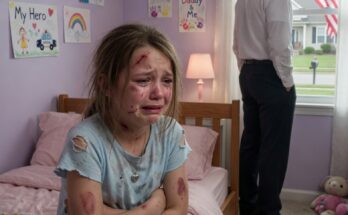
My seven-year-old son was sitting on the sofa beneath the yellow lamp, his little legs pressed close together, his hands folded too neatly in his lap. He looked like someone had placed him there and warned him not to move.
His face was turned toward the television.
But Mason was not watching it.
He was staring through it.
My bag slipped from my shoulder and hit the tile. My keys cracked against the floor, and Mason flinched so sharply that the movement went through me like a blade.
That tiny flinch told me something before I even saw the bruises.
Then my eyes adjusted to the yellow light.
Dark marks bloomed along both of his arms. One cheek looked swollen. The collar of his pajamas was twisted sideways, the fabric stretched in a way that made my stomach turn.
For three years, since I moved us into that small rental in Tampa, Florida, I had built our home around one promise.
Mason would never be afraid of the place where he slept.
I worked double shifts. I checked the locks twice every night. I knew the sound of every loose board in the hallway. I made that house small, safe, and predictable because, after his father left when Mason was four, stability was the only gift I could afford to give him every day.
Now my little boy was sitting under the lamp with marks on his body and fear in his eyes.
“My dear,” I whispered, stepping toward him, “what happened to you?”
I tried to keep my voice soft.
I tried to keep my panic from becoming another thing he had to survive.
Mason looked toward the hallway.
Then toward the kitchen.
Then toward the sliding glass door, where the rain made our living room reflect back at us like a dark mirror.
His lips trembled.
“Mommy,” he whispered, “I can’t tell you here.”
There are sentences a parent hears with the ear, and there are sentences that enter the body like ice water.
That one did both.
It was not only fear.
It was calculation.
My seven-year-old child was checking hallways, doorways, windows, and reflections before speaking. He was measuring whether danger could hear him.
A child that young should not know how to do that.
Rage rose in me so fast I nearly choked on it.
I wanted to search every room. I wanted names. I wanted answers. I wanted to find whoever had touched my son and make the world stop until they were held accountable.
But Mason was watching me.
Children do not need their mothers to explode in front of them.
They need their mothers to become steady enough to get them out.
So I did not scream.
I did not run down the hallway.
I did not tear through the house.
I picked up his blue hoodie, the one with the little zipper he always forgot to pull up, and wrapped it gently around him.
“We’re going for a drive,” I said.
Mason’s eyes filled with tears.
“To where?”
“Somewhere safe.”
At 9:47 p.m., I backed out of the driveway with my hands clenched around the steering wheel so tightly my knuckles looked pale under the dashboard light.
The storm hit the windshield in hard silver lines. Streetlamps flashed over Mason’s face in the rearview mirror. He sat in the back seat without making a sound, except for one small breath that caught every time we passed a bright patch of light.
I wanted to ask him again.
I wanted to know everything.
But something in his whisper still echoed inside me.
I can’t tell you here.
So I waited.
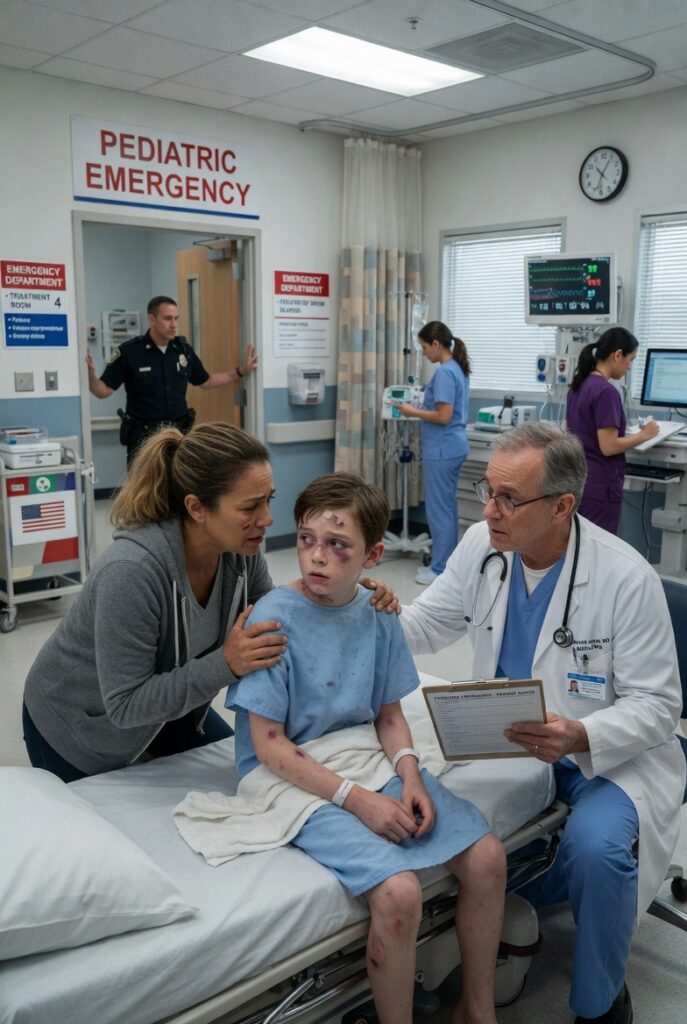
By 10:06 p.m., Tampa General Hospital had our names on an intake form.
The emergency room doors slid open with a cold hiss. The air smelled like disinfectant, coffee, and rain-soaked clothes. A nurse at intake looked up from her computer, saw Mason, and stopped typing.
Her eyes moved from his swollen cheek to his arms to the finger-shaped marks near his shoulder.
She did not ask us to wait.
They admitted him immediately.
A hospital intake form went onto a clipboard. A nurse wrote 10:06 p.m. across the top. Another nurse took photographs for the injury chart while I stood beside the bed with one hand on Mason’s sneaker, promising him I was right there.
Proof has its own language.
Timestamps.
Forms.
Photographs.
Names of witnesses.
People call it drama when there is no paper trail.
But paper remembers what frightened people sometimes cannot say out loud.
The doctor who came in was an older man with silver hair and tired, kind eyes. His badge said Dr. Harlan.
He did not stand over Mason.
He knelt beside the bed.
That one choice made my son breathe a little easier.
“Mason,” he said softly, “you are not in trouble. Your mom brought you somewhere safe. Can you tell me what happened?”
Mason looked at me.
I nodded, even though my throat felt like it had closed around glass.
Then my son leaned toward Dr. Harlan’s ear and whispered something so low I could not hear it over the monitor beeping beside us.
The change in the doctor’s face was instant.
The color drained from him.
His hand, still resting on the bed rail, went completely still. Behind him, a nurse froze with a roll of gauze halfway between her fingers. A tech stopped at the curtain with a tablet in one hand.
Even the woman in the next bay lowered her phone into her lap.
The monitor kept beeping.
Rain tapped against the ER windows.
Somewhere down the hall, a printer spat out paper like nothing in the world had just shifted.
Nobody moved.
Dr. Harlan rose slowly. He looked at Mason, then at me, and I saw professional horror in his eyes, the kind people get when training tells them what to do but humanity makes it hurt.
“Ma’am,” he said quietly, “I think you should sit down.”
My knees nearly gave out.
But I stayed standing.
For one ugly second, I imagined finding the person who did this and making them feel even one second of what Mason had felt.
Then my son reached for my sleeve.
The thought died in my hand.
Anger is easy.
Evidence is harder.
Evidence survives the room.
I reached for my phone with shaking fingers and called 911.
The dispatcher asked for my location. I gave her Tampa General Hospital, emergency department, pediatric bay four. I gave Mason’s age. I gave my name.
Dr. Harlan quietly handed a nurse the injury chart, and she wrote suspected child harm in black ink.
Mason’s small fingers tightened around my sleeve.
“Mommy,” he whispered, tears finally spilling down his face, “please don’t let him come back here.”
Before I could ask who, the automatic doors at the end of the ER hall opened again.
A Tampa police officer stepped inside.
Dr. Harlan walked straight toward him with Mason’s chart in his hand.
The officer’s boots squeaked once on the polished hospital floor, and I remember that sound because everything else in me went silent.
Dr. Harlan did not rush.
He moved with that careful calm doctors use when they are trying not to frighten a child who has already been frightened enough. He handed over the injury chart, the photographs, and the intake form marked 10:06 p.m.
Then he said something too quietly for the rest of the bay to hear.
The officer’s face changed before he even looked at me.
Mason buried his face against my side so hard I felt his tears soak through my shirt. I kept one hand on the back of his hoodie and one hand around my phone because, in the last twenty minutes, I had learned that a mother can be shaking and still become a record keeper.
Then the new thing happened.
A nurse came back from the desk carrying a sealed plastic evidence envelope.
Inside was Mason’s pajama collar tag, the one they had cut loose because the fabric around it was stretched and torn.
She placed it beside the chart and said, “We found this caught in the seam.”
The officer leaned closer.
Dr. Harlan went still again.
The nurse’s mouth tightened like she wanted to cry but refused to do it in front of my son.
Even the officer stopped writing.
Then Mason lifted his head just enough to look at me.
“He said nobody would believe me,” he whispered.
The officer turned his body toward me, voice low, careful, and official.
“Ma’am, before you answer my next question, I need you to understand something about who may have access to your home.”
My heart dropped.
“What do you mean?”
He looked at Mason first, then back at me.
“Your son told Dr. Harlan the person who hurt him used a key to enter the house.”
I stared at him.
For a moment, my mind refused to understand.
A key.
Not a broken window.
Not a forced door.
A key.
I thought of the front lock I checked twice every night.
The deadbolt.
The chain.
The little routine that had made me feel like a good mother.
Then I thought of the few people who had access.
Me.
My landlord, Mr. Voss.
My neighbor, Cheryl, who had an emergency spare because she watched Mason after school on late shifts.
And my brother, Callum.
My older brother.
The man who had moved into the garage apartment behind our rental two months earlier after losing his job.
The man I had trusted because he was family.
The man who had picked Mason up from school twice when I was stuck late at the hospital.
My stomach twisted.
“No,” I said before anyone accused him.
The officer did not react.
He had probably heard that word from too many families.
No.
Not him.
Not someone I know.
Not someone I let near my child.
“What exactly did Mason say?” I asked.
Dr. Harlan’s eyes softened.
“We need to ask carefully,” he said. “And we need a child advocate present. But he gave a name.”
The floor seemed to move beneath me.
Mason’s hand tightened in mine.
I looked down at him.
His face was hidden against my shirt, but I could feel his whole body trembling.
I crouched in front of him and gently touched his cheek, careful to avoid the swollen side.
“Mason,” I whispered, “did Uncle Callum do this?”
My son did not answer out loud.
He only closed his eyes.
And that was enough.
The officer stepped away to make a call.
A child protection specialist arrived less than thirty minutes later. Her name was Renée, and she had a soft voice, gray glasses, and the kind of patience that made Mason look at her for more than two seconds at a time.
She did not rush him.
She did not ask questions like accusations.
She sat near him with a clipboard lowered in her lap and said, “You can tell me as much or as little as you feel ready to say.”
Mason looked at me.
I nodded again.
He told the story in pieces.
Callum had been at the house when I left for my late shift.
That part was normal.
He sometimes came in to eat dinner or watch television while Cheryl, our neighbor, finished tidying up after babysitting.
But that night, after Cheryl left, Callum stayed.
Mason said Uncle Callum had been angry because he could not find money he believed I had hidden in the house.
He wanted my emergency cash envelope.
I kept it in the back of the linen closet for rent, groceries, and repairs.
Mason did not know that.
But Callum thought he did.
When Mason said he didn’t know where it was, Callum grabbed him hard enough to leave marks.
He shouted.
He shook him.
He twisted his pajama collar and told him not to scream.
Then he made him sit on the sofa and watch television until I came home.
“He said if I told,” Mason whispered, “he would come back when you were sleeping.”
My whole body went cold.
Renée wrote everything down.
The officer asked if Callum still had a key.
I nodded slowly.
“He has one to the back door,” I said. “He told me he needed it in case I got locked out or there was an emergency.”
The officer’s jaw tightened.
“Do you know where he is now?”
I reached for my phone.
There were four missed calls from Callum.
One text.
You home yet?
Another.
Don’t be dramatic about tonight. Mason bruises easy.
I stared at those words until they blurred.
Don’t be dramatic.
That is what people say when they have already decided the truth is inconvenient.
The officer asked if he could see the messages.
I handed him my phone.
He photographed the screen and asked permission to have another officer meet us at the house.
“No,” I said immediately. “I am not taking Mason back there tonight.”
“You don’t have to,” he said. “We can secure the property.”
Secure the property.
Those words should have comforted me.
Instead, all I could think was that my home had not been safe while my son sat inside it.
At 12:31 a.m., while Mason slept in a hospital bed with a blanket tucked under his chin, officers went to the house.
Callum was in the garage apartment.
They found the back door key on his keyring.
They also found my emergency cash envelope in his jacket pocket.
It had been opened.
Half the money was gone.
Later, they found the missing half inside a duffel bag beneath his bed, along with a bus ticket to Atlanta scheduled for the next morning.
When the officer returned to the hospital and told me, I sat down for the first time.
Not because I was relieved.
Because my legs finally stopped pretending they could hold me.
My brother had hurt my child for money.
Worse, he had counted on me doubting my own son.
He had counted on family meaning silence.
But Mason had whispered the truth.
And this time, somebody listened.
By dawn, the hospital room had turned pale blue with morning light.
Mason woke up confused, then frightened, until he saw me beside him.
“You stayed,” he said.
The words broke me more gently than the fear had.
“Of course I stayed.”
“Is he coming?”
“No,” I said. “He can’t come here.”
“Did you believe me?”
I sat on the edge of the bed and took his small hand in mine.
“Yes, baby. I believed you the moment you were brave enough to tell the truth.”
His eyes filled again.
“He said you’d be mad at me.”
“I’m not mad at you.”
“He said it was my fault.”
“It was not your fault.”
“He said families don’t call police on families.”
I swallowed hard.
“Families protect children,” I said. “That is what families are supposed to do.”
Mason looked at me for a long time.
Then he nodded once, as if placing that sentence somewhere inside himself where Callum’s words had been.
The next few weeks were a storm of paperwork, interviews, court dates, and sleepless nights.
I changed the locks before Mason came home.
Then I changed the door itself.
I installed cameras by the front porch and back gate, not because cameras create safety by themselves, but because proof had saved my son once, and I would never again underestimate the value of proof.
Cheryl, our neighbor, cried when she found out.
“I left him there,” she kept saying. “I thought Callum was safe because he was your brother.”
I wanted to blame her.
For about one minute, I did.
Then I remembered I had thought the same thing.
Callum had grown up beside me.
He had taught me to ride a bike.
He had held Mason as a baby.
He had shown up at birthdays, eaten at our table, laughed in our living room.
And then, behind all that history, he had become someone my son had to fear.
That was the hardest part to accept.
Sometimes danger does not arrive as a stranger in the dark.
Sometimes it already knows where you keep the spare key.
Callum denied everything at first.
He said Mason was confused.
He said I was stressed from working too much.
He said the bruises must have happened at school.
Then his story changed.
He said he had only grabbed Mason to “calm him down.”
Then he said he had been drinking.
Then he said he needed money and panicked.
Every excuse sounded smaller than the truth.
The evidence held.
The medical records.
The photographs.
The torn pajama collar.
The cash envelope.
The text messages.
The key.
And Mason’s statement, taken carefully by people trained to hear children without leading them.
The court issued a protective order.
Callum was not allowed near Mason, near me, or near our home.
My mother called from Jacksonville the day after the first hearing.
She cried for Callum.
Then she cried for me.
Then she asked, “Are you sure Mason understood what happened?”
I hung up.
For two days, I felt guilty.
On the third day, Mason had a nightmare and woke up calling for me. I found him sitting on the floor behind his bedroom door, hugging his knees, whispering, “Don’t let him in.”
After that, the guilt was gone.
I did not owe comfort to adults who needed time to believe what a child had already survived.
Mason started therapy the following week.
At first, he barely talked.
He drew instead.
For a while, every drawing had a sofa in it.
A yellow lamp.
A television.
A dark hallway.
Then, slowly, the drawings changed.
The hallway got shorter.
The lamp got brighter.
Then one day, he drew the front door with a big lock on it and two people standing inside.
One tall.
One small.
The small one was holding the tall one’s hand.
“That’s us,” he said.
I smiled even though my eyes burned.
“I see that.”
“And that’s the door.”
“I see that too.”
“He can’t open it anymore.”
“No,” I said. “He can’t.”
But healing is not one moment.
It is hundreds of small moments stacked on top of each other.
It was Mason asking if I could sit outside the bathroom while he brushed his teeth.
It was him needing the hallway light on.
It was him checking the back door three times before bed.
It was him asking, “What time do you come home?” every morning before school.
So I changed my shifts.
I took fewer nights.
We ate dinner at the same time every evening.
I put my phone on loud when I left the house.
I told his school exactly who was allowed to pick him up, and I removed every name that made my stomach tighten.
I also stopped apologizing for being protective.
Before, I had worried about seeming dramatic.
After that night, I understood something clearly.
A mother’s caution may annoy people.
A mother’s silence can destroy a child.
Months passed.
Callum eventually accepted a plea agreement. He was ordered to stay away from us, complete counseling and substance treatment, and face supervised probation after serving time. It did not feel like enough. Maybe nothing would have.
No sentence could erase the memory of Mason sitting on that sofa.
No court order could give him back the version of home he had before that Tuesday night.
But accountability mattered.
A record mattered.
The world had said, in writing, that what happened to Mason was real.
That he was believed.
That he was protected.
On the first anniversary of that night, Mason and I moved.
Not far.
Just to a smaller duplex closer to his school, with better lighting, new locks, and no garage apartment in the back.
The living room had big windows that caught the morning sun.
The first time we walked in, Mason stood in the doorway and looked around.
“No yellow lamp,” he said.
“No yellow lamp,” I promised.
We bought a blue one instead.
That night, after we unpacked only the essentials, we ate pizza on the floor and watched a movie with the volume low.
Halfway through, Mason leaned against my shoulder.
“Mommy?”
“Yes?”
“Can I tell you something?”
My body went still, but I kept my voice gentle.
“Always.”
He looked around the new living room.
Then he said, “I like it here.”
I closed my eyes for one second.
Those four words felt bigger than any court ruling.
Bigger than any apology my brother never properly gave.
Bigger than all the paperwork and sleepless nights and fear that had followed us from the old house.
Mason liked it here.
He felt safe enough to say so.
I kissed the top of his head.
“I like it here too.”
A few weeks later, he brought home a school assignment.
The teacher had asked the children to draw their favorite place.
Mason drew our new living room.
The blue lamp.
The couch.
The front door.
Me sitting beside him.
And at the top of the page, in careful second-grade handwriting, he wrote:
Home is where Mommy believes me.
I cried in the car after drop-off that morning.
Not because everything was fixed.
It wasn’t.
Mason still had nightmares sometimes. I still checked the locks more than necessary. Some family members still believed I should have handled things quietly.
But we were not living inside the silence anymore.
That was the difference.
The night I found my son on the sofa, I thought the worst thing I would ever see was the bruises on his body.
I was wrong.
The worst thing was the fear in his voice when he said he could not tell me inside our own home.
The most important thing was what happened after.
I listened.
I left.
I documented.
I believed him.
And because of that, my little boy learned something no one would ever take from him again.
The truth does not become smaller because someone powerful denies it.
Family does not mean protecting the person who caused pain.
And home is not just a place with walls, locks, and a roof.
Home is the place where a child can finally speak without being afraid of who might hear.
The End.