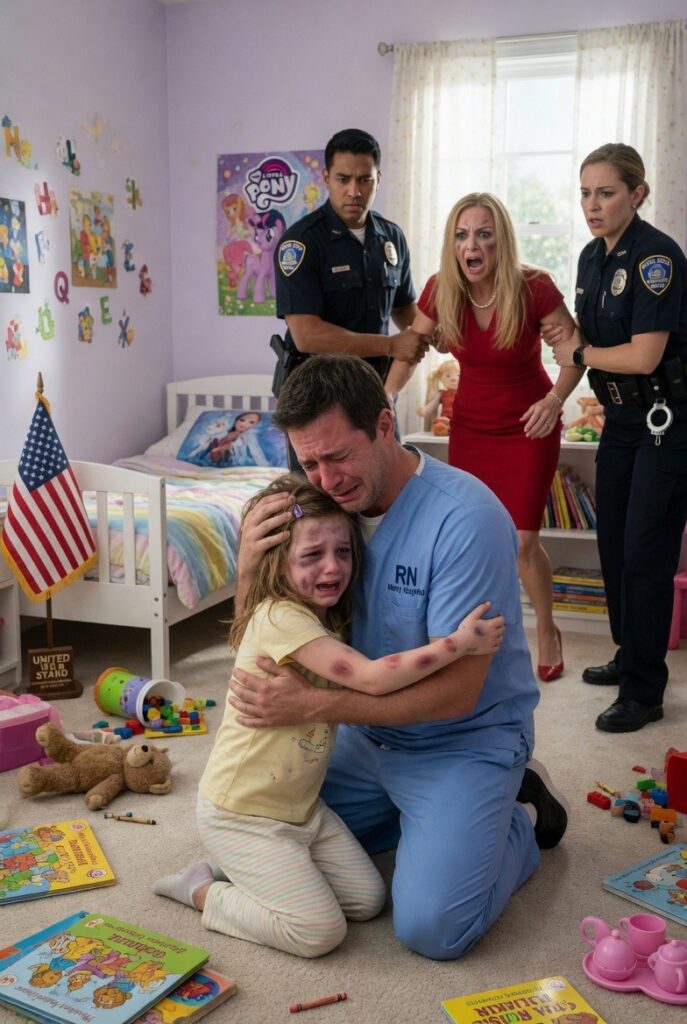
I’m Gideon, an ER nurse in a trauma unit, which means I have spent most of my adult life reading the quiet geography of pain.
A clenched jaw can tell you more than a scream.
A hand tucked inside a sleeve can tell you more than a visible mark.
A child who cries without making a sound can tell you more than any explanation an adult tries to give.
And the first time I walked into Maris’s Victorian house at 412 Birch Street, something in me knew the house had secrets.
It smelled like lemon polish, old wood, and something locked away too long.
The staircase groaned under my suitcase. The hallway mirror caught my face at an angle that made me look less like a husband and more like an intruder.
Then Lumi appeared at the landing in pink socks, clutching the banister with both hands.
She was seven years old, small for her age, with soft brown curls and eyes that seemed far too tired for a child.
“Are you going to stay?” she asked. “Or are you just visiting?”
I set my bag down slowly.
“I’m staying, Lumi,” I said gently. “I’m your stepdad now.”
She didn’t smile.
Maris did.
My wife had a perfect smile, the kind people trusted before they knew better. We had been married for six weeks, together for ten months, and she had made me feel chosen in a way I had not felt since my mother died.
She brought coffee to my night shifts.
She remembered my father’s birthday.
She gave me a key to 412 Birch Street before she gave me a drawer.
At the time, I thought that meant trust.
Later, I would understand that a key can be an invitation.
It can also be bait.
From the beginning, Lumi cried only when we were alone.
Never loudly enough for neighbors to hear.
Never dramatically enough for Maris to call it a tantrum.
Just silent tears sliding down her cheeks while she stared at the carpet, the wall, or the far corner of the room like she was waiting for something bad to happen.
“What’s wrong?” I would ask.
She would shake her head.
When I told Maris, she laughed.
“She just doesn’t like you,” she said once, stirring tea without looking up. “Don’t take it personally. She’s difficult with men.”
But Lumi never acted difficult.
She acted trained.
Three weeks later, Maris left for a business trip.
Her itinerary said Denver, two nights, the Westbridge Hotel, return flight at 4:40 p.m. on Friday. She kissed me in the doorway, kissed Lumi on the crown of her head, and whispered something I couldn’t hear.
Lumi went stiff.
That was the first detail I kept in my mind: the itinerary printed on the kitchen counter.
The second was the school behavior slip from Tuesday, clean and unsigned.
The third was the 7:18 p.m. voicemail Maris left that night, asking one question before anything else.
“Did Lumi behave?”
Not, How are you both?
Not, I miss my daughter.
Just, Did Lumi behave?
That evening, while a cartoon movie played softly in the living room, I noticed wet tracks shining on Lumi’s cheeks in the blue light from the TV.
“Lumi?” I said quietly.
She kept her eyes on the screen.
“Mommy says you’ll get tired of us,” she whispered. “She says all the men leave because I’m too much work. She says you’ll leave when you see the real me.”
I kept my hands loose on my knees.
My anger went cold instead of loud.
“I’m an ER nurse,” I told her. “I’ve seen people on their hardest days, and I’ve never once walked away because someone needed help.”
Her lip trembled so hard she bit it.
That night, I heard muffled sobbing from her room.
I knocked once, then opened the door only enough for her to see me.
“Do you want to tell me what’s making you so sad?”
“I can’t,” she gasped. “Mommy says… she says the fire would come if I told.”
The fire.
Children do not invent threats like that out of nowhere.
They borrow the words adults use to frighten them into silence.
Two days later, Maris came home with a perfect smile and a rolling suitcase that still had an airline tag looped around the handle.
At dinner, her knife clicked sharply against the china.
“Did Lumi behave herself?” she asked. “Any… emotional outbursts?”
Lumi’s hand tightened around her fork until her knuckles went pale.
“No, Mommy.”
It was a lie.
We both knew it.
The room went still around that little fork. The refrigerator hummed. The candle on the table flickered in the draft from the old window. Maris kept smiling. Lumi stared at the peas on her plate as if they could save her.
I watched my wife’s fingers rest beside the steak knife, clean and calm.
Nobody moved.
The next morning, I helped Lumi pull on her sweater for school.
“Let me help, kiddo,” I said.
She jerked back so violently her backpack hit the wall.
I froze.
Then I saw her upper arm.
Four small purplish-yellow marks on the right.
One larger thumb-shaped mark on the left.
The pattern was unmistakable.
It was the shape of an adult hand that had gripped her far too hard.
My breath left me, but my voice did not change.
“Lumi,” I said softly. “Who did this?”
She stared at the floor.
Then her little hand reached into her backpack.
She pulled out a folded drawing, a school nurse pass, and something wrapped in a crumpled paper towel.
“Daddy…” she whispered. “Look at this.”
And the moment I saw what she had hidden in that paper towel, I understood the marks on her arm were not the beginning.
They were a warning.
Inside was a tiny silver house key.
It was sticky from the paper towel. Along one edge, dried into the groove near the teeth, was a red-brown smear.
I had cleaned enough wounds in the ER to know when I was not looking at marker.
Across the back of the key, one word was written in Maris’s handwriting.
FIRE.
Not a child’s scribble.
Not a game.
Maris’s handwriting, sharp and slanted.
I turned the key over in my palm.
“Where did you get this?” I asked.
Lumi swallowed.
“Basement door,” she whispered. “Mommy said if I told you, she’d use it.”
Then she reached into the backpack again and pulled out one more thing I had not seen before: a folded yellow form from Birch Street Elementary, dated the week before I moved in.
It was a counselor referral.
At the bottom, under “child statement,” someone had written one sentence in block letters.
Child reports mother locks door when crying continues.
My hand closed around the paper so slowly I heard it crease.
From the kitchen, Maris’s phone buzzed on the counter.
One message lit the screen.
I did not touch it.
I only looked down.
It was from an unsaved number, and the preview said:
Did he find the key yet?
Lumi made a sound so small it barely counted as breathing.
Then the basement stairs creaked beneath us.
I looked toward the hall, still holding the key, and heard the back door open.
Someone was in the house.
I moved Lumi behind me.
“Stay close,” I whispered.
Her fingers gripped the back of my shirt.
The old floorboards groaned again.
Slow.
Careful.
Not a child’s steps.
Not Maris’s.
I picked up my phone from the entry table and dialed 911 without pressing call yet. My thumb hovered over the green button.
A shadow moved at the end of the hallway.
Then a man stepped into view.
He was in his late fifties, maybe early sixties, wearing a dark jacket and work boots. His face was pale, and his eyes dropped immediately to the key in my hand.
“You found it,” he said.
I tightened my grip on the phone.
“Who are you?”
He lifted both hands.
“My name is Henry Vale. I live behind the property. I’m not here to hurt anyone.”
Lumi pressed closer against me.
Henry looked at her, and his expression softened with something like shame.
“She found the key under the basement mat three weeks ago,” he said. “She didn’t know I saw her.”
My thumb stayed over the call button.
“Why are you in my house?”
“I came because Maris told me to check the basement door.”
That made the air feel thinner.
“You work for my wife?”
Henry lowered his eyes.
“I used to do repairs for her. Small things. The old lock. The back steps. The storm drain. I stopped after I heard the child crying one night.”
Lumi’s breathing turned uneven behind me.
Henry looked at the floor.
“I should have called someone then,” he said. “I didn’t. I told myself it wasn’t my business. That was wrong.”
My jaw tightened.
“What does the word on the key mean?”
Henry glanced toward the basement door.
“It’s not fire like flames,” he said. “It’s the furnace room. That’s what Maris calls it. The fire room.”
Lumi whimpered.
I turned toward her.
“You don’t have to go down there,” I said immediately.
Henry’s face changed when he heard that. He looked like a man seeing the full shape of what he had ignored.
“I have photos,” he said. “From outside the basement window. I didn’t know what to do with them, but I have them.”
I hit call.
When the dispatcher answered, I gave the address calmly, the way I had trained myself to speak in emergency rooms when everything inside me wanted to shake.
“My name is Gideon Hale,” I said. “I’m at 412 Birch Street. I’m with a seven-year-old child who may be in danger. I have physical marks, a school counselor referral, a key connected to a locked basement room, and a witness on the property.”
Henry looked relieved and terrified at the same time.
The dispatcher told me officers were on the way.
I kept Lumi beside me in the foyer. I did not let Henry move closer. I did not go into the basement. I knew enough from the ER to understand that evidence had to remain untouched if anyone was going to believe this child fully the first time.
While we waited, Maris called.
Her name lit up the screen like a threat.
I answered on speaker.
“Gideon,” she said sweetly. “Everything okay?”
I looked at Lumi.
Her face had gone colorless.
“Yes,” I said. “Lumi is here with me.”
There was a pause.
Then Maris said, “Put her on.”
“No.”
The silence that followed was small, but complete.
“Excuse me?” she said.
“She’s scared. She doesn’t need to talk right now.”
Maris laughed softly.
“Oh, Gideon. Don’t start this. She gets dramatic. She manipulates people. I warned you.”
I looked at the key in my hand.
“You warned me she was difficult,” I said. “You didn’t warn me she was afraid.”
Another pause.
Then her voice lowered.
“What did she tell you?”
There it was.
Not What happened?
Not Is my daughter okay?
What did she tell you?
Lumi began to cry silently again.
I kept my voice steady.
“She showed me the key.”
Maris stopped breathing.
For two seconds, the line was perfectly quiet.
Then she said, “Listen to me carefully. Put that back where you found it.”
“No.”
“Gideon, you have no idea what you’re doing.”
“I know exactly what I’m doing.”
Her voice sharpened.
“You are not her father.”
Lumi flinched.
I looked down at her.
She was staring at the phone as if those words had landed directly in her chest.
I crouched beside her and said, loud enough for Maris to hear, “I may not be the man who gave you life, Lumi, but I am the adult standing here now. And I am not leaving you alone with fear.”
For the first time since I had met her, Lumi reached for my hand.
Maris heard it.
Maybe she heard the tiny breath Lumi released.
Maybe she heard my silence.
Whatever it was, she changed tactics.
“Gideon,” she said, suddenly soft. “You’re tired. You work in trauma. You see terrible things and imagine them everywhere. Lumi has emotional problems. She needs structure.”
“No,” I said. “She needs safety.”
That was when the first patrol car pulled up outside.
Blue and red light flickered across the hallway mirror.
Maris heard the faint sound of the siren.
“What did you do?” she asked.
“I called for help.”
She hung up.
The next hour unfolded in pieces.
Two officers arrived first. Then a child welfare investigator. Then an ambulance, because I insisted Lumi be checked properly.
Lumi clung to me at first, then to a woman named Carla from child protective services who had a gentle voice and a purple scarf. Carla did not rush her. She did not ask questions like accusations. She sat on the living room floor with Lumi and let her hold a stuffed rabbit from her backpack while she spoke.
Henry gave his statement.
He showed the photos on his phone.
The basement door had a heavy lock installed on the outside.
Not inside.
Outside.
Behind it was the furnace room.
Small. Windowless except for a narrow glass pane near the ceiling. There was an old chair, a thin blanket, and a nightlight that did not work. On the wall beside the door were faint scratches low to the ground.
I stood at the top of the stairs while officers documented everything.
I had seen terrible rooms before.
Trauma rooms.
Emergency bays.
Hospital waiting rooms where families learned the worst news of their lives.
But that little basement space hurt differently.
Because it had not been built by accident.
It had been used with intention.
Lumi had called it the fire because her mother had taught her to fear that word.
If she cried too long, she went there.
If she spoke too honestly, she was reminded of it.
If she got too attached to me, Maris threatened it.
The key in my hand was not just a key.
It was proof of a childhood being controlled by fear.
Maris came home that evening.
Not from Denver.
From a hotel twenty minutes away.
The police were still at the house when she arrived. She stepped through the front door in a camel coat and heels, her perfect smile already prepared.
“Officers,” she said, sounding offended but calm. “There has been a misunderstanding.”
Lumi was sitting on the couch beside Carla.
The moment Maris entered, Lumi folded into herself.
Every adult in the room saw it.
Maris looked at me first.
The smile did not reach her eyes.
“Gideon has a tendency to overreact,” she said. “He works in emergency medicine. It affects him.”
One officer asked where she had been.
“Denver,” she answered.
I pointed to her suitcase by the door.
“There’s no airport tag from Denver,” I said. “Only the old one from last week.”
Her smile flickered.
The officer asked for confirmation of her travel.
Maris reached into her purse.
Her hands were steady, but her breathing had changed.
That was when her phone buzzed again.
She glanced down too quickly.
The officer noticed.
“Ma’am,” he said, “please place the phone on the table.”
Maris hesitated.
Then, slowly, she set it down.
The screen lit up with another message from the same unsaved number.
Did you get him out of the house?
Henry, standing near the kitchen doorway, went pale.
“That’s not me,” he said immediately.
The number belonged to someone else.
Later, we learned it was an old friend of Maris’s who had been helping her keep track of whether I was home, whether Lumi had talked, and whether anyone had noticed the basement lock.
Maris had not gone to Denver at all.
She had staged the trip to see what Lumi would say when left alone with me.
She wanted to know whether the fear she had planted was stronger than my patience.
It wasn’t.
When the officer asked Maris about the basement room, she laughed once.
“It’s an old house,” she said. “Children exaggerate.”
Then Carla asked Lumi one simple question.
“Sweetheart, do you feel safe with your mom right now?”
Lumi looked at me.
Then at Carla.
Then at the floor.
And in the smallest voice, she said, “No.”
Maris’s mask broke.
Not completely.
Just enough.
Her eyes hardened.
“After everything I do for you,” she said, staring at Lumi. “You choose him?”
The room went silent.
Carla shifted closer to Lumi.
I stepped forward, but the officer raised one hand slightly, warning me not to engage.
Maris looked at me then.
“You ruined my house,” she said.
I answered quietly, “No. I found what was already inside it.”
That night, Maris was taken in for questioning.
Lumi was not left alone.
The investigator arranged emergency placement while the case moved forward. Because I was married to Maris but not yet legally established as Lumi’s guardian, the situation was complicated. For two days, Lumi stayed with a licensed emergency foster family while I answered questions, submitted records, and gave every piece of evidence I had.
Those were the longest two days of my life.
I slept on the couch because the bedroom still smelled faintly like Maris’s perfume.
I kept seeing Lumi at the landing in pink socks asking if I was going to stay.
So I stayed.
I went to every meeting.
I called every number they gave me.
I contacted an attorney.
I gave the counselor referral to the investigator.
I gave them the voicemail.
I gave them the itinerary.
I gave them the key.
And when they asked me why I wanted to remain involved, I told the truth.
“Because that child called me Daddy before she knew whether I would protect her. I will not make her regret trusting me.”
Within a week, the court granted me temporary supervised contact with Lumi while the investigation continued.
The first time I saw her again, she walked into the visiting room holding the stuffed rabbit by one ear.
She looked smaller than I remembered.
I knelt down.
“Hi, kiddo.”
She stared at me.
“You came.”
“Of course I came.”
“Mommy said you wouldn’t.”
“I know.”
“She said once people saw how much trouble I was, they’d send me away.”
I had to swallow before I answered.
“You are not trouble, Lumi. You are a child. Children are supposed to need help. That’s not trouble. That’s being human.”
Her face crumpled.
Then she ran into my arms.
I held her carefully, like something precious that had survived a long fall.
Over the next months, the truth came out in pieces.
Maris had been charming to everyone outside the house.
At school events, she was polished and generous.
At work, she was admired.
To neighbors, she was the elegant single mother who had finally found a good man.
But inside the house, Lumi had learned rules no child should have to learn.
Do not cry too long.
Do not talk about the basement.
Do not tell teachers too much.
Do not make Mommy look bad.
Do not get attached to Gideon.
Because if Gideon saw the real story, Maris said he would leave.
But the more I saw, the more determined I became to stay.
The court case did not move quickly.
Nothing involving children ever feels fast enough when a child is waiting to feel safe.
Maris denied everything at first.
Then she blamed stress.
Then she blamed Lumi’s imagination.
Then she blamed me.
But the evidence did what frightened children often cannot do alone.
It spoke clearly.
The school counselor testified that Lumi had described being locked in a basement room when she cried.
The nurse documented the marks on Lumi’s arm.
Henry gave his statement and turned over his photos.
The phone records showed Maris had never flown to Denver.
The messages showed she had been monitoring us.
And the key, with one word written in her handwriting, connected her own threat to the locked door.
Maris eventually accepted responsibility in court, though even then she wrapped it in excuses.
She said she had been overwhelmed.
She said she had not meant to frighten Lumi.
She said the room was only for “cooling down.”
But Lumi’s therapist submitted a report that described the fear, the nightmares, the silence, and the way Lumi still froze whenever someone said the word basement.
The judge listened.
Then he ordered continued no-contact between Maris and Lumi, pending extensive treatment and future review. Custody was removed from Maris. A long-term kinship search found no safe relative willing and able to take Lumi.
That was when my attorney helped me petition for guardianship.
I was not her biological father.
I was not perfect.
But I was there.
And sometimes, for a wounded child, there is no stronger word than there.
The day the guardianship was approved, Lumi wore a yellow sweater with tiny white flowers on the sleeves.
She sat beside me in court, swinging her feet nervously.
When the judge asked if she understood what was happening, she nodded.
Then she looked up and asked, “Does this mean I don’t have to go back to the fire room?”
The courtroom went still.
The judge’s voice softened.
“No, sweetheart,” he said. “You do not have to go back there.”
Lumi reached for my hand under the table.
I held it.
Afterward, we did not go back to 412 Birch Street.
I sold what I could legally sell, packed only the things Lumi wanted to keep, and left the rest behind.
She chose her stuffed rabbit, three books, a blue sweater, and a shoebox full of drawings.
She did not want the pink socks from the landing.
She did not want the bedspread.
She did not want anything from the basement.
I rented a small house near her school with wide windows, a yellow kitchen, and no basement.
On the first night, Lumi stood in the hallway outside her room.
“Can I leave the door open?” she asked.
“Always.”
“And the light?”
“Always.”
“And if I cry?”
I knelt in front of her.
“If you cry, I come sit with you.”
She searched my face.
“No fire?”
“No fire.”
She nodded, but she did not fully believe me yet.
Trust does not return just because danger leaves.
It has to be rebuilt in tiny, ordinary moments.
A lunch packed the same way every morning.
A ride to school where nobody shouts.
A nightlight that stays on.
A door that remains unlocked.
An adult who keeps coming back.
Months passed.
Lumi started laughing again, though at first it startled both of us.
She joined an art club.
She stopped hiding food in her backpack.
She stopped asking if I was leaving every time I put on my jacket for work.
One evening, almost a year after the day she showed me the key, I came home from a shift and found her at the kitchen table with crayons spread everywhere.
She was drawing a house.
Not the Victorian house on Birch Street.
A small yellow house with wide windows and flowers near the porch.
In the drawing, there were two people standing outside.
One tall.
One small.
Both smiling.
In the corner of the page, she had drawn a door.
It was open.
“What’s this?” I asked gently.
“Our house,” she said.
Then she picked up a blue crayon and wrote something across the top.
Not Fire.
Not Fear.
Home.
I turned away for a second because my eyes were burning.
Lumi noticed anyway.
“Daddy?”
I looked back at her.
She smiled, small but real.
“You stayed.”
I sat beside her and pulled her gently against me.
“Yes,” I said. “I stayed.”
And I would keep staying.
Not because saving a child makes you a hero.
It doesn’t.
It makes you responsible.
It means you listen when the rest of the world dismisses a child’s tears as drama.
It means you notice the hand tucked into the sleeve.
It means you ask one more question.
It means when a little girl pulls a key from her backpack and whispers, “Daddy, look at this,” you do not look away.
Because sometimes the smallest piece of metal can unlock the truth.
And sometimes the child everyone called difficult was never difficult at all.
She was only waiting for one adult to believe her.
━━━━━━━━━━━━━━━━━━━━━━━━━━━━━━━━━━━━━━