My Sister Humiliated My 8-Year-Old Daughter at My Parents’ Anniversary Party — Then the Security Footage Changed Everything
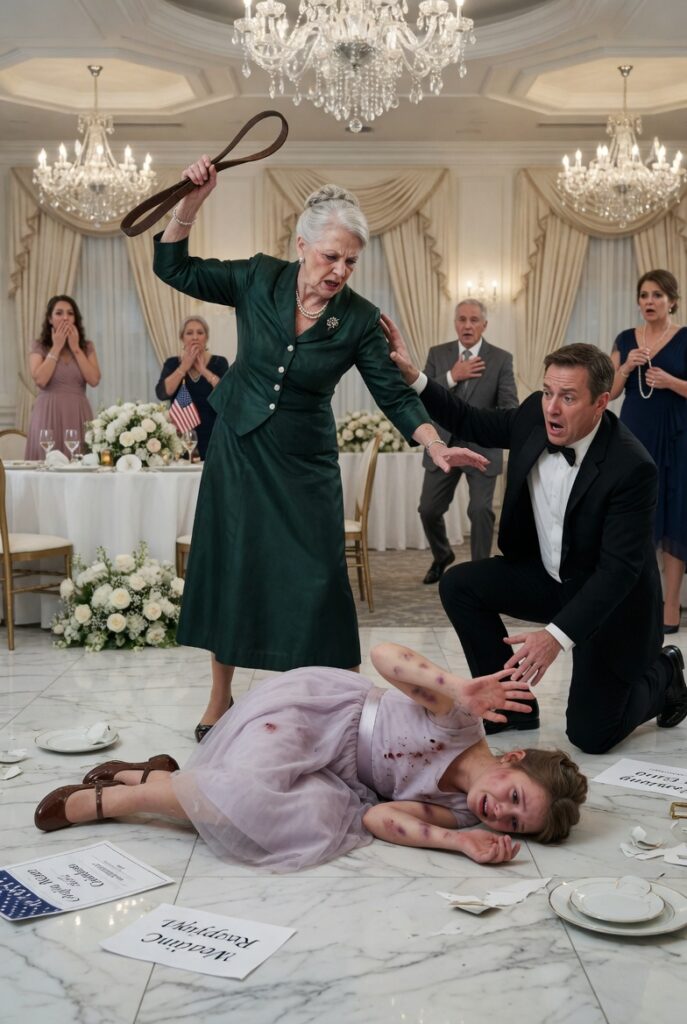
The first sound was not Ivy crying.
It was the thin leather whisper of Paige pulling the belt free from her dress loops.
That sound slid through the ballroom like something too ugly to belong beneath crystal chandeliers and white roses. Then the buckle clicked against her palm, bright and sharp under the golden lights, while fifty guests sat frozen in their seats.
For one terrible second, everyone pretended they did not understand what was happening.
Then Paige raised her arm.
And my eight-year-old daughter screamed.
Three weeks earlier, the invitation had arrived on cream-colored cardstock with raised gold lettering.
Forty years of marriage for Roger and Diane Crawford.
Formal attire required.
Reception at Hollow Creek Country Club.
Six o’clock sharp.
My husband, Marcus, saw it sitting on the kitchen counter and went quiet.
“Joanna,” he said, “we don’t have to go.”
He had never liked my family.
Not the comparisons. Not the polite little insults wrapped in smiles. Not the way my mother could look at me for half a second and make me feel like a child again.
But it was my parents’ anniversary.
And Ivy was only eight.
She still believed grandparents were supposed to be warm and safe because storybooks had taught her that families were soft places to land.
So I said yes.
That was the mistake I would replay in my mind for a long time.
The ballroom glittered the way expensive places do when they want people to forget what is hiding underneath.
Crystal chandeliers. Champagne-colored tablecloths. A string quartet near the windows. White roses piled so high on every table that guests had to lean sideways to speak around them.
At 6:14 p.m., according to the timestamp later printed on the country club incident report, we were escorted to Table 7.
In the back.
Near the kitchen doors.
Paige and her family were seated at Table 2, close enough to my parents that the photographer kept catching them in the same frame.
My mother, Diane, wore silver silk and a smile sharp enough to cut ribbon.
“Joanna,” she said, looking me over once. “You came.”
Not, I’m glad you’re here.
Not, you look beautiful.
Just, you came.
Marcus’s hand tightened around mine.
Ivy stood beside me in her pale blue dress, holding the little gift bag we had brought with both hands. Inside was a handmade card she had drawn herself. She had spent nearly an hour coloring tiny gold hearts around the words Happy Anniversary, Grandma and Grandpa.
My father, Roger, kissed the air beside my cheek and called Marcus “Mark” for the third time that year.
Marcus corrected him.
Dad laughed as if being corrected was the rude part.
Some families do not fall apart all at once.
They train you to recognize the sound of the fuse for years, then act shocked when the room finally fills with smoke.
Dinner began with filet mignon, sea bass, and a sommelier explaining wine like he was reading scripture.
Then came the speeches.
Dad’s business partner talked about discipline.
Aunt Felicity talked about sacrifice.
Then Paige stood in her designer dress and lifted her glass like she had been born expecting applause.
“Our parents taught us family hierarchy,” she said. “Some are born to lead, and others are meant to support.”
Polite laughter moved through the room.
Ivy looked up at me.
“What does hierarchy mean?” she whispered.
Before I could answer, Paige’s twelve-year-old son, Tanner, pushed back his chair and pointed at my daughter.
“Come help me with dessert.”
Then he grabbed Ivy by the arm.
He did not ask.
He grabbed her.
Marcus was on his feet before the chair stopped scraping.
“Absolutely not.”
Paige laughed lightly, as though we were all making too much of a harmless family tradition.
“He’s the eldest grandson,” she said. “The heir.”
My mother glided over, still smiling for the guests watching nearby.
“Tanner is the king of the family,” she said.
My father’s voice rolled across the table.
“She’ll learn her place.”
Ivy’s eyes filled with tears.
“Mom?”
I reached for her.
Paige yanked her back.
Then Paige took off her belt.
The room did not erupt immediately.
That was the worst part.
Forks hovered halfway to mouths. Wineglasses froze in midair. A waiter stood near the dessert cart with a silver coffee pot tilted just enough that one dark drop fell onto a saucer and spread like ink.
Aunt Felicity stared at the centerpiece as if the roses had suddenly become fascinating.
Fifty adults saw a grown woman raise a belt over an eight-year-old child.
Nobody moved.
I lunged forward, but my mother grabbed my arm with both hands.
Her nails dug through my sleeve.
“Don’t make a scene,” she hissed.
Marcus shoved his chair back so hard it toppled.
Dad stepped between him and Ivy, broad and red-faced.
“Stand down,” he barked.
The first strike landed across Ivy’s shoulder.
The sound split the room.
Ivy cried out so hard her voice broke.
Something cold moved through me then.
Not panic.
Not fear.
A mother’s rage does not always arrive screaming. Sometimes it comes quiet enough to let you notice everything: the vein pulsing in your father’s temple, your mother’s pearl bracelet pressing into your wrist, your sister’s painted nails wrapped around the belt like she had been waiting her whole life for permission to be cruel in public.
“Let her go,” I said.
Paige raised her arm again.
“Feed your brother or get out!” she shouted. “You’re useless!”
Ivy tried to crawl away.
Dad caught her around the waist.
He held my eight-year-old daughter down on the polished floor of a country club ballroom while Paige lifted the belt again.
Marcus shouted my father’s name, but two of Dad’s golfing friends grabbed him from behind.
Aunt Felicity hurried forward with a glass of ice water.
For one insane second, I thought she was going to help.
Instead, she threw it over Ivy’s face.
“Stop crying,” she snapped.
Ivy choked from the shock. Her wet hair stuck to her cheeks. Her small hands pressed against the floor, trying to push herself away.
I still remember the details because my mind chose them over breaking.
The overturned chair at Table 7.
Ivy’s blue hair ribbon beneath the dessert cart.
The printed seating chart folded beside my father’s plate.
The red mark rising on my daughter’s arm.
I twisted hard, and my mother lost her grip.
I did not slap her.
I did not scream.
I reached into Marcus’s jacket pocket because I knew exactly where he kept his phone.
But before I could unlock it, the ballroom doors opened.
The country club manager walked in holding a tablet.
The security feed was already playing.
Paige’s arm stopped in midair.
My father looked at the screen.
And for the first time in my life, Roger Crawford had nothing to say.
The tablet showed the angle from above Table 7 clearly enough that no one could pretend they misunderstood.
Ivy on the floor.
My father holding her down.
Paige with the belt raised.
My mother’s fingers locked around my arm.
Marcus struggling to reach his daughter.
The room changed temperature.
Paige lowered the belt half an inch, then lifted her chin as if she could still turn this into a lesson about respect.
My mother whispered, “Delete that.”
The manager did not blink.
His name tag said Nolan Pierce.
His hand was shaking, but he kept the tablet facing the room.
“Mrs. Crawford,” he said, “club policy requires immediate reporting when a child is harmed on the premises.”
That was the one thing my parents had not planned for.
Not my anger.
Not Marcus.
The cameras.
Then Nolan reached beneath the tablet and pulled out a printed incident form already clipped to a board.
It had the time, the table number, the witness count, and one line circled in blue ink:
MINOR VICTIM — ACTIVE PHYSICAL ASSAULT.
Aunt Felicity made a sound like she had swallowed glass.
Dad’s face drained first.
Then Paige’s.
My mother stared at the form as if paper had betrayed her more deeply than the people in the room.
Marcus finally broke free from the men holding him and moved toward Ivy with both hands open.
Dad stepped sideways, still trying to block him.
That was when Ivy lifted her soaked face from the floor and whispered, “Daddy… don’t let them keep me here.”
Marcus froze.
The whole room heard it.
Then Nolan looked past my father toward the open ballroom doors and said, “Officers, this is the family I called about.”
My mother turned toward me, furious and suddenly afraid.
“Joanna,” she said, “you will not ruin this family.”
I looked at my daughter on the floor.
Then I looked at the belt in Paige’s hand.
And I answered, “You already did.”
Two police officers entered the ballroom.
For a moment, nobody spoke.
All the things my parents valued most were suddenly useless.
Money could not erase the security footage.
Status could not silence the manager.
Their friends could not laugh this away.
My father tried first.
“This is a private family matter,” he said, straightening his jacket. “You’re interrupting a formal event.”
One officer looked at Ivy on the floor, then at Paige, then at my father.
“A child is involved,” she said. “That makes it our matter now.”
Paige started crying immediately.
Not because she was sorry.
Because people were watching her lose control of the story.
“She was being disrespectful,” Paige said. “She refused to help Tanner. We were correcting behavior.”
Marcus knelt beside Ivy and wrapped his jacket around her trembling shoulders.
“She is eight,” he said, his voice low and steady. “She was scared.”
I dropped to my knees beside them.
Ivy folded into me so hard I could feel every shiver.
“I’m sorry,” she whispered.
That broke something in me worse than the scream had.
My child had been humiliated and frightened in front of strangers, and her first instinct was to apologize.
I held her face gently in my hands.
“No, baby,” I said. “You did nothing wrong. Not one thing.”
My mother stepped toward us.
“Ivy, sweetheart,” she said in that polished voice she used in public, “Grandma didn’t mean—”
Marcus stood.
“Do not come closer.”
My mother’s face hardened.
“You have no right to speak to me that way.”
“I have every right,” Marcus said. “You stood there and helped them.”
The officer asked Ivy if she needed medical attention.
Ivy nodded without looking up.
The room shifted again.
Some guests looked down.
Some looked toward the exits.
Some suddenly found courage now that the police were there.
“I saw it,” one woman said softly.
Then another voice: “So did I.”
A waiter raised his hand. “I was standing near the dessert cart. The child tried to get away.”
Nolan handed the tablet and the incident report to the officers.
My father’s business partner murmured, “Roger, maybe you should cooperate.”
Dad turned on him with a look so sharp the man stepped back.
But the old power was gone.
The room had seen too much.
Paige was asked to hand over the belt.
She refused at first.
Then the officer repeated the request in a voice that left no room for argument.
Paige dropped it onto a white tablecloth.
The buckle landed beside a slice of untouched anniversary cake.
The image stayed with me.
Something meant for celebration sitting beside the proof of what my family had become.
We left through the side entrance.
Not because we were ashamed.
Because Ivy was shaking too badly to walk through the crowd.
Marcus carried her against his chest while I walked beside them, holding her wet ribbon in my hand.
Behind us, my mother called my name.
“Joanna,” she said, softer now. “Please. Think about what this will do to us.”
I stopped.
For years, that tone had worked on me.
It was the voice that made me apologize after being insulted.
The voice that made me show up after promising myself I was done.
The voice that made me explain away Paige’s cruelty as stress, Dad’s control as tradition, Mom’s coldness as elegance.
But that night, I looked at my daughter’s small face resting against Marcus’s shoulder, and the spell finally broke.
“I am thinking about what this did,” I said. “To Ivy.”
Then I walked out.
At the hospital, Ivy sat on the examination bed with a blanket around her shoulders and Marcus’s hand wrapped around hers.
A nurse spoke gently to her.
A doctor checked the marks and wrote everything down.
A child advocate arrived before midnight.
I answered questions until my throat felt raw.
Had anything like this happened before?
Had my family ever treated Ivy harshly?
Had we ever felt pressured to leave her alone with them?
Every answer felt like a door opening to a room I had avoided for years.
No, Paige had never done that before.
Yes, my family had always treated Tanner as more important.
Yes, Ivy had been made to feel small.
Yes, I had noticed.
No, I had not stopped it soon enough.
That was the part that kept me awake later.
Not the police.
Not the statements.
Not even Paige’s voice echoing in my head.
It was the memory of Ivy asking what hierarchy meant.
I should have taken her home right then.
But guilt is only useful if it becomes protection.
So I made decisions.
That night, Marcus and I gave our statements.
The next morning, I filed for an emergency protective order.
By the end of the week, my parents and Paige were ordered to have no contact with Ivy.
My mother called from blocked numbers.
My father sent messages through relatives.
Aunt Felicity wrote that “families should handle things privately.”
I deleted every message.
Then the video leaked.
Not by us.
Not by Nolan.
One of the guests had recorded part of the incident on her phone after hearing Ivy cry out. She sent it to another relative. By Monday morning, half the family had seen enough to stop defending my parents.
The elegant anniversary party became a scandal.
My father resigned from two charity boards.
My mother stopped attending church for a while because, for once, people whispered when she entered instead of when she left.
Paige’s husband moved out with Tanner three months later.
That surprised me.
What surprised me more was the letter he sent.
He wrote that Tanner had been taught to believe love meant being ranked above others, and he was afraid of what kind of man his son would become if no one stopped it.
I read that letter three times.
Then I put it away.
Because my healing could not depend on whether other people finally understood.
The legal process took months.
Paige accepted a plea agreement that included supervised probation, mandatory counseling, and a no-contact order with Ivy.
My father was charged for restraining her.
My mother and Aunt Felicity were required to cooperate with investigators and attend court-ordered family accountability sessions. None of it felt like enough. Nothing could give Ivy back the feeling of safety she had lost that night.
But it was something.
It was a record.
It was proof.
It was the first time the Crawfords could not rename cruelty as discipline and force everyone else to clap.
Ivy started therapy.
At first, she barely spoke.
She drew pictures instead.
For weeks, every drawing had a ballroom in it.
A blue dress.
A big chandelier.
A door.
The door was always closed.
Then, slowly, the drawings changed.
The door opened.
Then Marcus appeared in the doorway.
Then I did.
Then one day, she drew herself outside the ballroom, standing in sunlight, holding a blue ribbon.
When she showed it to me, I cried in the parking lot before driving home.
A year later, my parents sent another invitation.
This one came in a plain white envelope.
No gold lettering.
No expensive loops beneath my thumb.
Inside was a request for a private meeting.
My mother had written it by hand.
She said they wanted to apologize.
She said they were getting older.
She said family should not stay broken forever.
I sat at the kitchen table and read it twice.
Then Ivy walked in with her backpack, saw the envelope, and asked, “Is it from Grandma?”
I did not lie.
“Yes.”
Her shoulders tensed.
“Do I have to see them?”
“No,” I said immediately. “Never unless you choose to.”
She looked at me for a long moment.
Then she nodded.
“I don’t choose that.”
So I tore up the letter.
Not dramatically.
Not angrily.
Just quietly, into four pieces, then eight, then sixteen.
Marcus took the pieces and dropped them into the trash.
That night, Ivy slept with her door open, as she often did, and the hallway light on.
I stood there watching her breathe, thinking of the little girl in the pale blue dress who had once believed every grandparent was safe.
I could not undo what happened.
I could not erase the sound of the belt sliding free or the way fifty people froze when my daughter needed one brave adult to move.
But I could be that adult for the rest of her life.
I could teach her that love does not demand silence.
Family does not mean surrender.
Respect does not belong only to the loudest person in the room.
And no child should ever have to earn safety by knowing her place.
My father called it discipline.
My mother called it grace.
My sister called it hierarchy.
But Ivy and I learned the truth that night.
Sometimes the family you come from is not the family you are meant to protect.
Sometimes the bravest thing a mother can do is walk out of a glittering room, carrying her child, and never look back.
━━━━━━━━━━━━━━━━━━━━━━━━━━━━━━━━━━━━━━