Continue…
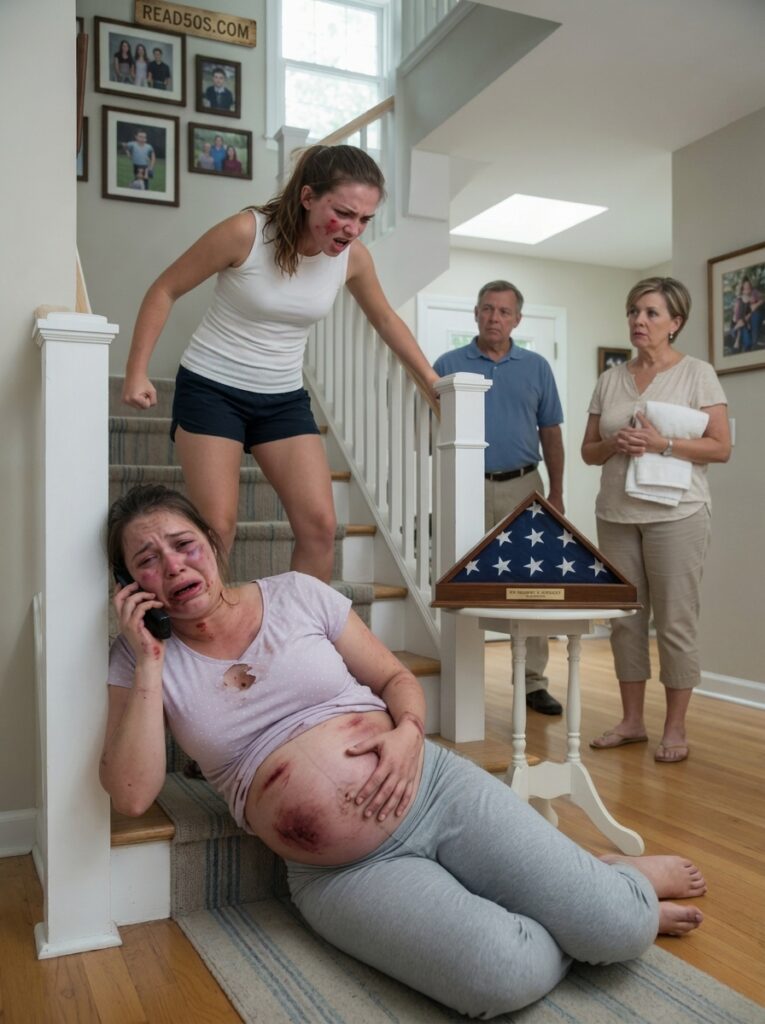
For the first time that afternoon, my mother truly looked afraid.
Not because I was bleeding.
Not because her unborn grandson might be in danger.
Because someone outside that house was listening.
That was the difference between my family’s version of love and Marcus’s.
My family cared about appearances.
Marcus cared about whether I was breathing.
My mother straightened.
“Marcus,” she said, forcing her voice into something soft and wounded, “this is not what Emma is making it sound like.”
Marcus did not raise his voice.
That made him scarier.
“Put the phone on speaker.”
“No.”
“Emma,” he said.
I pressed the speaker button with a shaking thumb.
His voice filled the hallway.
“Call 911. Now.”
My father finally muted the television.
The sudden silence from the living room felt obscene.
Khloe crossed her arms.
“She fell. Nobody pushed her.”
Marcus answered before I could.
“Good. Then you’ll have no problem saying that on a recorded call while an eight-month pregnant woman is bleeding at the bottom of your stairs.”
Khloe’s face paled.
My mother looked at my father.
My father stood slowly, not because he cared, but because the situation had become visible.
“Emma,” he said, “you need to calm down.”
I almost smiled.
Even then.
Even with blood on the carpet.
Even with pain pulsing through my whole body.
He still thought my calm was the emergency.
“My wife does not need to calm down,” Marcus said. “She needs an ambulance.”
My mother whispered, “We can drive her.”
“No,” Marcus said. “You cannot. She fell down stairs. She is pregnant. She is bleeding. She does not move until paramedics arrive.”
The word paramedics seemed to finally break through my mother’s denial.
She grabbed her phone with trembling fingers and dialed.
I watched her say the address.
I watched her say “pregnant daughter.”
I watched her glance at Khloe before saying “fall.”
Marcus heard it.
“So now it’s a fall,” he said.
My mother flinched.
Then Marcus spoke to me again.
“Emma, listen to me. I’m on my way. Stay still. Keep your hand on the baby if it helps. Breathe slow.”
A contraction-like pain tightened low in my stomach.
I gasped.
Khloe stepped back.
For the first time, she looked scared of what she had done.
Not sorry.
Scared.
There is a difference.
“Emma?” Marcus said sharply.
“I’m here.”
“Talk to me.”
“The baby moved.”
“Good. That’s good. Keep talking to me.”
I stared at the ceiling.
The hallway light buzzed.
My mother stood uselessly near the door.
My father hovered in the living room entry.
Khloe stayed at the bottom of the stairs like the scene had finally trapped her inside it.
“I’m scared,” I whispered.
Marcus’s voice softened.
“I know, baby. I know. But you’re not alone anymore.”
Not alone anymore.
That sentence held me together until the sirens came.
The paramedics arrived first.
Then police.
The moment they entered, the house changed.
My mother began crying.
Khloe began talking too fast.
My father suddenly became concerned.
All three of them tried to crowd the hallway with their own version of events.
“She slipped.”
“She’s very emotional.”
“My younger daughter is going through a divorce.”
“It was just a family argument.”
The lead paramedic knelt beside me and gently placed two fingers at my wrist.
“Emma, I need you to look at me,” she said. “Did anyone push you?”
My mother sucked in a breath.
Khloe froze.
My father said, “That’s unnecessary.”
The paramedic did not look at him.
She looked at me.
I thought of the two babies I had lost.
I thought of the nursery Marcus had painted soft green.
I thought of the apology they forced out of me while I lay bleeding at the bottom of the stairs.
And I said, “Yes.”
The hallway went silent.
“My sister pushed me.”
Khloe shouted, “That’s not true!”
One officer stepped between her and me.
The paramedic kept her eyes on mine.
“Are you having abdominal pain?”
“Yes.”
“Any bleeding?”
“Yes.”
Her face changed.
Professional.
Controlled.
But urgent.
“We need to transport now.”
They stabilized my neck, checked my blood pressure, and moved me carefully onto a stretcher.
I cried when they lifted me, not from embarrassment, not from weakness, but because every inch of movement sent fear through my body.
Marcus arrived as they were loading me into the ambulance.
His shirt was untucked.
His face was white.
He reached for my hand before he reached for anyone else.
“I’m here,” he said.
I broke then.
Just a little.
“Marcus, the baby—”
“We’re going to the hospital,” he said. “We’ll handle one second at a time.”
He climbed into the ambulance with me.
My mother tried to follow.
Marcus turned.
“No.”
She blinked.
“I’m her mother.”
He looked at the blood on my jeans, then at the officers standing in the doorway.
“Then you should have acted like it before I answered the phone.”
The ambulance doors closed on her face.
At the hospital, everything became bright lights and fast hands.
A fetal monitor was placed over my stomach.
For the longest three seconds of my life, there was only static.
Then a heartbeat filled the room.
Fast.
Steady.
Alive.
I covered my face and sobbed.
Marcus leaned over me, forehead pressed to my hand.
“Thank God,” he whispered.
The doctor explained that I had injuries from the fall, including a sprained ankle, bruising, and a fractured wrist bone, but the baby’s heart rate was strong.
They needed to monitor us closely.
There was still risk.
I was not out of danger.
But my son was alive.
Our son was alive.
Marcus stayed beside me all night.
Every time the monitor shifted, his eyes snapped toward the screen.
Every time I winced, his hand tightened.
Near dawn, an officer came to take my statement.
Marcus asked if I wanted him to leave.
I said no.
Then I told the truth.
The credit card.
The Vegas trip.
Khloe following me upstairs.
The sentence about finally staying pregnant.
The push.
The blood.
The forced apology.
The phone call.
I had spent my whole life editing the truth so my family could survive their own ugliness.
That morning, I stopped editing.
The officer had already obtained the recording from Marcus.
He told me the call captured enough to support my statement.
My mother saying apologize.
My father refusing to help.
Khloe denying and then falling silent when Marcus mentioned police.
Their voices.
Their choices.
Evidence.
Khloe was questioned.
At first, she claimed I slipped.
Then she claimed she barely touched me.
Then she claimed I had provoked her.
Each version moved closer to the truth without ever becoming remorse.
My parents tried to explain.
My mother said she panicked.
My father said he thought I was exaggerating.
Then the officer asked why neither of them called an ambulance before Marcus demanded it.
There was no good answer.
There never had been.
I stayed in the hospital for three days.
Three days of monitoring.
Three days of Marcus sleeping in a chair.
Three days of doctors checking my son while I tried not to imagine the fall over and over again.
On the second day, my mother came to the hospital.
The nurse asked if I wanted to see her.
For once, someone asked me.
Not her.
Not Marcus.
Me.
I almost said no.
Then I said yes, but only with Marcus in the room.
My mother entered holding flowers from the gift shop.
Pink lilies.
Her eyes were swollen.
She looked smaller than I remembered.
“Emma,” she whispered.
I waited.
“I’m sorry,” she said.
The words sounded like something she had rehearsed in the elevator.
“For what?” I asked.
She blinked.
“What?”
“For what are you sorry?”
Her fingers tightened around the plastic wrapping.
“For everything.”
I shook my head.
“No. Say it.”
Marcus stayed silent beside me.
My mother’s lips trembled.
“I’m sorry I told you to apologize while you were bleeding.”
I waited.
“I’m sorry I protected Khloe.”
I waited again.
Tears spilled down her face.
“I’m sorry I did not call for help.”
That was the first apology that sounded like truth.
But truth did not mean access.
“Thank you for saying that,” I said.
Hope flashed in her face too quickly.
“But you are not welcome near me or my baby right now.”
Her face crumpled.
“Emma, please.”
“No.”
“But I’m your mother.”
I looked at her.
“No. You are a woman who watched her pregnant daughter bleed and worried about Khloe’s feelings.”
The flowers shook in her hands.
Marcus stood then.
“The visit is over.”
My mother left crying.
I cried too after she was gone.
Not because I regretted what I said.
Because sometimes choosing yourself feels like grieving the family you wished you had.
Khloe did not come.
She sent one text.
You’re really going to ruin my life over an accident?
I stared at it for a long time.
Then I forwarded it to the officer.
Marcus said nothing when I did.
He only kissed my forehead.
Six weeks later, I gave birth to our son.
He came early, small but fierce, with dark hair, loud lungs, and a grip strong enough to make the nurse laugh.
We named him Jonah.
The first time they placed him on my chest, I thought about the staircase.
The blood.
The apology.
The phone call.
Then I looked at his tiny face and realized something.
He would never grow up watching me apologize for being hurt.
That cycle ended with me.
The legal process continued after Jonah was born.
Khloe faced consequences for what she did.
My parents faced consequences in a different way.
Not every failure becomes a charge, but every failure can become a boundary.
We cut contact.
Completely at first.
Later, my father sent letters.
My mother entered counseling.
Khloe continued to blame me for a long time.
That surprised no one.
The first year of Jonah’s life was not easy.
Healing never is.
I had nightmares about stairs.
I flinched when people raised their voices.
I cried the first time Jonah rolled near the edge of the bed because my body remembered falling before my mind could stop it.
Marcus was patient.
Not perfect.
Patient.
He moved our bedroom downstairs for three months because climbing stairs made me shake.
He installed a baby gate before Jonah could even crawl.
He never once told me I was overreacting.
One night, after Jonah finally fell asleep, I stood at the bottom of our own staircase and stared upward.
Marcus found me there.
“You okay?”
I nodded, then shook my head.
“I hate that I apologized.”
He came beside me.
“You survived.”
“I said sorry to her.”
“You did what you had to do until you could call me.”
That was when I cried.
Because he was right.
That apology was not surrender.
It was strategy.
It bought me the seconds I needed to reach my phone.
One phone call changed everything, yes.
But not because Marcus saved me like some storybook hero.
He helped.
He recorded.
He came.
He stood between me and the people who had taught me to shrink.
But the real change began when I decided my baby and I were worth protecting, even if it meant exposing my family.
Years later, Jonah became a toddler who climbed everything.
Couches.
Chairs.
My legs.
The bottom two stairs before I could stop him.
Every time, my heart jumped.
But every time, I breathed through it.
One afternoon, he sat on the second step, holding a toy truck, and looked up at me with Marcus’s eyes.
“Mama, up?”
I smiled through the tightness in my chest.
“Not yet, baby. We go together.”
I sat beside him on the step.
The carpet was different in our house.
Soft gray.
Clean.
No brown specks.
No blood.
No family pretending not to see.
Jonah leaned against me, warm and alive, and drove his toy truck across my knee.
For the first time, stairs did not feel like the place where my family almost ended.
They felt like a place my son would learn to climb safely.
With me beside him.
And if he ever fell, he would never have to apologize for bleeding.
The End.
- My Son-in-Law Humiliated My Daughter in a Crowded Restaurant—Then His Mother Laughed and Called It “Discipline”
 PART 1 The instant Victor wrapped his fist around my daughter’s hair, every conversation in the restaurant stopped. He forced Emily’s head toward the table and said, “Lower your head …
 - My Son-in-Law Humiliated My Daughter in a Crowded Restaurant—Then His Mother Laughed and Called It “Discipline”PART 1 The instant Victor wrapped his fist around my daughter’s hair, every conversation in the restaurant stopped. He forced Emily’s head toward the table and said, “Lower your head …
- My Son-in-Law Humiliated My Daughter in a Crowded Restaurant—Then His Mother Laughed and Called It “Discipline”PART 1 The instant Victor wrapped his fist around my daughter’s hair, every conversation in the restaurant stopped. He forced Emily’s head toward the table and said, “Lower your head …
- My Son-in-Law Humiliated My Daughter in a Crowded Restaurant—Then His Mother Laughed and Called It “Discipline”PART 1 The instant Victor wrapped his fist around my daughter’s hair, every conversation in the restaurant stopped. He forced Emily’s head toward the table and said, “Lower your head …
- My Son-in-Law Humiliated My Daughter in a Crowded Restaurant—Then His Mother Laughed and Called It “Discipline”PART 1 The instant Victor wrapped his fist around my daughter’s hair, every conversation in the restaurant stopped. He forced Emily’s head toward the table and said, “Lower your head …