Continue…
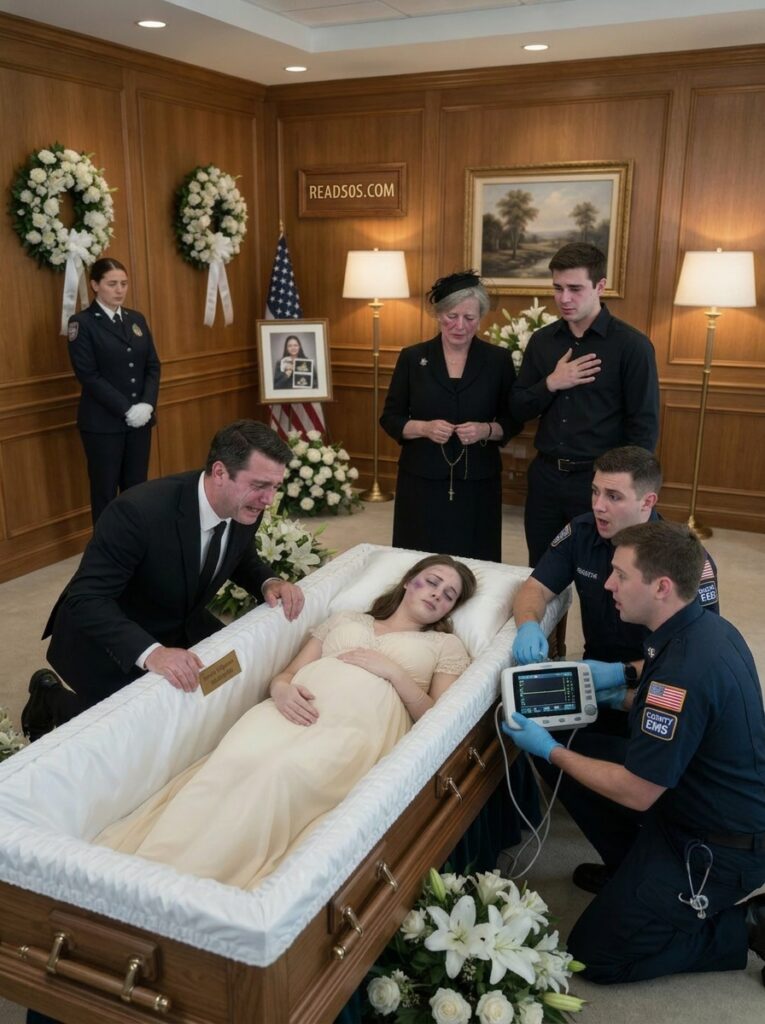
The room changed after Mateo said those words.
Not loudly.
Not dramatically.
But completely.
One moment, it had been a place prepared for goodbye.
The next, it became an emergency room without walls.
The doctor moved fast.
“Get her out of the coffin,” he ordered. “Carefully. Support the neck and spine. I need oxygen, monitor leads, and a transport board now.”
The attendants obeyed with trembling hands.
Mateo did not move until a paramedic gently touched his arm.
“Sir, we need space.”
“She’s alive?” Mateo asked.
The doctor did not lie to him.
“She is not responding the way we need her to,” he said. “But the baby has a heartbeat, and there is a weak maternal sign in the earlier hospital form. That means someone rushed this process before the truth was settled.”
Mateo looked at Héctor.
Héctor was inching backward toward the side wall.
A security guard stepped in front of him.
“Nobody leaves,” the doctor repeated, louder this time.
Doña Carmen collapsed into a chair, one hand pressed to her mouth.
“My daughter,” she whispered. “My daughter…”
But Mateo could not tell whether she was grieving, guilty, or afraid.
Maybe all three.
Valeria was lifted onto the transport board.
Her face remained still.
Too still.
The fetal monitor chirped again, thin and stubborn, as if Diego himself were insisting the room listen.
Mateo walked beside the stretcher as they moved toward the ambulance.
Héctor tried to speak behind him.
“Mateo, wait. You don’t understand.”
Mateo turned.
The look on his face made Héctor stop.
“You’re right,” Mateo said. “I don’t. But I will.”
The ambulance doors slammed shut.
This time, Mateo climbed in.
No one stopped him.
At Hospital General de Xoco, the emergency staff moved Valeria into a trauma bay.
The same hospital whose intake form had been hidden beneath a cremation authorization.
Mateo stood outside the doors while doctors shouted instructions through masks and gloves.
He watched through a small glass window as they worked over his wife.
He watched a nurse place both hands over Valeria’s belly to check Diego again.
He watched the doctor’s face tighten.
Then the doors closed fully.
Mateo was left in the hallway with bloodless hands, a ruined suit, and a single sheet of paper folded in his pocket.
MATERNAL PULSE WEAK BUT PRESENT.
That sentence was no longer a medical note.
It was an accusation.
A police officer arrived twenty minutes later.
Then another.
Then a hospital administrator with pale lips and a folder clutched too tightly against her chest.
Mateo gave them everything he had.
The cremation authorization.
The hidden intake form.
The names.
The time.
The moment Héctor tried to leave.
The words Héctor had whispered.
That paper shouldn’t be here.
When the officer heard that, his pen stopped moving.
“Who is Héctor to your wife?”
“Her brother,” Mateo said. “And he had a spare key to our apartment.”
The officer looked up.
“Why?”
“Because I trusted him.”
The word tasted bitter.
Trust.
So many terrible stories begin with that word.
While Valeria was in surgery, Mateo’s mind began moving backward.
Not to the crash.
Before it.
To the week leading up to it.
Valeria had been restless.
She checked her phone often.
She moved the blue folder of ultrasound pictures from the bedroom drawer to her work bag, then back again.
She had asked Mateo if their apartment deed was stored safely.
He had laughed gently and said, “Why are you thinking about paperwork? We’re about to have a baby.”
She had smiled, but it had not reached her eyes.
“There are things that should be clear before Diego comes,” she had said.
Mateo had thought she meant insurance.
Hospital bags.
Birth certificates.
Now he wondered what she had truly been trying to say.
His phone buzzed.
A delayed message appeared, one that had not come through before because his phone had been off in the crematorium chapel.
It was from Valeria.
Sent the night before the crash.
9:07 p.m.
If something feels wrong tomorrow, check the blue folder.
Mateo stared at the screen until the letters blurred.
Then he ran.
He did not wait for permission.
He drove to their apartment with a police officer following behind him.
The rain had stopped, but the city still smelled wet and electric.
His hands shook so badly he dropped the keys twice before opening the door.
Inside, the apartment looked exactly as Valeria had left it.
A mug near the sink.
A folded baby blanket over the chair.
A tiny pair of socks on the table.
The ordinary cruelty of interrupted life.
The blue folder was in the bedroom drawer.
Under the ultrasound photos, beneath the hospital forms, Mateo found a smaller envelope.
Inside were printed copies of documents.
A draft property transfer.
A private clinic referral.
A notarized authorization bearing Valeria’s signature.
But the signature was wrong.
Close.
Careful.
Almost believable.
Not hers.
There were also screenshots from Héctor’s messages.
One showed him writing to someone named Lozano.
She won’t sign. We need another way before the child is born.
Another said:
If the baby comes, her husband gets more control. Finish the transfer first.
Mateo felt the room tilt.
The property was a small building Valeria had inherited from her father before she married him.
Three rental units in Coyoacán.
Not glamorous.
But valuable.
Valeria had always said the income would one day help pay for Diego’s school.
Héctor had wanted to sell it for years.
Doña Carmen had said, “Your brother knows business better than you.”
Valeria had refused.
Now the whole pattern appeared.
The fake authorization.
The private clinic referral.
The urgency before Diego’s birth.
The crash.
The quick paperwork.
The immediate cremation.
Mateo sat on the floor with the documents spread around him like broken glass.
The police officer in the doorway spoke softly.
“Mr. Vargas, you need to come back to the hospital.”
Mateo looked up.
“Why?”
The officer hesitated.
“Your wife is out of surgery.”
He could not read the officer’s face.
That terrified him more than words.
When Mateo returned to the hospital, the emergency doctor met him in the corridor.
His gloves were gone.
His eyes were tired.
“We delivered the baby,” he said.
Mateo stopped breathing.
“Diego?”
“He is alive,” the doctor said. “Very premature. Very fragile. But alive. He has been taken to the neonatal unit.”
Mateo pressed one hand to the wall.
The hallway bent.
“And Valeria?”
The doctor’s expression changed.
That was how Mateo knew before he heard the answer.
“We did everything we could,” the doctor said softly.
No.
The word did not come from Mateo’s mouth.
It came from somewhere deeper.
“No.”
“She had severe injuries from the crash and delayed intervention,” the doctor continued, his voice heavy. “If she had remained under care when that first weak pulse was noted, we might have had more time. I cannot promise an outcome. But she should never have been released for final arrangements so quickly.”
Mateo closed his eyes.
For a moment, he heard Valeria’s voice in their kitchen.
Promise me you’ll teach him to be gentle before the world teaches him to be hard.
Then he heard Diego’s heartbeat in the crematorium.
Thin.
Mechanical.
Holy.
His wife was gone.
But their son had fought his way into the world from inside a lie.
Mateo saw Diego for the first time through the glass of the neonatal unit.
He was tiny.
Too tiny.
Wrapped in tubes and warm light.
His chest moved in small, determined lifts.
A nurse stood beside Mateo.
“He is strong,” she said.
Mateo could not speak.
He placed one hand against the glass.
“Your mother saved you,” he whispered.
And he meant it.
Because Valeria had left the blue folder.
Valeria had sent the message.
Valeria had moved inside the coffin just enough for Mateo to notice what everyone else wanted buried.
The investigation moved quickly after that.
Héctor was detained first.
He claimed grief had confused him.
Then he claimed the hospital form had been a clerical error.
Then he said Mateo was trying to steal Valeria’s family property.
But the documents in the blue folder spoke louder than he did.
The forged authorization.
The messages.
The clinic referral.
The rushed cremation request.
The hidden hospital form.
The officer who had heard Héctor’s statement at the crematorium wrote it down word for word.
That paper shouldn’t be here.
Doña Carmen tried to blame Héctor alone.
She cried in front of cameras outside the prosecutor’s office and said she was only a grieving mother.
But her signature was on one of the release documents.
Her phone records placed her in repeated contact with the same notary who had processed the questionable transfer.
She had known enough.
Not everything, perhaps.
But enough to choose silence over her daughter.
And silence, Mateo learned, can be a kind of signature.
A doctor from Hospital General de Xoco also came under investigation for releasing Valeria’s body while the earlier note clearly stated there had been a weak maternal pulse and unstable condition.
Whether it was negligence, pressure, or payment, Mateo did not know at first.
But the truth began to widen.
People had moved too fast because they needed Valeria gone before anyone checked the papers.
They had mistaken grief for blindness.
They had mistaken a husband’s heartbreak for weakness.
They had mistaken a coffin for the end of evidence.
They were wrong.
Mateo buried Valeria properly one week later.
Not in a rushed ceremony.
Not under the pressure of people who had tried to erase the truth.
In a small cemetery with rain clouds over the hills and white flowers beside her photograph.
Diego was still in the hospital, too fragile to leave, but Mateo brought a tiny blue blanket from the neonatal unit and placed it beside Valeria’s picture.
“I kept my promise halfway,” he whispered to her. “He is here.”
His voice broke.
“I don’t know how to do the rest without you.”
A breeze moved through the flowers.
No answer came.
But for the first time since the crematorium, the silence did not feel like a wall.
It felt like a task.
Raise Diego.
Protect the truth.
Do not let the world make him hard.
The next months were brutal and tender.
Mateo lived between the neonatal unit, the prosecutor’s office, and the apartment where Valeria’s things still waited for her.
Diego fought through infections, breathing scares, and nights when nurses spoke too softly near his incubator.
Mateo learned the language of monitors.
He learned how to wash his hands up to the elbows.
He learned how to touch his son through openings in the incubator, with one finger resting gently against a foot smaller than his thumb.
“Hi, Diego,” he would whisper. “It’s Papa. I’m here.”
At first, Diego did not react.
Then one morning, his tiny toes curled around Mateo’s finger.
Mateo cried so hard a nurse brought him a chair.
Three months later, Diego came home.
He came home to the apartment where Valeria had folded his onesies.
To the blue folder that had saved his life.
To the kitchen where she had laughed two days before everything broke.
Mateo hung one photo above the crib.
Valeria smiling in a yellow dress, one hand on her belly.
He told Diego about her every night.
Not only how she died.
Never only that.
He told him how she sang badly while cooking.
How she taught children to write their names.
How she cried at commercials with old dogs.
How she believed tenderness was not weakness.
The trial took longer.
Héctor’s attorney argued that the crash was an accident and the property documents were unrelated.
But the timeline destroyed him.
Valeria discovered the papers.
She photographed them.
She sent the message.
The crash happened the next day.
The hospital intake form showed instability.
The family signed for immediate cremation.
The hidden document appeared beneath the authorization sheet.
The forged transfer was filed shortly after.
Piece by piece, the lie lost its shape.
Héctor and the others involved were held accountable.
The property transfer was voided.
Valeria’s building was protected for Diego.
The medical release was reviewed, and the people who had failed to follow proper procedure faced consequences.
None of it brought Valeria back.
Justice never has that kind of power.
But it gave Mateo something he could one day give his son.
The truth.
Not rumors.
Not whispers.
Not a family story polished by guilty mouths.
The truth.
On Diego’s first birthday, Mateo took him to Valeria’s grave.
The baby was still small for his age, but healthy now, with bright eyes and a serious little frown that made Mateo laugh through tears.
He placed Diego on a blanket beside the flowers and opened the blue folder.
Inside were the ultrasound pictures.
The hospital papers.
A copy of Valeria’s final message.
And a letter Mateo had written for Diego to read when he was older.
Your mother loved you before you took your first breath. She fought for you when she could no longer speak. Everything I do now is because of the promise I made to her and to you.
Diego slapped one tiny hand against the paper, wrinkling the edge.
Mateo smiled.
“Careful,” he said softly. “That’s evidence, little man.”
Then he laughed.
A real laugh.
The first one in months.
Years later, when Diego was old enough to ask why his mother was in the photograph but not at breakfast, Mateo told him the truth in pieces he could carry.
At five, Diego learned that his mother loved him very much.
At seven, he learned that she had been hurt in a crash but helped save him.
At ten, he learned that some adults had lied and that brave people told the truth.
At sixteen, he read the blue folder.
By then, the paper had softened at the corners.
The ink had faded slightly.
But the truth remained.
Diego sat at the kitchen table for a long time, silent.
Then he looked at Mateo.
“She knew?”
Mateo nodded.
“She knew something was wrong. She left us a path.”
Diego’s eyes filled.
“And you opened the coffin.”
Mateo closed his eyes.
Even after sixteen years, the memory could still bring the smell of copal smoke back into the room.
“I asked to see her one more time,” he said.
Diego looked down at the folder.
Then at the photo of Valeria on the wall.
“She saved me.”
“Yes,” Mateo whispered. “She did.”
Diego stood and walked to the photograph.
For a moment, he said nothing.
Then he touched the frame gently.
“I’ll be gentle,” he said.
Mateo’s chest tightened.
“What?”
Diego turned back to him.
“You said she wanted you to teach me before the world made me hard.” His voice shook. “You did.”
Mateo covered his mouth with one hand.
Because sometimes healing does not arrive as justice, or punishment, or even answers.
Sometimes it arrives as a son becoming the promise his mother asked for.
The crematorium had almost turned a lie into ashes.
A family secret had almost disappeared behind paperwork, signatures, and wet eyes.
But love noticed what protocol missed.
A father asked for one last look.
A baby moved.
A hidden form fell into the light.
And the truth, buried too quickly, rose before the fire could touch it.
The End.
- ON MY WEDDING DAY, I SHOWED UP WITH A BRUISED EYE… THEN MY FIANCÉ SMILED AND SAID, “IT’S SO SHE LEARNS”
 On the morning of her wedding, Valeria Salgado stood in front of the bridal suite mirror with concealer layered over her cheekbone and her swollen left eye. The makeup artist …
 - MY HUSBAND LEFT ME IN LABOR FOR HIS CAREER — BUT THE NEIGHBOR HE MOCKED BECAME THE ONE WHO SAVED US
 “I can’t pause my career for a hypothetical,” Ryan said, checking his passport while I sat doubled over on the sofa. I stared at him, one hand pressed against my …
 - CUT OFF MY ARM! THE BOY BEGGED THROUGH TEARS — HIS FATHER THOUGHT HE WAS LOSING HIS MIND UNTIL THE NANNY BROKE THE CAST AND FOUND THE TRUTH
 PART 1 “If you don’t stop screaming right now, I swear I’ll call the doctor first thing tomorrow and have you taken somewhere they can control this behavior.” Alejandro’s voice …
 - AT MY WEDDING, MY PARENTS CHOSE MY SISTER’S RICH HUSBAND OVER ME… THEN THE CHAPEL DOORS OPENED AND THEY LEARNED WHO MY FIANCÉ REALLY WAS
 The first thing I noticed was the sound. Crystal glasses clinking somewhere deep inside the steakhouse private room while I sat alone in a bathroom stall at my own rehearsal …
 - A 65-YEAR-OLD WOMAN THOUGHT SHE WAS FINALLY PREGNANT… BUT WHEN LABOR BEGAN, THE DOCTOR SAW SOMETHING THAT LEFT HIM SPEECHLESS
 At 65 years old, Margaret Hale saw two bold lines on a pregnancy test. For several seconds, she simply stood in the bathroom, staring at it. The window was open …