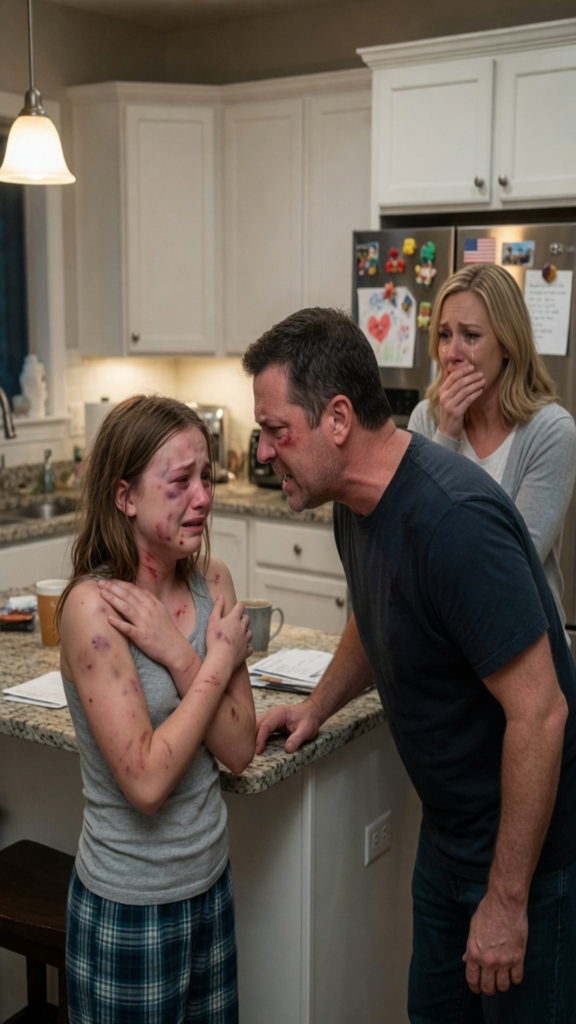
Continue…
The first officer arrived twelve minutes later.
I remember because the clock above the exam-room sink read 12:19 a.m. when Dr. Ellis stepped back inside with a woman in a dark jacket beside him.
She was not in uniform.
Her badge hung from her belt.
“My name is Detective Nora James,” she said. “Lily, I’m here to make sure you’re safe.”
Safe.
That word felt too big for the room.
My mother came in behind her, eyes red, voice already shaking.
“This is unnecessary,” she said. “She fell. My daughter is clumsy. She’s always been clumsy.”
Detective James did not look away from me.
“Lily,” she said, “do you want your mother in the room while we talk?”
My mother answered immediately.
“She’s a minor. I’m her mother.”
Detective James finally turned to her.
“And right now, I am asking Lily.”
That was the first time in years I heard an adult make room for my voice and defend the space around it.
I looked at my mother.
For one painful second, I saw the woman who used to braid my hair before school.
The woman who made pancakes shaped like hearts when I was little.
The woman who cried at my father’s funeral and promised me, “It’s just us now. I’ll protect you.”
Then I saw the woman who had stood in the kitchen while Richard twisted my arm.
The woman who had picked up her purse before she picked up me.
The woman who had said, “You fell down the stairs.”
I turned back to Detective James.
“No,” I whispered. “I don’t want her here.”
My mother made a sound like I had struck her.
“Lily.”
Dr. Ellis stepped between us before she could come closer.
“Mrs. Holloway, you need to wait outside.”
“My husband will be furious.”
The words slipped out before she could stop them.
Detective James heard them.
So did Dr. Ellis.
So did the nurse.
And in that one sentence, my mother told the room more than she meant to.
My husband will be furious.
Not, my daughter is scared.
Not, what happened to my child?
Not, please help us.
Just fear of Richard.
After she left, the room became quiet.
Detective James pulled a chair beside my bed.
She did not stand over me.
She did not demand a perfect story.
She said, “You can tell me only what you’re ready to tell me.”
I stared at my lap.
My broken arm had been stabilized, wrapped carefully, and placed against my body. It hurt every time I breathed.
But the worse pain was knowing that if I told the truth, I might destroy the only home I had.
Even if that home had already been destroying me.
“He didn’t mean it,” I whispered.
The sentence came out automatically.
Like something trained into me.
Detective James did not argue.
She only said, “Who told you that?”
My eyes filled.
“My mom.”
The nurse turned away.
I swallowed.
“He always means it.”
Those four words opened the door.
Not all the way.
Just enough.
I told them about the kitchen.
The dishes.
The rain.
The slap.
The twist.
The crack.
I told them Richard made me practice the staircase story in the car while my mother drove.
I told them he had done things before.
Many times.
I could not say all of it.
Not then.
But I said enough.
Detective James listened without changing her face.
Dr. Ellis wrote medical notes.
The nurse photographed visible injuries with my permission.
Then Detective James asked gently, “Do you have anything else that might help us understand what has been happening?”
For seven months, I had imagined someone asking that question.
Still, my hands shook.
“My hoodie,” I said.
The nurse looked at the chair where my wet hoodie lay folded inside a plastic bag.
“There’s an old phone in the lining.”
Detective James stood slowly.
“With your permission?”
I nodded.
She opened the bag, checked the torn seam, and pulled out the phone.
Small.
Cracked.
Black case.
My father’s old phone.
For one second, I felt like I had betrayed him by using it to hold so much pain.
Then I realized maybe that phone had done what he would have done if he had still been alive.
It had stayed with me.
Detective James turned it on.
I told her the passcode.
There were folders.
Math Notes.
Old Homework.
Spanish Project.
Inside them were photos.
Dates.
Short recordings.
Richard’s voice.
My mother’s voice.
My own.
The room went painfully still as Detective James listened to only a few seconds of one recording.
Richard saying, “Say it exactly right.”
Me crying.
My mother whispering, “Please, Richard, not so loud. The neighbors will hear.”
Detective James stopped the recording.
Her jaw tightened.
“Lily,” she said softly, “you did something very brave.”
I did not feel brave.
I felt sick.
I felt like the walls were listening.
“Is he going to come here?” I asked.
Detective James glanced toward the hallway.
“There are officers with him now.”
My heart stopped.
“What?”
“Your stepfather was waiting in the parking lot.”
Of course he was.
Richard always stayed close enough to control the story.
Detective James continued, “When officers approached, he told them you were troubled and that your mother was overwhelmed. He said he was worried about you.”
A laugh broke out of me.
Small.
Horrible.
“He always says that.”
“I know,” she said.
Not I believe you yet.
Not we’ll see.
I know.
That almost broke me.
Richard was brought inside in handcuffs.
Not past my room.
I did not see him.
But I heard him.
His voice carried down the hallway, smooth and offended.
“This is ridiculous. I volunteer with half the department’s families. Ask anybody. That girl has problems.”
That girl.
Not my stepdaughter.
Not Lily.
That girl.
Then his voice sharpened.
“Karen, tell them.”
My mother began crying.
For years, that sound had meant danger for me.
When my mother cried, Richard became angrier.
When Richard became angrier, I paid for it.
But this time, police were standing between his voice and my body.
Detective James asked if I wanted to see my mother.
At first, I said no.
Then I changed my mind.
Not because I forgave her.
Because I needed to ask one question while the truth was still fresh and everyone could hear.
My mother entered with a social worker beside her.
Her makeup had run under her eyes.
She looked smaller than she had in the kitchen.
Older.
“Lily,” she whispered.
I looked at her.
“Why didn’t you choose me?”
She covered her mouth.
That was the question that had lived inside me for years.
Not why did Richard hurt me?
Cruel people do cruel things.
But why did my mother hand me back to him afterward?
She sobbed.
“I was scared.”
“So was I.”
“He said he would ruin us.”
“He was already ruining us.”
“I didn’t know how to leave.”
“You knew how to lie.”
The room went silent.
My mother bowed her head.
And for the first time in my life, she did not tell me I was being dramatic.
She did not tell me I should have been quieter.
She did not tell me I knew how Richard was.
She only whispered, “I’m sorry.”
I thought those words would feel bigger.
They did not.
Sorry could not straighten my arm.
Sorry could not erase years of fear.
Sorry could not make her the mother I needed when I was eight, ten, twelve, sixteen.
But it was the first true thing she had said all night.
Child protective services placed me in emergency care that morning.
I did not go home.
Not with my mother.
Not to Richard.
A woman named Mrs. Alvarez picked me up from the hospital after my arm was set. She had soft gray hair and a car that smelled like peppermint gum.
She did not ask me to tell the story again.
She only said, “You can sleep when we get there. The bedroom door locks from the inside if that helps.”
I cried in the car.
Quietly.
Facing the window.
She pretended not to notice, which was exactly the kindness I needed.
The next weeks were a blur of interviews, court hearings, medical appointments, and adults using words like placement, protective order, evidence, and testimony.
Richard’s public image cracked slowly at first.
People did not want to believe it.
That was one of the hardest parts.
Neighbors said, “But he was always so helpful.”
Church members said, “There must be another side.”
A man from the youth baseball league said, “Richard is strict, but he loves family.”
Strict.
That word can hide so much cruelty when people are determined not to see.
Then the recordings were reviewed.
Then the medical reports were entered.
Then Dr. Ellis testified that my injuries did not match the staircase story.
Then Detective James described the audio from the old phone.
Then a neighbor remembered hearing screams months earlier.
Then another admitted she had seen me with bruises in summer and believed my mother’s excuse.
The hero story collapsed one witness at a time.
Richard tried to charm everyone at first.
Then he tried to blame me.
Then my mother.
Then stress.
Then alcohol.
Then grief.
He had excuses for everything except the recordings of his own voice.
He was held accountable.
So was my mother, though differently.
Some people online wanted simple labels.
Monster.
Coward.
Victim.
Villain.
Real life was messier.
My mother had failed me.
Deeply.
Repeatedly.
She had lied to protect the man who hurt me.
She had chosen fear over motherhood.
I could understand that she was afraid.
I could understand it and still know that I deserved better.
Both things were true.
I stayed with Mrs. Alvarez for seven months.
Seven months of learning that plates could break without anyone screaming.
That a man raising his voice on television was not a warning.
That footsteps in the hallway did not always mean danger.
That dinner could be eaten slowly.
That nobody would punish me for leaving a cup in the sink.
My arm healed faster than the rest of me.
The cast came off.
The bruises faded.
The marks around my neck disappeared.
But the body remembers even after skin pretends nothing happened.
I jumped at loud laughter.
I slept with a lamp on.
I hid snacks in drawers.
I apologized for using too much shampoo.
Mrs. Alvarez never mocked me.
Whenever I said sorry for something ordinary, she would answer, “You are allowed to exist here.”
The first time she said it, I did not understand why I started crying.
You are allowed to exist here.
That became the sentence I carried into adulthood.
Years passed.
Richard’s name disappeared from local praise and became attached to court records instead.
The people who once called him a hero mostly stopped talking about him.
Some apologized.
Most did not.
That is another truth people do not like.
Not everyone who looked away comes back to say they are sorry.
Some simply move on because your survival makes their silence uncomfortable.
Dr. Ellis wrote me a letter before I graduated high school.
It was short.
Lily, I am proud of you. The truth you carried was heavy, and you should never have had to carry it alone. I am grateful you survived long enough for someone to listen.
I kept that letter in the same box where I kept my father’s old phone.
The phone no longer worked by then.
But I did not throw it away.
It had held the truth when no one else would.
My mother and I did not become close quickly.
For a long time, I refused visits.
Then I allowed letters.
Most were full of apologies.
Some were full of explanations.
I learned not to confuse the two.
Eventually, she entered a counseling program and moved away from everything connected to Richard.
She wrote once:
I told myself I was trapped. But I trapped you with me. I will regret that for the rest of my life.
That was the first letter I answered.
Not with forgiveness.
With honesty.
I wrote:
I am alive. I am healing. I do not know yet what place you will have in my life, but I know what place you no longer have. You do not get to ask me to be quiet.
She never asked again.
When I was twenty-four, I became a patient advocate for teenagers in crisis.
Not because pain automatically gives life purpose.
I hate when people say that.
Pain is not a gift.
But truth can become a tool.
And I knew how to sit beside someone who could not speak yet.
I knew how to ask, “Do you feel safe?” and wait.
Really wait.
I knew that a child staring at the door is often answering before they find words.
One rainy night, years after my own emergency room visit, I stood in a hospital hallway and heard a doctor make a quiet call.
Not dramatic.
Not loud.
Just calm.
Professional.
Necessary.
Police assistance for a minor patient.
Possible ongoing family harm.
The words took me back so sharply I had to put one hand against the wall.
For a second, I was sixteen again.
Paper bed.
Broken arm.
Wet clothes.
My mother’s lie.
Then a young girl in the exam room looked at me.
She had the same careful eyes I used to have.
I stepped inside gently and said, “You don’t have to tell everything at once. You just have to start where you can.”
She cried then.
So did I, later, in my car.
Not because I was broken.
Because I remembered the night one doctor did not accept the staircase lie.
The night one quiet 911 call opened a door.
The night everything Richard Holloway built around himself finally started falling apart.
People asked me later what saved me.
The doctor?
The police?
The old phone?
The answer is all of them.
But also this:
Someone finally looked at my body and believed what my mouth had been too afraid to say.
Someone finally understood that a child does not become evidence because she wants attention.
She becomes evidence because every adult before that made silence safer than truth.
My name is Lily Holloway.
I was not clumsy.
I did not fall down the stairs.
And the man everyone called a hero was finally exposed because one doctor looked closer, stepped into the hallway, and made the call my mother should have made years before.
The End.
- ON MY WEDDING DAY, I SHOWED UP WITH A BRUISED EYE… THEN MY FIANCÉ SMILED AND SAID, “IT’S SO SHE LEARNS”
 On the morning of her wedding, Valeria Salgado stood in front of the bridal suite mirror with concealer layered over her cheekbone and her swollen left eye. The makeup artist …
 - MY HUSBAND LEFT ME IN LABOR FOR HIS CAREER — BUT THE NEIGHBOR HE MOCKED BECAME THE ONE WHO SAVED US
 “I can’t pause my career for a hypothetical,” Ryan said, checking his passport while I sat doubled over on the sofa. I stared at him, one hand pressed against my …
 - CUT OFF MY ARM! THE BOY BEGGED THROUGH TEARS — HIS FATHER THOUGHT HE WAS LOSING HIS MIND UNTIL THE NANNY BROKE THE CAST AND FOUND THE TRUTH
 PART 1 “If you don’t stop screaming right now, I swear I’ll call the doctor first thing tomorrow and have you taken somewhere they can control this behavior.” Alejandro’s voice …
 - AT MY WEDDING, MY PARENTS CHOSE MY SISTER’S RICH HUSBAND OVER ME… THEN THE CHAPEL DOORS OPENED AND THEY LEARNED WHO MY FIANCÉ REALLY WAS
 The first thing I noticed was the sound. Crystal glasses clinking somewhere deep inside the steakhouse private room while I sat alone in a bathroom stall at my own rehearsal …
 - A 65-YEAR-OLD WOMAN THOUGHT SHE WAS FINALLY PREGNANT… BUT WHEN LABOR BEGAN, THE DOCTOR SAW SOMETHING THAT LEFT HIM SPEECHLESS
 At 65 years old, Margaret Hale saw two bold lines on a pregnancy test. For several seconds, she simply stood in the bathroom, staring at it. The window was open …