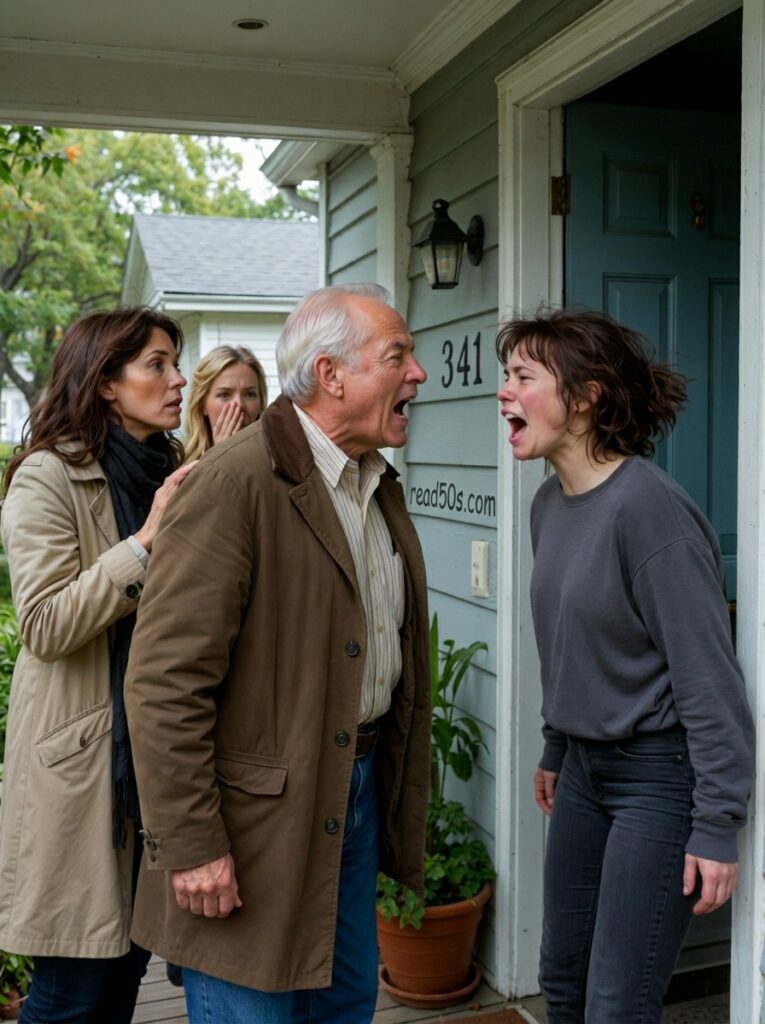
Aunt Ruth arrived before my father could decide whether to keep shouting.
Her blue Subaru pulled into the driveway behind my parents’ car, blocking them in. She got out in jeans, a heavy navy coat, and the expression of a woman who had spent sixty-two years being underestimated and was finally tired of it.
“Step away from the door, Richard,” she said.
My father turned. “This is family business, Ruth.”
“No,” she replied. “This is trespassing.”
My mother stiffened. “How dare you speak to your brother that way?”
Aunt Ruth looked at her with quiet disgust. “I drove alone through a storm to bury Claire’s husband and babies while you were eating birthday cake. Don’t lecture me about manners.”
For once, my father had no quick answer.
I watched from the hallway screen as his face shifted. He was not ashamed because he felt remorse. He was ashamed because Ruth had said it outside, loudly enough for the neighbor across the street to hear.
That had always been my family’s real religion: appearances.
When I was growing up, my parents never asked whether something hurt. They asked who had seen it. If Melissa screamed at me, I was told not to upset her. If she ruined my graduation dress because she wanted attention, I was told to be gracious. If she announced her engagement two days after Ethan’s and my tenth anniversary memorial dinner invitation went out, my mother called it “bad timing,” then asked me to move my dinner.
Melissa was not evil in a dramatic way. She was worse than that. She was ordinary selfishness polished until it looked innocent. She learned early that tears worked better than truth, and my parents rewarded her every time.
But funerals reveal people.
So does money.
My father turned back toward the doorbell camera. His voice lowered into the tone he used when trying to sound reasonable.
“Claire, open the door. We’re not here to fight. We’re concerned about you.”
I pressed the speaker button again.
“You were not concerned when I stood beside three coffins.”
My mother’s face tightened. “That is unfair. We were in shock.”
“You told me Melissa’s dinner reservation mattered more than my children’s funeral.”
Melissa removed her sunglasses. Her eyes were dry.
“I didn’t know you’d make it into some public scandal,” she snapped. “My friends are sending me articles. Brandon’s parents saw it. Do you know how humiliating this is before my wedding?”
Aunt Ruth barked out a laugh.
I felt something shift inside me.
Not healing.
Not forgiveness.
Something cleaner.
Recognition.
For six months, I had wondered whether grief had made me remember the call worse than it was. I had replayed my father’s voice at three in the morning, searching for a crack of pain, some hidden panic, anything that would prove he had not meant it.
But here they were, standing outside my house, and still none of them had said Ethan’s name. None of them had said Lily. None of them had said Noah.
They had only said headline, scandal, embarrassed, wedding.
My father rubbed his forehead. “Look, mistakes were made.”
“By whom?” I asked.
He looked straight into the camera. “This attitude is exactly why people worry about you.”
“No,” I said. “People worry about you now because they know what you did.”
His eyes flashed.
There he was.
The father I knew.
Not calm.
Not reasonable.
Just angry that control had slipped from his hands.
“You think that settlement makes you powerful?” he said. “That money came because your family died. Don’t act like you earned it.”
For one second, the hallway tilted.
Then I looked at Ethan’s sweatshirt in my hand.
I remembered him at Lily’s kindergarten concert, wiping his eyes when she sang off-key. I remembered Noah asleep on his chest during a thunderstorm. I remembered how Ethan used to say, “Claire, your family taught you to apologize for bleeding on the floor after they cut you.”
I lifted my chin.
“You’re right,” I said. “I didn’t earn it. Ethan, Lily, and Noah paid for it with their lives. That is why you will never touch a cent.”
My mother moved closer to the camera. “Nobody said anything about money.”
Aunt Ruth folded her arms. “You drove here after seeing the settlement amount.”
“We drove here because she’s isolating herself,” my mother replied.
“No,” I said. “I’m protecting myself.”
That was when Daniel Price arrived.
He pulled up beside the curb in a black sedan, wearing a charcoal overcoat and carrying a folder. Daniel was in his early forties, precise, calm, and allergic to nonsense. He had represented Ethan’s parents in a business matter years earlier, which was how I found him after the accident.
He walked up the driveway with the same expression he wore during depositions.
“Mr. and Mrs. Harper,” he said. “Melissa. I’m Daniel Price, Claire’s attorney. You’ve been notified in writing not to come to this property uninvited.”
My father scoffed. “She’s our daughter.”
“She is a thirty-four-year-old adult,” Daniel said. “And she has made her wishes clear.”
“My daughter is grieving and being manipulated,” my mother said, shooting a look at Aunt Ruth.
Daniel opened the folder. “Your daughter executed her estate documents with full capacity, in my office, in the presence of two witnesses and a notary. She also provided a written record of family estrangement, including screenshots of messages sent after the funeral.”
Melissa’s mouth fell open. “You kept screenshots?”
I almost smiled.
“Yes,” I said through the speaker. “Especially the one where Mom said you were hurt I missed your birthday call.”
My mother’s face went pale.
Daniel continued. “Any further attempts to pressure Ms. Miller regarding her settlement, foundation, property, or estate planning may be documented as harassment.”
My father took one step toward him. “Are you threatening me?”
“No,” Daniel said. “I’m informing you.”
The neighbor across the street, Mrs. Alvarez, was now standing openly on her porch with her arms folded. She had brought casseroles after the funeral. She had also planted lilies near my mailbox because Lily loved her name flower. My mother noticed her and instantly lowered her voice.
“Claire,” she said, suddenly wounded. “Please. Let’s not do this outside.”
I opened the front door then.
Everyone froze.
I stepped onto the porch in Ethan’s sweatshirt, my hair tied back, my face bare. For months, I had imagined this moment. In every version, I was shaking. In every version, I either screamed or collapsed.
But when I saw them standing there, they looked smaller than they did in my memory.
My father looked older, but not softer. My mother looked polished, but afraid. Melissa looked furious, not heartbroken.
I stood beside Aunt Ruth.
“You want privacy now?” I asked. “You should have offered dignity then.”
My mother’s eyes filled with tears on command. “I lost them too, Claire.”
“No,” I said. “You lost access to the role of grieving grandmother after you chose not to attend their funeral.”
Her tears stopped.
Melissa snapped, “That’s cruel.”
I turned to her. “No, cruel was asking me why I didn’t call you on your birthday while my children were being buried.”
She flinched, but only because Daniel and Aunt Ruth heard it.
My father pointed at me. “You’re tearing this family apart.”
I looked past him to the bare maple tree in the yard, where Ethan had once hung a swing for Lily. The rope was gone now. I had taken it down after the accident because seeing it sway in the wind made me physically sick.
“This family was already broken,” I said. “I just stopped standing in the middle holding the pieces.”
My mother whispered, “What do you want from us?”
For the first time, it almost sounded like a real question.
But it came too late.
“I wanted you at the funeral,” I said. “I wanted you to hold my hand when I buried my husband. I wanted you to cry over Lily’s pink casket and Noah’s blue one. I wanted my parents.”
The porch fell silent except for the wind dragging dead leaves along the steps.
“Now?” I continued. “I want you to leave.”
My father’s jaw hardened. “You’ll regret this.”
Daniel immediately raised his phone. “Please repeat that clearly for the record.”
My father glared at him, then turned away.
My mother hesitated. For one delicate second, I thought she might say she was sorry. Not a polished sorry. Not a social sorry. A real one.
Instead, she said, “Melissa’s wedding is in April. I hope you don’t make this worse.”
And there it was.
The final thread snapped so quietly I almost missed it.
“I won’t be there,” I said.
Melissa laughed bitterly. “Good. Nobody wants that energy at my wedding.”
Aunt Ruth stepped forward. “Then everyone has what they want.”
My father opened his mouth, but Daniel spoke first.
“Leave now.”
They left.
Not dramatically.
Not with one final speech.
They climbed into their car, backed out of my driveway, and drove away like people leaving a restaurant after bad service.
When the street became quiet again, I realized I was breathing normally.
Aunt Ruth touched my shoulder. “You okay, honey?”
I looked at the door, the porch, the mailbox lilies, and the empty swing hook in the maple tree.
“No,” I said honestly. “But I’m free.”
The headline changed everything, but not because of the money. The money only exposed what had always been there.
My parents did not panic because they had hurt me.
They panicked because everyone else could finally see it.
In the months that followed, I moved forward in pieces. The foundation held its first fundraiser in May. Ethan’s parents spoke about truck safety regulations. I spoke for exactly four minutes. My voice trembled when I said Lily and Noah’s names, but I said them.
Reporters asked about my family. I gave the same answer every time.
“My focus is honoring my husband and children.”
That was true.
It was also the cleanest way to close a door.
Melissa’s wedding happened without me. I knew because someone sent Aunt Ruth a photo of the empty chair my mother had apparently insisted on placing near the front, as though my absence were a performance she could frame. Ruth deleted it without showing me, but later she admitted it existed.
I did not ask to see it.
On the anniversary of the accident, I drove to the cemetery alone at sunrise. I brought yellow tulips for Ethan, daisies for Lily, and a small red toy truck for Noah. I sat in the grass between them and told them about the foundation, about Margaret learning to smile again, and about Ruth taking me to Maine for a weekend because I had never seen the winter ocean.
Then I told them the truth.
“I miss you every minute,” I whispered. “But I’m still here.”
The wind moved softly through the trees.
There was no answer, of course.
Only morning light.
Cold air.
My hand resting on the names carved into stone.
For the first time since the funeral, I did not feel abandoned by everyone.
I felt surrounded by the people who had truly loved me.
And that was enough to stand up, walk back to my car, and keep living.