The folder opened with a soft crackle that somehow sounded louder than the applause had.
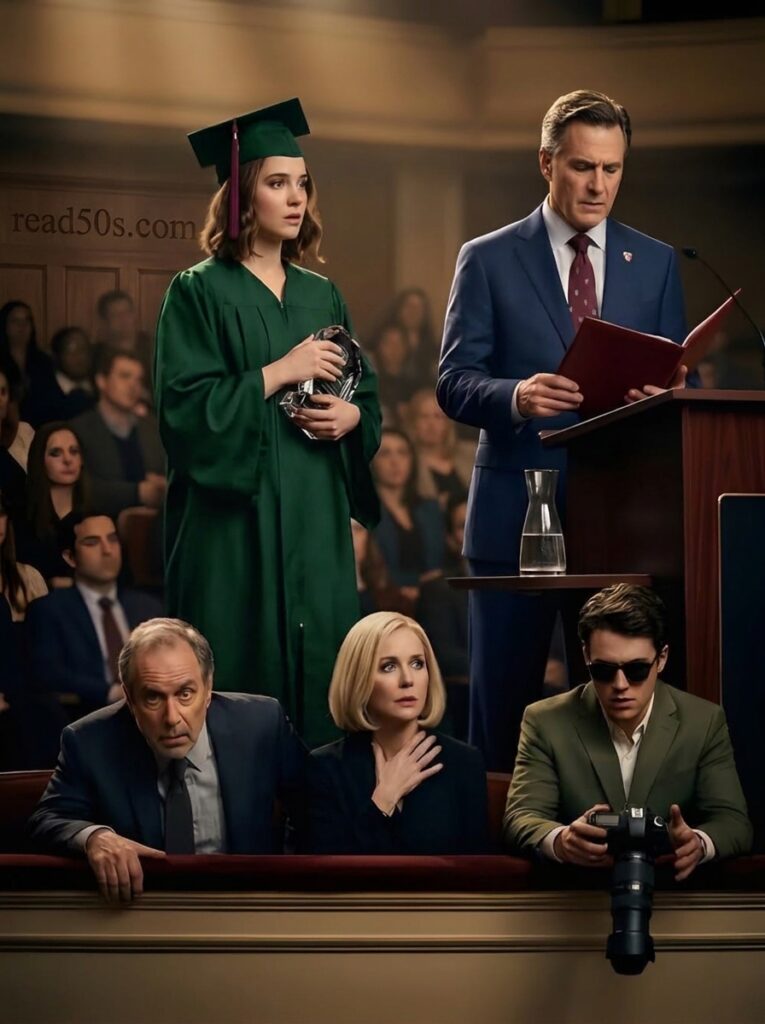
Dr. Elaine Porter glanced at the page, then at me, and finally at the audience.
“Sarah Thompson has been admitted to Harvard Medical School’s direct-entry MD-PhD program in translational neuroscience,” she said.
“Full tuition.
“Full research funding.
“And a summer placement in our Boston lab beginning in six weeks.”
For a second, nobody moved.
Then the room erupted.
People stood.
Not everyone, but enough that the sound rolled through the auditorium like a wave.
The crystal award in my hands threw cold light across the podium.
My mother’s fingers flew to her throat.
My father’s smile arrived too late and sat on his face like something borrowed.
Marcus’s sunglasses slipped from his hand and fell into his lap.
The camera he had brought to photograph himself lay on the floor beside his shoe.
I should say I was shocked, but that would not be true.
The offer itself had stopped shocking me six months earlier, at 2:13 in the morning, when I sat on the edge of my studio apartment bed in a coffee-stained sweatshirt and listened to Dr. Porter say the words over a video call because she had been too excited to wait until morning.
What shocked me was hearing them in that room, with my family forced to sit still and swallow every syllable in public.
Dr. Porter continued.
“Sarah also joins our lab with a publication already accepted and an invitation to present her work at the International Neurobiology Conference this fall,” she said.
“We are very proud that she chose to keep this private until graduation.”
Chose.
That word mattered.
It made the secret sound deliberate, not frightened.
Dean Morrison stepped back toward the microphone, grinning openly now.
“Miss Thompson asked for time until the paperwork was final, and we honored that request.
“We are honored now to announce that our university is sending one of its brightest researchers to Boston.”
The applause struck again.
Someone behind my parents whistled.
A woman in the left section shouted, “Go, Sarah!”
My family stared at me as though they had been seated at the wrong ceremony and had only now realized whose name was printed on the program.
Marcus had built half his personality around the word Harvard.
He wore it like a designer label, even now, years after law school, while living in the pool house and telling everyone he was “between opportunities.”
Seeing that same word tied to me in a room full of witnesses seemed to do something to his spine.
He sat straighter but somehow looked smaller.
I thanked the dean.
I thanked Dr. Porter.
I heard my own voice through the microphone and barely recognized how steady it sounded.
Then I walked off the stage, holding the award in one hand and the crimson folder in the other, feeling, for the first time in my life, not as though I had been chosen, but as though I had finally been seen.
The rest of the ceremony blurred.
Names were called, caps were adjusted, and cameras flashed.
My heart kept beating in my throat.
I sat back down only because there was nowhere else to go, and my family sat beside me in a silence that was no longer bored.
It was busy.
Calculating.
Rearranging.
My mother leaned toward me first.
“Why didn’t you tell us?” she whispered.
There was no hurt in her voice.
There was panic.
Because you would have touched it, I thought.
Because you would have asked what it paid.
Because you would have found a way to make it about Marcus, the family name, or what you believed you were owed.
Out loud, I said, “I wanted to wait until it was real.”
Marcus gave a short laugh through his nose.
“Harvard Medical? Since when?”
Dr. Porter, still seated in the row ahead of us, turned around just enough to answer him herself.
“Since January,” she said pleasantly. “After we read her work.”
Marcus stopped talking.
When the ceremony ended, the aisle filled with parents carrying flowers, balloons, stuffed bears, noise, and pride.
My family moved quickly, suddenly afraid that the moment might escape them.
My father reached me first and placed both hands on my shoulders for the kind of photograph he had never bothered to arrange before.
“That’s our girl,” he said too loudly, already scanning the crowd to see who was close enough to hear him.
My mother was crying without tears.
Careful crying.
Performance crying.
“We were hard on you because we knew you were capable,” she said.
“You know that, right?”
It was such a clean lie that I almost admired it.
Professor Liang came through the crowd before I had to answer.
He was carrying the canvas satchel he had owned for longer than I had known him, and his tie was crooked from clapping.
He hugged me once, awkwardly but fiercely.
“You did it,” he said.
“We did it,” I replied.
My father extended his hand as though he were meeting a business associate.
“I’m Sarah’s father. We appreciate everything the school has done.”
Professor Liang shook his hand, but his expression did not change.
He had watched me fall asleep over a microscope.
He had watched me hide my hands beneath the desk after double shifts because the burn marks from the espresso machine were raw.
He knew exactly how much the school had done and how much my family had not.
Marcus bent down to pick up his camera.
“So now you’re basically following in my footsteps,” he said.
Dr. Porter looked at him, then at me.
“Not exactly,” she said. “Direct-entry MD-PhD candidates are selected very differently.”
The words were polite.
The effect was not.
A small circle formed around us—faculty members, students, parents, and people who had never noticed me until the applause taught them where to look.
My mother straightened and began telling strangers, “She has always been brilliant,” as though the sentence had always existed in her vocabulary but had somehow never reached me.
I stood inside that small orbit and remembered another night, two years earlier, when she had stood in the kitchen with my father and said, “Marcus needs help now. Sarah can figure something out. She always does.”
They thought I was asleep.
I was standing at the top of the stairs, holding a pathology textbook and listening to my future being reassigned.
That was the semester their help with tuition stopped.
Not all at once.
That would have been honest.
Instead, there were delays, excuses, clipped phone calls, a suggestion that I take fewer laboratory credits if money was tight, and a reminder that Marcus had expenses because “his field matters immediately.”
When the final transfer never arrived, I picked up extra shifts at the coffee shop, added tutoring sessions on weekends, and started eating whatever food remained in the department seminar room after guest lectures.
Professor Liang discovered the truth because he walked into the lab at midnight and caught me trying to hide a paper bag of stale bagels in my backpack.
He never embarrassed me by pretending not to notice.
He simply left meal vouchers on my bench the following week and said the department had extras.
That was the thing about genuine support.
It did not announce itself.
It noticed.
My father was still performing pride for anyone within earshot when Dean Morrison approached with a campus communications coordinator and a woman from the development office whom I recognized from a scholarship dinner I had once served at, not attended.
“Sarah,” the coordinator said, “we would love a quick statement for the university release. There is also a small luncheon for award recipients and visiting faculty in 20 minutes.
“You are welcome to bring two guests.”
My mother answered before I could.
“Wonderful. We will all come.”
The coordinator smiled politely.
“There are only two additional seats.”
My father’s hand tightened on my shoulder.
Marcus looked offended on principle.
I knew my answer before the question had fully settled.
“Professor Liang,” I said, “and Ms. Alvarez, if she is still here.”
Everyone blinked.
Ms. Alvarez managed the coffee shop where I had opened at five in the morning for three years.
She had covered my shifts before exams, slipped sandwiches into paper bags with notes that said, Eat this, and once drove me home after a 14-hour day because I had fallen asleep while standing.
She had come to graduation wearing her only blazer and sat three rows behind my family with flowers from the grocery store.
My mother stared at me as though I had slapped her.
“Your coffee shop manager?” my father asked.
“Yes,” I replied.
He smiled the way people smile just before they stop pretending.
“After everything we spent on you, you are taking a barista to lunch instead of your own family?”
There it was.
The invoice.
Professor Liang moved first.
He pulled a plain white envelope from his satchel and handed it to me without a word.
The bursar’s seal was stamped across the flap.
My father saw it and frowned.
“What is that?”
I slid my thumb beneath the flap and opened it.
Inside was a payment ledger Dean Morrison had quietly asked the office to print that morning after an email chain surfaced from my father to the university development office.
In the messages, my father had asked how the parents of “a student we fully funded” would be acknowledged in any press release.
The ledger was simple.
Tuition charges.
Scholarship credits.
Payroll deposits from work-study.
Research stipends.
Emergency grants.
My own electronic payments, month after month, from the account I had built with coffee tips, tutoring money, and laboratory hours.
Under parental contributions, after the spring semester of my freshman year, one clean number appeared repeatedly:
$0.00.
I handed the last page to my father.
“You should read that before you say ‘we’ again,” I said.
The color in his face changed so quickly that it looked painful.
My mother leaned closer and read the page over his arm.
She went completely still.
Emma, who had wandered close enough to hear but not close enough to help, lowered her phone and read the line upside down.
Her mouth fell open.
Marcus snorted.
“School accounting always looks strange.”
Professor Liang answered him.
“It does not look strange. It looks accurate.”
For a moment, no one in the circle spoke.
The noise of the surrounding crowd seemed to move farther away, as though the world had stepped back to give us space.
My father folded the page in half.
“We had responsibilities,” he said tightly.
“You make it sound as though we abandoned you.”
I looked at him and heard the words he had whispered less than an hour earlier.
Failure.
“You called me a failure before my name was announced,” I said.
“In case your memory needs help, that part was free.”
Emma’s eyes snapped toward him.
“Dad?”
He ignored her.
“Do not do this here.”
That was the first honest thing he had said all day.
He knew exactly what this was.
Witnesses.
Context.
A version of the story that did not belong to him.
Dr. Porter stepped closer, not intruding, merely present.
“Sarah,” she said, “the car for Boston can leave whenever you are ready this evening. There is no rush.”
Boston.
Evening.
Car.
My mother caught the words like a hook.
“Tonight?” she asked. “What do you mean, tonight?”
“The summer research rotation begins with orientation tomorrow,” Dr. Porter explained.
“We arranged early housing because Sarah asked to transition directly after commencement.”
I had signed the papers two weeks earlier.
Apartment keys were waiting for me in Cambridge.
A laboratory badge was waiting at security.
A future with my name already printed on the schedule board.
My family had assumed graduation would end with dinner.
They had not understood that, for me, it would end with departure.
Marcus laughed again, but this time the sound was thinner.
“You are leaving tonight? Without even speaking to us?”
I thought about the six months I had spent saying nothing because I needed one corner of my life untouched by their doubt.
I thought about the nights I had answered calls from Boston in my apartment stairwell so I would not risk hearing my father’s voice in my head while Dr. Porter explained funding, research tracks, and housing.
I thought about how carefully I had protected my joy because no one teaches children from families like mine how to celebrate.
They teach us to hide anything beautiful until it can no longer be taken away.
“There was not much to discuss,” I said.
My father lowered his voice.
That had always been more dangerous than shouting.
“Family helps family,” he said.
“You will receive a stipend from this program. Do not forget where you came from.
“Your brother has loans. He is going through a difficult time.”
There it was.
Not pride.
Not an apology.
A hand reaching into a pocket he believed had just been filled.
I did not cry.
That felt important.
“That money is for my living expenses and research,” I said.
“None of it belongs to you.”
His jaw hardened.
“After everything—”
“After everything I paid for,” I said, tapping the ledger.
“Choose your words carefully.”
The woman from development beside Dean Morrison pretended to check her phone.
The coordinator appeared fascinated by the floor.
Nobody rescued him.
That was new.
My mother tried another approach.
“People are watching,” she whispered. “Do not embarrass us.”
The sentence almost made me laugh.
Marcus shoved his camera into its case.
“You are acting as though one fancy offer makes you better than everyone else.
“Let us see how long you last there.”
Dr. Porter turned toward him with a calmness I had learned to fear in intelligent women.
“Sarah is already working at a level that impressed our faculty,” she said.
“I would not worry about how long she will last.”
He looked away first.
Ms. Alvarez reached us then, breathless and clutching the inexpensive bouquet she had been too shy to hand me in front of my family.
When I told her about the luncheon, her eyes immediately filled with tears.
“Baby, are you sure?” she asked.
“I am sure,” I answered.
My mother’s face crumpled in a way that might have been genuine if it had appeared an hour earlier.
The luncheon was held in a bright room overlooking the quad, with white tablecloths and far too many forks.
I sat between Professor Liang and Dr. Porter.
Ms. Alvarez kept smoothing her blazer and whispering that she did not belong there.
That was ridiculous because, out of everyone in the room, she was one of the people who had most directly kept me alive long enough to earn my seat.
A campus photographer asked whether I wanted a family photograph for the university feature.
“No,” I said.
He nodded as though the answer were perfectly ordinary.
Then he asked, “Who would you like mentioned as the people who supported you?”
I looked at Professor Liang’s ink-stained cuffs.
At Ms. Alvarez’s hands, still red from years of steam and hot water.
At the crystal award on the table beside my plate.
“Professor Liang,” I said.
“Ms. Alvarez.
“And the people in the lab who kept the lights on ten minutes longer than they were supposed to.”
I did not mention my family.
That omission did more damage than any speech could have.
My phone vibrated during the soup course.
My mother: Please do not shut us out on the biggest day of your life.
My father: Dinner at 7. We need to discuss numbers and next steps.
Marcus: Congratulations. Do not get weird.
I turned the screen facedown and continued eating.
After lunch, I returned to the lab one final time to clear out my locker.
The building was quiet, emptied by commencement and the summer heat.
The fluorescent lights hummed overhead.
On my bench sat the mug Professor Liang bought for every first-year student who joined the lab.
Mine said KEEP GOING in block letters that had begun to fade from repeated washing.
I placed the crystal award in my backpack beside it.
Professor Liang stood in the doorway while I peeled my name from the locker tag.
“How are you?” he asked.
Nobody in my family had asked me that all day.
I released a breath that I felt deep in my bones.
“Lighter,” I said.
He nodded.
“Good.”
In the parking lot, my father was waiting beside his car.
Of course he was.
The late sunlight turned the windshield gold.
He straightened when he saw me, no longer angry, just sharp.
“Your mother is upset,” he said.
Your mother, not we.
Even he had learned something from the ledger.
I kept walking until only a few feet separated us.
Professor Liang remained near the building entrance, far enough away to be polite but close enough to matter.
“I did not ask you to wait,” I said.
“I am trying to fix this,” my father replied.
“You do not throw away your family over one misunderstanding.”
I almost asked which misunderstanding he meant.
The whisper.
The years.
The money.
The way my success had only become interesting once it had prestige attached to it.
But I was tired, and something inside me had shifted.
I no longer wanted a confession from people who had made an identity out of withholding one.
So I made it simple.
“You did not lose me today,” I said.
“You lost the version of me that kept begging to be treated like your daughter.”
That struck him harder than anger would have.
He looked down at the asphalt between us.
“People make mistakes.”
“Yes,” I said.
“And then they live with the consequences.”
He reached for the old script one last time.
“We did what we could. Marcus needed help.”
There it was again.
The hierarchy.
The calculation.
The investment.
I smiled then, not kindly, but clearly.
“That is exactly why Boston never called you.”
I walked past him before he could answer.
Emma caught up with me near the curb beside Dr. Porter’s car.
She was out of breath, with her hair stuck to her cheeks and her phone forgotten in her hand.
“Sarah,” she said, her voice shaking.
“Did Dad really say that? Failure?”
I looked at her.
She was 18, spoiled by neglect more than by love, but still young enough that the truth might be useful.
“Yes,” I said.
She swallowed.
“I thought you just did not care what they said.”
“That is the trick,” I told her.
“People think being quiet means nothing hurts you.
“It usually means you have been hurt enough to become good at hiding it.”
Her eyes filled with tears.
“I am sorry.”
It was the first apology anyone in my family had offered without a condition attached.
I touched her arm.
“Start paying attention to who gets loved openly and who gets loved only when they win.”
She nodded once.
Then I got into the car.
The campus disappeared in pieces—the brick science building, the coffee shop awning, and the lawn where families were still taking photographs in the evening light.
My phone continued buzzing until I turned it off.
Somewhere behind me, there was a restaurant reservation with four seats, and my name had never truly been meant for one of them.
Somewhere behind me, my father was deciding whether humiliation felt more like anger or loss.
Somewhere behind me, Marcus was probably already telling himself that I had been lucky.
Ahead of me was the highway to Boston, a furnished studio in Cambridge, a laboratory that smelled like ethanol and possibility, and work that had room for all the parts of me my family had called too much or not enough.
That night, after unpacking two suitcases and one lifetime of caution, I opened the crimson folder again on my new desk.
Inside were the official offer letter, funding details, orientation schedule, security badge instructions, and a short handwritten note from Dr. Porter tucked between the pages.
You do not have to shrink to be safe here.
I read the line three times.
Before midnight, my mother posted a photograph from the ceremony.
She had cropped it carefully so that the distance between us appeared smaller.
Her caption read:
Proud of our brilliant girl. Harvard bound.
I stared at it for a long moment, then set my phone aside without responding.
Pride after public proof was not the same as love.
I understood that now.
A week later, the university’s feature story was published.
It quoted Professor Liang.
It quoted Dr. Porter.
It mentioned the coffee shop job, the late nights in the lab, the research, the award, and the Boston program.
It did not mention family sacrifice because there had been none to mention.
My father called twice that morning and left no message.
Marcus texted me a link to the article with one line:
Big deal.
I deleted it.
By the end of the month, I was standing inside a Harvard laboratory wearing a clean white coat, with my badge clipped straight and my name printed correctly on the schedule board.
Dr. Porter introduced me to a room full of people who wanted to know what I could do, not what I had failed to be for someone else.
When I spoke about my work, nobody looked past me.
Nobody checked a watch.
Nobody asked whether we could finish before four.
Sometimes, in the quiet minute before the centrifuges started and the hallway traffic picked up, I still heard my father’s whisper from the auditorium.
We are finally done wasting money on this failure.
He had been right about one thing.
We were done.
Just not in the way he had meant.
THE END.