My Husband Said Our Daughter Was Faking—Then the Scan Changed Everything
PART 1 — THE SCAN
My fifteen-year-old daughter had been telling us for weeks that her stomach hurt and that she felt sick almost every day.
My husband always gave the same answer.
“She’s faking it. Don’t throw money away on hospitals.”
I took Maya to a doctor behind his back anyway.
The moment the physician studied her ultrasound, his expression changed.
Then he said quietly, “There’s something inside her.”
The whole room seemed to tilt beneath my feet.
I had known something was wrong before anyone else in our house was willing to admit it.
For several weeks, Maya had been fading in front of me in small, frightening ways that were easy to dismiss individually and impossible to ignore once I recognized the pattern.
First came the nausea.
It usually happened in the mornings, but sometimes it struck during dinner. She would suddenly press her lips together, push her plate away, and stare at the table until the feeling passed.
Then came the sharp pain low in her stomach.
It made her bend slightly whenever she thought no one was watching.
After that, the dizzy spells began.
She would reach for the hallway wall or kitchen counter as though the floor had shifted beneath her worn sneakers.
Maya was fifteen, but lately she looked younger.
Her shoulders curled inward beneath oversized hoodies, and she moved through the house with the cautious steps of someone trying not to wake a dangerous animal.
The girl who once stayed outside until dark kicking a soccer ball against the garage door had disappeared.
She stopped taking blurry photographs of sunsets above our mailbox.
She stopped laughing loudly with her friends on video calls.
She stopped arguing about bedtime, asking for rides, or leaving snack wrappers on the coffee table.
At dinner, she pushed pieces of chicken around her plate until they went cold.
I noticed every change because mothers learn the rhythms of their children long before those children realize they have rhythms.
I knew Maya’s normal footsteps on the stairs.
I knew the way she opened the refrigerator when she was hungry and the particular sigh she made when homework had gone badly.
This was different.
Robert noticed too, although he behaved as though refusing to name the problem would make it disappear.
Whenever I suggested taking her to a doctor, he brought up money.
Whenever I mentioned her pain, he blamed school stress.
Whenever Maya said she felt sick, he found a reason to accuse her of exaggerating.
One Thursday evening, the kitchen smelled like reheated leftovers and dish soap while the porch flag tapped softly against the post outside.
Maya sat three feet from her father with both arms folded tightly across her stomach.
Her face looked pale beneath the yellow light above the table, and her dinner remained untouched.
Robert never looked up from his phone.
“She’s putting on an act,” he said.
Maya lowered her eyes.
“Robert, look at her. She’s been sick for weeks.”
He continued scrolling as though we were discussing a cable bill instead of our daughter.
“Teenagers make everything dramatic. We’re not wasting money on hospitals because she wants attention.”
Maya’s fingers tightened around the hem of her hoodie.
“I’m not trying to get attention,” she whispered.
Robert finally looked up, but there was no concern in his expression.
“Maya is stressed about school,” he told me, speaking as though she weren’t sitting beside him. “If you keep babying her, she’ll continue doing this.”
I tried to answer, but he interrupted.
“We already have deductibles, copays, and bills. You don’t run to the hospital every time a teenager claims her stomach hurts.”
Fear about money can make people cautious.
I understood that better than most.
I had stood in grocery-store aisles calculating whether the larger package truly saved enough to matter. I had waited for payday before filling the gas tank completely.
But in Robert, fear about money had become something colder.
It had become neglect disguised as financial responsibility.
It sounded reasonable only if you refused to look directly at the child paying the price.
So I watched Maya.
I watched her fall asleep after school with her sneakers still on and her backpack slipping from one shoulder.
I watched her wake two hours later, confused and still exhausted.
I watched her wince while bending to tie her shoes.
I watched her pause halfway down the stairs, gripping the railing until the dizziness passed.
I watched the color drain from her face and weight slowly disappear from her body while Robert guarded the checkbook as though it mattered more than she did.
I asked Maya privately whether something had happened at school.
She shook her head.
I asked whether anyone had hurt her.
She looked startled and said no.
I asked whether the pain happened after meals, whether it woke her at night, and whether she had noticed any other changes.
She answered carefully, embarrassed by some questions and frightened by others.
Nothing she said gave me an explanation.
But none of it sounded like an act.
The pain was real.
The fear was real.
The way she had begun sleeping curled protectively around her stomach was real.
Robert kept insisting that we wait.
He said she would feel better after her next exam.
He said she needed more sleep, less screen time, fewer excuses, and a better attitude.
He said almost everything except the one thing Maya needed to hear from him.
I believe you.
Then, at 2:13 on a Monday morning, I heard a sound from her bedroom.
It wasn’t a scream.
It was a breath—thin, broken, and wrong.
I had been lying awake beside Robert, listening to the air conditioner cycle on and off.
The sound was so faint that I might have missed it if I had been asleep.
I crossed the hallway barefoot.
Maya’s door stood partly open, and a narrow line of light stretched across the carpet.
When I pushed the door wider, I found her curled on her side beneath the desk lamp with both arms wrapped around her stomach.
Her knuckles were white against her gray hoodie.
Tears had soaked a dark crescent into the edge of her pillow, and strands of hair clung to her damp cheek.
For one second, I couldn’t move.
Then I sat beside her and touched her shoulder.
“Maya, honey, look at me.”
She slowly opened her eyes.
“Mom,” she whispered, “please make it stop hurting.”
That was enough.
Whatever fear I had of Robert’s anger disappeared.
I no longer cared whether he called me dramatic, irresponsible, or wasteful.
I no longer cared how loudly he argued about the bill.
Medical debt could be negotiated.
A payment plan could be arranged.
The cost of ignoring my daughter might be something I could never repay.
I helped Maya sit up and brought her water, but she managed only one small sip.
She begged me not to wake Robert.
That request hurt more than I expected.
It meant she had already learned that being sick in our house required permission.
I promised she would never have to convince me again.
The following afternoon, while Robert was still at work, I drove to Maya’s school.
I entered the front office at 1:42 and told the attendance clerk I needed to sign my daughter out.
The clerk checked my identification, slid the form toward me, and printed a dismissal slip with the time stamped across the top.
Locker doors closed in the hallway.
A teacher reminded students not to run.
Ordinary sounds continued around me, making my fear feel almost private.
Maya appeared several minutes later with her backpack hanging loosely from one shoulder.
She walked slowly, one hand pressed beneath her hoodie.
The attendance clerk noticed.
“Are you all right, sweetheart?”
“We’re getting her checked,” I answered.
Saying it aloud steadied me.
Maya looked at me, and relief briefly crossed her face.
Outside, I fastened her seat belt even though she had been doing it herself for years.
Her hands were trembling too badly to guide the metal buckle into place.
I drove directly to Riverside Medical Center without calling Robert.
Maya barely spoke.
She rested her head against the passenger window and watched gas stations, traffic lights, shopping centers, and school buses pass.
Every few minutes, I glanced at her to make sure her eyes remained open.
“Are you mad at me?” she asked suddenly.
The question nearly made me miss the turn into the hospital.
“For what?”
“For making this expensive.”
I tightened my grip on the steering wheel.
“You didn’t make anything expensive. You’re sick, and we’re getting help.”
She nodded but didn’t look convinced.
Robert had repeated his words often enough that they had begun living inside her.
At registration, a woman slid a clipboard toward me with patient forms, a consent line, and a bright orange insurance sticker.
The sticker made my stomach tighten because I could already hear Robert asking how much everything would cost.
I signed anyway.
I wrote Maya’s full name, birth date, address, allergies, medications, and the length of time she had been ill.
When I reached the box asking how severe her pain was, I looked at her.
“Eight,” she said.
I circled the number.
A nurse called Maya’s name and led us through two heavy doors.
She wrapped a blood-pressure cuff around Maya’s thin arm, clipped a monitor to her finger, and asked many of the same questions.
Maya answered politely even when speaking seemed to drain her.
The nurse printed a wristband with her name and birth date and fastened it around her arm.
That small piece of plastic affected me more than the forms had.
It meant someone besides me had officially recorded that Maya was there.
That she was a patient.
That her pain deserved attention.
By 3:08, they had ordered bloodwork and an ultrasound.
A technician drew several tubes of blood while Maya looked away and gripped my hand.
She apologized when her palm became sweaty.
“You don’t need to apologize for anything today.”
My phone buzzed while we waited.
Robert had sent one message.
Where are you?
There was no question about Maya.
No concern about why we had left.
I turned the phone facedown.
Part of me expected him to call and demand an explanation.
He didn’t.
Fear can train someone to obey through small corrections, disappointed looks, arguments about money, and the constant suggestion that every decision requires approval.
Motherhood has a different spine.
It stands even when the rest of you is shaking.
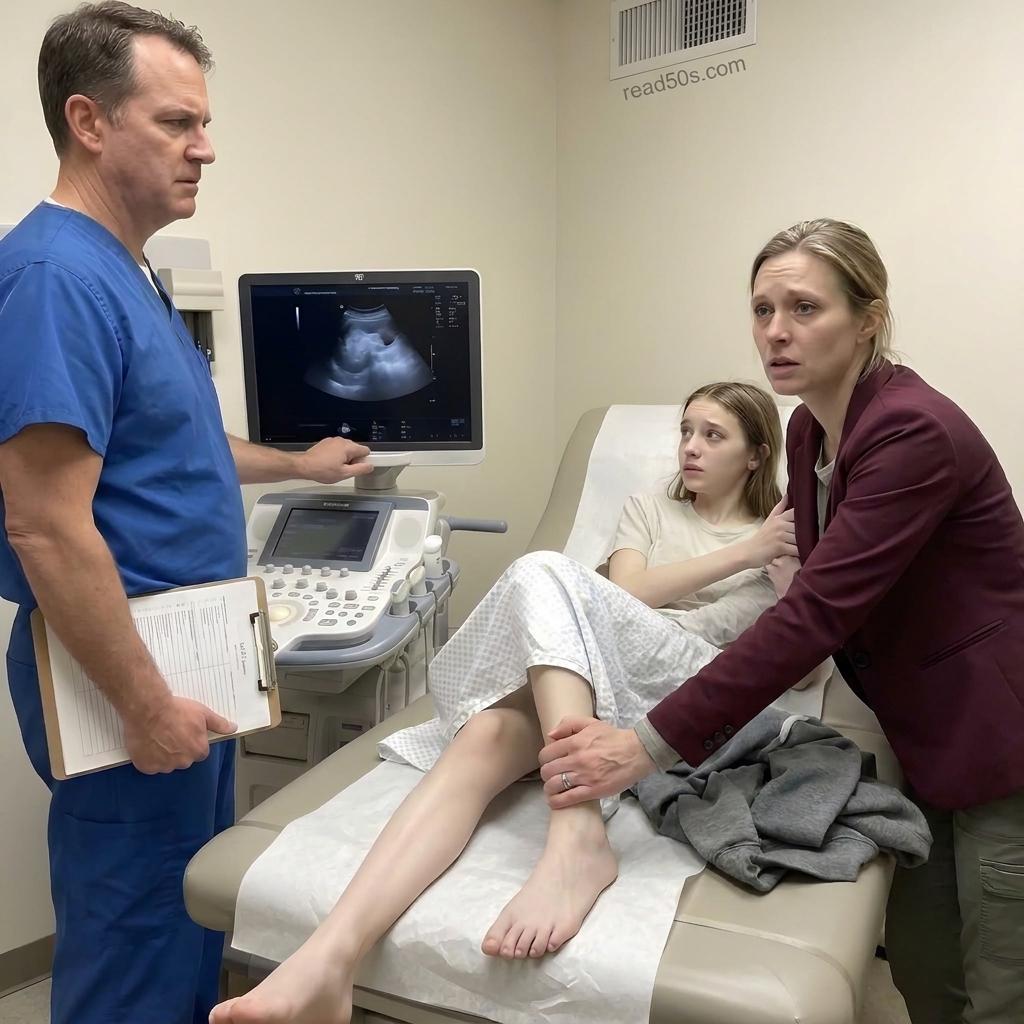
A staff member brought us into a dim examination room where an ultrasound machine waited beside a narrow table.
Maya removed her hoodie and folded it carefully over a chair.
Her T-shirt hung more loosely than I remembered.
She climbed onto the table beneath a thin paper sheet, gripping the mattress edge.
The room smelled like antiseptic and warm plastic.
The machine gave off a low electrical hum while the technician dimmed the lights.
“This may feel cold.”
Maya flinched when the gel touched her skin.
The technician moved the wand slowly across her lower abdomen while gray shapes shifted across the monitor.
I tried to read the woman’s expression, but her face had the controlled neutrality of someone trained not to reveal what she was seeing.
At first, she asked routine questions.
“How long has the pain been this severe?”
“Any fever?”
“Any previous abdominal problems?”
Then the questions stopped.
The technician adjusted the wand and leaned toward the monitor.
She moved over the same area again.
Maya turned toward me.
“Is something wrong?”
The technician offered a gentle smile that did not reach her eyes.
“The doctor will review the images.”
She saved one picture.
Then another.
She asked Maya to change position and measured something on the screen.
With every click, the woman’s shoulders became more rigid.
Finally, she wiped the gel from Maya’s skin and lowered the sheet.
“The doctor will be here shortly.”
“How shortly?” I asked.
“I’m going to tell him the images are ready now.”
When she left, Maya reached for her hoodie but didn’t put it on.
Her hands were trembling again.
“Mom, what did she see?”
“I don’t know.”
“She became quiet.”
“I know.”
Maya pushed herself onto one elbow.
“What if Dad was right? What if this is nothing and we came for no reason?”
I sat beside her and held her hand.
“You don’t need permission to seek help when you’re in pain. Even if every test is normal, bringing you here was still the right decision.”
She looked at the wristband.
“I didn’t want him to be angry with you.”
“I can handle your father being angry.”
The truth was that I didn’t know whether I could handle whatever was coming through the door.
Seven minutes passed.
I knew because I watched the clock.
Maya lay back but kept her fingers wrapped around mine.
The hallway remained busy with rolling carts, low voices, and doors opening and closing.
Then Dr. Lawson entered holding a clipboard too tightly.
He introduced himself, but I barely heard him.
One look at his expression made my stomach drop.
He looked at Maya, then at the ultrasound monitor, and finally at me.
“Mrs. Thorne, we need to talk.”
Maya pushed herself onto one elbow.
“Am I in trouble?”
The question broke something open inside me.
She was fifteen, in pain, lying on a medical table, and still believed whatever the doctor found might be her fault.
“No, sweetheart. You are not in trouble.”
Dr. Lawson approached the monitor.
He studied the scan as though deciding what he could responsibly say before receiving every answer.
“The ultrasound shows that there is something inside her.”
For one second, the room stopped being a room.
The lights felt too bright.
The machine sounded too loud.
My hand found Maya’s ankle beneath the paper sheet because I needed physical proof that she was still beside me.
“Inside her?” I repeated. “What does that mean?”
Maya gripped my sleeve.
The doctor turned the monitor slightly.
I had no medical training and couldn’t interpret the shadows on the screen.
But one area looked different.
It had a shape, a boundary, and a presence that tightened my chest before anyone explained it.
I remembered every time Maya pressed a hand against her stomach.
Every cold dinner.
Every exhausted afternoon.
Every dizzy pause on the stairs.
Every time Robert accused her of performing.
I thought about the orange insurance sticker that had frightened me and felt ashamed that money had occupied even one corner of my mind.
Whatever was on that screen had been growing inside my child while we argued about whether her pain deserved a bill.
“Is it bad?” Maya whispered.
Dr. Lawson placed the clipboard beside the machine.
“I need to confirm several things before I name it.”
“Confirm what?”
He checked Maya’s intake form.
“Before we order additional imaging, we need a pregnancy test. That is standard for a patient her age.”
Maya’s face flushed.
“I’m not pregnant.”
“I believe you,” he said. “But we need the result documented before using certain imaging.”
It was the first time that day a man had said those words to her.
I believe you.
The test was negative.
A short time later, a CT scan confirmed what the ultrasound had suggested.
Maya had a large mass arising from her right ovary.
It measured almost eighteen centimeters.
The weight of it had caused the ovary to twist, restricting its blood supply.
“That explains the severe pain, nausea, dizziness, and loss of appetite,” Dr. Lawson said. “Her bloodwork also shows significant anemia.”
I struggled to breathe.
“Is it cancer?”
“We don’t know. Many masses in young patients are benign. We won’t know exactly what it is until surgery and pathology.”
“Surgery?”
“This cannot wait.”
He looked at Maya.
“The twisting is an emergency. If the tissue has lost its blood supply, it can become dangerous. The surgical team is being contacted now.”
Maya stared at him.
“Am I going to die?”
“No,” he answered carefully. “You came here, and we know what we’re treating. But we need to move quickly.”
Then he looked at me.
“If you had waited much longer, this could have become far more serious.”
I thought of Robert’s voice.
She’s faking it.
Don’t waste money.
She wants attention.
My phone began ringing.
Robert’s name appeared on the screen.
This time, I answered.
“Where are you?” he demanded.
“At Riverside Medical Center.”
“You took her to the hospital after I told you not to?”
I looked through the glass as nurses began preparing Maya for emergency surgery.
“She has an eighteen-centimeter ovarian mass. It has twisted one of her ovaries and cut off the blood supply.”
Silence followed.
Then Robert asked the question that ended something inside me.
“How much is this going to cost?”
I lowered the phone.
For a moment, I couldn’t believe he had said it.
Then I realized I believed it completely.
“Your daughter may lose an organ,” I said. “And you are still asking about money.”
“That is not what I meant.”
“It is exactly what you meant.”
I ended the call.
Maya was watching me from the bed.
“Is Dad coming?”
“I don’t know.”
“Is he mad?”
I placed my phone inside my bag.
“His feelings are not your responsibility.”
A nurse handed me the surgical consent forms.
My hands shook as I signed.
Then I walked beside Maya’s bed until the double doors separated us.
For the first time in weeks, someone was finally taking her pain seriously.
I only prayed we had not arrived too late.