My father-in-law was released from prison after five years, but his own children said:
“Let him come back alone and sleep in the storage shed until the wedding is over.”
I traveled more than 500 kilometers to pick him up, stayed silent when he asked about his family, and opened the letter he had kept hidden—never imagining the name that appeared at the end.
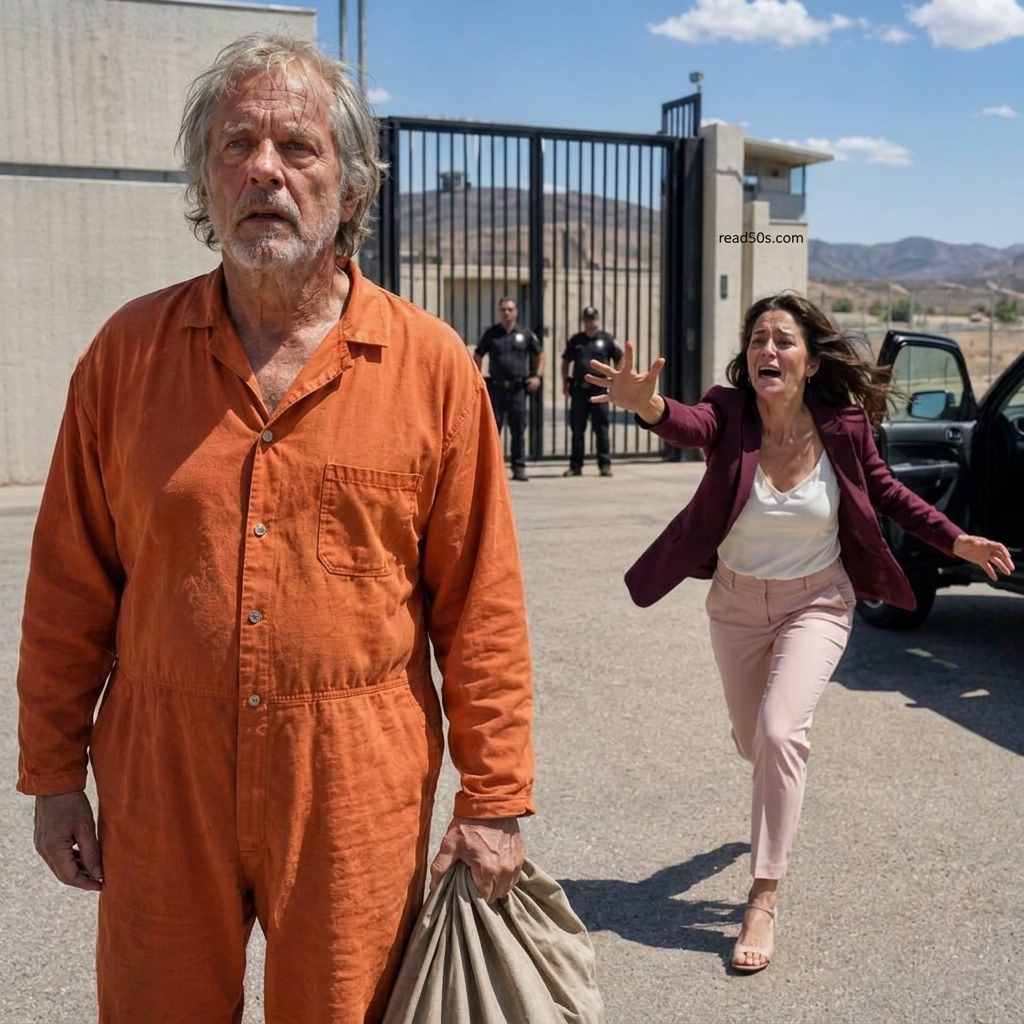
“If your father comes back before the wedding, let him sleep in the storage shed. No one needs to find out he was in prison.”
Claudia, my sister-in-law, said it in front of her mother’s portrait as casually as if she were deciding where to put a box of Christmas decorations.
For a moment, I thought someone would challenge her.
Rafael, my husband, sat at the table with his eyes lowered.
Santiago, who was getting married the following month, rubbed his thumb across the edge of his phone and said nothing.
Uncle Arnulfo, the same man who was always talking about dignity, respect, and protecting the family name, stared at the wall.
Nobody defended Don Eusebio.
I looked at the release letter lying on the table between us and felt fourteen years of marriage shift beneath my feet.
My name is Mónica Castañeda.
I was thirty-nine years old and worked as an accountant near Alvarado, Veracruz.
Rafael and I lived with our two children, Paula and Emiliano, in the family house.
The important detail was that the house did not belong to Rafael.
It belonged to his father.
Don Eusebio Montiel.
Five years earlier, Don Eusebio had been convicted of misappropriating money that was supposed to pay twenty-seven farmers for their corn.
The conviction destroyed more than his freedom.
In our community, people stopped saying his name normally.
They lowered their voices.
Some spoke about him with anger.
Others spoke with that particular kind of satisfaction people sometimes have when a respected man falls publicly.
His wife, my mother-in-law, never recovered from the shame.
She died while he was still serving his sentence, without ever getting another chance to hug him.
His youngest son, Iván, disappeared after the trial.
At first, the family said he needed time.
Then weeks became months.
Months became years.
Eventually, even Rafael stopped asking where his brother had gone.
No one knew whether Iván had moved away, changed his number, or simply decided he wanted nothing more to do with the Montiel family.
That was the version everyone repeated.
But when I thought about Don Eusebio, prison was never the first thing I remembered.
I remembered my wedding day.
My mother had given me a pair of secondhand earrings because that was what she could afford.
They were small and old-fashioned, and two of Rafael’s relatives made jokes about them loudly enough for me to hear.
I smiled because I was embarrassed and did not want to cause trouble.
Don Eusebio heard them too.
He walked over, looked at the earrings, and said they were worth more than anything bought to impress strangers because they had come from my mother.
The jokes stopped.
Years later, when I gave birth to Emiliano, I suffered a hemorrhage.
Everything happened quickly.
Rafael was terrified.
I barely understood what was happening.
And expenses began piling up while I was still trying to recover.
Don Eusebio sold cattle to help us cover what we needed.
He never used that help against me afterward.
He never reminded Rafael that he owed him.
And despite the difference between the family I came from and the family I had married into, Don Eusebio never once called me the poor daughter-in-law.
He called me his daughter.
That history was why the letter in front of me felt like more than a piece of paper.
I had found it hidden inside a drawer at Rafael’s business.
It was from Don Eusebio.
He had written that he would be released on November 27.
The family had received the letter three weeks earlier.
Three weeks.
Rafael had known the exact date his sixty-eight-year-old father would walk out of prison, and he had hidden it from me.
I picked up the letter and looked at him.
“Were you really going to let a sixty-eight-year-old man travel more than 500 kilometers alone?”
Rafael barely raised his eyes.
“Don’t make a scene.”
I almost laughed.
Apparently, the scene was not abandoning his father at a prison gate.
The scene was me objecting to it.
“Santiago is getting married next month,” Rafael continued. “If the bride’s family finds out about Dad, they could call the whole thing off.”
I looked toward Santiago.
He did not deny it.
That night, we called Claudia, Santiago, and Uncle Arnulfo together so there could be no misunderstanding about what everyone was proposing.
I asked one simple question.
Who was going to pick up Don Eusebio?
Nobody volunteered.
Claudia said the bus route was safe.
Arnulfo said people would start talking the second anyone saw Don Eusebio getting out of a family car.
Santiago said the timing was terrible and asked why his grandfather could not stay somewhere else until after the wedding.
Rafael kept insisting that this was temporary.
Temporary humiliation was still humiliation.
Then Claudia went further.
She suggested that someone clean out the old storage shed near the chicken coop.
There were tools inside.
Sacks.
Old containers.
Things nobody had used in years.
But according to Claudia, if it were cleaned properly, Don Eusebio could sleep there without having to enter the main house.
I stared at her.
“The house is in his name,” I said. “And you want to hide the owner in the yard?”
That finally got a reaction from Rafael.
He slammed his hand onto the table beside the letter.
“My father has already turned our lives upside down enough!”
The sound made Santiago lift his head.
Even then, he did not defend his grandfather.
I looked around at the family I had spent fourteen years trying to belong to.
They were not arguing about whether Don Eusebio deserved forgiveness.
They were not arguing about what he had done five years ago.
They were discussing where to hide him so his existence would not interfere with a wedding.
That was what I could not accept.