Teresa’s admission did more than confirm what had happened to Sofía.
It reached backward into Ricardo’s childhood.
“I gave her a few swats because she became defiant,” she had said. “Nothing I haven’t done before with Ricardo and Lucía. They survived.”
I stood at her door with my phone recording inside my coat pocket and realized I was no longer listening to a grandmother explain one terrible afternoon.
I was listening to a mother describe a pattern.
Twenty-five minutes earlier, I had left Ricardo at home with our daughter.
Before that, I had been kneeling beside Sofía while she revealed what Teresa had hidden underneath her clothes.
The entire evening had changed in less than an hour.
It began with a closed bedroom door.
Sofía had come home from her grandmother’s house looking wrong.
Not injured in a way I could immediately see.
Wrong in the way only a parent sometimes notices.
Too quiet.
Too careful.
Too aware of her own body.
Normally, after spending time away from us, she came home carrying the whole day with her.
She would tell me what she ate.
What she drew.
What someone said.
Whether something funny happened.
Six-year-olds rarely begin with the part of a story adults consider important.
They begin with the cookie shaped like a star.
The dog across the street.
A sticker.
A broken crayon.
That afternoon, Sofía gave me nothing.
She walked rigidly through the house with both arms close to her sides.
She said she was tired.
Then she went to her room.
I followed because something in her posture bothered me.
She waited until I entered.
Then she closed the door.
“Mom, promise you won’t be mad at me.”
I remember that sentence more clearly than almost anything else.
Not because of the words themselves.
Because of what they told me.
Before I knew what had happened, my daughter already believed there was a chance I would blame her for it.
I crouched so we were closer to eye level.
“I’m not mad.”
Sofía hesitated.
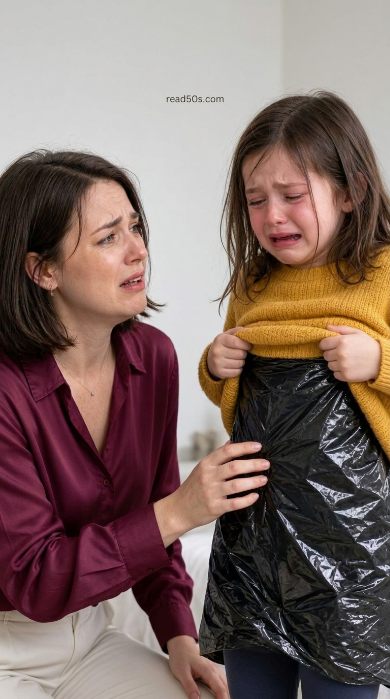
Then she lifted her red sweater.
The black plastic underneath made no sense at first.
My brain tried to turn it into something ordinary.
A costume.
A craft.
Something from a game.
Then I saw how it had been cut.
One opening for her head.
Two for her arms.
A black trash bag altered into a crude layer of clothing and placed beneath what she had worn home.
The plastic was damp against her skin.
I touched only the edge.
“Did Grandma put this on you?”
Sofía nodded.
I carefully helped remove it.
The skin near her shoulders and waist looked irritated where the plastic had trapped heat and rubbed against her.
Then she moved one arm.
That was when I saw the bruising along her side.
My breathing changed.
I did not want my reaction to frighten her into stopping.
So I kept my voice level.
“Who did that?”
She did not answer immediately.
Then she turned enough for me to see several red marks lower on her back.
Straight.
Regular.
They did not look like the scattered result of a child falling while playing.
“Who put this on you?” I asked again.
“Grandma.”
“Why?”
Sofía swallowed.
“Because I ate cookies.”
I thought I had misheard.
“What?”
“She said I had to sweat them out so I wouldn’t get fat.”
For months, Teresa had commented on Sofía’s body.
Not constantly.
That almost made it easier to dismiss at first.
A remark at dessert.
A joke about portions.
A glance when Sofía asked for more food.
“She really likes sweets.”
“Watch that appetite.”
“She’s getting a little chubby.”
Each time, I pushed back.
Each time, Teresa minimized it.
According to her, I was overreacting.
She had raised children.
She knew what she was doing.
People were too sensitive now.
That was how she framed it.
I had told her clearly that Sofía’s body was not a topic for criticism.
She did not need food turned into shame.
She did not need to learn that a grandmother’s affection changed depending on what she ate.
Teresa would agree just enough to end the argument.
Then weeks later, another comment would appear.
Ricardo and I discussed it more than once.
That December, we gave Teresa what I now wish we had not given her.
Another chance.
On December 27, Ricardo and I both had to work.
Teresa offered to watch Sofía.
I hesitated.
I remember that hesitation because afterward I replayed it until it became torture.
I had a bad feeling.
Not a prediction.
Not knowledge.
Just reluctance.
Then I told myself we had already set boundaries.
I told myself Teresa understood.
I told myself a grandmother who made inappropriate comments about food was not necessarily someone who would physically hurt a six-year-old child over cookies.
I was wrong.
Standing in Sofía’s bedroom, I asked about the marks.
Her eyes dropped.
“I kept taking the bag off because I was hot.”
My throat tightened.
“And then?”
“Grandma got mad.”
Sofía paused.
“And took out her belt.”
Ricardo reached the doorway at that exact moment.
He had heard enough.
The color left his face.
He crossed the room and dropped to his knees in front of our daughter.
He did not interrogate her.
He did not demand details.
He said the first thing she needed to hear.
“You did nothing wrong, sweetheart.”
Sofía looked at him.
Something in her face loosened.
Not completely.
But enough for me to understand how heavily she had been carrying the idea that she had misbehaved.
She had eaten cookies.
She became hot.
She removed something that made her uncomfortable.
An adult punished her.
Yet she came home asking me to promise I would not be angry with her.
That was the part I could barely tolerate.