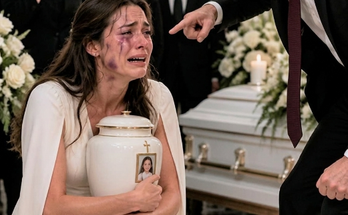
My father threw my grandmother’s savings passbook into her grave and called it worthless.
The next morning, I carried that same muddy blue book into the bank.
The teller turned pale.
The manager locked the doors.
And before I had finished explaining where the passbook came from, someone was already calling the police.
My name is Chloe Henderson.
I was twenty-seven when Margaret Henderson—Grandma Maggie to me—died.
Two nights before her funeral, she squeezed my hand and whispered:
“Chloe… don’t let Richard find it.”
Richard was my father.
And apparently, the person she feared most.
I did not understand what she meant until the funeral.
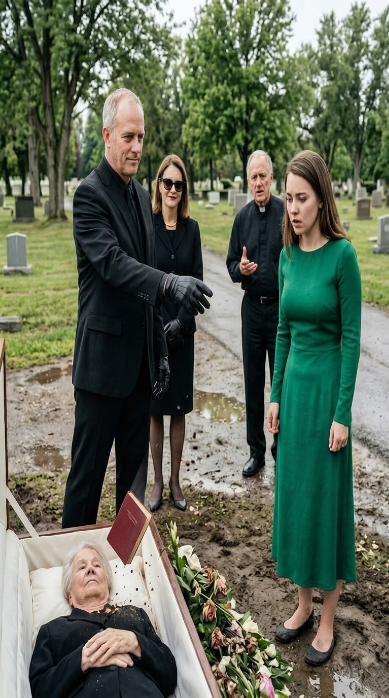
We were standing at Oakfield Cemetery beneath a gray sky.
The ground was wet.
My borrowed black dress was already stained near the hem.
Dad stood beside Grandma’s open casket wearing polished black gloves.
Then he held up her little blue savings passbook.
“That book isn’t worth a dime,” he said.
He tossed it into the casket.
“Let it rot with the old lady.”
It landed against Grandma’s chest among the flowers.
Nobody protested.
My stepmother, Susan, gave a small laugh.
My half-brother Tyler leaned toward me.
“If there’s fifty bucks in there, burgers are on you.”
Several relatives laughed.
Dad looked toward me.
“There’s your inheritance, Chloe. An old notebook. No house. No land. No money.”
I said nothing.
But I remembered that book.
Grandma had kept it wrapped in an embroidered napkin inside an old butter-cookie tin beneath her bed.
Sometimes, when I was little, she would place it beside the porcelain angel on her kitchen table.
“This little paper is for when I’m gone,” she once told me.
“But only you should know.”
When the funeral ended and everyone left, I remained behind.
I listened to shoes crunching over gravel.
Car doors.
Engines.
Then silence.
I dropped to my knees.
Using my bare hands, I dug into the loose wet soil until my fingers touched the passbook.
I pulled it free.
Mud smeared across my dress.
When I opened the first page, I saw Grandma’s name.
Margaret Henderson.
Beneath it, in shaky blue handwriting:
If Richard says it’s worth nothing, it’s because he already tried to cash it.
I ran.
That night, I locked myself inside my apartment.
I shoved a chair beneath the doorknob and spread the passbook across my kitchen table.
The early transactions were small.
$50.
$120.
$300.
Occasionally $1,000.
The kind of savings Grandma could have built over decades of baking, laundry work, and hemming clothes for neighbors.
Then the entries changed.
Large withdrawals.
Transfers.
Amounts that seemed impossible.
Beside many were the initials:
R.H.
Richard Henderson.
My father.
Then I found a folded note.
Chloe, if you are reading this, forgive me for not telling you sooner. Your father didn’t just take money from me. He also tried to take something that has been rightfully yours since you were born.
At the bottom:
Don’t go to the family. Don’t believe Susan. Go straight to the bank. Ask for the account marked with the red stamp.
I searched until I found a nearly faded red circle on the final page.
Beside it was a handwritten routing code.
I did not sleep.
At eight the next morning, still wearing the grave-stained dress, I entered First Oakfield Bank.
The lobby looked painfully normal.
People depositing checks.
Parents quieting children.
Someone arguing about a debit card.
I walked toward a young teller.
“My grandmother died yesterday. She asked me to bring this here.”
I unwrapped the passbook.
The teller entered the account number.
She frowned.
Entered it again.
Then looked at me.
“Are you a direct relative?”
“I’m her granddaughter.”
“Your name?”
“Chloe Henderson.”
She asked for identification.
As soon as she compared my license with whatever was on the screen, her hands started shaking.
Then she picked up the phone.
“Manager, I need you at window four.”
A pause.
“And call security.”
A man in a sharp gray suit hurried over.
He closed the teller window and took the book.
“Where did you get this?”
“My grandmother.”
“She gave it to you personally?”
“Not exactly.”
He waited.
“My father threw it into her grave.”
The manager went still.
“What is your father’s name?”
“Richard Henderson.”
His eyes closed briefly.
Then he picked up the phone.
“Detective Miller? Yes.”
He looked directly at me.
“It’s happening again.”
I backed away.
“What does that mean?”
The manager opened the passbook.
On the inside cover was another message I had missed.
If Richard is still alive, do not trust his words. Trust the records.
“What records?”
The manager looked toward the bank entrance.
“Before I answer that, Detective Miller needs to be here.”
Twenty minutes later, a woman in her fifties entered wearing a dark coat and carrying a thick folder.
She looked at the passbook.
Then sighed.
“Margaret really did it.”
“Did what?”
Detective Miller sat across from me.
“Protected you.”
She opened her folder.
Photographs.
Old statements.
Legal records.
Then she pushed a photograph toward me.
Grandma stood in it.
Beside her was a woman I barely remembered.
My mother.
Laura.
And beside them stood a younger Richard Henderson.
My father.
“What is this?”
The detective looked at me carefully.
“Chloe, how much do you know about your mother’s death?”
“My mother died when I was four.”
“That’s what Richard told you.”
My body went cold.
“What do you mean?”
She placed a birth certificate on the table.
Not mine.
Emily Rose Henderson.
The date showed Emily had been born three years before me.
“Who is she?”
Detective Miller answered quietly.
“Your sister.”
I laughed once because the alternative was screaming.
“I don’t have a sister.”
“Yes, you do.”
“Where is she?”
The detective looked down.
“She disappeared twenty-four years ago.”
The same year my mother died.
Suddenly, the passbook did not feel like money anymore.
It felt like evidence.