My ex-husband invited his “childless” former wife to Christmas dinner because he expected everyone to see the woman he had successfully left behind.
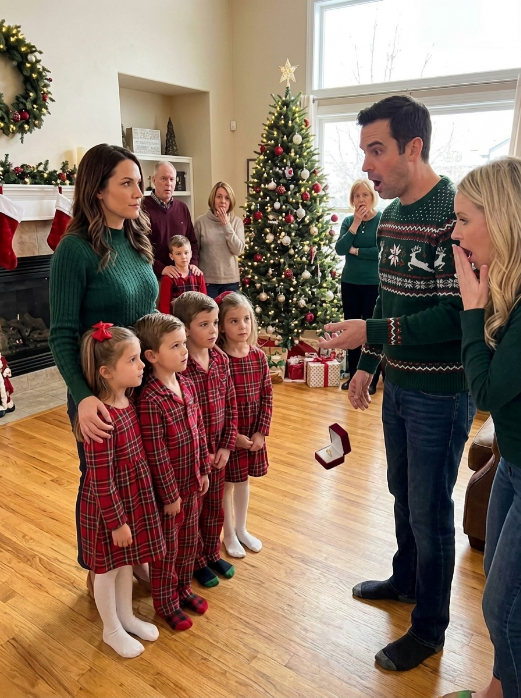
Instead, I arrived with four eight-year-old children.
His children.
The quadruplets he had abandoned before they were born.
Eight years earlier, Daniel Reynolds walked out while I was pregnant.
There was no heroic explanation.
No secret crisis.
No tragedy.
He simply decided the life we had planned was suddenly too complicated.
The pregnancy had become high-risk.
Doctors had already warned me there might be more than one baby.
I was frightened.
Daniel was frightened too.
The difference was that I stayed.
He left.
He filed for divorce.
Changed his number.
Moved.
And allowed his family to believe whatever version made his decision easier to defend.
Eventually, I delivered four premature babies.
Noah.
Ethan.
Sophia.
Olivia.
There were incubators.
Monitors.
Doctors speaking in careful voices.
For months, every day felt uncertain.
I slept in hospital chairs.
Learned to understand oxygen readings.
Celebrated grams of weight gain like other parents celebrated birthdays.
Daniel never came.
After the children were medically stable, my attorney contacted him.
We needed accurate medical history and legal documentation.
Daniel initially challenged paternity.
So formal testing was completed.
The result left no question.
All four were his.
Daniel signed the acknowledgment.
Then asked his lawyer to handle everything else.
He did not want visitation.
He did not ask for photographs.
He did not ask what colors their eyes were.
Or which one cried the most.
Or whether they were healthy.
He disappeared again.
The first years were difficult.
There is no elegant way to describe raising four infants largely alone.
I worked from home whenever possible.
Built consulting projects between feedings.
Hired help only after I could afford it.
My mother stayed for weeks at a time.
Friends became family.
I learned that independence rarely means doing everything alone.
It means knowing help is not the same thing as control.
Eventually, my consulting work grew.
I specialized in corporate restructuring and risk management.
Then I started my own firm.
One employee became five.
Five became twenty.
We opened an Austin office.
By the time my children were eight, I was no longer merely surviving.
We had a home.
Savings.
Schools I trusted.
A life full of ordinary chaos.
Then Daniel texted.
Mom wants to see you one last time. Christmas Day. Be there.
I could have ignored him.
Part of me wanted to.
But the children had begun asking more questions about their father.
I never told them Daniel was a monster.
He wasn’t.
A monster would have been easier to explain.
Daniel was simply a man who made a selfish decision and then spent years avoiding what that decision said about him.
I told the children the truth in age-appropriate pieces.
Their father left before they were born.
He knew they existed.
He was not part of our life.
Noah had recently asked:
“Does he know our names?”
I did not know.
That question stayed with me.
So when Daniel invited me to Christmas, I decided to go.
Not to humiliate him.
Not to reclaim him.
To let my children see the people whose photographs existed in old family albums.
Christmas morning, we traveled to Colorado.
The children wore matching holiday outfits because Sophia had insisted.
When we landed, Daniel’s mother, Eleanor, came outside.
The glass in her hand shattered when she saw us.
I understood only later why.
She recognized Daniel immediately in four different faces.
Inside, Daniel stood beside Brooke, his girlfriend.
An engagement ring was open in his hand.
He saw the children.
Then me.
The box fell.
“Merry Christmas,” I said.
“I thought it was time your family met the grandchildren they never knew they had.”
Daniel’s mother looked from me to him.
“Grandchildren?”
Olivia asked:
“Are you Daniel?”
“Yes.”
“Mom said Daniel is our father.”
Daniel looked ill.
Then Olivia asked:
“If you’re our dad, why didn’t you ever come see us?”
Nobody moved.
Eleanor turned toward Daniel.
“What does she mean?”
His father, Thomas Reynolds, looked just as confused.
“You told us Katherine lost the pregnancy.”
I looked at Daniel.
That was the first time I learned what he had told them.
“There wasn’t one baby to lose,” I said.
“There were four.”
Daniel tried to claim he had not known.
I pulled up the old paternity acknowledgment.
His signature was there.
He knew after they were born.
Brooke read it.
Then looked at Daniel.
“You told me your ex-wife couldn’t have children.”
“I said—”
“You told me you never had the opportunity to become a father.”
Daniel said nothing.
Brooke looked toward the children.
“You abandoned four.”
She handed him back the ring.
“You didn’t lose the opportunity.”
Her voice shook.
“You refused it.”
Then she left.
Eleanor asked me if she could meet the children.
I allowed it.
Not because I had forgotten what she said to me during the divorce.
But because the children deserved the chance to make their own decisions about their grandparents.
She knelt.
“I’m Eleanor.”
Sophia answered:
“We know.”
Eleanor looked surprised.
“Mom showed us old pictures.”
That sentence broke her.
Then Thomas asked something that changed the room again.
“Were you ever receiving the money?”
“What money?”
Daniel immediately looked toward his father.
Thomas’s expression hardened.
“The family trust distributed support every year after Daniel told us he had established private educational accounts for the children.”
I stared at him.
“I have never received anything from your family.”
Eleanor whispered:
“Daniel told us you refused direct support.”
“I never discussed support with either of you.”
Thomas looked at his son.
“How much is left?”
Daniel sat down.
Nobody spoke.
“How much, Daniel?”
Finally:
“Most of it.”
“Most?”
“I used some.”
Eleanor closed her eyes.
The Reynolds grandparents had begun setting aside money after Daniel privately admitted to them—years after telling them I miscarried—that the pregnancy had actually resulted in children.
But he still refused to reveal that there were four.
He told them I wanted no contact.
He said he would manage any money they wished to provide.
They trusted him.
Over the years, they transferred money into an account Daniel controlled.
Education support.
Medical reserves.
Birthday gifts the children never saw.
I looked at him.
“You knew enough to collect money for them.”
His head lowered.
“And still not enough to meet them.”
That was the first moment Daniel truly seemed ashamed.
Not embarrassed.
Not trapped.
Ashamed.
Thomas demanded complete statements.
Daniel tried to postpone the discussion.
His father refused.
“This stops today.”
I raised my hand.
“The children are not staying here while adults argue about money.”
I gathered their coats.
Daniel stood.
“Please.”
I looked at him.
“Not today.”
“You can’t just leave.”
I almost laughed.
“You did.”
Then my children and I walked out.
Eight years earlier, Daniel had left me carrying his future.
That Christmas, I left him standing inside the life his lies had finally destroyed.