I Was Mopping a Courthouse Floor When I Got the Call That My Seventeen-Year-Old Son Had Been Shot Through Both Kneecaps by the County Sheriff—and That the Man Had Laughed While He Screamed
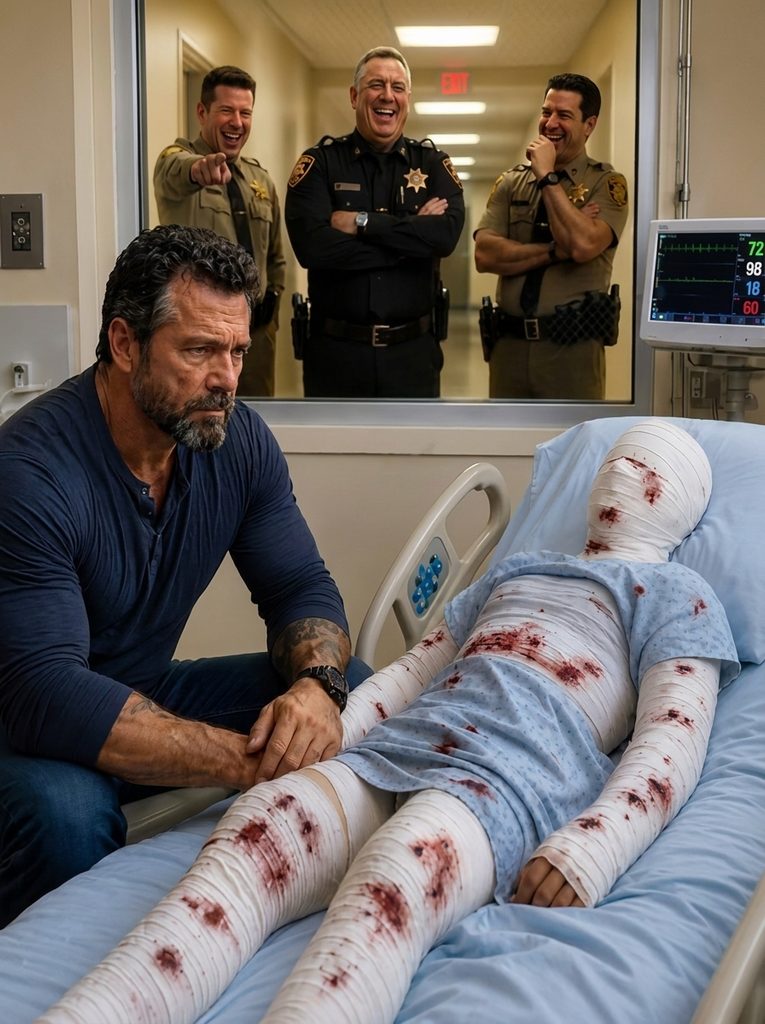
For seventeen years, Sheriff Rick Barnes had watched me mop the floors outside his office.
He saw an aging janitor.
He never saw Dennis Irwin.
That was intentional.
I had spent almost two decades in a life built around missions, classified operations, and decisions made when hesitation could cost lives.
Then I met Sarah.
Tyler was born.
And one day I realized I did not want my son growing up believing his father belonged more to a mission than to him.
So I disappeared into ordinary life.
I took a courthouse maintenance job.
Night shift.
Steady paycheck.
No travel.
No weapons.
No secrets that followed me home.
Or so I believed.
Then Sheriff Barnes shot my son.
Tyler survived.
But while Dr. Harold Donnelly worked to repair the damage to his knees, I called the men I had once trusted with my life.
Bishop.
Viper.
Carver.
By 1:15 in the morning, we were gathered inside an abandoned mill outside town.
I had not seen them together in seventeen years.
Their hair was grayer.
Their faces older.
But when I walked inside, Bishop looked at me exactly the way he had twenty years earlier.
“What happened?”
I told them.
Tyler had finished basketball practice around 10:30.
Shortly afterward, his phone received a message from an unknown number.
It claimed to know something about my military past.
It ordered him to come alone to an old railyard.
Viper had recovered enough digital records to establish that someone later removed the official dispatch history connecting Barnes to the scene.
Tyler had not stumbled into trouble.
He had been summoned.
“Who knew enough about your past to bait him?” Bishop asked.
I looked at the message again.
One name came to mind.
Thomas Vance.
Decades earlier, I had led an operation involving Blackthorne Corporation, a private defense network accused of diverting enormous amounts of government money.
Vance had run part of that network.
During the operation, his family suffered a terrible loss.
He blamed me.
Before he disappeared into federal custody, he promised something I never forgot.
He said killing me would be too easy.
If he ever got the opportunity, he would make me watch my own family suffer instead.
“But Vance died,” Carver said.
“That’s what the records said.”
Viper began searching.
A few minutes later, he looked up.
“He didn’t.”
The public record showed Thomas Vance dying in custody years earlier.
The deeper records suggested otherwise.
He had been quietly transferred into a restricted medical arrangement.
Eventually his trail led back to Colorado.
And to financial entities associated with people around Sheriff Barnes.
Bishop looked at me.
“Barnes was working for Vance.”
I stared at Tyler’s last phone location.
“Yes.”
For seventeen years, I thought my old life had forgotten me.
It hadn’t.
Vance had simply been waiting.
I wanted to confront Barnes immediately.
But Bishop stopped me.
“We collect everything first.”
That was the difference between the man I had been and the father I was trying to remain.
The younger Dennis might have treated anger like an order.
This time, I wanted proof.
Viper preserved the recovered communications.
We copied the altered records.
We documented the financial connections.
Then we discovered Barnes was at his private property outside town.
I went there.
Not to kill him.
To hear him speak.
Barnes was not frightened when he saw me.
At first.
He actually laughed.
“Reaper.”
That one word confirmed more than any confession could have.
The sheriff had known who I was.
He had known for years.
“You shot my son.”
Barnes smiled.
“He went somewhere he shouldn’t have.”
“He was seventeen.”
“He should have learned respect.”
I felt every muscle in my body tighten.
But I did not give him what he wanted.
Thomas Vance was there too.
Older.
Scarred.
Walking with a cane.
But unmistakable.
“You wanted me,” I said.
Vance smiled.
“Yes.”
“Then why Tyler?”
“Because killing you would have ended your suffering.”
He looked directly at me.
“I wanted you alive to watch his.”
That was when I understood the cruelty was the point.
Tyler’s injuries were not collateral damage.
They were the message.
Then Vance showed me a live hospital security feed.
Three armed men were moving toward Tyler’s recovery floor.
Sarah was outside his room.
Vance smiled.
“You came all this way to confront me while your family was still unprotected.”
My stomach turned cold.
Then he said something worse.
“The person who let my people into that hospital is your friend.”
Harold.
Dr. Harold Donnelly.
The surgeon I had trusted with Tyler.
For one terrible moment, I believed him.
Then Bishop’s voice came through my earpiece.
“Dennis.”
I stopped.
“Trust the protocol.”
That sentence took me back years.
Harold.
Bishop.
Sarah.
There were pieces of my old life Vance did not know nearly as well as he believed.
I left Barnes and Vance behind and turned all my attention toward the hospital.
Because revenge could wait.
My family could not.
FULL STORY — PAGE 2
At Mercy General, Sarah sat outside Tyler’s room.
Three men entered the corridor.
They were not doctors.
Not nurses.
Not police.
Sarah knew immediately.
What Thomas Vance never understood was that marrying me had not made Sarah helpless.
Long before Tyler was born, she had worked in military training herself.
She had left that life for many of the same reasons I had.
Family.
Peace.
Normal mornings.
She saw the men approaching and began moving away from Tyler’s door.
Then the room itself opened.
Harold stepped out.
Vance had lied.
Harold had never betrayed me.
Months earlier, people connected to Vance had approached him and attempted to recruit him.
Harold pretended to cooperate.
Then contacted Bishop.
The old team had known somebody was looking for my family.
They just had not known where the first attack would come from.
The night Barnes shot Tyler finally revealed it.
Harold had already moved Tyler to a secure treatment area.
The room Vance’s men were approaching was a decoy.
Hospital security and federal officers moved in moments later.
The attackers were taken into custody.
When I finally reached Sarah, she looked at me.
“You’re late.”
Despite everything, I almost laughed.
“Where’s Tyler?”
Harold approached.
“He’s safe.”
Then he gave me the first good news I had heard all night.
The nerve structures had survived.
The repairs had gone well.
The damage was serious.
Recovery would be painful.
But Harold believed Tyler could walk again.
Possibly run.
Maybe even play basketball.
I closed my eyes.
For several seconds, I could not speak.
Hours earlier, Tyler had looked at me and said:
“I’ll never walk again.”
Now there was hope.
Then Viper arrived with another update.
Thomas Vance was trying to leave Colorado.
He believed his hospital attack had succeeded.
He was heading toward a private aircraft.
This time, I did not chase him alone.
Everything we had collected—the financial records, the recovered communications, the altered dispatch logs, the attempted hospital attack—was already moving through federal channels.
Vance had spent years believing secrecy made him untouchable.
By sunrise, that secrecy was gone.
Federal agents intercepted him before he left the country.
When I saw him again, he no longer looked like a powerful ghost from my past.
He looked old.
Tired.
Cornered.
“Why didn’t you kill me?” he asked.
I stared at him.
Because that was what he wanted to understand.
Men like Vance believed violence proved power.
They understood enemies.
They understood revenge.
What they did not understand was restraint.
“If I killed you,” I said, “you’d become the dead man everyone argued about.”
I looked toward the agents waiting behind him.
“But alive?”
I paused.
“You answer for everything.”
Vance’s face changed.
For years, he had imagined bringing the old Dennis Irwin back.
Instead, he had forced me to prove I no longer needed to become that man.
Federal agents took him away.
Then there was Barnes.
By morning, state and federal investigators had converged on the Livingston County Sheriff’s Department.
The investigation did not stop with Tyler.
Once the records began opening, people started talking.
Residents who had been intimidated.
Contractors pressured for money.
Deputies ordered to falsify reports.
Citizens who had complained and suddenly found themselves arrested.
Barnes’s authority had not protected law.
It had protected Barnes.
He was found inside his office attempting to prepare for escape.
I happened to be there when agents entered the building.
This time, I was wearing my old gray courthouse shirt.
Barnes looked at me.
“You’re just a janitor.”
I stared at him.
“For seventeen years.”
I looked around the office I had cleaned hundreds of times.
“I emptied your trash.”
“Cleaned this desk.”
“Walked past you while you acted like this county belonged to you.”
His face hardened.
“You think this makes you somebody?”
“No.”
I shook my head.
“My son made me somebody seventeen years ago.”
Barnes looked away.
Then he muttered:
“I should’ve finished the kid.”
Every person in the room heard him.
I did not touch him.
I did not need to.
The agents placed him in handcuffs.
For the first time in years, the man who made half the county afraid was the one being escorted through the courthouse doors.
And I?
I picked up my mop bucket.
There were muddy footprints across the marble from the federal teams.
Somebody still had to clean them.
That was the part Barnes never understood.
Being a janitor had never been humiliation.
I chose ordinary life.
I chose Sarah.
I chose Tyler.
I chose a job that let me come home.
There was no shame in any of it.
The only shame belonged to a man who believed a badge made him better than the people whose floors I cleaned.
FULL STORY — PAGE 3
Two weeks later, Tyler stood between two parallel support bars in Mercy General’s rehabilitation gym.
Sarah stood in front of him.
I watched from the doorway with Harold.
Tyler’s legs shook beneath him.
His face tightened.
Sweat ran down his forehead.
“Three steps,” Sarah told him.
“Just give me three.”
Tyler lifted one foot.
Slowly.
Carefully.
Step one.
He tightened his grip on the bars.
Moved the other.
Step two.
Then stopped.
His entire body trembled.
“I can’t.”
Sarah smiled.
“Yes, you can.”
His eyes moved toward me.
I did not say anything.
I did not tell him soldiers pushed through pain.
I did not tell him to be strong.
He was seventeen.
He had already been forced to carry enough.
So I simply nodded.
Tyler looked forward again.
Released one hand.
Then the other.
For three seconds, my son stood without holding anything.
Sarah covered her mouth.
Tyler moved one foot.
Step three.
Then collapsed into his mother’s arms laughing and crying at the same time.
“I did it.”
Sarah held him.
“I know.”
“I walked.”
“I know, baby.”
Harold stood beside me.
“Three months, he may be walking without those braces.”
I looked at him.
“And basketball?”
“Dennis.”
“Tell me.”
He smiled.
“If that kid works the way I think he will, I wouldn’t bet against him.”
I swallowed hard.
“Thank you.”
Harold shook his head.
“Thank Tyler.”
Tyler eventually learned everything.
Not immediately.
We waited until he was strong enough.
Then I told him who Vance had been.
Why Barnes targeted him.
Why those men from my old life appeared at the hospital.
He listened without interrupting.
When I finished, he looked at me.
“Dad?”
“Yeah?”
“Are you going back?”
“Back where?”
“To them.”
He meant Bishop.
Viper.
Carver.
The unit.
The life I had walked away from when he was born.
“No.”
He studied me.
“Really?”
“The mission is finished.”
I put my hand behind his neck.
“My job is being your father.”
Tyler smiled.
“Good.”
Then:
“Because you were already terrible at retirement.”
I laughed.
Months passed.
Physical therapy became part of our life.
Then the braces came off.
Tyler walked without support.
Then jogged.
The first time he returned to the basketball court, he did not take a shot.
He simply stood at center court.
Looked down at his knees.
Then bounced the ball once.
Twice.
He looked at me in the bleachers.
I lifted my thumb.
He smiled.
And shot.
The ball hit the rim.
Bounced out.
Tyler stared.
I shouted:
“Terrible!”
He laughed so hard he had to bend over.
That was the moment I knew we were going to be okay.
Not when Vance was arrested.
Not when Barnes lost his badge.
Not when the investigation exposed everything they had hidden.
When my son could miss a basketball shot and laugh about it.
That was recovery.
ONE YEAR LATER
The Livingston High gym was packed for the regional championship.
Tyler was eighteen now.
Jersey number 14.
No braces.
No support bars.
No wheelchair.
Nothing on his legs except the scars he no longer tried to hide.
Sarah stood beside me in the bleachers.
Bishop, Viper, and Carver had driven in for the game.
They looked ridiculous in matching Livingston Lions booster jackets.
Four seconds remained.
Livingston trailed by one.
The opposing team tried a cross-court pass.
Tyler intercepted it.
The crowd stood.
He crossed half court.
Two seconds.
One.
Tyler launched the ball.
The buzzer sounded.
The shot dropped through the net.
The gym exploded.
Sarah screamed louder than seven hundred teenagers.
Carver nearly knocked me into the next row.
“That kid has a jump shot!”
“He gets it from Sarah.”
Tyler’s teammates lifted him onto their shoulders.
He held the trophy above his head.
One year earlier, he had looked at me from a hospital bed and whispered:
“I’ll never walk again.”
Now he was standing above everyone.
Laughing.
Running.
Living.
I did not think about Rick Barnes.
I did not think about Thomas Vance.
That was perhaps the greatest victory.
They had stopped being important.
The following morning, before sunrise, I returned to the courthouse.
I still worked maintenance.
People often asked why.
After everything that happened, surely I could have done something else.
They misunderstood.
I never became a janitor because I had nowhere else to go.
I became one because I finally knew where I wanted to stay.
Close to home.
Close to Sarah.
Close to Tyler.
I pushed my yellow bucket toward the center of the rotunda.
Morning light passed through the stained-glass dome and stretched across the marble.
I dipped the mop into warm water.
Set it against the floor.
And began cleaning.
No mountain operation waited for me.
No old enemy.
No secret mission.
Only a quiet courthouse waking up.
Tyler would be at school in two hours.
Sarah had asked me to bring milk home.
Normal things.
Wonderful things.
For years, men like Barnes and Vance believed ordinary life had made me weak.
They were wrong.
Ordinary life was what I had been protecting all along.
I pushed the mop across the marble one more time.
The floor was clean.
My son was walking.
My family was together.
And the man people once called Reaper—
was finally just Dennis again.
The End.